Cramer's first hour: a mix of fact, factoids, opinions from various sources -- often not cited -- while listening to Cramer's first hour on CNBC.
Boeing: very, very challenged; Cramer doesn't understand why folks are so bullish on Boeing. The argument that there are only two aircraft manufacturers "doesn't hold water."
Intel (INTC): lots of discussion -- says Intel in big trouble. Interestingly, AMD and XLNX mentioned numerous times (positively). Cramer: to call Intel "problematic" is too optimistic. At the open, down another 5%; now down about 4% -- ten minutes into trading.
Cramer may need to assemble a list of companies with balance sheet problems -- Carl.
I am inappropriately exuberant about the US economy and the US market.
I am also inappropriately exuberant about all things Apple.
See disclaimer. This is not an investment site.
Disclaimer:
this is not an investment site. Do not make any investment, financial,
job, career, travel, or relationship decisions based on what you read
here or think you may have read here. All my posts are done quickly:
there will be content and typographical errors. If anything on any of my
posts is important to you, go to the source. If/when I find
typographical / content errors, I will correct them.
Reminder: I am inappropriately exuberant about the US economy and the US market.
I am also inappropriately exuberant about all things Apple.
And now, Nvidia, also. I am also inappropriately exuberant about all things Nvidia.
After spending quite a bit of time on Broadcom yesterday (research), it appears that to a great degree all of these "chip companies" -- designers, fabricators -- have a monopoly in their "narrow" sector of the "semiconductor" market.
The chip companies that appear to be benefiting from this:
For the record: I first mentioned "Nvidia" on the blog on July 10, 2017. Link here.
Nvidia was $149.80; AMD was $13.60; and, INTC was $33.23. Today:
NVDA: $594.91
AMD: $174.23, and, acquired XLNX in the meantime;
INTC: $48.15
For the archives:
This blows me away. I wasn't paying attention today. Just following a couple of stories -- mostly tech sector stories -- and now, late this evening, wrapping up some loose ends, I saw the "close."
MDU: big story -- lost in shuffle. Will post as stand-along. Link here.
natural gas pipeline
North Bakken Expansion project
capacity: 250 million cubic feet per day
potential: up to 625 million cubic feet per day
completion -- look at this -- a 15,426-foot horizontal directional drill of a 24-inch pipeline
crossing Lake Sakakawea on the Missouri River
just less than three miles long: one of the longest of its kind in the world
project completed under a shortened timeframe; reduced original schedule by two months after a delay in receiving approval from the FERC (I'm shocked, shocked -- a FERC delay?)
total project expansion: 100 miles of pipeline, a compressor station expansion; a new compressor station;
with this project, MDU subsidiary now has total pipeline capacity greater than 2.4 billion cubic feet of natural gas per day (memo to self: check Hess / North Dakota)
AMD: up almost 10% in after-hours trading. Whoo-hoo. Closed at $117; traded at $128 after hours. So, how did XLNX do? Holy mackerel. XLNX also up over 9% after hours. Closed at $198; after-hours surged to $217. AMD earnings beat by 10%; revenues beat by 5%.
SBUX: up a bit during the day, before earnings announced, but then missed on earnings (citing inflation and Omicron -- didn't AAPL have the same problem -- inflation and Omicron as well as supply chain problems? Down about 2% after hours. Later: this is incredible. SBUX is now trading up! What's up? I don't know but it warms the cockles of my heart. LOL.
PayPay and Block: both down after hours. PayPal down a 16%. Down $30, trading at $147. So, what's the real story. No one has mentioned it yet. The story now being told? Apple. Apple announced it will take all credit cards on its iPhone Wallet, not just its own Apple card. This will severely hit one of the few revenue streams that Block and PayPal have.
Debbie Downer: yesterday, Melissa's panel on Fast Money all sounded like Debbie Downer. I missed Fast Money today because Sophia and I studied Spanish, read Wings of Fire, and did multiplication flashcards. But it looks like tech is back. I'll replay Melissa on Hulu later tonight. See if anyone eats crow. They won't; they'll change the narrative.
DWAC? I have no clue. Let's look. Holy mackerel! DWAC surged 14% today; up $10 and trading at $83.
Spread? Most interesting story today? WTI and Brent only one dollar apart.
****************************** Back to the Bakken
Active rigs:
$88.20
2/1/2022
02/01/2021
02/01/2020
02/01/2019
02/01/2018
Active Rigs
32
14
54
64
58
No new permits. Absolutely nothing reported. Did Bismarck have the day off? A winter storm?
Active rigs: NDIC reports 34 but one was a SWD and one rig is a CCS rig. I didn't check to see if there are any double-counted rigs. So, 32 active rigs for now.
******************************** The Book Page
Again,
if interested in origin of solar system, earth, fossil fuel, origin of
life, this is currently the best new book on the market right now for
armchair/amateur biologists, geologists, fossil fuel aficionados.
How The Mountains Grew
John Dvorak
c. 2021
Pegasus Books, August 2021
From the book, pages 183 - 185:
Soon after the Morrison Formation ... the Jurassic Period came to an end.
But there is a problem here: what exactly marks the end of the Jurassic and the beginning of the next geologic period, the Cretaceous?
Some geologists maintain that there was a mass extinction that can be used to mark a division between the Jurassic and Cretaceous periods. Others suggest that if an extinction did occur -- and some have questioned it -- the event was limited geographically and was not global in extent, an so cannot be used to distinguish between two geologic periods. In short, not everyone agrees that a sudden shift occurred in the plant's history between these two periods.
Some of the problem seems to be the fault the history of geology (sic). The Cretaceous Period, one of the first geological time periods to be names, was first formally defined in 1822 by d'Ormalius d'Halloy for a thick strata for white chalk cropping out in the Paris Basin; whereas, the Jurassic Period was first introduced in 1829 by Alexandre Brongniart for an unusual set of marine fossils found in the Jura Mountains that run along the France-Switzerland border. Neither man was concerned with defining where the boundary between the two time periods should be located within the rock record. And so two centuries have passes as generations of geologist have struggled with the problem.
Currently members of the International Commission on Stratigraphy have taken a radical step and have abandoned the use of fossil succession to define the boundary -- which is how all other geologic periods of the Phanerozoic Era are defined -- and, instead, are using a change in the Earth's magnetic field. (One could almost feel the hearts of professional geologists being broken when the decision was made. Geologists are a conservative bunch, especially when it comes to defining their holiest scepter, the Geologic Time Scale.)
So, for now, the boundary between the Jurassic and the next geologic period, the Cretaceous, is defined as the top of the normal magnetic polarity stripe known as Chron M19n. It occurred 145.7 million years ago and is coincident with an "explosion" in the number of small, globular microorganisms known as Calpionella alpine that can be found in Mexico and across Central and Eastern Europe -- and so there is reason for the conservatives in the world of geology to hope that the Jurassic/Cretaceous boundary, will eventually, be defined by fossil succession. Thus, as this illustrates, a considerable effort goes into precisely defining the boundaries of the Geologic Time Scale.
But for those who choose to look at the history of the 'Earth through a wider lens, it is sufficient to note that there is a significant change in vegetation between the Jurassic and the Cretaceous periods -- the first flowers and the first broad-leaf trees appeared during the Cretaceous -- and that there is a significant change in the types of animals, including in the types of dinosaurs.
And, as d'Hallow noted, there was a surprisingly large amount of chalk deposited during the Cretaceous period.
More federal money for North Dakota: North Dakota will receive up to $40 million to clean up abandoned oil and gas wells. Whoo-hoo! It appears only seven states will receive more than North Dakota, but not only is ND in the top seven or eight, it is also at the high end of federal money being disbursed. Link when I get it. Arrived in my e-mail from Department of Interior.
From the department:
The Department of the Interior today announced $1.15 billion in funding is available to states from the Bipartisan Infrastructure Law to create jobs cleaning up orphaned oil and gas wells across the country. This is a key initiative of President Biden’s Bipartisan Infrastructure Law, which allocated a total of $4.7 billion to create a new federal program to address orphan wells. Millions of Americans across the country live within a mile of an orphaned oil and gas well.
Orphaned wells are polluting backyards, recreation areas, and public spaces across the country. The historic investments to clean up these hazardous sites will create good-paying, union jobs, catalyze economic growth and revitalization, and reduce dangerous methane leaks.
“President Biden’s Bipartisan Infrastructure Law is enabling us to confront the legacy pollution and long-standing environmental injustices that for too long have plagued underrepresented communities,” said Secretary Deb Haaland. “We must act with urgency to address the more than one hundred thousand documented orphaned wells across the country and leave no community behind. This is good for our climate, for the health our communities, and for American workers.”
Plugging orphaned wells will also help advance the goals of the U.S. Methane Emissions Reduction Action Plan, as well as the Interagency Working Group on Coal and Power Plant Communities and Economic Revitalization, which focuses on spurring economic revitalization in the hard-hit energy communities.
I keep reading all those news stories that a winter storm slammed Texas.
Well, here's the video.
***************************** The Market -- For The Archives
Wow, talk about an afternoon surge. After a slow start this morning, the market is now taking off. I guess mom-and-pop investors are not worried about the Fed raising the rate from 0.00000% to 0.25% or whatever they think it will be.
Updated through November 30, 2021. Still at record highs and trending higher.
XLNX: wow. I've accumulated XLNX for decades. Today, I just happened to see it jumped $13, up over 7%, now trading about $191. This is still not a 52-week high. I wonder how much of this is due to a short squeeze. I think a lot of folks got burned on this one assuming the merger would not take place, after the Chinese delayed it. AMD is up almost $8.
Oil: "all" oil stocks are up.
Commodities are up: SCCO, FCX
AAPL: after soaring last week, up $12/share (?), AAPL is up another $3 / share today after a slow start.
PLUG: is up $2.76 on a $21 stock. Whoo-hoo!
It's hard to find anything that's trading down. If so, pretty much profit taking after recent jump in price. Even EPD is up a bit. LOL. What's ENB doing? Up nicely. EPD reports tomorrow, February 1, 2022, before market open; forecast, 54 cents EPS; "whisper number" is 57 cents.
Holy mackerel, NVDA is up $13.
SBUX: I've never invested in SBUX and the company if facing a lot of headwinds but I need to diversity out of energy, and I'm seriously thinking of looking at SBUX. I'll wait to see what Jim Cramer has to say this evening. SBUX reports earnings at 5:00 a.m. ET tomorrow morning (February 1, 2022); forecast, 79 cents EPS. The "whisper number" is 82 cents.
ARKK: must be having an incredible day ... let's check ... yup, up 8%.
S&P 500: up 83 points. Remember, under the 10:1 rule, this would equate to an 800 point jump in the Dow today; just saying.
Dow: regardless, the Dow was up a remarkable 400 points. Go back and look at my favorite chart.
I'm posting this for the archives for the grandsons and their mother who will end up managing the portfolio after I die. At 75 years of age, I turn the portfolio over to our younger daughter. The twins will be in first or second grade by then, home schooled, majoring in the "3-R's" with a minor in business and investing.
Prediction: the S&P 500 will hit 4,500 before it hits 4,600.
Note: the above companies fascinate me. I own shares in some but not all. I've been in and out of some of them over the years.
Disclaimer: this is not an investment site. Do not make any investment, financial, job, career, travel, or relationship decisions based on what you read here or think you may have read here.
Fast Money:
dead cat bounce; expect more volatility; expect to test lows again;
one day of trading doesn't change the tone of the market; still going to go back down
sigh of relief, but that's all; be skeptical; last day of the month; simply buying bargains in an over-sold bargain;
they all sound like "market timers" to me; not long-term investors;
panelist agrees: this is a "trading show"; not an investing show;
wow, talk about a lot of "Debbie Downers."
something tells me Jim Cramer will have a different take;
so they start off with: ARKK; TSLA; ZOOM;, Teladoc; Roku; none of them on my radar scope, though I did go off the reservation last year and started a position in ARKK; sold before end of year;
and, then having said that, one of the panelists is bullish on Teladoc;
another one? Trimble
another one? Palantir
it seems if one is willing to go down that road; there are a lot better companies to look at;
enough of this; moving on; next up, Mad Money
Mad Money:
unlike the Fast Money folks, Jim Cramer makes a case for a bull market for most commodities, and the S&P
I agree with Jim Cramer's "case" for a bull market, but with a huge pullback, probably during the summer
Cramer never mentioned the mid-term elections but hard to believe we would see a recession prior to the mid-terms
***************************** Jason Day And The Early Morning Club
I’m writing this column at 4 a.m., but I need to
level with you: It’s nowhere near as romantic as that sounds. I am not
sitting in a hotel lobby, tuxedo bow tie unfurled, cigar smoldering in
an ashtray, pecking at an old Underwood typewriter after a long night
out with movie stars, rock gods and other assorted fabulous people.
The truth is I fell asleep last night right after reading to my
kids. I passed out shortly before 9 p.m. with a copy of “Friendship
According to Humphrey,” about a class pet hamster trying to adapt to a
new frog in the room, resting atop my chest. (It’s a fun read. Humphrey
is adorbs.)
I’m awake because over the past two
years, I’ve joined a new club: the very, very early morning club. I know
a lot of people have lives and jobs that require them to wake up
extremely early, but this is a new lifestyle for me. It took two small
children and one pandemic that kept us all home to figure out that if I
was going to continue to be productive, and write nonsense humor columns
like this one, I was going to need to be productive at an uncommon
hour, sitting alone in the dark.
I'll expand on this later.
****************************** Book Recommendation
Again,
if interested in origin of solar system, earth, fossil fuel, origin of
life, this is currently the best new book on the market right now for
armchair/amateur biologists, geologists, fossil fuel aficionados.
How The Mountains Grew
John Dvorak
c. 2021
Pegasus Books, August 2021
From the book, pages 145 - 147:
The Permian: why did so much oil accumulate in such a small region of the continent?
Burial of phytoplankton and zooplankton, often cyanobacteria or foraminifera -
buried in mud and silt; anaerobic (sealed off from oxygen); sealed off from decomposition by bacteria; the organic matter would change chemically into a waxy substance known as kerogen if burial continues; kerogen would turn into oil
the deeper the sediment, the higher the temperature, the move from natural gas to oil
the sweet spot in temperature, the "oil window," is between 140° and 250° Fahrenheit which corresponds to a burial range of five thousand to twenty thousand fee.
but it must be trapped: impermeable rock layers of salt or gypsum or similar material
the Permian Basin met those conditions,and it me them multiple times
most oil-rich regions ahve one or two places in the rock sequence (strata, formations, subformations)
the Bakken has a dozen +/- in the Permian Basin there are eleven such strata
Midland:
multiple "plays" in the Wolfcamp Shale or the Bone Springs Formation
if it these multiple oil plays that gives West Texas the distinction of having one of the largest -- if not the largest -- reservoir in the world
which raises the next question: why were these conditions met multiple times in the Permian Basin?
the answer: it was a consequence of the collision of Euramerica and Gondwana and the formation of the supercontinent, Pangea.
One question: is there any future for a cellphone company who now takes the lead in China?Or is this the beginning of an end for its well-known competitor?
EOG and Eagle Ford: link here. Be sure to read through the thread to the possible / likely explanation (which I suspect is wrong).
Chevron: miss. Folks are missing the story. Hopefully, I will find time to get back to this one; there's an interesting side to this story.
Apple: perhaps this weekend, if I find the time, I will post the top ten things that blew me away in Apple's 1Q22 earnings / conference call. For now, until I find something else, #1, link here, from The Wall Street Journal:
Apple's iPhone 13:
Signs of Apple’s improved China performance had been emerging since
the iPhone 12 with 5G cellular connectivity made its debut in late 2020.
They picked up pace when the iPhone 13 lineup was introduced in
September. During the iPhone 13’s debut in China, it rose to first place
in the market that initial week, according to Counterpoint Research.
Strong sales in the final three months of 2021 continued,
allowing the company to capture the top position in the country, with
23% of the market compared with 16% a year earlier.
Meanwhile, Huawei, once Apple’s biggest rival in China for the premium smartphone market, fell to 7% of the market from 23%. U.S. sanctions
have curbed Huawei’s ability to buy chips and use American software,
such as Alphabet Inc.’s Android operating system, reducing its supply of
phones and prompting users to ditch the brand.
Longest-serving attorney general dies suddenly and unexpectedly; not Covid-related; huge friend of oil sector; guided the players through the Bakken revolution;
XLNX: surges. Up $2.22 (1.3%) at close yesterday; pre-market today, up $12.77 (7.31%). Something happened? AMD down. Even Jim Cramer mentioned this in the eight o'clock hour (central time). Later: XLNX up $14.50, up 8.3%, in pre-market trading. INTC down 3% in pre-market. Of the five major semiconductors, INTC the only one that is down.
Full-self-driving was the focus; explains why no new models. TSLA margins approaching 30%; in same ballpark as Apple's margins of 38%. Pulling away from competition: margins for GM and F 14%. TSLA now the benchmark for manufacturing. Much more than a car company now.
Shakeout coming? TSLA pulling away from competition. Oh, I already said that.
Ford is the second best.
Rivian having problems; that's why Amazon "switched." To succeed, EV manufacturers need three things: 1) attractive product; 2) ability to produce; and, 3) quality -- it has to work. Tesla clicking on all three, as is Ford. Rivian is faltering in manufacturing and quality. GM: questions about attractiveness and quality. They had to recall all their Bolts last year; only delivered 26 EVs in 4Q21. Ford delivered 29,000 Mustang EVs; ramping up200,000 to and doubling their F-150 Lightning production; $40 billion cash on hand.
************************************* Back to the Bakken
Active rigs:
$88.20
1/27/2022
01/27/2021
01/27/2020
01/27/2019
01/27/2018
Active Rigs
31
12
55
65
57
Thursday, January 27, 2022: 47 for the month, 47 for the quarter, 47 for the year 38391, conf, Petro-Hunt, Dahl 162-100-13A-24-2H, 38049, conf, Slawson, Muskrat Federal 8-28-33H, 37905, conf, CLR, Charolais South Federal 7-10H2,
As recently as the mid-to-late 2000s, the U.S. was expected to become a
major importer of LNG. Instead, the opposite occurred. Once forecast to
need tens of millions of metric tons of LNG each year to meet its own
power needs, the U.S. is now producing about the same amount and sending
it out to Asia, Europe, and other overseas markets. That swing — from
the expectation of being a major LNG importer to the reality of being a
top-tier producer/exporter — has had a huge impact on the global market,
and the influence of that reversal cannot be overemphasized. In today’s
RBN blog, we look at how U.S. production has moved LNG closer to being a
global commodity, the effect of growing U.S. production on the market,
and prospects for future growth.
XOM: link here -- up $2.35, up 3.8%; closed at $63.54.
CVX: link here -- up $1.91; up 1.6%; closed at $119.26.
COP: link here -- up $1.59; up 2.2%; closed at $73.77.
Cramer: driven higher by hope --
Tesla
Pfizer
Nvidia
Apple
Meta (Facebook)
Lennar
Netflix
Amazon
Toll Brothers
Home Depot
S&P 500 top ten winners in 2021:
Devon Energy, up 179%. Likely to repeat.
Marathon Oil, up 146%. [Top operator in the Bakken.]
Moderna, up 143%; not likely to repeat.
Fortinet, p 142%; not a bargain at current price.
Signature Bank, up 139%. Say what? Under the radar.
Ford Motor, up 136%; will continue.
Bath & Body Works, 132%; likely to continue.
Nividia, up 125%; old Cramer favorite. Still one of Cramer's favorite; perhaps his favorite.
FANG, Diamondback Energy, up 123%; $35-breakeven price; cutting back on drilling costs; like to repeat that 123% annual gain in 2022.
Nucor, up 115%. Another favorite of Cramer's. Thinks current share price is way too low. Says no analyst agrees with him; that's why he likes Nucor even more.
The "w" in WTI now stands for "wow": WTI started off weak this morning, but by late morning, WTI had surged almost 3%; up $2.06; and, trading at $75.85.
Louisiana Light: up 2%; up $1.47; trading at $75.32
************************ Merger
No news.
AMD: now up 4.55%; up $6.65; trading at $152.79; 52-week high: $164.46.
XLNX: now up 2.8%; up $6.05; trading at $222.16; 52-week high: $239.79.
The "w" in WTI now stands for "wow": WTI started off weak this morning, but by late morning, WTI had surged almost 3%; up $2.06; and, trading at $75.85.
US retail sales: blow away expectations. Record spending everywhere.
Example, a single 75-year-old woman whose IRA is worth $100,000 at the
end of 2021 will have to withdraw a minimum of $4,065 in 2022, about
$300 less than she would have under the earlier guidelines
For tax year 2021, regarding non-spouse / non-eligible designated beneficiaries who inherit an IRA after 2019 are subject to a new 10-year payout rule and do not use this or any table.
But look at this, for tax year 2022 (tax will be due April 15, 2023):
new longevity tables (to the taxpayers' advantage; and,
then this:
The
IRS included a transition rule for non-spouse beneficiaries who
inherited an IRA prior to January 1, 2022 after RMDs have begun, and who
are currently using the Single Life Table. The transition provides a
“reset” for the life expectancies using the new tables. Therefore, table
changes for 2022 will be more complicated.
There will be a one-time reset (“redetermination”) of the life expectancy that year. The beneficiary will “go back” to the year after the year of owner’s death and find his/her (i.e., beneficiary’s not the deceased) single life expectancy as of his/her age in that year
using the new table. Subsequently, one year will be deducted from the
new life expectancy for each year since the first distribution year to
arrive at the divisor for the relevant post-2021 year.
S&P 500: trading above its all-time high. Closed at a new all-time high.
Every S&P 500 sector: on track for double-digit gains this year. Link here.
Dow: within 15 points of going over 36,000 (again) -- trading at 35,985. Closed at 35,951.
First group "financial / economic" indicators:
10-Year Treasury: link here. Remains below 1.5%. Some suggest the TYT could go to 1%; most investors are equity-heavy; may move to balance with more bonds -- at least that's the "theory."
TSA: boardings in 24 hours exceeds that of 2019, pre-pandemic. Source. Seven day average remains almost 10% below that of 2019.
One person's interpretation:
Feel like it’s a construct of recent risk off moves in growth and high beta. Demand rising for stable businesses with strong cash flow and dividends in the face of tightening monetary policy and general uncertainty. Almost like a flight to fixed income except you can’t own bonds. High beta definition here.
EU crisis: Kosovo starts cutting electricity to most of its two million citizens. Bloomberg.
EU crisis: US saving Europe again. Flotilla of US LNG tankers streaming to Europe. Link here.
Omicron: top five symptoms -- it's a "cold." Link here.
AMD/XLNX: is the deal dead? Link here. Best outcome now: the deal won't close before the end of the year but will eventually close. Worst outcome: deal won't close. That's fine. XLNX will do fine, long term.
Covid-19: it's baaaaccck. So much for all that optimistic talk about Covid being behind us. Not so fast. But again, the policies will be worse than the "disease." It looks like we're going to be seeing Brandon in his mask at all the DC Christmas parties.
Jim Cramer on Enbridge:
dividend greater than 7%
solar and carbon capture big part of their business
interview with CEO
incredible things said about environment and energy
Cramer is excited about Enbridge
pipeline challenges: there's going to be more pain before politicos willing to support pipelines
natural gas is going to be a huge, huge deal in the Permian
Enbridge is very, very well set up in the Permian to export LNG: locality (production); locality (terminals);
has been in renewable energy for 20 years;
comment: I know this very, very well; posted on the blog ten years ago about ENB getting into wind and solar farms in Canada; at the time, as an investor in ENB, I was not happy
hydrogen projects, incubation projects
Paris protocol: to be met CCS is critical; Enbridge positioned perfect for CCS
Do three of these four headlines not get you excited? The fourth is a non-story; I won't even click on it. From oilprice:
Note: I will post this again as a stand-alone but in the daily activity report below, there are certain things going on of which folks may not be aware:
first and foremost: after telegraphing they were not interested in the Bakken any more now that they were in the Permian, EOG is getting quite active in the Bakken again;
pad drilling is resulting in several DUCs being reported at the same time: those folks who suggest that the dropping number of DUCs is driving the production in the shale plays these days may be correct, but those folks are missing the bigger picture;
CLR's reported IPs don't seem particularly great but reported IPs are very deceiving. Top three months -- production -- is of much more interest; so time will tell;
CLR: in addition to aforementioned comment, even if the IPs are not as robust as we might help, for the investor / the owners, the money spent to drill and complete these wells is sunk costs; it's gone; it was spent six months to two years ago; now, that's history, and now we have free cash flow.
twice as many active rigs year / year, going into winter months
oh, I almost forgot, this does not show up in this post and I've not talked about it on the blog yet, but NOG announced a new dividend program rewarding owners of the company (anyone who owns shares, owns part of the company, often forgotten) -- this should remind folks we're in the manufacturing stage of the Bakken and not the boom; that's been true for several years but it seems some folks outside the Bakken don't understand that;
Santa Claus rally: I did not know this. I assumed the Santa Claus rally applies to market action between Thanksgiving and the end of the year. According to Jim Cramer, the Santa Claus rally does not traditionally / historically begin until later this week, around December 17th or slightly later.
Jim Cramer on Jay Powell: every investor should listen to Cramer's monologue on Jay Powell. Best I've heard from anyone on this one.
PFE: $50 billion in cash the past two years simply from vaccine sales. I think $50 billion is about one-four the amount of cash AAPL has. Fact-check necesito. That $50 billion is absolutely huge.
Onshore gas flaring in the U.S. has plummeted, falling to its lowest level since at least 2012.
The most significant contributors to this steep decline were the Bakken and Permian plays.
The
contribution of privately-owned players to gas flaring totals has
declined from a record high of 61.5% in April 2021 and sits at 52.3% as
of September.
“While the reduction in the Bakken was
largely in line with expectations, based on our analysis of satellite
data, the rate of change in the Permian is surprising. The decline in
flaring activity across the board is a concrete sign that best practices
are spreading beyond just large producers to small, privately-owned
operators too, and this trend looks likely to continue in the
foreseeable future,” says Artem Abramov, head of shale research at
Rystad Energy.
***************************** Back to the Bakken
Active rig report:
NDIC reports 31 wells; I did not check for duplicates;
one of the 31 wells is a SWD well; not oil and gas;
Slawson with one rig
Kraken not on the list but a reader says the Kraken rig is in Montana
Active rigs:
$70.87
12/15/2021
12/15/2020
12/15/2019
12/15/2018
12/15/2017
Active Rigs
30
14
53
67
53
No new permits.
Fifteen permits renewed:
Rimrock (9): Nosepress, Shifty, Amethyst, Citrine, Emerald, Ruby, Sapphire, Hammerhead, and Tiger, all in Dunn County;
EOG (6): five Riverview permits in McKenzie County and one Burke permit in Mountrail County.
Six producing wells (DUCs) reported as completed:
37399, 1,374, CLR, Gale 8-32H1, Cedar Coulee, first production, --; t--; cum --;
38238, 1,600, CLR, Jenson 10-8H, Chimney Butte, first production, --; t--; cum --;
37374, 1,225, CLR, Gale 6-32H1, Cedar Coulee, first production, --; t--; cum --;
37400, 1,062, CLR, Gale 9-32H, Cedar Coulee, first production, --; t--; cum --;
36793, 1,359, Sinclair, Harris Federal 2-32H, Lone Butte, first production, --; t--; cum --;
38236, 584, CLR, Mittlestadt 10-17HSL1, Cedar Coulee, first production, --; t--; cum --;
Time's Man of the Year: Elon Musk. Perhaps one of the better picks in a long, long time.
Why the market keeps going higher ... in one chart: link here.
inflation: highest it's been since 1982
today: 10-year Treasury -- 1.5% and trending down today;
1982: 10-year Treasury -- greater than 10%
perhaps this is the time to really, really, really add debt to one's financial sheet
how fast can the TYT move?
From that linked article -- think about this -- how fast a publicly traded company puts together a marketing initiative in response to a television show:
Peloton: Count me as in the minority here, but I kind of like how Peloton's responding to the uproar over its connected bike causing Mr. Big of "Sex and the City" to have a heart attack in the latest reboot of the series.
First, Peloton blamed Mr. Big's lifestyle of partying and red-meat eating for him dying after a 45-minute ride.
Then on Sunday, Peloton put a tweet out saying Mr. Big is alive and is enjoying a romantic evening with his favorite instructor Jess King (Allegra in the show).
Having said all of that, this is still a nightmare for the company right smack in the middle of the holiday shopping season and before New Year's resolution season in January. It will do no favors to a stock that has been clobbered this year for a litany of reasons, as long-time Peloton bear Simeon Siegel of BMO Capital Markets explained.
Market commentary: IBD -- link here. Most noteworthy, Rivian reports today.
No news, yet, regarding AMD / XLNX but both are up in pre-market trading. Overall, semiconductors appear to have a good day ahead of them.
Peak demand: investors now see peak demand (crude oil) moving much farther to the right. Link to Tswvetana Paraskova.
First group "financial / economic" indicators:
10-Year Treasury: link here. At 1.467% trending down.
DXY: link here.In a very narrow range. Today up slightly at 96.32.
Silver: link here. Up one-half of one percent at $22.31.
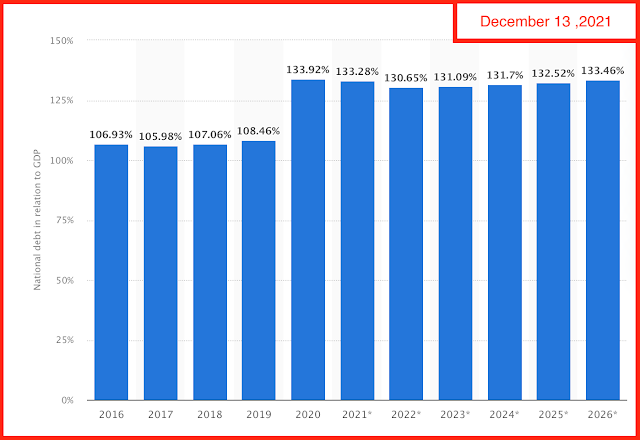
That's an interesting graph: of course the jump is all due to Covid-19 -- well, "almost all." And it probably didn't matter who was president during fiscal years / calendar years (?) 2019 - 2020 but for the record it was Donald Trump. Interestingly enough, assuming recent spending has been factored into the graph above, the ratio will drop every so slightly during the Biden administration. Just trolling. Interesting but not actionable.
US budget deficit, FY2021: link here. A record was not set.
The U.S. incurred the second-largest budget deficit on record in the
fiscal year that ended Sept. 30, reflecting government expenditures tied
to the coronavirus pandemic and adding fuel to congressional debates
about proposed spending.
The $2.8 trillion deficit was the second largest
since 1945 as a share of the nation’s gross domestic product and
trailed only the prior fiscal year’s $3.1 trillion shortfall, when not
adjusting for inflation.
The deficit for the fiscal year was 12.4%
of all economic output, down from 15% the previous year, the Treasury
Department and Office of Management and Budget said Friday. The deficit was 4.6% of GDP in the 2019 fiscal year, before the pandemic began.
The fund rate: incredibly low, according to Steve Liesman. Take out inflation, and the "easy money" gap is widening. The gap between investors and savers continues to widen, favoring the former.
The big story on CNBC this morning: Apple (AAPL) -- closing in on that $3-trillion market cap.
Biggest decision I have all day: whether to watch CNBC. Decision made. Television off. Good luck to everyone.
Daimler Trucks splits off tomorrow. I've been looking forward to this day for a long, long time. This is really, really going to be interesting. I have some photos of the EV truck factory in the Daimler factory in Portland, OR, with the proto-type on which the mechanics are training. I'm not posting the photos. I don't know who took the photos but I don't want anyone to get fired. Something tells me those photos were not authorized. I would expect to see / hear an interview on CNBC tomorrow on this new EV truck company, but CNBC may not think it's that big a deal. I won't be watching CNBC. I haven't watched CNBC since the "flash crash" the day after Thanksgiving. It's unlikely I will start watching again until after January 1, 2022. One of a gazillion links here.
XLNX / AMD merger: shorts are building. Link here. The other day I suggested what these two equities could settle at prior to the merger. Again, we're assuming the merger closes before the end of the year.
$228 / sh XLNX
$132.75 / sh AMD
XLNX fell 4%, fell almost $10/share, to close at $215 / share
AMD fell 5%, fell over $7/share, to close at $138 / share.
Interesting, huh?
Starbucks: the employees at one of three Starbucks restaurants in Buffalo, NY, were the first to ever unionize a Starbucks restaurant. Link here. Starbucks, the company, may want to "get ahead" of this sooner than later. Later: this is such a crazy story. This is not a grass roots effort. This is being pushed by "Big Labor" and "Big Labor" lost. There are nineteen Starbuck restaurants in Buffalo; one of the nineteen, unionized. How many employees at that one Starbucks? Nineteen, I believe. Fact-check needed. And of the nineteen employees, not all voted to unionize. Wait until these employees start paying union dues. LOL.
CPI data for November, 2021, will be released Friday morning, 8:30 a.m. ET, December 10, 2021. The forecast is for 6%+. Anything below 6.7% will be "what we expected" but if it's 7% or greater it will be quite a story. I think I saw a headline today that Brandon is already preparing Americans to expect the worst, telling us the November data is already "old" and does not reflect the significant drop in prices we've already seen in December. For example, except today when I saw gasoline prices go up again in my neighborhood, gasoline had dropped two cents / gallon in the last couple of weeks.
Supply chain shortage: likewise, with cargo ships anchoring beyond the horizon while waiting for berthing at the Los Angeles / Long Beach ports, the congestion at the ports has been greatly reduced. So, we're making headway.
It is impossible to articulate how beautiful the weather is right now. I had to pick up something at Target tonight; pitch black after 8:00 p.m. CT; and it was nice enough to wear my short-sleeve Hawaiian shirt while riding my bike.
Target was incredibly busy. If this is any indication of how the economy is doing, the economy is doing very, very well.
tea leaves: announcement that deal is closed will be early next week, maybe Monday
1.7234
AMD up slightly at the close; down a bit after hour -- $145.24 --> $250 implied for XLNC
XLNX up 0.4% at the close; up 0.25% after hours -- $225
back of the envelope
delta: $250 - $225 = $25 / XLNX share
some assume, I suppose, after it's announced that the deal closes, AMD drops a big and XLNX jumps a bit
25/2 = 12.50
145.24 - 12.50 = $132.75
1.7234 * $132.75 = $228 / sh XLNX
$132.75 / sh AMD
King of LNG: US to beat Qatar at its own game: link to Tsvetana Paraskova. A reader said as much just a couple of days ago. EIA forecast for el fin de 2022:
US: 11.4 bcf/d
Australia: 11.4 bcf/d
Qatar: 10.3 bcf/d
WTI: continues to creep up; up 31 cents today; now at $72.36.
Enerplus has a permit for a Lob well in SWSE 31-149-92;
to be sited 829 FSL and 2084 FEL, part of the "Tennis" pad?
Ovintive has permits for three Clear Creek Federal wells in SESW 36-152-97;
the wells will be sited 295 FSL and between 2529 FWL and 2489 FWL;
Thirteen permits renewed;
CLR (6): two Berlain permits in McKenzie County; two Olympia and two Charleston permits, all in Williams County
MRO (6): all in Dunn County -- Sallie USA, OTT USA, Ellis USA, CHdester USA, Borrud USA, and Bean USA;
BR: one Hawktail permit in Dunn County
Producing wells (DUCs) reported as completed:
37423, 1,263, Slawson, Tempest Federal 2-14H, Big Bend; how coincidental: I noticed the wells were starting to produce earlier to today and posted here;
37424, 294, Slawson, Orca Federal 3-23-26H, Big Bend, first production, 10/21; t--; cum --;
Omicron? Virus burning itself out. ala Spanish Flu? Whatever. Pfizer booster handles the variant just fine. Sort of like how seasonal flu is handled. Annual "seasonal flu" shot. PFE up slightly (very slightly) in early morning trading.
Omigoodness: I just returned from the grocery store where I get potatoes, Spam, and Covid shots. I went in to get my Pfizer booster. No waiting, no appointment necessary, just walk-in. But I was early. I'm not "eligible" until December 19, 2021, to get the booster. That tells me everything I need to know about the seriousness of Covid-19 omicron. LOL.
From the Los Angeles Times: not saying this would happen in Texas, but my hunch is not as likely -- it's not as if the families didn't have enough time ...
Thousands of L.A. Unified students have not shown proof of vaccination
About 34,000 students have yet to comply with the COVID-19 vaccine mandate in the Los Angeles Unified School District — and there’s no longer enough time for students to get the first shot and complete their required inoculation by the January 10, 2022, start of the second semester.
This will probably force the nation’s second-largest school system into some difficult decisions. Students who are not fully vaccinated — or exempt — will be forced into the district’s independent study program or will have to leave the Los Angeles public school system.
Shifting 34,000 students 12 and older into independent study would be challenging. And who would teach these students?
The 34,000 total, by itself, would make up one of the 25 largest school systems among about 1,000 districts in California. There’s no current indication, however, that L.A. Unified is backing down.
Active rigs: last year at this time, we were down to sixteen active rigs in North Dakota; now, we're back to 32. The definitive rig report currently shows 29 active rigs but that's because some rigs are in the process of moving to new sites.
Active rigs:
$71.72
12/8/2021
12/08/2020
12/08/2019
12/08/2018
12/08/2017
Active Rigs
29
16
55
64
53
No wells coming off confidential list today.
RBN Energy: Very low- and no-carbon alternatives to old-school bunker fuels, part 2.
International shipowners need to significantly reduce their
carbon-dioxide emissions by 2030 and will come under pressure to achieve
carbon neutrality by 2050. Given that the industry currently depends
almost entirely on fossil fuels for ship propulsion — and that every
zero- or near-zero-carbon alternative faces serious headwinds — it won’t
be an easy or low-cost transition. One pathway would be expanding the
use of LNG as a bunker fuel in the near term and then shifting to
alternatives like bio-LNG and synthetic LNG as they become more
commercially available and economic. Another would be to use “green” or
“blue” hydrogen, ammonia, or methanol. But there are challenges to each,
not the least of which are the small volumes of non-traditional fuels
being produced — and their high cost — and the need for new
infrastructure both to produce and distribute them, as we discuss in
today’s RBN blog.
This is the second blog in our series on efforts to reduce emissions of carbon dioxide (CO2) and other greenhouse gases in the shipping industry, which accounts for about 3% of global GHGs. Previously, we looked at the push by leading international shipping associations
and many large shipowners to have the International Maritime
Organization (IMO) ratchet up the industry’s decarbonization goals. In
effect, shipowners — themselves under pressure from their large,
ESG-minded customers, shareholders, and lenders — are telling the IMO
that its goals of reducing global shipping’s carbon intensity (CI) by
40% from its 2008 level by 2030 and total GHG emissions by 50% by 2050
are far too timid. They want the IMO to set a more aggressive
CI-reduction target for 2030 as well as a goal of eliminating or fully
offsetting GHG emissions by mid-century.
Further, a long list of international shipping associations —
including the International Chamber of Shipping, Intercargo, and the
World Shipping Council — has been pressing for the creation of a $5
billion research-and-development fund to accelerate the advancement and
introduction of zero-emission technologies and fuels for maritime
transport. If approved, the IMO-administered fund would be financed by a
proposed $2-per-metric-ton ($2/MT) levy on all marine-fuel sales. There
also have been a number of proposals — by countries, shipping
organizations, and individual companies — to implement a levy on
shipping companies for each metric ton of CO2 equivalent (CO2e) their fleets emit.