Well, if you are a farmer and “they” want to put a CO2 pipeline through your property this should give you a warm fuzzy:

I wonder if he had a slide of the explosion in East Palestine, OH, as part of his presentation? LOL.
Well, if you are a farmer and “they” want to put a CO2 pipeline through your property this should give you a warm fuzzy:
I wonder if he had a slide of the explosion in East Palestine, OH, as part of his presentation? LOL.

I have to find a post where this story is and will be followed. Let's follow this story here. Now, how to tag it? NDXL-Pipeline? Or Pipeline-NDXL? Oh, there it is, it already has a name: Midwest Carbon Express.
There is no such thing as a "CO2 spill" -- well, at least not yet -- they're running out of excuses to ban pipelines .


Note: This post is in progress but there's enough here for most readers to put the story together.
Disclaimer: in a long note like this coming from multiple sources, there will be content and typographical errors. Facts and hunches will be interspersed and it will be difficult to separate the two.
Updates
December 6, 2021: update; Midwest Carbon Express.
November 26, 2021, daily activity report -- a geophysical permit approved --
November 25, 2021: see comments. Link here, dated November 15, 2021. Data points:
November 25, 2021: see first comment below. That comment has link to Bismarck Tribune article. Archived here. If behind paywall, headline will provide enough background. Data points:
November 24, 2021: Summit Carbon Solutions has moved T&S Drilling 1 from Milton Flemmer 1 (#38594) to Archie Erickson 2 (#38622); see this post;
Where We Stand In Mercer County
There are three "operators" of interest:
Summit Carbon Solutions
Rampart Energy
UND EERC
Background
For background, see this post from June 28, 2021 -- just a few months ago.
Rampart Energy Company:
Rampart Energy Company
- June 16, 2021
- Rampart's wildcat, Coteau 1, will be sited in SWSW 1-145-99, Mercer County, 555 FSL and 460 FWL; the oil field is also a wildcat;
- Rampart has about 50 permits in North Dakota; it has been active in North Dakota since 1959;
- Rampart's previous well in North Dakota, #27081, Craig Allen 10-3H, Stanley oil field; SESW 11-155-91; a Bakken well that was drilled in 2015 and has reported a respectable 228K bbls crude oil cumulative;
Now today: I believe these are carbon capture exploratory wells. To the best of my knowledge, NDIC is not updating the map or the scout tickets, so it's difficult to figure out what's going on.
A reader writes:
I see they have a rig drilling the Coteau #1. I'm assuming it's for carbon capture?
But a buddy of mine said there's what looks like 2 more drilling locations ready to MIRU between I-94 and Beulah on highway 49. Any insight on this?
If any reader has any update on the Rampert Energy rigs drilling these wells, readers would appreciate an update.
Later:
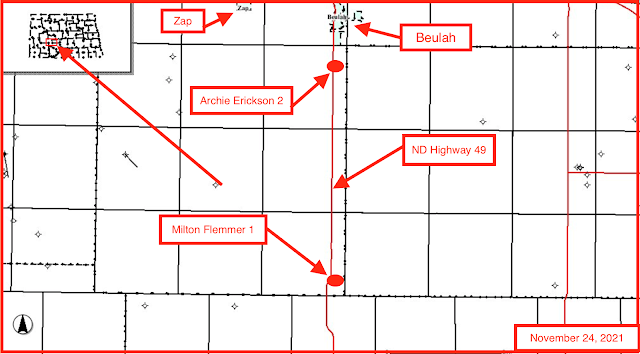
This must the location the reader's buddy was reporting when he/she said there appeared to be two more drilling locations ready to MIRU between I-94 and Beulah on Highway 49. So far my sleuthing only comes up with Milton Flemmer 1. If the buddy is correct, we may also be looking at Milton Flemmer 2 but that's a bridge too far right now.
See this post from October 20, 2021:
So, the first map, November 24, 2021:
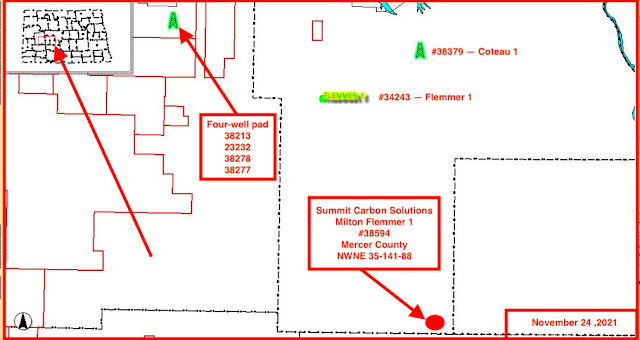
Map updated November 24, 2021, following NDIC's end-of-day daily activity report:
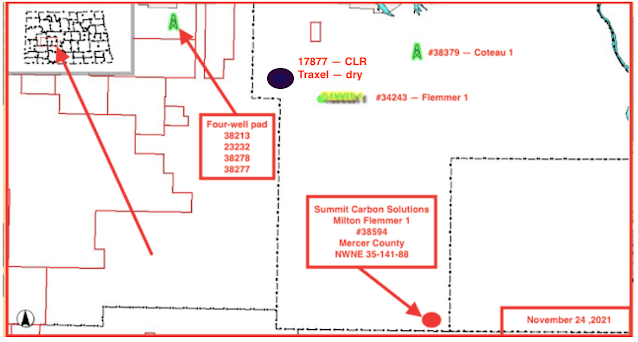
Wow, it never quits. Seeing these maps, this post, a reader was reminded of a wildcat that Harold Hamm drilled back in 2009 looking for the eastern fringe of the Bakken. In the map below, the black circle is the general location of that well:
The map:
Synopsis:
Original Post
Feature story of the day. You may have to "register" to get to article over at Reuters but it's free. I've archived the article. Regular readers know what this is all about. I'll come back to it later when I get caught up.
Nov 23 (Reuters) - Dan Tronchetti received a letter in August that alarmed him: Summit Carbon Solutions, a company he'd never heard of, wanted his permission to conduct survey work for a 2,000-mile pipeline it planned to route through his Iowa corn and soybean fields.
The project, dubbed the Midwest Carbon Express, had ambitions to become the world's largest carbon dioxide pipeline, moving climate-warming greenhouse gases from Midwest biofuels plants to North Dakota for permanent storage underground.
But Tronchetti's first concern was for his livelihood. "It would go more than half a mile through prime farmland," he said.
The 65-year-old is among dozens of landowners along the route who are refusing to cede their property to the project, according to Reuters interviews with five landowners, four community groups organizing opposition, several academics and industry sources plus a review of filings with state regulators.
The impasse could escalate into potential court battles if Summit tries to seize the land by claiming eminent domain. Such legal fights contributed to the cancellation of the Keystone XL oil pipeline this year.
The outcome of the dispute poses huge stakes for Summit's $4.5 billion project, and for the Midwest ethanol producers it would serve who are hoping to wipe away their carbon footprints and burnish their green credentials.
It also represents what could be the biggest test yet for the carbon capture and storage (CCS) industry, which has struggled for years but which advocates say could become a powerful tool in the global fight against climate change.
Underground geological formations in the United States have the potential to store 2.6 trillion tons of planet-warming CO2, enough to cover all of America's historical emissions and those to come for centuries, according to the Department of Energy.
But there are open questions about whether CCS can ever fill them. Despite billions of dollars of public investment over the past decade, the technology remains relatively untested.
The United States boasts just 12 operational commercial CCS facilities that together have an annual capacity to store away 19.64 million tons of carbon, about 0.4% of national emissions.
Much, much more at the link; this is simply the beginning of a long, long article.
UNP, 3Q21 earnings:
Economic indicators released today: wow, wow, wow -- the housing sales numbers were absolutely incredible. I was impressed.
A reminder, IBM to split into two companies:
Wework: set to go public via a SPAC two years after failed IPO. Link to WSJ.
Supply chain shortages:
********************************
CCS
Updates
October 21, 2021: HartEnergy has the story, finally. And also at KFYR.
North Dakota’s regulatory framework for geologic sequestration of carbon dioxide (CO2) is leading the nation again as the North Dakota Industrial Commission approved the first Class VI well in North Dakota on Oct. 19.
North Dakota was the first state to receive primacy of Class VI wells from the US EPA in 2018, followed only by Wyoming in 2020.
Original Post
U.S. Secretary of Energy Jennifer Granholm, during a visit to the Energy & Environment Research Center at UND, said she believes North Dakota is poised to play a key role in addressing climate change.
Granholm visited Grand Forks on Thursday, Oct. 14, to tour the EERC with Sen. John Hoeven, R-N.D., and Gov. Doug Burgum. Following that tour, they held a discussion with energy company executives from across the state.
That discussion focused on the generation of clean power, but also on advancing to commercialization carbon capture utilization and storage technology (CCUS) — essentially stripping carbon from coal or other energy sources, and burying it underground. Energy executives said doing so will require expanded federal financial assistance.
Granholm said she doesn't view combating climate change with a silver bullet, but rather "silver buckshot." In North Dakota, that buckshot pattern hits several targets, including further rolling out wind and solar power, but also working to decarbonize fossil fuels.
And, then look at this:
Burgum said North Dakota "hit the jackpot of geology" because the state can store 252 billion tons of carbon underground in a carbon "sink." That amount, he said, equates to 50 years of national carbon production from energy generation, or 4,400 years in what North Dakota generates on its own.
Granholm agreed, saying: "You've got a comparative advantage, clearly in carbon capture and storage because of your geography," and called the storage capacity a "gift to the planet."
In May, Burgum announced an ambitious plan to make North Dakota carbon neutral by 2030. Burgum said since that announcement, investment from outside the state has poured in, to the tune of $25 billion for projects like carbon capture programs.
All cases from the Milton R. Young Station, Minnkota Power Cooperative.
These are cases, not permits:
Updates
October 21, 2021: HartEnergy has the story, finally. And also at KFYR.
North Dakota’s regulatory framework for geologic sequestration of carbon dioxide (CO2) is leading the nation again as the North Dakota Industrial Commission approved the first Class VI well in North Dakota on Oct. 19.
North Dakota was the first state to receive primacy of Class VI wells from the US EPA in 2018, followed only by Wyoming in 2020.
Original Post
Re-posting:
North Dakota carbon storage: ethanol plant seeks to capture emissions. Amy R. Sisk. Key words:
- Richardton ethanol plant
- Red Trail Energy
- could be the first project in North Dakota that both captures and injects carbon emissions underground
- North Dakota and Wyoming are the only states that have assumed full permitting authority fro the EPA for carbon injection projects
- first location: a well east of the Stark County plant targeting the Broom Creek rock formation more than 6,300 feet deep
- CO2 would form a plume in the pore space;
- "supercritical" under high pressure and temperature
- CO2 to be trapped there forever; the nearest drinking water source lies 4,000 feet above the injection layer, but if it escapes, hey, we have carbonated water
- 90% of landowners with pore space in the project area have signed leases, meeting the state's 65% threshold for a project to move forward
- one carbon capture project has already operated for years within North Dakota at Basin Electric Power Cooperative’s Great Plains Synfuels Plant near Beulah. Carbon dioxide from the facility is piped to Canada where it’s injected into old oil fields to boost oil production