Locator: 48825B.
Ford: doubles down on EVs. Link here. Link here.
- $30K pickup that powers the house for six days;
- faster than a twin turbo Mustang
- towing power of a Western Star
- won't have CarPlay but will have "never-before seen updated infotainment
- all for $30K
MU: surging.
Orsted. Link here. Sinking.
************************************
Back to the Bakken
WTI: $64.23.
New wells:
- Tuesday, August 12, 2025: 25 for the month, 73 for the quarter, 503 for the year,
- 41272, conf, CLR, HM Hove 8-9H,
- Monday, August 11, 2025: 24 for the month, 72 for the quarter, 502 for the year,
- 41465, conf, Krakken, Boxcar 4-9-16 5H,
- 41271, conf, CLR, HM Hove 7-9H,
- Sunday, August 10, 2025: 22 for the month, 70 for the quarter, 500 for the year,
- 39520, conf, BR, State Dodge 3C MBH,
- Saturday, August 9, 2025: 21 for the month, 69 for the quarter, 499 for the year,
- 41464, conf, Kraken, Boxcar 4-9-16 4H,
- 41270, conf, CLR, HM Hove 6-9H,
RBN Energy: oil and gas companies experiment with twisty new well designs to boost output. Archived.
The oil and gas industry is always working to develop the most
efficient methods for unlocking more hydrocarbons. To cut costs and
maximize output from their acreage, some companies are rolling out more
creative well designs, such as U-turn (aka “horseshoe”) and J-hook
wells, which use dramatic, 180-degree underground turns to access more
oil and gas from each location. In today’s RBN blog, we’ll discuss the
benefits of these approaches and the technical hurdles associated with
drilling these deep bends underground.
In Part 1
of this blog series, we discussed how the Shale Era was made possible
by unprecedented advancements in drilling and completion technology,
especially in horizontal drilling and hydraulic fracturing. The
combination of the two, along with other basin-specific techniques, has
significantly increased the efficiency of oil and gas recovery, as
evidenced by, among many things, higher initial production (IP) rates,
lower decline rates and higher EURs (estimated ultimate recovery
numbers). We also detailed how the industry has increasingly utilized
much longer laterals and how the choice of well tubing — coiled or stick
pipe — plays an important role.
At
the beginning of the drilling process, a crucial decision must be made
regarding how the well will be designed. Typically, in horizontal
drilling, it starts by drilling a vertical section from the surface down
to the targeted rock formation. Then, the directional drilling will
steer the wellbore into a horizontal path, which can extend for one, two
or three miles, and even longer in some cases. This can increase the
amount of hydrocarbons that can flow into the well and boost production
rates. Once the well is at the desired depth, the wellbore is lined with
steel casing and cemented in place to prevent collapse. Then, the well
is hydraulically fractured, and finally, pumps are installed to bring
oil or gas to the surface.
While the horizontal well is the go-to design in most popular shales
in the U.S., a few E&Ps have started pushing boundaries in the last
few years with new twists on the horizontal well design. The first we’ll
discuss is the U-turn or horseshoe well. This is a more complex
technique often used where space is tight, or the geology is challenging
(more on that below). It starts with the drill path going down
vertically from the surface, just like a typical horizontal well. Once
it reaches the target depth, it turns and drills horizontally, usually
about a mile out. Here’s where the twist comes in. Rather than stopping
or branching straight out, the drill bit makes a tight 180-degree or U-turn
underground and heads back in the opposite direction. This creates a
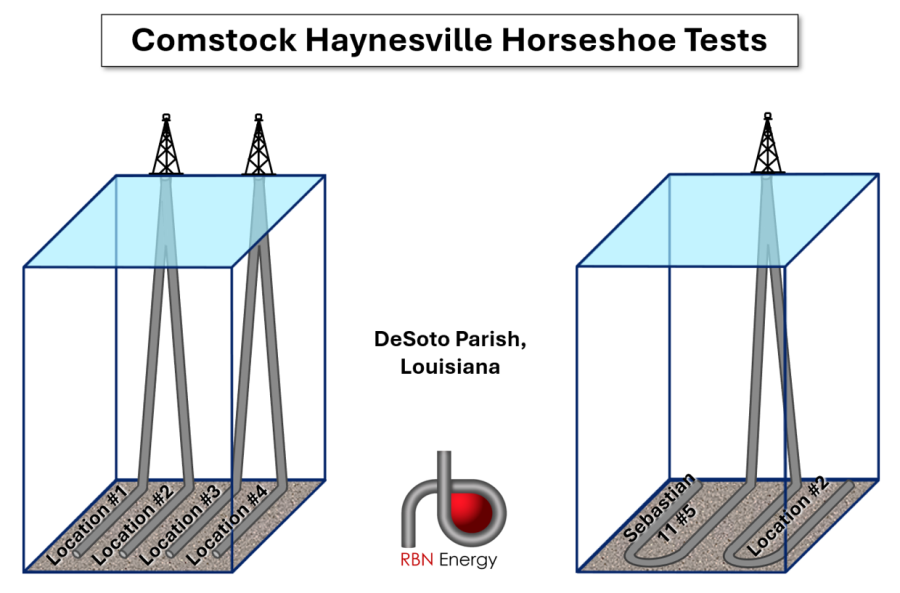
second horizontal leg parallel to the first, as shown in the graphic to
the right in Figure 1 below.
Figure 1. Comstock Haynesville Horseshoe Test. Source: Comstock