Showing posts with label PeakDemand. Show all posts

Monday, June 26, 2023

This Is Pathetic -- On A Good Day For Oil -- Oh, Never Mind -- It's Worse Than I Thought -- And I'm An Optimist -- LOL -- June 26, 2023

Locator: 45065WTI. 

The Energy Institute Statistical Review of World Energy, 2022, has just been released.

So, after all this data was released,

  • solar and wind ddn’t dent fossil fuels,
  • global economy is ready to surge post-Covid, 
  • Saudi Arabia cuts production, 
  • Russia almost stages a coup, 
  • and .... and .... and ... and ..

What did WTI do today?

  • can't break $70
  • surges ... by 19 cents -- disregard -- that was pre-market ---
  • up ... by 0.27% -- disregard -- that was pre-market ---

Now that the market has opened,

  • didn't break $70
  • drops half-a-percent
  • trading below $69
  • looks like WTI will close slightly up but below $70
  • and this is on a "good news" day for oil.

And the lead story over at Oilprice.com: Saudi Arabia could slash oil supply to the US.

OMG.

Seriously.

That's the headline. That's the top story. Slash. Pretty scary word.

OMG.

On that news, WTI drops half-a-percent. And the huge July 4th this weekend -- and a long weekend -- five days -- people will start leaving Friday -- Monday is the "who cares -- tomorrow is the holiday -- I will just call in sick" day -- five days ... 

Does anyone pay attention to data any more?

Saudi Arabia oil to US -- historical -- link here. 


Remember, Saudi has a huge refinery in the US -- unless they want to buy Permian oil for that refinery, they can't "slash" much.

I guess it depends on the definition of "slash."

Oh, here we go ... WTI is starting to move ... up 15 cents .... trading at $69.31.

Good luck to all. I'm going biking.

On A Great Day For Oil -- WTI Surges -- Up 19 Cents -- Can't Break $70 -- June 26, 2023

Locator: 45064WTI.

The Energy Institute Statistical Review of World Energy, 2022, has just been released.

So, after all this data was released, solar and wind don't dent fossil fuels and global economy is ready to surge post-Covid, and Saudi Arabia cuts production, and Russia almost stages a coup, and .... and .... and ... and ..

What did WTI do today:

  • can't break $70
  • surges ... by 19 cents
  • up ... by 0.27%
  • and this is on a "good news" day for oil.

The real stories.

Bloomberg leads with this today:

Global electrical generation by fuel, link here:

European electrical generation by fuel, link here:

Global energy consumption, link here (at the link, the screenshot only shows through 2013; click on the graphs to go out to 2022):

Renewables growth did not dent fossil fuel dominance in 2022, link here:

Oil and the Russian coup, link here:

Saudis "tightening" the screws on America, link here:

Saudi in deep doo-doo, link here:

Wind energy: read the small print. Link to Bloomberg. How charts confuse folks.


Tuesday, March 22, 2022

Inflation Coming In At 7.9%. Now This. This Is What Really, Really Scares Jay Powell -- March 22, 2022

Gasoline prices surging.

The very same day this data was released was the day Jay Powell, "Fed chairman," implied the Fed would raise overnight rates more than expected, faster than expected.

I've maintained ever since beginning the blog, the best indicator of the US economy was gasoline demand. And by that metric, the US economy is on fire.

Compare gasoline / diesel demand in:

  • Russia
  • Europe
  • Britain

This has to be terrorizing the Fed: US sees highest gasoline demand since at least 2017.

This is despite:

  • massive EV penetration (needs to be fact-checked but that's what "everyone" says)
  • CAFE standards that in some cases border on the absurd
  • at least five oil-price shocks in recent history that supposedly resulted in demand destruction

Did we mention that gasoline prices are surging with $120 oil? 

Demand destruction? What demand destruction?

The bigger concern is supply destruction (see earlier post).

But I digress.

I'm sure I must be misinterpreting the headline story. 

Back to the things that put terror into the hearts of "Fed" members: US sees highest gasoline demand since at least 2017.

Greta's head is exploding.  

More and more, the story is not "demand destruction," but "supply destruction."

Link to Tsvetana Paraskova.

  • U.S. gasoline demand on Sunday jumped by 12.6 percent compared to the previous Sunday.
  • U.S. gasoline prices fell slightly last week from the highs on March 11. 

Not one percent or two percent or even five percent or ten percent, but almost 13 percent. 

Trivia: the number page on the blog when one searches "demand destruction" was posted Saturday, April 23, 2011. 

From wikipedia:

Demand destruction is an economic term used to describe a permanent downward shift in the demand curve in the direction of lower demand of a commodity such as energy products, induced by a prolonged period of high prices or constrained supply.

So, if US sees highest gasoline demand since at least 2017, does that change all those arguments about "demand destruction"? 

Is this sort of like Hubbert's "peak oil theory" which has been clearly disproved?

********************************
Finally, Summer

Monday, February 17, 2020

Oil And Gas In The News -- February 17, 2020

Investors losing their patience, Rigzone. Link here.
Owing to a collapse of oil prices at the end of 2018, M&A activity in oil and gas has almost ground to a halt after a flurry of deals last autumn. After a decade of funding the expansion of unconventional oil and gas, Wall Street investors have lost patience and want a return on their investment.
Andrew Dittmar, Senior M&A Analyst at Enverus, notes, "investors who funded the shale revolution over the last decade have become vocal in advocating for pay-outs and cutting back on providing new capital. That flowed through to limited M&A and a negative reaction to deals for much of the year."
India's upside for oil demand seems unlimited, Rizone. Link here.
With almost 1.4 billion people, India remains the most energy-deprived nation on Earth. The upside for demand seems almost unlimited. India has 635 million people under the age of 24. This is a burgeoning young population the size of the total populations of the U.S., Japan, Germany, France, and Canada. Coal will remain the main source of energy, but the proven global reality that demand mounts as human development progresses makes India’s oil usage unidirectional: up.
Today, oil accounts for 25 percent of India’s total energy demand, rather high for a still developing country. The latent demand, however, is just staggering. Indians use less than 0.2 gallons of oil products per day, versus 2.6 gallons for the U.S. Even though it has almost 11 times more people, India overtook Japan only in 2015 to become the world’s third largest oil consumer after the U.S. and China.
Over the past decade, China (45 percent) and India (20 percent) have accounted for the bulk of new global oil demand. Driven by more diesel fuel, gasoline, and LPG, India could race past China to become the world’s primary new consumer within five or seven years. For those claiming “the end of oil,” the truth is that the world’s most vital fuel has no material substitute whatsoever. Electric transport, for instance, is overly expensive here in the rich U.S., let alone for a still developing country where 70 percent of the people subsist on biomass. Dreaming of the same luxuries that Westerners enjoy, gas-guzzling SUVs now comprise 35 percent of all car sales in India.
****************************************
The Apple Page

About a year ago, I forget exactly when, I bought a new iPad Pro along with the latest generation Apple Pencil.

I love the iPad Pro for surfing the net but not much else. I thought it would be possible to use it for blogging, but it's not optimized for such, at least without a peripheral keyboard. So, I use is mostly for surfing.

It links perfectly and seamless with any number of BlueTooth speakers, that I have around the house. I learned recently that there is an "Alexa" app for the iPad and that, too, works great. I assume it's tied in with my monthly Amazon Music subscription. Doesn't matter to me one way or the other. Over the weekend I learned that there is a Kindle app that works on the iPad Pro and now I have downloaded the books I have bought from Amazon. Also, a subscription to a art/painting magazine to which my wife subscribes can be downloaded on the app. Awesome.

But I had forgotten about the pencil. Never used. Had completely forgotten I even bought it. While re-organizing the closet two weekends ago I stumbled across the unopened Apple Pencil box. Wow.

With the Daytona 500 postponed, and the PGA tournament a real bust, I had a lot of free time.

Daytona 500: after an incredible opening -- President Trump, grand marshal, and Melania, making a grand entrance -- folks disappointed that his limousine didn't take the 31° banks at 70+ mph -- the race went for 20 laps or so before it was postponed / rain delay. 

PGA tournament: The host, Tiger Woods, placed dead last, #68 in a field of 68. And he was there by himself. Ryan Palmer placed #67; and, then three were tied at #64. Tiger Woods was +11 for the tournament, dropping five more in the final round. Adam Scott was the winner at -11 for the round.

So, I had a lot of time to play with the new Apple Pencil.

It's truly amazing. Best feature. It charges simply by being next to the iPad Pro. It doesn't need to be plugged into anything and no cables. Simply place the pencil next to the iPad Pro and it charges.

I did not know which "painting" app to purchase. Good, bad, or draw, after searching the net, I settled on "Procreate" for $9.99 or $10.00 (don't remember which). [I just checked the receipt: with tax, $10.81.] Today, I note that "Procreate" gets 4.5 starts (out of 5) or better at the Apple App Store.

I had forgotten how easy it was to add money to my Apple Account -- I don't think I've added money to that on-line account for six years (seriously; it could be longer) -- it still had $1.85, but I added $20 or $25.

And then a couple of clicks later I had "Procreate" on my desktop. It's not quite as intuitive as I expected, but I found a great YouTube video to get me started, and after learning a few basics, I was in business.

Most amazing is the multi-finger "touches" that can do so much. "Procreate" calls them "power-moves." Also, the layering. Absolutely incredible.

I don't know if "Procreate" is the "best" app for such stuff, but Sophia is going to have a great time with this one.

The Apple Pencil also works with Apple Notes and I'm sure it works elsewhere.

One certainly doesn't need the Apple Pencil, but it sure is fun. I'm thinking I can use it for some of my graphics on the blog. We'll see.

Friday, August 23, 2019

Keystone XL -- Nebraska -- Hope Springs Eternal -- August 23, 2019

From twitter moments ago:


Later: see the "Seward jog" here.

************************************
Another Bogus Story: The US Drowns The World In Oil

Nope, Virginia, the world is not going to be drowning in oil in 2029.

This might be as good a time as ever to re-look at that "US to drown the world in oil" story that went viral a few days ago.

Something didn't ring true about that article when I first read it, but I couldn't put my finger on it.

Remember, this was at an anti-oil, green energy site. Why would they post such a story? It's obvious they were posting the story to scare folks about how much oil (i.e., CO2 emissions] the US was going to produce over the next ten years, a "call to arms," as such, to keep this from happening. If I recall correctly the data for that article came from Rystad Energy.

This is what caught my attention. There were some interesting data points not mentioned in the article.

For example:
  • total global supply
  • total global demand
This is what also caught my attention.

Not one Mideast country is contributing any significant amount of new oil or natural gas to the global supply by 2029 (and perhaps earlier). By 2029, Saudi Arabia will be a net importer of oil.  By 2029, Russia will not be adding any more new oil and gas more than Ohio. One has to assume that if Russia's production is growing only  as much as Ohio, Russia's growth in exports will be similarly constrained; they will need it for themselves Mexico, Venezuela, Norway are not on the list.

Think about that. Assuming global growth pretty much matches global demand, if it were not for the US, the global shortfall would be huge.

That's the real take home message in the graphics at that post.

By 2029 the world is not going to be drowning in oil. The US won't be drowning the world in oil. In fact, the US will be the major source for new oil and gas in 2029, but supply will not exceed demand by much; there won't be anyone drowning in oil.

The flip side of all that hand-wringing by Global Witness is opportunity. For the US.

From a white paper published in 2018, looking out to 2035, McKinsey provided this reference case:
  • We expect growth in oil supply to come from (1) OPEC, (2) US shale oil and (3) selected offshore basins e.g. Brazil that are breaking-even below USD75/bb; ample resource base and cost discipline keeps long term average prices at USD65-75/ bbl 
  • The outlook is combined with a peak in demand growth in the early 2030s - driven by slower chemicals growth and peak transport demand as fuel economy, electrification, & reduced car ownership decreases oil consumption 
  • By 2035, under our base case E&P companies need to add >40 MMb/d of new crude production from mainly offshore and shale unsanctioned projects to meet demand, and ~4- 5% of these new additions will come from YTF resources.
["YTF" = "yet to find."]

But think about that.

Today, Russia, Saudi Arabia, and the United States produce about 40 million bopd. An amount equal to that will need "to be found" (and the infrastructure to support it) to meet global demand by 2035.

McKinsey does provide an alternative scenario in which there is an accelerated transition away from fossil fuels. If that were to occur, McKinsey concludes:
  • A radical disruption scenario in road transport and chemicals sectors brings peak oil demand before 2025, and a ~30 MMb/d decline by 2035 compared to the Reference Case
  • Liquids demand disruptions reduce the need for unsanctioned projects by ~50%, driving project cancellations and delays mostly in offshore regions and oil sands
  • The reduced supply stack leads the average global crude slate to become more sour 
  • Lower oil demand could subsequently drive OFSE and refinery utilization down, with European refineries feeling the strongest impact; there could be further opportunities in decarbonization
The tea leaves do not suggest to me we will see that "accelerated transition" but even so, let's say we do, read the McKinsey summary very, very closely. If I'm reading that correctly, even in the Accelerated Transition case, global demand for liquids will increase by 10 million bpd by 2035.

Tuesday, August 20, 2019

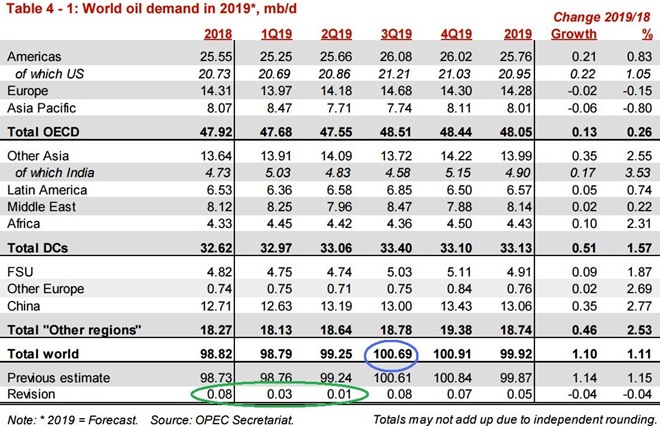
Follow-Up To An Earlier Post On 2018 - 2020 Global Crude Oil Demand -- August 20, 2019

Locator: 10025GLOBALDEMAND.

Bottom line: global demand for crude oil was revised upward for 2018, and global demand will continue to increase through 2020, according to latest reports from OPEC.

See this note for background.

Pay particular attention to this:
  • OPEC reports July's oil output was two (2) million bopd short of global demand;
The reader who noted that, also noted this:
It should be noted, that to the best of the writer's knowledge, no one is reporting that OPEC supply in July, 2019, was two (2) million bopd less than global demand.
That was a couple of days ago.

Today, the reader provided an update and a likely explanation for the "2 million bopd" figure. From the reader today:
I now understand why no one had that 2 million barrel shortfall that the OPEC report revealed. Whoever wrote the demand summary for OPEC started with a big misdirect that was picked up by the media, who have press deadlines to meet & who thus don't have the time to dig through a hundred pages of tables ... below is the note Reuters picked up that OPEC demand intro and came up with a headline that read:
OPEC sees bearish oil outlook for rest of 2019, points to 2020 surplus despite an upward revision to demand. Nick Cunningham at Oilprice did the same thing, called the OPEC report bearish. 
The key thing to look at is the revision line on the demand table: https://rjsigmund.files.wordpress.com/2019/08/july2019opecreportglobaloildemand.jpg.

This is the explanation in greater detail:
What happened here is that whoever wrote the OPEC summary misstated what the data showed.

The Reuters article reads "the Organization of the Petroleum Exporting Countries cut its forecast for global oil demand growth in 2019 by 40,000 barrels per day (bpd) to 1.10 million bpd and indicated the market will be in slight surplus in 2020."

Since that didn't fit anything I saw when reading the report, I went back and found the summary that Reuters referred to.

On page 43 of the OPEC report, the first line of their demand summary says
"World oil demand is projected to rise by 1.10 mb/d in 2019, showing a downward revision of 0.04 mb/d from the previous month’s projection. "
The table on the same page shows the data, which I've already written about (see link to the table above);

You'll see that demand for 2019 was revised 0.05 mb/d HIGHER...but because demand for 2018 was concurrently revised 0.08 mb/d higher, the GROWTH of demand from 2018 to 2019 was revised down a rounded 0.04 mb/d.

Everyone who is writing about the OPEC report is taking that downward revision of growth to mean reduced demand, which is not the case. In fact, third quarter demand was revised 0.08 mb/d higher and came in 1.98 mb/d greater than July's global output.
Comment: I see this often: folks confusing "growth" with "demand" when looking at these reports. 

This gets deep into the weeds but it's important enough on many levels to deserve a post of its own.

Bottom line:
Demand growth was adjusted lower, not that demand was adjusted lower.

In fact, 2019 demand was adjusted higher, but 2018's demand was revised even higher, and hence the difference between 2018 and 2019, ie "growth", was less.
I get it. I wouldn't have figured it out on my own, but I get it. Because I've made that same mistake.

By the way, on another note, I pretty much ignore prognostications regarding crude oil demand put out by OPEC. 

Wednesday, November 21, 2018

Nine Wells Coming Off The Confidential List Today -- November 21, 2018 -- Hubbert's Peak Oil Theory Is Dead -- Rigzone

Agree completely: from Rigzone -- Shell is wrong -- global oil demand can only increase. Archived.
Bolstered by the U.S. shale revolution, global oil production has surged by over 20 percent in the past 15 years. The great rise has put to bed the “peak oil production” theory but it has not stopped the apparent new concern of “peak oil demand,” now portrayed as perhaps the main threat to the future of the world’s oil industry.
In fact, it’s hardly just anti-oil environmental groups; many of the major producers themselves (Royal Dutch Shell in particular) assert that global oil consumption will soon peak and thereafter begin its terminal decline. The basis of this belief is the growth of electric vehicle sales and the need to reduce oil use to combat climate change.
Yet for oil, what’s past is prologue: even with higher prices, both the Energy Information Administration (EIA) and International Energy Agency (IEA) modeling have repeatedly forecast more demand for as far as the eye can see. After all, oil is the world’s most important fuel, supplying 35 percent of all energy used. While the link between economic growth and oil use can be viewed from a variety of perspectives, the two clearly progress in tandem – a long studied link demonstrated in regression modeling and peer-reviewed studies.
************************************
Back to the Bakken

Wells coming off the confidential list today -- Wednesday, November 21, 2018:
  • 34053, SI/NC, WPX, Howling Wolf 28-33HT, Wolf Bay, no production data,
  • 34050, SI/NC, MRO, State Oster 14-36TFH, Bailey, no production data,
  • 33516, 962, Enerplus, Sodium 147-93-05B-08H-TF, Moccasin Creek, 35 stages; 5 million lbs; t5/18; cum 121K 9/18;
  • 33515, 1,828, Enerplus, Chrome 147-93-05B-08H, Moccasin Creek, 37 stages; 12.4 million lbs; t5/18; cum 148K 9/18;
  • 33514, 1,907, Enerplus, Aluminum 148-93-32CH, McGregory Buttes; t5/18; cum 78K 9/18;
  • 33513, 1,157, Enerplus, Gold 147-93-05B-08H-TF, Moccasin Creek, 39 stages; 5.6 million bls; t5/18; cum 138K 9/18;
  • 33512, 1,227, Enerplus, Zirconium 147-93-05B-08H, Moccasin Creek, 38 stages; 12.6 million lbs; t5/18; cum 136K 9/18;
  • 31194, SI/NC, Slawson, Jore Federal 1-12H,
  • 30484, 405, Lime Rock Resources, Emil Veverka 5-20-17H-143-95L, Murphy Creek, t6/18; cum 45K 9/18;
Active rigs:


11/21/201811/21/201711/21/201611/21/201511/21/2014
Active Rigs62553865191

RBN Energy: BC pipeline outage disrupts western US winter gas prices and flows.
Natural gas markets in the U.S. Northwest have been in turmoil ever since a rupture on Enbridge’s BC Pipeline system over a month ago (on October 9) disrupted Canadian gas exports to Washington State at the Sumas border crossing point. Service on the affected line has been restored but at a reduced operating pressure for now, and Canadian gas deliveries to Sumas remain at about half of their pre-outage levels, creating supply shortages in the region. Spot natural gas prices at the Sumas, WA, trading hub have been volatile, soaring well above Henry Hub and rocketing to a record outright price of nearly $70/MMBtu late last week. The outage has reverberated across the Western U.S. gas market, sending regional prices reeling as gas flows adjusted to help offset supply shortages. Today, we examine the knock-on market effects of the outage on Western gas flows and prices, and potential implications for the winter gas market.

Tuesday, March 6, 2018

Peak Demand? What Peak Demand? Global Crude Oil Demand Will Rise Nearly 7 Percent In Less Than Five Years -- March 6, 2018

With regard to global oil, the current 30-second elevator speech:
  • US shale oil production will continue to surge;
  • US will take market share from OPEC;
  • OPEC is in a bind -- a strategy to manipulate the price of oil by increasing production / cutting production is full of risks;
  • Mark Papa continues to beat the drum that US shale is reaching peak production; and,
  • oil demand growth to shift to petrochemicals, away from motor vehicles
No new links. Many of these stories have been previously posted and linked, but this is the one data point that jumps out at me:
Boosted by economic growth in Asia and a resurgent U.S. petrochemicals industry, global oil demand will increase by 6.9 million bpd by 2023 to 104.7 million, according to the IEA.
2023: that's only five years from now. That's still within my investing lifetime. And Sophia will just get started.