Locator: 50905B.
Bull run: now, nine weeks long -- since March, 1950, this bull run of 9 weeks ranks #16 -- CNBC. Only #16?
NBA: game 1 tonight.
Elizabeth Warren: missed the AI revolution.
15 minutes of fame: Scott Pelley fired by CBS. I don't think I've watched 60 Minutes in the last decade but apparently Scott Pelley is the Big Man on Campus over at CBS News.
Pageviews: since the beginning -- June 3, 2026, 7:36 a.m.: 59,949,501. By the end of the month, we should have 60 million pageviews total since the blog began. Now, June 5, 2026, 5:00 a.m.: 60, 073,897:
- delta: 124,306 over almost exactly two days
- per day: 62,153
- this seems somewhat impossible; I will have to check some additional calculations later.
Later, 4:23 a.m. Saturday, June 6, not quite 24 hours later, pageviews:
- right now: 60,132,667
- not quite 24 hours ago, June 5, 2026, 5:00 a.m., yesterday: 60,073,897
- in that 24-hour period: 58,770 page views.
Later, 6:45 a.m., Sunday, June 7, 26 hours later, pageviews:
- right now, 60,204,191
- 26 hours ago: June 6, 2026, 4:25 a.m.: 60,132,667
- in that 26-hour period: 71,524 page views (on a weekend)
- at the height of the Bakken boom, I hit a high of around 6,000 pageviews / 24 hours
- five years later (2014 or thereabouts), the average was maybe 3,000 pageviews / 24 hours
- now: 70,000 pageviews / 24 hours
- I'm not sure what this is all about but it appears to be accurate
This site is not monetized -- none of my blog sites are monetized.
With regard to page views (pageviews), google gemini has incorrect information. I provided google gemini with the correct information and gemini confirmed it with data from mineralrightsforum.com. Thank you. I didn't check that link; I have no idea if it works from this end. I do believe this site is the only site dedicated to the Bakken that requires no password, no subscription, no e-mail requirement, and is not monetized.
*******************************************
Back to the Bakken
WTI: $95.66. Up $1.90; up 2%.
New wells reporting:
Thursday, June 4, 2026: 2 for the month, 158 for the quarter, 315 for the year,
42003, conf, Slawson, Cannonball Federal 6-27-34H,
Wednesday, June 3, 2026: 1 for the month, 157 for the quarter, 314 for the year,
None.
RBN Energy: Permian's rising NGL output spurs another round of "wellhead-to-water projects. Link here. Archived.
The
rapid buildout of Permian gas processing plants and other NGL-related
infrastructure in Texas and southeastern New Mexico isn’t just
continuing, it’s accelerating. Not just processing, but also new and
expanded NGL pipelines, new fractionators in Mont Belvieu (and near
Corpus Christi), and new ethane and LPG export capacity. Funny thing is,
all that growth and investment is happening as crude oil-focused
production in the Permian has remained flat as a pancake. In today’s RBN
blog, we discuss the latest project announcements and why associated
gas and NGL production in the Permian are still rising.
Crude
oil prices have been elevated for three months now thanks to the Iran
war, but Permian producers have resisted the temptation to ratchet up
their drilling-and-completion activity. In fact, the Permian rig count
is virtually unchanged from the end of last year (247 then vs. 246 as of
mid-May) and so is basin oil production, at 6.6 MMb/d, according to our
weekly Crude Oil Permian
report. That extraordinary discipline during an extended period of WTI
prices north of $90/bbl raises an important, two-part question for folks
who focus on the NGL side of things: If Permian crude oil production
isn’t rising in this price environment, has oil output there pretty much
peaked and, if so, what does that mean for the basin’s production of
associated gas and NGLs?
Spoiler alert: Even if
Permian crude oil production stays flat — heck, even if it were to sag
by a few hundred thousand barrels a day — the basin’s output of
associated gas and NGLs will continue to increase, and at a pretty good
clip. (And that’s impacting the market for NGL purity products like
propane — see our recent Wind of Change blog.) As we explained a few months ago in Hold On ... I’m Coming,
the mix of crude, natural gas and NGLs emerging from Permian wells has
been evolving for many years now, with the general trends being (1) more
gas per barrel of oil (that is, a higher gas-to-oil ratio, or GOR) and
(2) more NGLs per thousand cubic feet of gas (that is, a higher
gallons-per-Mcf, or GPM).
The shift toward gassier,
more-NGL-packed production in the Permian has been significant. By our
estimate, the overall basin’s GOR has increased from 3.4:1 in 2014 to
4.4:1 in 2025, a gain of almost 30%, and the Permian’s GPM has risen
from about 4.5 to 5.2. And from everything we’ve seen and heard about
where producers are drilling and what’s emerging from their newer wells,
this ramp-up in GORs and GPMs has been accelerating — and that’s what
we’ve got in our models.
This suggests that, even
under a flat oil production scenario, the Permian’s associated gas and
NGL output will keep climbing into the 2030s. RBN’s mid-case scenario
for the basin, which envisions a gradual rise in crude oil production
into the 2030s and sees dry gas output increasing to 28 Bcf/d in 2030
and NGL output climbing to 4.8 MMb/d. The same analysis predicts that by
2035, Permian dry gas production will rise to 32 Bcf/d and NGL output
will top 5.5 MMb/d, or about 50% of the U.S. total for NGLs.
We
have blogged extensively about the new and expanded natural gas
pipelines out of the Permian (mostly toward the Gulf Coast but also to
the Desert Southwest and maybe the Midcon). But it’s been a while since
we did a roundup on planned additions to the interconnected set of
“wellhead-to-water” assets that process, transport, fractionate, store
and export NGLs. There’s a lot going on, so to keep things simple, we’ll
tackle this company by company, starting with Targa Resources and
Enterprise Products Partners.
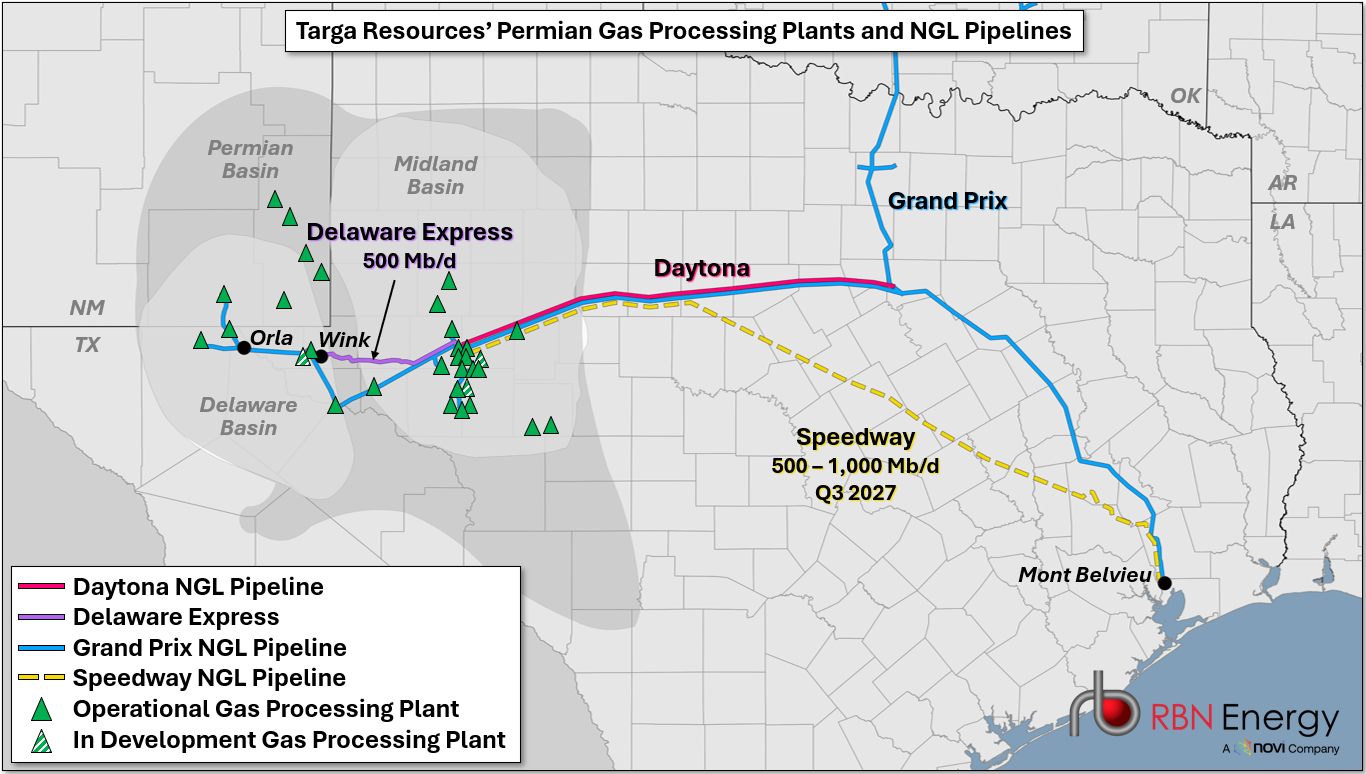
Targa Resources is
one of a select few midstream companies with a complete range of
NGL-related assets, everything from gas gathering pipelines and
processing plants in the Permian to NGL takeaway pipelines,
fractionators and NGL storage at Mont Belvieu and NGL export facilities.
Targa has 8.7 Bcf/d of gas processing capacity in the Permian, split
about evenly between the Midland Basin (4.4 Bcf/d) and the Delaware
Basin (4.3 Bcf/d). (Eighteen of its 21 Midland plants are actually owned
by a Targa/ExxonMobil joint venture in which Targa holds a 72.8%
stake.)
During its Q1 2026 earnings call on May 7,
Targa said that it recently started operation of its two newest
processing plants: the 275-MMcf/d Falcon II facility in the Delaware (in
February) and the 275-MMcf/d East Pembrook plant in the Midland (in
late March). Four additional plants, each with a capacity of 275 MMcf/d,
are scheduled to come online by the end of 2027, including the East
Driver plant in the Midland in Q3 2026 and — all in the Delaware —
Copperhead (Q1 2027), Yeti (Q3 2027) and Yeti II (Q4 2027). The
midstreamer also announced two more Delaware processing plants during
its recent call. The 265-MMcf/d Roadrunner II facility and the
275-MMcf/d Copperhead II plant will both start operating in Q1 2028.