Tuesday, April 14, 2026

Trane: Another Rabbit Hole -- April 14, 2026

 l

I'll have to come back to this later. Going bike-riding. 

Just Tech For Now -- April 14, 2026

l

It's unlikely I will ever watch CNBC except for small snippets, I suppose, but even that is very unlikely. CNBC on-line is great for headlines and when I'm blocked by paywalls at Bloomberg and Reuters, the chatbots get me what I want. 

Oracle: link here

Amazon: signs $12 billion deal to buy Globalstar.

Ticker AMZN

News for AMZN


*****************************
Others

MU: up 2% today; up over $7.00.

AMD: up 1% today; up over $2.50

AVGO: up 7% past five days; up $25 past five days.

ORCL: up 4% today; up almost $7 today.

************************
Market

***************
The Book Page

Why Machines Learn: The Elegant Math Behind Modern AI, Anil Ananthaswamy, c. 2024 / 2025.

This is why the AI revolution is not even closely / remotely near the end. If Americans don't want LDCs in their backyard, the revolution will continue unabated in China.

This is why this book is so good. Notes are updated here

Chapter 10
The Algorithm that Put Paid to a Persistent Myth
 
First paragraph: Minsky and Papert myth; discussed with Geoffrey Hinton. This is what makes this book so good.
 
Hinton: one of the key figures behind the modern deep learning revolution.
 
Hinton got interested in neural networks in the mid 1960s when he was still in high school in the UK. 
 
This is why this book is so good:
 

Incompetent, Irrelevant, And Immaterial -- Tuesday -- April 14, 2026

l

The bubble: I've literally lost the bubble on everything. 

I feel I am adrift, completely lost at sea. There's so much going on and yet so much is not being discussed -- anywhere. So, if I get into the mood, lots to discuss. My problem: I don't know where to begin. It's sort of like Artemis II -- done that 50 years ago; what did this four-person mission gain us? A lot of "I love me" photos. Quick: name one of the four astronauts. 
So, there's a lot to discuss today, if I'm so moved. 

  • The UN: have you ever witnessed such impotence? Checking the thesaurus I found 25 words from which to choose. Impotence, irrelevance, and incompetence all work. The three "i's." 
  • Renewable energy: Europe was the only one leading the charge (no pun intended) and even the EU is more concerned about price of LNG / oil rather than saving the earth. It appears we have at least another eleven years to act. 
  • Carbon capture: whatever happened to that? Going all the way back to Denbury, XOM, and XTO.
  • BRK: what in the world is going on with BRK?
  • EVs: are they or are they not something the US will see any time soon? Ford's Farley weighs in.
  • The market: I haven't watched CNBC since the war began and except for checking a few tickers, I haven't look at the market (at least not as much as I once did) and haven't even checked my portfolio. 
  • GOP should be concerned: how soon will the MAGA folks start referring to themselves as the disciples, or vice versa, when will the Pope and/or The New York Times start referring to the members of Trump's cabinet as the fifteen disciples?  [Footnote: the US cabinet has 23 members when one includes the VP, and seven additional cabinet-level positions. Enough to play 11-man football among themselves.]

Back to the UN: Perry Mason, aka Raymond Burr, already did this for us:

Wow, wow, wow, doesn't that describe the UN, Schumer, and The New York Times? Remember, it's the UN's responsibility to keep international waterways open. I guess the Brits forgot that. Along with almost everyone else except Trump. I don't think Netanyahu really cares one way or the other.

********************************
Back to the Bakken 

WTI: $95.87. Falling like a rock. There seems to be a huge disconnect between reality, rhetoric, and the direction the price of oil is taking. Down 3% this morning according to oilprice

New wells reporting:

  • Wednesday, April 15, 2026: 43 for the month, 43 for the quarter, 200 for the year,
    • 41802, conf, XTO, GBU Athena 31X-3G, 
    • 40867, conf, Hess, RS-Piepkorn-155-92-1208H-2,
  • Tuesday, April 14, 2026: 41 for the month, 41 for the quarter, 198 for the year,  
    • 41945, conf, Phoenix Operating, Goodnight 22-15 5H,
    • 41944, conf, Phoenix Operating, Goodnight 22-15 4H,
    • 41943, conf, Phoenix Operating, Goodnight 22-15 2H,
    • 41942, conf, Phoenix Operating, Goodnight 22-15 1H-LL,
    • 41871, conf,  Phoenix Operating, Goodnight 22-15 3H, 
    • 41801, conf, XTO, GBU Athena 31X-3C,
    • 41800, conf, XTO, GBU Athena 31X-3F,
    • 40634, conf, Hunt Oil, Oakland 154-89-30-19H-1, 

RBN Energy: what is driving large-scale data center projects to secondary markets? Link here. Archived.

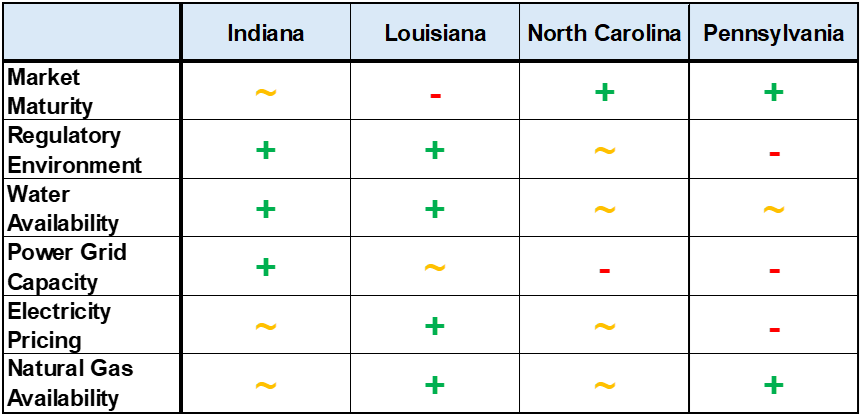
As rising AI-driven demand for data centers has supported growth in key markets like Virginia and Texas, developers are increasingly casting a wider net — landing major projects in states that haven't historically been on the radar. While established hubs still dominate the landscape, regulatory hurdles, rising power costs and grid congestion are pushing developers to look elsewhere. In today's RBN blog, we'll examine the factors drawing large-scale data center projects to “non-key” states, with a close look at Indiana, Louisiana, North Carolina and Pennsylvania.

In Part 1 of this series, we examined the key factors driving data center development across seven leading states — Arizona, California, Georgia, Illinois, Ohio, Texas and Virginia. While Texas appears to lead in new development thanks to its business-friendly regulatory environment, relative strength in power and direct access to Permian Basin natural gas, it faces a familiar Catch-22 also seen in California, Illinois and Virginia: the same conditions that attract development are weakened when that development arrives. So far, that dilemma is partially responsible for the interest toward comparatively less-mature states like Arizona, Georgia and Ohio — but that doesn’t make them immune from those issues either.

With that in mind, large-scale projects are increasingly appearing outside of those key markets — a theme we initially explored in I Know Places. In Indiana, Amazon and Meta have both announced multibillion-dollar commitments. Louisiana was selected as the site for Meta’s Hyperion Data Center, which is under construction. Amazon has also announced investments in North Carolina, in addition to projects by Microsoft and other more speculative plans in the state. And lastly, Pennsylvania’s market is expected to grow, driven by a $20 billion investment from Amazon, on top of the highly publicized planned restart of a Three Mile Island nuclear unit to power Microsoft data centers.

Figure 1 below offers our analysis of these four states. Comparing each on the factors that determine where data centers are built hints at these projects’ rationales. The matrix indicates whether a specific factor (rows) is a relative strength (green plus sign), weakness (red minus sign), or neither (yellow tilde), in each state.

Figure 1. Relative Strengths and Weaknesses of Indiana, Louisiana, North Carolina and Pennsylvania.
Source: RBN