Locator: 48715TSUNAMI.
New link at “links” page:
*****************************
Tsunami
I got up to check the "tsunami news." Yes, we have no tsunamis.

Locator: 48715TSUNAMI.
New link at “links” page:
*****************************
Tsunami
I got up to check the "tsunami news." Yes, we have no tsunamis.

Locator: 48714TRAIN.
Just how expensive is the California bullet train: link here.

Locator: 48713SBUX.
Top line beat.
Bottom line: misses.
After reporting: shares pretty much unchanged.
Locator: 48712ARCHIVES.
Both AMD and GLW were very, very conscious decisions to begin positions about two years ago based on where I thought AI was headed. I bought AMD shortly after seeing the photo of Lisa Su on the cover of Barron's. GLW was a much more recent addition to the portfolio (see this post). This is on a day that the market is down a bit. Link here. Link here.
AMD:

GLW:

My books for the next week: I've had these two books in my library for years. Periodically I go back and spend some time on them.


Rievaulx Abbey, pages: 74, 102, 106 - 108, 160, 180, 260, 306-309.
Rievaulx Abbey, wiki.
Cistercian abbeys, from another blog, posted March 11, 2010. Licorice and Rievaulx Abbey.
During my multiple visits to Yorkshire between 2002 and 2004, a close friend introduced me to the abbeys in the shire. We visited them all, and visited them more than once. I think Rievaulx Abbey was one of my favorites.
Today, while tutoring a student, somehow the subject of licorice came up. We were curious about the origin of licorice. I guessed licorice originated somewhere in Africa or possibly southwest Asia. Wow, was I wrong. It originated in southern Europe.
But this, from Wikipedia, almost made me fall off my chair:
Pontefract, an old medieval town in West Yorkshire, England, was the first place where liquorice mixed with sugar began to be used as a sweet in the same way it is in the modern day. Pontefract Cakes were originally made there. In Yorkshire and Lancashire it is colloquially known as Spanish, supposedly because Spanish monks grew liquorice root at Rievaulx Abbey near Thirsk.Maybe more later, but this is enough memories of Yorkshire for me for the moment.
My life: books and the market.
The next US civil war: electricity -- residential vs commercial / industrial. Trust me on this one. Battle lines and/or the orders of battle are just now beginning to form.
WTI: has just jumped one dollar / barrel. The "majors" are up a bit but otherwise not much change. Yet.
Is this why? E.P.A. plans to revoke legal basis for tackling climate change. I assume in addition to numerous other things, this makes a lot of legal challenges affecting oil companies a moot issue.

OKE -- whoo-hoo -- is up 1.3% today.
Tech, the big tech stocks -- the magnificent 7 and about ten others:
This, by the way, also holds true for the seven leading (and many, many more to follow) chatbots. All chatbots:
Exhibit A: one is up 14% over the past five days; and one is down 13% over the past five days:


******************************
The Book Page
Tag: movies
No notes yet but this is where the notes on Clicked will be posted.
MOTION PICTURES + MONTAGE = CINEMA.
The book:
Suddenly Something Clicked: The Languages of Film Editing and Sound Design, Walter Murch, c. March, 2025.
Search the blog for other posts on this book.
I'll say something different a month from now (or probably even sooner) but this might be my #1 book recommendation for the year. What could be better? A genius at age 81 reflecting on the best movies ever working with the best directors ever. It's amazing how often The Conversation comes up in conversation in this book and yet Walter Murch has not yet talked about The Conversation. I can't wait to hear him on that movie. Wow. I just watched it in its entirety the other night. "Free" on Amazon Prime. I can finally say I've seen this movie. I think I watched it once before and have watched bits and pieces of it several times. But now I've seen it and ready to ready what Walter Murch has to say about it.
And best of all, this is the first of a three-book set. Volumes 2 and 3 have already been written and "will be published at the appropriate time."
A huge piece of the book has to do with "cuts." [Well, duh, it's a book on film editing.]
Looking at the long continuum of US history, I can think of two major "cuts." The collapse of Wall Street in 1929, and the Covid lock down in 2020.
Run the film from 1919 to 1928, and then cut to 1931.
Likewise, run the film from 1945 to 2019, ad then cut to 2021.
On one level, it would be as if absolutely nothing happened, but ... everything happened.
Perhaps for Israeli Jews, run the film from 1611 to 1945 and then cut to 1947. Wow.
Locator: 48710CSX.
Updates
Later, 10: 21 a.m. CT: link here.

Original Post
For the meteor showers, link here.
But now? The Cramer hour.
Let's see if NBC allows him back on the air. Yup, there he is.
LOL.
Leads with UNP and NSC: first American transcontinental railroad in modern era. And ever in the history of the US.
$320 / share; currently trading at $286. $85 billion deal.
FTC:
Thoughts:

Back of the envelope, CSX:
Everything fits.
The big, big, big deal: Trump leaves office having "built" two transcontinental railroads.
The "re-industrialization" of America.
Think about all the story lines.
Politics: Governor Newsom / California can't even build a short state railroad from Los Angeles to San Francisco, with cost trending toward $150 billion. Two US transcontinental railroads, $160 billion ($85 billion + $85 billion).
President Trump leaves office with two transcontinental railroads. The US has never had a transcontinental railroad (much less two) owned by one company. The first transcontinental railroad in the United States was not owned by a single company. It was built by two companies: the Central Pacific Railroad and the Union Pacific Railroad. These companies built separate sections of the line, which eventually met in Promontory, Utah.
Quick: name one thing -- just one thing that would be a better example -- a better photo op -- a better story -- to politicize that America is back! Two transcontinental railroads.
In Elizabethan times / Shakespeare era: the "king maker" was "John of Gaunt."
2025: the "deal maker" is President Trump.
**********************************
Cramer Continues
Unitedhealth (UNH): huge miss. Huge. Cramer and Faber both say they don't know how UNH could have gotten this so wrong.
Novo Nordisk AS (NVO): also shocking. Down 21% in pre-market trading. Blames Lilly.
Second big story: Baker Hughes to buy Chart Industries. Wow. Chart has air exchangers for cooling, think data centers. Chart Industries has a lot of pieces -- but the cooling piece is very, very interesting. One may want to start following TRANE.

AI is an energy story. It's now a "cooling" story.
Just how expensive is the California bullet train: link here.

**********************************
Disclaimer
Brief
Reminder
Briefly:
Chart Industries: link here.


*************************
The Book Page
The Man Who Made The Movies: The Meteoric Rise And Tragic Fall Of William Fox, Vanda Krefft, c. 2017.
Notes on Chapter 21: background
Regardless of internal changes at Fox, the big changes were external with regard to the movie industry.
We are now entering the age of the Roaring 20's and the end of WWI.
Internally: huge problems for William Fox.
Externally: movie industry with major changes with regard to its financial foundation.
In the mid- to late 1910s, Wall Street came calling.
The bankers had been watching the movie industry to see if the industry had legs. In 1915, the banks pounced.
1915: Harriman National Bank, p. 285.
J. P. Morgan & Co, 1917, had reportedly earmarked $100 million for investment in the industry.
Following the Armistice, the industry surged and the banks' profits from movies were enormous.
Three factors:
Of all the changes occurring, none understood them better than Adolph
Zukor, who would become Fox' chief rival. Zukor: Famous Players-Lasky
(later Paramount Pictures). Adolph Zukor would become Fox's chief rival,
the one to catch up with and overtake, the only other studio head whom
Fox considered his equal in intelligence, p. 286.
Zukor: six years older than Fox; born in the town of Risce in the same
Tokay grape district of Hungary as Fox's Tolcsva -- truly amazing. Both William Fox and Adolph Zukor were born in Hungary, come to US and build Hollywood.
Zukor partnered with Marcus Lowe in a chain of nickelodeons. Remember: the book opened with William Fox ready to announce that Fox was going to buy substantial ("majority") number of shares in Loew's MGM.
April, 1912: Zukor formed Famous Players to import Sarah Bernhardt's Queen Elizabeth; later Tyrone Power, John Barrymore, and soon-to-be Fox star William Farnum.
This was well ahead of United Artists which formed in 1919: Mary Pickford, DW Griffith, Douglas Fairbanks, Charlie Chaplin.
Now the story of how fast Zukor rose.
Famous Players-Lasky (FPL), by 1917: Mary Pickford, Douglas Fairbanks, John Barrymore, Dorothy Gish, directors D. W. Griffith and Cecil B. DeMille. Note these names -- soon to come -- United Artists.
By mid-1919: FPL was by far the largest American movie studio.
With the help of JP Morgan, Marcus Loew took his firm public, 1919.
1919 - 1920: Fox plodded on. Were his best days behind him?
Fox News, idea came in summer of 1919.
Fox was starting to lose it. He began taking time off twice a year to rest at a sanatorium.
In 1920, William Fox was 41 years old.
Locator: 48707WMB.
There are reports that Williams along with its partner GeoSouthern are looking to sell some core holdings in the Haynesville, specifically GEP Haynesville II; rumors suggest the proceeds could amount to as much as $1.5 billion. Source: Hart Energy.
Investors appear to be unhappy with this development.
Locator: 48706CHRD.
ChatGPT says Chord Energy is now the largest producer in the Bakken. But as noted, it took three attempts to get that answer from ChatGPT and I'm still not sure how accurate (or current) the data is. Report here.
I can't find any news regarding CHRD in past 72 hours that might explain the move and ChatGPT was unhelpful. Chord Energy reports earnings August 6, 2025.
Note that CHRD pays almost 6% and has a P/E of about 7.5.

Locator: 48705B.
Apple: not less than three stories involving Apple today on CNBC.
European car manufacturers in trouble, following EU-US deal: link here.

BA: surges. New 52-week high.
GLW: chart of the day -- CEO live interview on CNBC early this morning. Very, very bullish. The P/E is amazing. If they grow into that P/E -- hope springs eternal.

**********************************
Back to the Bakken
WTI: $66.69.
New wells:
RBN Energy: more on the Permian's still-expading produced water infrastructure.
Through the early years of the Shale Era, produced water gathering systems in the Permian were mostly small, simple and focused solely on transporting the salty, petroleum- and mineral-tainted water emerging from wells to nearby saltwater disposal wells. In the 2020s, though, these systems — now mostly owned and operated by third-party produced water specialists — have been becoming larger, more interconnected, and more likely to include at least some water recycling and reuse. In today’s RBN blog, we’ll continue our look at big, far-reaching produced water systems in West Texas and southeastern New Mexico.
In Part 1, we summarized what produced water is, how it’s been dealt with over the decades, and what challenges it poses to Permian E&Ps. We also noted that produced water generation in the Permian has been growing quickly — from an estimated 7 MMb/d in 2017 to 21 MMb/d currently — and that produced water volumes are likely to increase by about 1 MMb/d each year to 2030, even if crude oil production stays close to flat. And we pointed out that while the vast majority of the produced water in the Permian’s Delaware and Midland basins is still disposed of in Class II wells (aka saltwater disposal wells, or SWDs), an increasing share — about one-quarter, or 5 MMb/d — is now being recycled for reuse, typically for completing wells but also for enhanced oil recovery (EOR).
We also described the steps that both the Texas Railroad Commission (RRC) and New Mexico’s Oil Conservation Commission (OCC) have been taking to address concerns about seismic activity caused in some specific parts of the Permian by produced water injection. Among other things, they have identified “seismic response areas” (SRAs), set limits on injection rates, and curtailed or suspended injection at certain locations. Lastly, we looked at Western Midstream’s produced water gathering and disposal network in the southern Delaware Basin and the company’s ongoing development of the new 42-mile, 800-Mb/d Pathfinder Pipeline to transport produced water to existing and planned SWDs in eastern Loving County, TX.
Today, we’ll discuss three other large systems in the Permian, each of which helps to show how much the shale play’s produced water sector has grown and evolved over the past few years.
WaterBridge
Houston-based WaterBridge has two primary elements. One is NDB Midstream, a strategic partnership between private equity firm Five Point Energy and investor-owned E&P Devon Energy that owns and operates large-scale produced water gathering, transportation, recycling and disposal assets in the northern Delaware Basin in West Texas and southeastern New Mexico and the Eagle Ford in South Texas. The other is WaterBridge Operating, a portfolio company of Five Point Energy and Singapore sovereign wealth fund GIC that operates sets of similar produced water assets in the southern Delaware in West Texas and the Arkoma Basin in Oklahoma.
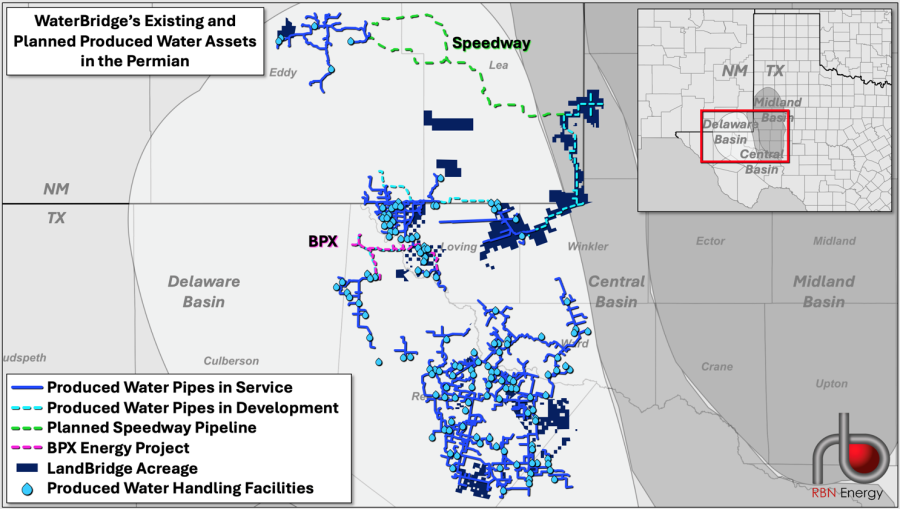
In the Permian, WaterBridge has more than 1,700 miles of produced water gathering and transmission pipelines (medium-blue lines in Figure 1 below) and more than 3.8 MMb/d of water-handling capacity at 160-plus facilities (SWDs, recycling plants, etc.; light-blue water drop icons). In January, NDB Midstream and WaterBridge Operating signed long-term agreements with BPX Energy — the U.S. onshore subsidiary of BP — under which the WaterBridge units will build and operate 400 Mb/d of new produced water handling capacity to support BPX’s ongoing development in the Stateline area, with the ability to increase that capacity to 600 Mb/d.
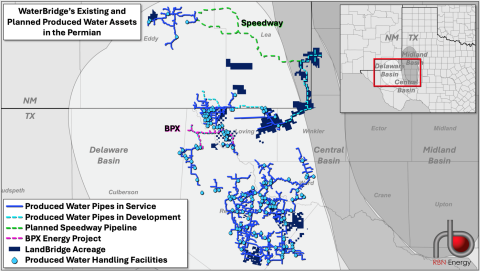
Figure 1. WaterBridge’s Existing and Planned Produced Water Assets in the Permian. Source: RBN