Chatbots
are becoming the go-to source for online answers for many consumers,
chipping away at the dominance of traditional web search and adding
another avenue of outreach that brands must cultivate to connect with
customers.
An
estimated 5.6% of U.S. search traffic on desktop browsers last month
went to an AI-powered large language model like ChatGPT or Perplexity,
according to Datos, a market intelligence firm that tracks web users’
behavior.
That pales beside the 94.4% that still went to traditional search engines like Alphabet’s Google or Microsoft’s
Bing, which have tried to fight off the new competition by adding
artificial intelligence summaries to the top of their search results.
But
the percentage of traffic that went to browser-based AI search has more
than doubled since June 2024, when it was 2.48%, according to Datos,
which is part of marketing software company Semrush. It has more than quadrupled since January 2024, when the figure was just under 1.3%.
From the first section of chapter four of The Story of Semiconductors by John Orton, c. 2004.
This is absolutely fascinating. It puts into perspective:
how far we've come; and,
how fast things are moving.
This was done quickly using a keyboard that has a "bad" n. I've tried to correct all the typographical errors but can't guarantee that all typographical errors have been corrected.
Note: below:
Ge: the semiconductor, germanium; and,
Si: the semiconductor, silicon.
Chapter 4: Silicon, Silicon, and yet more Silicon.
4.1 Precursor to the revolution
With
the crucial advantage of hindsight, we are very well aware of the sea
change consequent upon the invention of the transistor but it should not
really surprise us to learn that those struggling to come to terms with
it at the time were less readily persuaded.
Yes, it [the
transistor] was small and yes, it used far less power than the incumbent
device (the thermionic valve -- the vacuum tube) but there were
disadvantages too. There was the problem of excess noise and the
difficulty in producing devices which could amplify at high frequencies.
Needless to say, in its early days, the transistor was seen essentially
as a possible replacement for the valve -- many of the companies taking
part in its development were primarily valve (or, since they were
mainly American companies such as RCA, GE, Sylvania, and Philco, tube) companies whose main business was, and continued to be for some considerable time, either valves or tubes. [In American these were called "vacuum tubes"; in England they were called thermionic valves.]
It
is important to recognize that, though solid state circuity was
eventually to dominate the market, sales of valves did not even reach
their peak until 1957 and showed little sign of serious decline until
the late 1960s -- the transistor might be an exciting technical advance
but was not at all obvious that it represented a major commercial
investment.
The possible exceptions were the small start-up
companies, such as Texas Instruments (TI), Farichild, Hughes, or
Transitron, who carried none of the tube or valve baggage which
encumbered the larger companies but they were, by definition, small and
insignificant! They were, however, flexible and enterprising and it was
from them that many of the important innovations in semiconductor
technology were to come.
Technical innovation might be exciting and full to the brim with promise but, during the 1950s, the chief problem in transistor manufacture
was one of reproducibility. We have already touched on the difficulty
of controlling the base width in double-doped and alloyed structures
which had a direct and crucial effect on cut-off frequency but there was
the additional problem of encapsulation which frequently failed to
stabilize the device against atmospheric pollution.
Many
manufacturers were obliged ot divide their product into "bins"
containing high-grad devices which might sell for $20 apiece down to
run-of-the-mill (crumby?) specimens which they were lucky enough to
offload for 75 cents!
Only with the emergence of planar technology
could these problems be overcome -- and this process was not even
invented until 12 years after the point contact transistor.
And, needless to say, it took several more years to become widely accepted.
Nevertheless,
early transistors did find applications, first in hearing aids where
the low power requirement, low weight, and small volume were obvious
bonuses (though the excess noise associated with many devices could
hardly have been welcomed by users!) and in small portable radios -- the
ubiquitous "Transistor" which did more than anything to bring the word
into common usage. [This explains the "hearing aid" mania that began in the 60s and to some extent, continues.]
Again, it was on one of the small firms (TI)
which saw the opportunity and forged an arrangement with the Industrial
Development Engineering Associates (IDEA) to produce the "Regency TR1"
radio in October 1954. It was challenged, in the following year, by
Raytheon with its own model and subsequently by subsequently by numerous
others, including, significantly, Sony who later contributed to the
delight of youth (and the chagrin of the elderly!) with its highly
successful "Walkman" personal tape player.
Applications in car
radios followed soon afterward and, in spite of various sticky patches,
by the year 1960 there were some 30 US companies making transistors to a
total value of over $300 million (see Braun and Macdonald 1982: 76 -
77.)
Another area of application which attracted immediate
attention was that of computers. These were still in a very primitive
state of development during the 1950s -- analogue computers had been
used in radar systems as early as 1943 but the first general purpose
digital electronic coputer (ENIAC -- Electronic Numerical Integrator and
Calculator) was not built (at Penn State University) until 1946.
It filled a large room, used 18,000 valves and dissipated 150kW!
British
computing skills had been honed by code-breaking endeavours with the
Colossus machine during the Second World War (Colossus was first
introduced in 1943 and by the end of the war there were no less than 10
machines in use) and this experience was probably vital to the
development in Cambridge of a rival to ENICAC, known as EDSAC (Electronic
Digit Storage Automatic Calculator).
This appeared towards the
end of the 1940s, while the first transistorized computer was probably
the TRADIC developed by Bell for the US Army in 1954, employing 700
transistors and 10,000 Ge diodes (all hand-wired!), followed by a commercial computer from IBM, containing over 2,000 transistors, in the following year.
The
low dissipation and small physical size of the transistor gave it an
immediate advantage and its solid state construction offered hope of
much improved reliabiliyy -- however, it was initially limited in speed
by its relatively poorly controlled base width and once the decision to
use digital techniques became generally accepted, this took on a more
serious aspect because of the extra speed required for digital
processing (see Box 4.1).
Indeed, there was relatively little
enthusiasm for the long-term future of such machines -- a US survey at
the end of the 1940s suggested theat the likely national need
might be satisfied by about a hundred digital computers!
Such are the
perils of technological forecasting! In mitigation, one must accept that,
at that time, they [computers] were relatively expensive and ponderous
instruments.
While the commercial and consumer markets for
transistors and transistorized equipment were still in an uncertain
state, there could be little doubt of the seriousness of US military
interest.
Much military electronic equipment had either to be
portable, to be airborne, or to be attached to missiles where size,
weight, and ruggedness were at a premium. The transistor therefore came
as a heaven-sent opportunity to the military purchasing arm and, right
from the word "go," government finance for transistor development was
widely available -- indeed, there was more than a hint to suggest that
military backing kept the youthful transistor industry afloat during a
large part of the 1950s. [I was born in 1951; the history of the computer age and my life are almost exact contemporaries.]
Something between 35% ad 50% all US
annual semiconductor production was destined for military use during the
period 1955- 63 (Braun and Macdonald 1982: 80).
(It should be
remembered, too, that it was largely pressure from the military that led
to the early demise of Ge in favour of Si as the preferred transistor
material on the grounds of its much better resistance to thermal runaway).
Added to this came the decision by President Kennedy in
1961 to mount an intensive space programme, with the intention to "put a
man on the moon by 1970."
Once again, given the modest lifting
capability of current US rockets, weight was a vital factor and all
electronics must therefore be transistorized.
Ruggedness and reliability, too, were better served by solid state devices than by the older, relatively fragile vacuum tubes.
The
European industry, though technically well advanced, received only a
fraction of this level of support, and with inevitable consequences --
competition with America was, at best, patchy and generally
ineffective.
Nor was this state of affairs helped by some unfortunate technical planning.
An
unhappy example lies at the door of the British Post Office (then
responsible for telecommunications as well as mail delivery, see
Fransman 1995: 89 - 97).
When it became clear, after the Second
World War, that domestic and industrial demand for telephone services
was soon likely to escalate, the Post Office, in 1956, took the bold
decision dramatically to upgrade its telephone switching capabilities by
leapfrogging from the rather ancient mechanical switching technology
then in use to an advanced, digital " time division multiplexed" (TDM) system, employing fast electronic switches.
This
was designed to bypass the more modest technology the being
contemplated by most of their rivals, the crossbar switching system and
to give the United Kingdom an almost unassailable lead in this important
field.
It failed on account of the inadequacy of the components
then available -- a complete exchange was installed in Highgate Wood in
1962, only for it to succumb to excess heat from the 3,000 thermionic
values employed (see Chapuis and Joe 1990: 62).
At the time when the
decision was made to go ahead, the transistor was far too uncertain a
prospect (Ge devices were liable to thermal breakdown and Si had
scarcely had time assert itself -- it was, in any case, rather slow for
digital applications-- see Box 4.1) so the choice of an old, well tried
component technology was probably inevitable. (Even though this did
contrast with the boldness of the overall project aims!)
Success
with similar TDM switching systems had, in fact, to wait until 1970 when
suitable integrated circuits (IC) became available. What was worse from
the UK industry viewpoint was the resulting attempt to salvage
something from the ruins by reverting to he original mechanical
switching technology, thus robbing the Post Office suppliers of the
opportunity to develop intermediate switch technology, based on
transistors and (as they became available) integrated circuits. It was a
body blow for UK solid state device technology from which it never
quite recovered.
These references to integrated circuits
(ICs) serve to bring us back to our mainstream discussion of the
development of solid state active devices, for it was the invention of
the integrated circuit in 1958 - 9 which provide the jumping-point for
the real electronic revolution which still shows no sign of slowing. It
was clear to many, "wizz kids" of the 1950s that the transistor had the
potential for the development of large-scale, though compact, electronic
circuits, and several attempts were made to facilitate progress in this
direction.
However, it soon became apparent that there was a
limitation set by the necessary interconnections -- all of which
required individual attention with bonder or soldering iron -- and
several people began thinking of way to overcome this. The first public
proposal for integration has been credited to an Englishman, Geoffrey
Dummer of the Royal Radar Establishment (RRE, as then was) who presented
a conference paper in Washington in May 1952, and who, by 1957, has
persuaded the RRE management to fund a contract with the Plessey Company
to build a flip-flop circuit based on his ideas. This resulted in a
scale model which seems to have created considerable interest among
American scientists but very little excitement within the United
Kingdom! In fact, it was at TI in September 1958 that Jack Kilby first
built an actual circuit in the form of a phase-shift oscillator. It used
Ge, rather than Si because, at the time, Kilby could not lay hands on a
suitable Si crystal and it employed external connecting wires
individually bonded to the components but it demonstrated the use of the
bulk Ge resistance to form resistors and a diffused p-n junction
diode to provide capacitance -- there was no need to add these
functions by hanging discrete components onto the semiconductor circuit.
As a demonstration of the integration principle, it may be likened to
the point contact transistor -- a huge step forward but some way from
commercial viability.
The practical breakthrough came from
Fairchild Semiconductors in the following year, in the form of a patent
application by Robert Noyce claiming a method of making an integrated
circuit using the Si planar process and forming the necessary
interconnections by evaporating metallic films and defining them by
photolithography. This was surely the practical way to go but it was
nearly 2 years (March 1961) before Fairchild made their first working
circuits based on these principles, closely followed by Texas in October
1961. These two companies were serious rivals, not only with regard to
IC manufacture -- a titanic patent battle, also ensured over the
question of priority in the basic invention (see the stimulating account
given in Reid 2001). It took nearly 11 years of legal jousting [think Charles Dickens, Bleak House] before
the Court of Customs and Patents Appeals finally adjudicated in favour
of Fairchild -- Robert Noyce was officially declared the inventor of the
microchip! Not that it mattered very much -- by that time the world of
chips had moved on to such a degree that the issue had become of little
more than academic interest and, in any case, the two protagonists Kilby
and Noyce were, on a personal basis, more than happy to share the
credit. In the year 2000, Kilby was awarded a half share in the Nobel
prize and, doubtless Noyce would have joined him had he not died some 10
years earlier. That it should have taken the Nobel Committee more than
40 years to acknowledge a technical development of this magntude must
be seen as both remarkable in itself and sad in the extreme in that it
prevented Noyce from receiving his rightful share of the honour.
So
prodigious have been the ramifications of their invention that one is
somewhat taken aback to learn of the initial lack of interest shown by
equipment manufacturers in these early circuits. The problem was that
they were too expensive -- it was actually cheaper to build the same
circuit from individual component, hard-wired together, than to buy the
appropriate integrated version from TI or Fairchild. Sales were minimal.
Stalemate!
That was until May 1961 when President Kennedy threw down
his famous challenge that America should put a man on the moon by the
end of the decade. Almost immediately it became clear that the required
rocket guidance would demand highly sophisticated computer technology
and that such advanced circuity could only be realized in integrated
form. Hang the expense -- this was the only way to go! Such a dramatic
kick-start to a technological revolution smacked of divine intervention
by a Higher Being with an unfair interest in the fledgling US chip
industry -- certainly no other country ever received a comparable boost.
The result was demonstrated by the number of ICs sold: in 1963 the
number was a mere 500,000, by 1966 it had risen to 32 million.
Government
spending may have been the vital stimulus but the importance of
diversification was quickly appreciated. Jack Kilby was put to work at
TI to develop a revolutionary consumer product in the shape of a pocket
calculator which appeared in1971. No fewer than 5 million calculators
were sold in 1972. At the same time the digital watch made its
appearance took the consumer market by storm. Ted Hoff of Intel
developed the first microprocessor also in 1971 and the first personal
computer (PC) followed in 1975 in the form of a Popular Electronics kit!
The revolution was well and truly launched and the industry has hardly
cast a backward glance.
Progress in increasing complexity of integrated
circuits has shown a quite remarkable steadiness -- in 1965 Gordon Moore
(a physical chemist working in Noyce's group at Fairchild) made his
famous pronouncement which came to be known as "Moore's Law," that the
number of components on an IC would continue to double every year and
such has almost been the case. A careful examination of the data up to
1997 suggests that the annual increase is actually closer to a factor of
about 1.6 but the really striking feature is its long-term consistency,
encouraging confident prediction for future increases, at least as far
as the end of the first decade of the new millennium.
Solid state
circuitry has gone from "small scale integration" (SSI, up to 20 "gates"
in the 1960s to "medium scale integration" (MSI, 20 - 200 gates) at the
of the 1960s through "large scale integration" (LSI, 5,000 - 1000,000
gates) in the 1980s and what might be called "ultra large scale
integration" (ULSI, 100,000 - 10 million gates) by the end of the 1990s.
Moore himself, continued to play a role in these developments --
together with Robert Noyce, he left Fairchild in 1966 to found Intel
whose sales rose from $2,700 in 1968 to $60 million in 1973 and in the
year 2000 to $32 billion. The basis of this performance has, of course,
been the steady decrease in size of the component transistors and
we shall look in more detail at this anon. However, we must first
bactrack to examine another important breakthrough, the development, at
last, of a real field effect transistor (FET).
Disclaimer: this is not an investment site. This is meant for one reader who asked about the market and Chord somehow came up in the discussion. So, it's simply a note with regard to a specific issue; it is not a recommendation for investing.
Background: in a sidebar discussion (via e-mail) with a reader earlier this morning, Chord Energy came up in discussion.
I asked ChatGPT to provide a list of the top producers in the North Dakota Bakken. The first reply was incredibly wrong and I pointed out to ChatGPT that Chord Energy now has three wholly-owned subsidiaries: Oasis, Whiting, and Enerplus. With that information, I asked ChatGPT to re-run the data.
The second answer from ChatGPT failed to note that Grayson Mill was acquired by Devon Energy, so I had to ask a third time, point that out. This is the third "run" by ChatGPT with regard to this query.
So, I cannot vouch for the accuracy of what follows, but here is ChatGPT's list of top Bakken producers, North Dakota, 2024 - 2025. My hunch: it's based on a combination of current and old information and may not be completely accurate:
net acreage: 1.3 million acres; 98% in North Dakota; balance not mentioned but probably Montana
"now the largest operator by far in the region thanks to the Enerplus acquisition and prior merger between Oasis and Whiting"
it's my understanding that royalties from Chord now come from three entities: Chord-Oasis; Chord-Whiting; and Chord-Enerplus.
2. Devon Energy (acquired Grayson Mill):
estimated production: 150,000 boepd
net acres: 430,000
3. CLR:
estimated production: 140,000 boepd
net acreage: 1.14 million acres
this information may have been acquired when CLR was a publicly traded company, which was several years ago;
not sure how ChatGPT would have access to this information if CLR chose not to report it somewhere
4. Chevron (via Hess):
estimated production: 208,000 boepd from acquired Hess operations
net acreage: 465,000 acres in the Bakken following acquisition of Hess
5. ExxonMobil (XTO Energy):
production: 100,000 boepd though it has sold portions of its Bakken assets
net mineral acreage: 515,000 acres
6. EOG:
producing: less than 100,000 estimated;
net acreage: 231,000 net acres in the Bakken
It took three attempts with ChatGPT to get this information; I assume the information is fairly accurate but with so many errors by ChatGPT the first two times (and major errors) one wonders.
Thinking out loud / rambling: I owned shares in Chord Energy for awhile after it acquired Oasis but then sold all my shares in Chord when it acquired Whiting. I always felt that Enerplus was the best of the three (Oasis, Whiting, and Enerplus.
In the sidebar discussion with the reader I mentioned that I wish I still owned Chord but I am now so heavily weighted in oil I simply can't afford to have any more energy in my portfolio. However, paying a dividend of 7%; having a P/E of 7;and, being the top producer in the Bakken, Chord is looking pretty good (within the oil sector). I will raise cash (I'm always fully invested) by selling a dividend-paying ETF and substitute that ETF for Chord. I would still be looking at Chord as a takeover target.
That still leaves me with too much energy in my portfolio, so over the next few days / weeks, I will see if there's an energy position I can sell to offset any Chord I might buy.
If that makes sense.
Not mentioned by ChatGPT in this thread, when specifically asked, ChatGPT says Phoenix Operating (Phoenix Capital Group --> Phoenix Energy) is the seventeenth largest operator in the North Dakota (and Montana) Bakken:
launched in late 2023;
by mid-2024, already ranked as the 17th most prolific operator in the Williston Basin
25,000 boepd; 18,500 bopd
focusing on:
ultra-fast drilling;
set records in 2H2024 by drilling three-mile Bakken laterals in under 6.5 days, breaking the basin's historical pace
Phoenix Capital Group rebranded as Phoenix Energy reflecting its shift from merely a mineral acquirer (like NOG?) to a vertically integrated energy firm engaged in production, minerals, and non-operated interests across major US basins.
Being announced now: the US-Malaysia trade deal. This was a huge success for the US.
WBNA: we now know how much Caitlin Clark "adds" to the WBNA.
Viewership of this year's WNBA all-star game dipped a whopping 36% from last year.
Last year, Caitlyn Clark played; this year, Caitlin Clark was on the bench due to a groin injury. Sort of takes away from the shirt the WBNA players were wearing: pay us what we are worth. Better? Pay Caitlin Clark what she's worth. LOL.
WBNA: the league would do well to protect their franchise players from injuries just as the NFL protects their quarterbacks.
Today's market, AI:
there is some suggestion that the cash burn being experienced by AI companies may be accelerating, resulting in a pullback in stock prices.
******************************* Back to the Bakken
Director's Cut, released July 22, 2025: data for May, 2025. Link here (won't open in Firefox).
oil production:
May: 1,112,790 bopd
April: 1,173,319 bopd
natural gas production:
May: 3.355 BCF/day
April: 3.4671 BCF/day
Today's daily activity report:
WTI: $66.36.
Active rigs: 32.
Four new permits, #42149 - #42152, inclusive:
Operator: Whiting
Field: Foreman Butte (McKenzie County)
Comments:
Whiting has permits for four Toonie wells, lot 1 and NENW 18-150-101;
to be sited 333 / 370 FNL and 1192 / 1284 FWL.
Six permits renewed:
BR (2): two Sandie permits, Elidah oil field, McKenzie County;
Lime Rock Resources (2); two Reuben Schneider permits, Fayette oil field, Dunn County;
Enerplus: one Spoiler permit and one London permit, the former in South Fork oil field; the latter in Moccasin Creek; both in Dunn County;
Two permits canceled:
Formentera Operations: a Maverick permit and an FTH permit canceled; both in Burke County;
But again, the headline is so unhelpful. Profit shrinks $1.1 billion -- so, what is that in context? What's the denominator. ChatGPT will provide me the story in a nanosecond with the prompt: GM's second quarter 2025 earnings and what does that mea.
Stargate: oh, oh. Exclusive in The WSJ. I track Stargate here.
Stargate struggling. This story may have legs, or it's simply one
should expect in a $500-billion start-up with individuals at the top
with strong personalities.
Today:
CNBC: OpenAI expands Oracle data center deal; says parts of Stargate 1 in Texas are operational
it was also a huge story streaming on CNBC this morning
"all" the tech stocks are down today: CNBC discussed but it was mostly blah, blah, blah
Inside Monkey: a stand-alone story on Oracle and Jim Cramer -- "almost Palantir like."
Tech: I've suggested before that Oracle is the poor man's Palantir. This certainly suggests this could be correct. Link here.
Bottom line:
I added to my position in Oracle today;
note: when I say "my" position, that is a "figure of speech." I'm literally moving money from my estate / portfolios to those of our five grandchilden.
in this case, the new shares in Oracle are going to the three youngest grandchildren
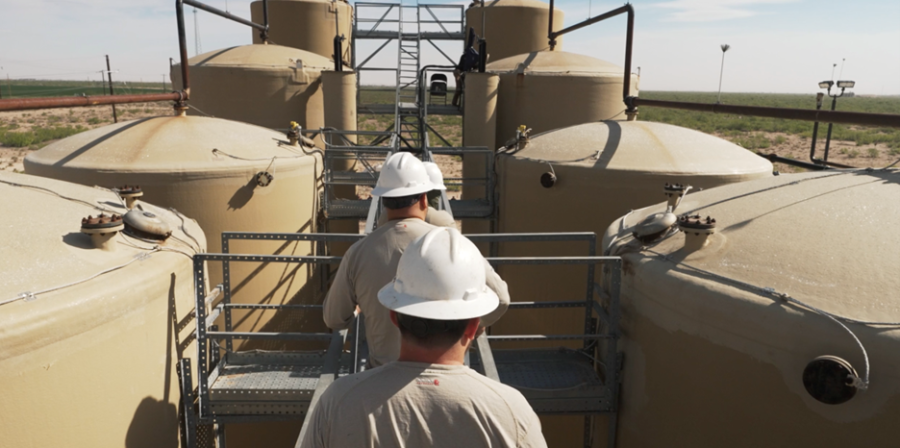
There’s a lot going on in the Permian produced water space lately.
Crude-oil-focused production in the prolific shale play is generating
vast and increasing volumes of produced water that needs to be recycled
or injected into disposal wells. State regulators, concerned about
injection-related seismic activity, are tightening their rules, ramping
up oversight and cracking down. Produced water gathering systems are
being expanded and long-distance pipelines are being planned and built.
In today’s RBN blog, we discuss the latest developments and where things
are heading.
We took our first deep dive (so to speak) into produced water way back in 2017 in Wipe Out!.
There we explained that, in addition to producing large amounts of
crude oil and associated gas, Permian wells also generate massive
volumes of produced water — collectively, many millions of barrels a day
of water that is chock-full of petroleum residue, minerals and
especially salt (which makes it brine) and that must be dealt with
either by the producer or (more likely nowadays) a third-party produced
water specialist. We noted that the produced water disposal problem is
nothing new; a lot of water has always come along with oil and gas out
of a well. A hundred years ago, E&Ps disposed of the produced water
simply by pumping it back into the same formation it came from. That
approach made the water-disposal problem go away, and sometimes it
actually improved well performance –– the water increased pressures at
the bottom of the well and drove more oil into the well bore and up to
the surface, hence initiating some of the first enhanced oil recovery (EOR) techniques.
By
the early 1970s, wastewater of all sorts was being disposed of by
pumping it underground, not only from oil and gas operations, but from
all sorts of industrial activity. Addressing public concerns at the
time, the Safe Drinking Water Act of 1974 mandated that the
Environmental Protection Agency (EPA) establish rules for wells used for
any wastewater disposal, which became known as the Underground
Injection Control (UIC) program. That program designated five
classifications of underground disposal wells, of which oilfield
produced water wells were designated Class II wells — and often referred
to as saltwater disposal wells, or SWDs. Over the ensuing decades, tens
of thousands of Class II wells were drilled and used to dispose of
produced water from conventional wells, with much of the water pumped
back into the very same formation the oil came from, just like in the
early years of the industry. The conventional reservoirs were permeable
enough to absorb the produced water being pumped back into them.