The graphic speaks just the opposite -- the lead-up to the energy crisis in Europe had nothing to do with the United States .... wow, talk about misinterpreting data ....

The graphic speaks just the opposite -- the lead-up to the energy crisis in Europe had nothing to do with the United States .... wow, talk about misinterpreting data ....

Wow, the Europeans will pay more for eight hours of electricity than I pay in a month. What a great country! Thank you, Brandon!


A reader sent me an interesting energy article from the current issue of Foreign Affairs, January/February 2022. . The writers at the linked article look at the curent global energy picture through the lens of global warming; atmospheric CO2; and, renewable energy.
However, if one reads the article through the lens of US energy dominance one reads a completely different story.
I haven't read the article closely; I've scanned through it and read it more closely later. But I'm beginning to wonder: perhaps it no longer matter through what lens we read these types of articles.
For Europe, their Plan A, now that they have shut down their nuclear plants and coal mines, is renewable energy. Europe and the UK have no Plan B, although the UK is talking about hydrogen power. But to my hydrogen, takes a lot of electricity.
For America, we have Plan A, Plan B, Plan C, and so on.
From December 2, 2021, just two days ago: "The US to become energy dominant ...."
Bottom line: no matter how you view it, or through which lens you are watching, the energy gap between the US and Europe is going to keep widening.
By the way, it's interesting to see that we said the same thing back in 2013 -- eight year ago.
Winter: Americans forget that cold weather hits Europe up to two months before it hits the US.
Ukraine: is it already running out of energy; and it's not even December, yet? Link here.
UK: another UK energy retailer goes bust; Javier Blas has lost count of how many have gone bust. This time is CNG which supplied 41,000 businesses. Link here. I believe we are well into double-digit the number of electricity providers in the US that have gone bust due to high cost of natural gas.
EU: woke. Slowly, than all at once, the world is waking up to the absurdity of wind and solar "LCOE" cost -- reliability matters in the real world. Link here.
Okay, here's the count: at the start of the year, the UK had 47 domestic natural gas and electricity retailers. Today, that has fallen by nearly half with only 25 suppliers remaining. Link here.
Equinor: spiking its natural gas output with butane and propane (which normally are split and sold separately), another example of whatever-it-takes to boost supply to Europe. Link here.
Here we go: Dallas Cowboys vs Minnesota Vikings -- tomorrow night, Sunday night football.
Sports tonight;
Dear John: apparently union reaches deal with John Deere. Needs to be fact-checked.
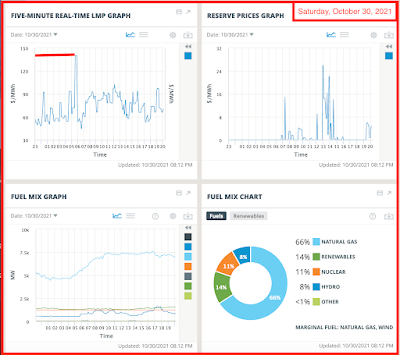
ISO NE: link here -- a spike to $135 / MWh early this morning.
Weather:

Covid vaccine rollout:
Influenza surveillance, US: negligible.
Updates
October 25, 2021: right on cue, CNBC is now talking about a "warmer" winter. LOL. When I was growing up in North Dakota, it was difficult to tell the difference between -40°F and -42°F during the month of February.
Original Post
Sophia and I are tracking the global energy crisis, 2021 - 2022, at this site.
News tonight: a colder winter threatens to worse Asia's energy crisis.
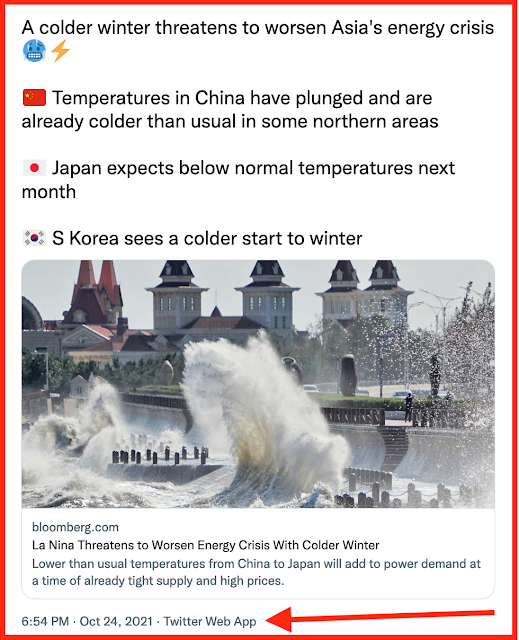
Right now, there is a segment of the media that is primed to talk about the energy crisis this winter. "Everyone" agrees that if this winter is "colder than normal," there will be a crisis of historic proportions.
I think that's all wrong.
The facts are:
So, I think it's all wrong to suggest / imply that only if we have a colder winter than usual there will be a crisis of historic proportions.
Just "having winter" will be enough to cause huge problems. I guess the only question is when do the problems "really" begin? In November, or December? Or in January or February?
The Farmers' Almanac, by the way, doesn't see a particularly unusual winter. I suppose, looking at the map, The Farmers' Almanac suggests the winter in general will be typically cold, perhaps worse than usual over the Great Plains, extending into Texas. But nowhere does the Almanac suggest warmer than usual.
On top of that, as noted above, the media is primed to start reporting those stories, so even typical winter events, typical winter temperatures are likely to result in "the sky is falling" reporting. And unlike really hot weather, really cold weather -- especially with lots of snow -- provides great video for the evening network news programs.
Already, as noted above, we have China, Japan and South Korea already anticipating colder weather sooner.
I think this will be fascinating to watch.
If there is no new Covid-19 surge, one might see "ice age" stories take Covid-19 off the front page.
*****************************
The Day Of The Dead
One of the fastest-growing -- perhaps the fastest-growing -- fiestas in the United States right now.

Winter
Winter, 2021 - 2022: increasing number of reports suggest a warm October will be followed by a brutal winter.
***************************
Natural Gas
UK: natural gas prices at the UK's NBP hub for delivery in the core winter months are at their steepest premium to nearby markets in 15 years, reflecting heightened supply security concerns. Or do they reflect the weather forecast by the Farmer's Almanac?
Google: US natural gas production as a percent of global production. Around 25% currently. Reuters sees huge growth in 2022. Link here. But look at this from the IEA, July 18, 2017.
Flashback: 2019, Forbes, BP's 2019 review, production and consumption of natural gas.
BP, 2020 in review: natural gas consumption decreased by 2.3%, similar to the fall seen in 2009 during the financial crisis. Despite the reduction in absolute levels of gas demand, the share of gas in primary energy continued to rise, reaching a record high of 24.7%.
Wildcard: Resident Biden could upset natural gas momentum. Forbes, September 9, 2021.
A fool's errand: to predict fossil fuel prices. TotalEnergies: natural gas price spike unlikely to be sustained. The natural gas spike, apparently, is simply transitory. A great article for the archives.
TED: I have not watched this video; I probably won't. From the review, it suggests TED has really let us down this time.
Preaching to the choir (it is Sunday morning, after all): the Wreck of the Global Warming Narrative .. the global warming scare is more than three decades old, yet the disaster that's been forecast on a nearly daily basis since the late 1980s has yet to arrive. Meanwhile, Antarctica recorded coldest winter in recorded history.
In land area, Indonesia is smaller than Denmark. Hold that thought.
Countries strongly dependent upon coal, ZeroHedge:

Oil: meanwhile the stories keep coming in -- shortage of crude oil; end-of-year crude oil could see $90-Brent; $87-WTI. With WTI at $84 yesterday, I don't see a lot of difference between yesterday's price and end-of-year price as forecast by Goldman's Jeff Curie. Remember: whether or not guys like Jeff Curie are right or wrong, folks make decisions based on their estimates.
***************************
Americans on the Move
Moving company, Mayflower, data:
******************************
Lana Del Rey
Eighth album: Blue Bannisters.
Apparently just released.
Full album is already on YouTube.
Her fans are incredible.
Updates
October 24, 2021: winter and natural gas wrap for the day. One day later, right on schedule: CNBC talks about a "warmer" winter.
October 19, 2021: America, specifically the US.
Original Post
Energy crisis: everything leads back to coal, a subject no one really wants to discuss. Everyone knows that what's going on in coal right now suggests huge policy failures over the past decade. There are currently three energy crises and each has its own unique beginning.
The three energy crises:
The 2021 - 2022 US energy crisis is all about the price of gasoline and electricity.
Poster child:
Updates
October 19, 2021: this is something I had not seen before.
Original Post
Energy crisis: everything leads back to coal, a subject no one really wants to discuss. Everyone knows that what's going on in coal right now suggests huge policy failures over the past decade. There are currently three energy crises and each has its own unique beginning.
The three energy crises:
Updates
October 19, 2021:
Original Post
Energy crisis: everything leads back to coal, a subject no one really wants to discuss. Everyone knows that what's going on in coal right now suggests huge policy failures over the past decade. There are currently three energy crises and each has its own unique beginning.
The three energy crises:
It seems that story is being reported / repeated more and more. That post linked to Simon Watkins.
Now, this from Alex Kimani: how much oil can OPEC realistically add? For Alex:
China and LNG: link to Tsvetana Paraskova -- China seeks long-term US LNG supply amid energy crisis.
Several Chinese energy giants have intensified discussions with U.S. liquefied natural gas (LNG) exporters to secure long-term supply deals in light of record spot prices in Asia, rising demand, and the specter of power shortages.
China and many other energy importers in Asia are scrambling to procure gas and coal supplies ahead of the winter amid a global energy crunch. The higher demand after the pandemic and the muted supply response have sent China’s coal futures and Asia’s LNG spot prices to record highs in recent days.
Threatened with power outages, China is now looking to secure long-term U.S. LNG supplies, despite the tense bilateral relations and the trade spat. Long-term deals would also protect buyers from spikes in spot LNG prices, which the market is seeing these days.
At least five major Chinese energy firms, including China National Offshore Oil Company (CNOOC) and Sinopec, are in advanced discussions for long-term LNG deliveries with American suppliers including Cheniere Energy and Venture Global.
Hey, Greta: coal generation in UK jumps as wind speed drops. Link to Charles Kennedy.
Coal met some 3 percent of the UK’s electricity demand on Friday morning, reaching its highest level of Britain’s power generation in one month, amid lower wind speeds this week and an outage at a gas-powered plant.The last time the UK generated 3 percent of its electricity from coal was in early September when low wind generation reduced renewable power supply and triggered the massive spikes in UK wholesale electricity prices.
Utility Uniper fired up its coal-powered plant in Ratcliffe early on Friday, while the gas-fired plant in Pembroke, Wales, operated by RWE, suffered an unplanned outage.
Over the past week, gas has consistently accounted for the largest share of the UK’s electricity generation, according to data from National Grid ESO. For example, on Wednesday, gas produced 44.8 percent of Britain’s electricity, more than wind with 19.2 percent and nuclear with 12.6 percent.
Surging natural gas prices and warm and still weather in September forced the UK to fire up an old coal plant that was on standby in order to meet its electricity demand.
Germany: new administration says Germany will exit coal in 2030, eight years earlier than expected. US LNG companies will bank money. Link here.
Space poll:
New poll: when we last posted WTI it was trading above $82. Jim Cramer said WTI has peaked. Quick poll: will WTI trend lower (by at least a dollar) on Monday?
Big things are happening in Europe, UK in response to the crisis.
Two issues, and they appear completely separate.
Natural gas.
Gasoline.
They are related but we can dispense with the UK gasoline crisis for the moment. This was how it played out:
Okay, now natural gas. This is a bigger problem for the Brits and even with a warm winter, the UK could be in big, big trouble. One would hope BoJo is coordinating with JoBid to get LNG shipments prioritized to the UK, not Asia. [There are reports saying that will not happen.]
This is not a story about Russia. Wow, that gets tiresome.
This started with the "Angela Merkels" years ago when faux environmentalists started shutting down coal plants (2000) and nuclear reactors (Fukishima, 2011). It's ironic how it happened. Shutting down coal plants would not have been a disaster had there been no problem with nuclear plants, but that all changed, for Germany, with Fukishima. For Germany, coal was their Plan A. Nuclear plants, their Plan B.
The UK had no Plan B. One could say the same thing for the UK, except instead of shutting down nuclear reactors in response to Fukishima they simply increased reliance on wind.
And it was the "wind issue" that brought the UK to its knees most recently.
Well, to some extent. I don't believe it was simply the wind.
A gedankenexperiment:
Imagine what would happen in the US if for whatever reason, Resident Biden shut down the Permian. Just shut it down. Things were reversed in the US. Plan A was oil from Canada via the Keystone XL. There was no Plan B because no Plan B was needed. Oil was more than plentiful in Canada and no one in their right mind ever thought any US president would shut down a simple pipeline.
Fortunately for America, Mark Papa (EOG) and Harold Hamm (CLR) came up with a Plan B before it was even needed; pure serendipity. In fact, Plan B, light oil was not what the refiners along the Gulf coast needed. They were optimized for heavy oil.
So, with the loss of the Keystone X, Plan A: not a big deal but unpleasant for the oil industry, especially the refiners, and ultimately those who buy gasoline for their automobiles, like you and me.
So, now with the loss of the Keystone XL, imagine Resident Biden shutting down the Permian.
That's exactly what happened in Europe with regard to natural gas. And no one is talking about it. Until today, interestingly enough, and I will provide the link later. Actually there are two links but I can't find one of them now. Not to worry. By the end of the week, there will be many links, many stories.
The US did not shut down the Permian. But the Dutch shut down "the" Groningen, the largest natural gas field in Europe. Made the decision based on risk of earthquakes. Europe's Plan B: like Keystone XL from Canade, Europe's Plan B was Nord Stream 2 from Russia.
The problem: Americans like Trump did not like Nord Stream 2. I have no idea what drove that: knee-jerk politics, or well-founded national security issues.
So, whereas Americans did not have a Plan B if the Keystone XL did not materialize, Mark Papa and Harold Hamm pre-empted any serious problems for the US.
But not the Europeans. It was just the reverse. They closed the Groningen (Plan A) knowing Nord Stream 2 (Plan B) was coming down the pike.
While editing this, a reader wrote to remind that there even more to the story. The reader reminded me that at the time the Groningen decision was being made there is/was another copious energy supply that was stillborn ... the project to frac the Bowland Basin shale.
A company named Cuadrilla not only drilled a horizontal well 3 years ago, they were able to frac about 5 stages.The preposterous restrictions placed upon the company included not exceeding a .5 (point 5) reading on the Richter scale during the fracturing process. (For context, rambunctious football fans regulary produce Richter readings of 2 when stomping their feet. As the Richter scale is algorithmic, that 2 is something like 30/40 times more prominent than the acceptable .5).Combining both the known Bowland and Weald Basin shale gas resources, the UK possesses about a 80 to 100 year supply of natgas beneath their feet.
For Cuadrilla, this was just what the DAPL operators experienced: experiencing harassment at the very time recognizing how acute the need for natural gas.
But, as usual, there's even more.
Folks are blaming the Russians.
Nope, nothing could be farther from the truth.
First, the timing and the geopolitics. Why would Russia risk being exposed to "cheating" at the very time they are trying to get this thing approved by Europe and by the US?
Second, there are many, many indications that Russia itself is reaching the limits of its production. That has been addressed at the blog on number occasions over the past ten years. Russia is facing a very, very cold winter (again, nothing new).
Link here, but this article appeared after I drafted the above. Cyril Widdershoven is one of my favorite contributors over at Oilprice.com.