Locator: 50836B.
Google Gemini / Spark AI introduced.
Qeshm Island: explosions heard overnight. Mum's the word.
WTI: spikes to $108.80 mid-morning. Later, $107.70. CVX up $2.70 today; trading at $197.06/
****************************************
Back to the Bakken
WTI: $103.30, but there are reports that WTI has hit $107.10 overnight.
New wells reporting:
- Tuesday, May 19, 2026: 48 for the month, 148 for the quarter, 305 for the year,
- 42030, conf, Kraken, Dwyer East LE 2-36-26 11H,
- 41750, conf, KODA Resources, Stout 1301-1BH,
- 19795, conf, Devon Energy, Johnson 150-99-34-27-1H,
- Monday, May 18, 2026: 45 for the month, 145 for the quarter, 302 for the year,
- 41956, conf, Kraken, Dwyer East 26-35 8H,
RBN Energy: After years of declining interest, the Anadarko is now an M&A hotbed. Link here. Archived.
The
prospect of procuring steady-as-she-goes production assets at
reasonable prices has been spurring interest in the sprawling Anadarko
Basin. In just the past few weeks, two privately held producers closed
on deals totaling more than $4 billion, and earlier this month, publicly
held Diversified Energy — in partnership with Carlyle Group, the global
investment firm — announced an agreement to buy a big set of assets
from Camino Natural Resources for nearly $1.2 billion. In today’s RBN
blog, we discuss the big-money M&A happening in the Anadarko and the
drivers behind it.
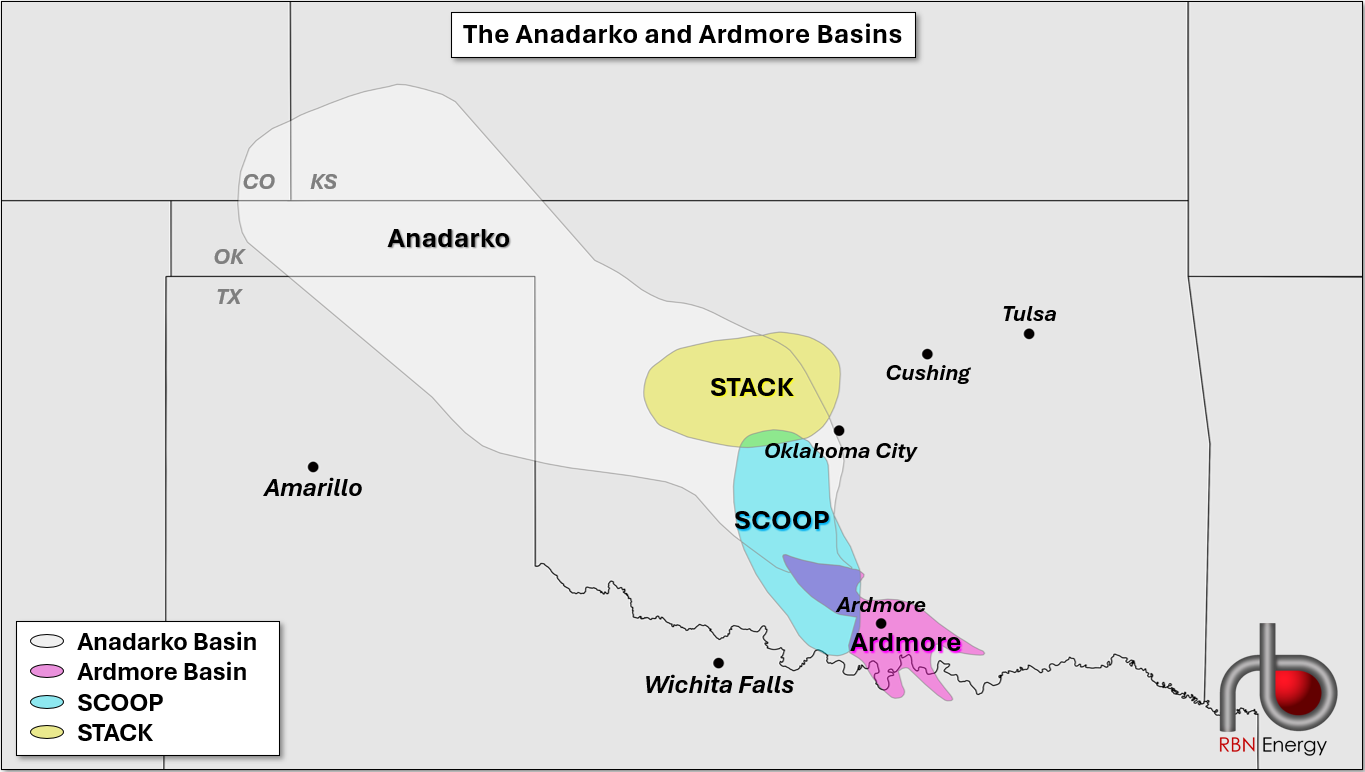
The 50,000-square-mile Anadarko
Basin, which is centered in western Oklahoma but extends into the Texas
Panhandle and western Kansas, has seen its ups and downs during the
Shale Era. Back in the early-to-mid 2010s — after the booms in the
Bakken and the Eagle Ford, and before the Permian took (and held) the
spotlight — it seemed for a moment that all eyes were on the Anadarko’s SCOOP/STACK
(see Figure 1 below; we’ll make brief mention of the adjoining Ardmore
Basin in Part 2). Production from horizontal wells in the Anadarko
continued rising through 2019, with crude oil output peaking at about
500 Mb/d and natural gas production approaching 7 Bcf/d.
But
a combination of the Covid shock and better rock (and economics)
elsewhere — especially the Permian — took the wind out of the Anadarko’s
sails; so did the determination there was “pressure communication”
between the STACK’s Meramec
and Woodford formations, complicating development there. (Put simply,
pressure communication means that wells in one formation are interfering
with the other rather than behaving independently — a bad thing.)
E&Ps in the play ratcheted down their Oklahoma capex; production
sagged and then plateaued at less-impressive levels: about 300 Mb/d of
oil and 5 to 5.5 Bcf/d of gas in recent years.