Showing posts with label California. Show all posts

Saturday, August 30, 2025

California To Temporarily Set Aside Penalties For Excessive Refining Profits -- Released Well After News Cycle Ended Friday Night -- August 30, 2025

Locator: 48995CA. 

Behind a paywall, link here, and archived:

HOUSTON, Aug 29 (Reuters) - California's Energy Commission voted on Friday to temporarily set aside penalties for excessive refining profits that were adopted after gasoline pump prices climbed over $8 a gallon in 2022.

The five-year delay in implementing the penalties comes as Phillips 66's Los Angeles refinery is preparing to begin shutting production as early as next week ahead of a permanent closure.

The fact is, supply is declining faster than demand, and we need to bring them into alignment: that means slowing supply loss while aggressively pursuing the transition to zero emission vehicles," the Commission's staff said in an emailed statement. [So far, there is no Plan B to slow supply loss in California, according to ChatGPT.]

California's Democratic Governor Gavin Newsom had proposed the penalties, but has since switched direction amid worries of price spikes in 2026 after the closure of the Phillips 66 refinery and a San Francisco-area plant operated by Valero Energy Corp next year.
Coincidentally, this blog was posted about twelve hours earlier, link here.

California refiners: link here

Phillips 66 on track to shut down its California refinery as scheduled, or perhaps slightly ahead of schedule. No talk yet of who might buy it. ChatGPT says there are no reports of anyone looking to buy this refinery, and the state of California seems to be caught flat-footed on this development though it was announced years ago; California was very, very aware of this closure; but, failed to come up with a Plan B, except to import refined products.

Flashback to 2022

In 2022, California gasoline prices saw significant increases, driven by events like the Russia-Ukraine war.
Prices reached historic highs, averaging $5.89 a gallon in the summer of 2022, with some counties seeing prices over $6.
The surge in California prices occurred alongside record-breaking national averages, with the U.S. average reaching $4.25 per gallon in March 2022.
In Oregon, it was not much better.
In 2022, average gas prices in Oregon peaked around $5.55 per gallon in June and remained high, with an average of $5.14 in late September before dipping slightly by year-end, although overall prices were consistently above the national average.
These elevated prices were driven by high demand, supply constraints from West Coast refinery issues, and limited crude oil transportation options like pipelines.

PSX ticker:

Wednesday, April 23, 2025

California: Valero Plans To Shut Down Or Significantly Reduce Its Larger Refinery In Northern California By The End Of April, 2026 -- April 23, 2025

Locator: 48491CALIFORNIA.

 Updates

April 26, 2025: WSJ opinion. Waste of ink.

Original Post

Link here

Link here: https://www.foxnews.com/politics/gop-lawmaker-warns-likely-move-blue-state-will-make-gas-prices-skyrocket. You will have to "cut and paste" that link.


This is a fascinating story. I will come back to this story later if I have the energy.

To put this in perspective: 

And this:

At best, this will only result in an increase in the price of gasoline in California. My hunch: if necessary, the state of California will allow another operator to come in to operate the refinery.

Critical mass:

The loss of refinery capacity in the state of California is a fascinating one. Social media has no clue.

My not-ready-for-prime-time initial thoughts on the news yesterday that Valero was going to close its large refinery in northern California in early 2026. I sent this to the reader who sent me the link to the story in the first place:

This is an incredibly fascinating story. There’s a phenomenon in math/physics — the phenomenon of critical mass — and we see it in many instances, including nuclear weapons. LOL.
But, for me, the best example is a brain tumor. The brain is encased in a non-expandable skull, unlike the abdomen. An abdominal mass can grow to an unbelievable size and won’t cause any problem simply due to its size. A brain tumor is completely different. It can grow in size to a very limited extent, often resulting in no signs or symptoms whatsoever, before it reaches critical mass and the individual literally goes into a coma, seizes, or dies in a space of hours, without immediate surgical relief of that intracranial pressure. 

Likewise, a significant shortage of gasoline occurring in a very short period of time, in a state already with the highest gasoline prices in the United States, won’t simply result in a gradual increase in price. Early on it will be obvious there’s a shortage of gasoline when service stations don’t receive their usual allotment. It will start with the small independents, first in the rural areas and the quickly in the large cities. One will start to see plastic bags placed on gasoline pump nozzles with "out of order" advisories. At that point, it’s over. Panic will set in. People will keep their gas tanks full, exacerbating the situation. 

All things being equal, if nothing changes between now and the refinery closure I give California one month before it becomes an unimaginable state — and then a national — emergency. 

Gasoline will be rationed and California will be back to gas lines. Focusing on the price of gasoline is the wrong metric. It won’t be price; it will be panic.

I don’t think California has the port facilities necessary to import that much gasoline.

**************************
In Other California News

San Francisco Centre is a ghost town. Link here. Link here.

Price of gasoline in California: link here.

Phillips 66 will cease operations at its refinery in Los Angelese this year. Link here.

****************************
Fortunately Everyone In California Has An EV


**********************
More From California

Oscar Eduardo Ortega-Anguiano, 43, was driving drunk, high, and speeding at nearly 100mph on the 405 freeway in Orange County in November 2021, when he crashed into a car being driven by a young couple, 19-year-olds Anya Varfolomeev and Nicholay Osokin, killing them both as they burned alive.
  • illegal immigrant who already has been deported twice is going to be released again 
  • in 2022, OEOA was convicted of two counts of gross vehicular manslaughter while intoxicated
  • in spring 2022, he was convicted of two counts of gross vehicular manslaughter while intoxicated, and he was sentenced to 10 years in prison
  • will be released six years early, unless state reconsiders;
  • will likely be handed over to ICE though "sanctuary city / sanctuary state" iss ues come into play
  • his previous criminal convictions include burglary in 2005; vehicle theft in 2007; and battery on spouse with kidnapping in 2014," the statement from ICE explains.
  • good like finding anyone other than Fox News reporting this story.

Wednesday, March 19, 2025

The California Budget -- Rambling -- For The Archives -- March 19, 2025

Locator: 48531CALIFORNIA.

Updates

March 20, 2025: link here.

Original Post 

Biggest economic story on my mind right now? California's budget. By this summer, this may be the #1 financial story among states. California has very little wiggle room. It already has highest tax rates; highest energy costs; highest Medicaid (Medi-Cal) costs. And an unfriendly administration.

Link here.

California has taken these steps to balance the budget:

  • first, unprecedented, Governor Newsom proposed a two-year budget instead of the usual one-year budget which allows him to forecast rosy tax receipts two years out to cover the huge unexpected deficit now being forecast;
  • to get to a balanced budget, even with that sleight of hand(s), Governor Newsom told the state lawmakers last week that the state needed a $3.4 billion loan to make "critical payments for Medi-Cal," as California calls Medicaid;
  • well, that turned out to be a bit of smoke and mirrors; if he got the loan inserted into the spending bill, it would be easy to simply raise that loan to the amount really needed; and,
  • that came this week -- it turns out the state needs $6.2 billion for "critical Medi-Cal. payments.

Governor Newsom is blaming it on two things:

  • high prescription costs; and,
  • uninsured illegal immigrants

The "high prescription costs" is bogus. That's been a problem for decades. Nothing new here. 

The problem is really about uninsured illegal immigrants -- 12 million of them, most of whom come first to Texas, and then spread out to friendly states (such as California) / sanctuary cities (such as San Francisco and Los Angeles). And, yes, uninsured illegal immigrants are prescribed high-cost pharmaceuticals just as those high-cost pharmaceuticals are prescribed for insured folks. 

To me, it doesn't matter. I have no dog in this fight. I don't live in California. 

But I find it fascinating to see how Governor Newsom gets out of this one.  

Population of California: 40 million.

Medi-Cal critical payments loan: $6.2 billion.

$6.2 billion / 16 million households = $400 / household. Or about $1 / day / household. Easily manageable. 

Warren Buffett's company holds about $350 billion in cash. $6.2 billion / $350 billion = 1.8%. 

By the way, on another note, there is an obvious way to end that phenomenon of sanctuary cities.

Sunday, April 25, 2021

The Newsom Announcement -- Sunday, April 25, 2021

Wow, talk about tectonic shifts.

After "the Newsom announcement," I thought it was time to get caught up with CRC.

California Resources Corp is the state's largest oil and gas production company.

It filed for bankruptcy protection on a Wednesday evening, mid-July, last year (2020). Just three months later, a federal judge approved the company's reorganization plan

There are three major producers in the state of California:

  • CRC: the largest in production, apparently;
  • Chevron:
  • Aera: jointly owned by Shell and Exxon Mobil.

I don't know where it stands now, but this gives me an idea:

CRC, the Santa Clarita-based company, created in late 2014 as a spin-off from Occidental Petroleum, was saddled with debt from its inception after transferring billions of dollars to Occidental. 
But it did well for part of its brief history, reporting average net daily production of 132,000 barrels of oil equivalent per day in 2018
By this week, though, nearly half of its 17,500 wells sat idle, from the tidelands of Long Beach and Huntington Beach to the sprawling Elk Hills oil field.

I believe the total amount of oil produced by California is now less than 400,000 bbls crude oil daily (need to fact check). 

2020: 144,349,000 bbls crude oil during the entire year
/365 = 395,476 bopd

Holy mackerel:

  • the state: 400,000 bopd
    • that equals DAPL out of North Dakota
  • CRC: largest oil producer? 132,000 boepd in 2018?

Oil production. I've always said Libya was irrelevant. California is irrelevant.

There was never going to be any fracking in California. Geologically it won't work; politically it won't work. 

The Newsom announcement. Nothing more than a political statement (for obvious reasons).

Doesn't change a thing. 

Except it sends a message to those working in the oil business in California. They're not welcome. At least by some. 

Companies like CRC, Chevron, and Shell-ExxomMobil know where they stand.

But companies like SRE, one of my favorite, need to figure out where they stand.  

*********************************
Production -- CRC

San Joaquin Basin: 72% of CRC's estimated proved reserves as of  year-end 2020, including CRC's flagship Elk Hills Field near Bakersfield.

Los Angeles Basin: comprises 24% of CRC's estimated proved reserves as of year-end 2020, including the Wilmington Field in Long Beach.

Ventura Basin: approximately 2% of CRC's estimated proved reserves as of year-end 2020.

Sacramento Basin: approximately 2% of CRC's estimated proved reservs as of  year-end 2020, where the company operates natural gas fields that supply the San Francisco Bay area. 

By the way, aren't California cities starting to ban natural gas ovens?

Monday, April 29, 2019

The Decline And Slow Death Of California -- Zero Hedge -- April 29, 2019

For the archives.

We've talked about this -- the road-to-California -- many, many times.

Link here.

North Dakota / the Bakken is mentioned in this article.

The statistics are quite interesting.

Random thought: OXY's strong interest in Anadarko/the Permian? The "replacement" for its California assets spun off some years ago. An "unhealthy" rebound relationship?

Disclaimer: this is not an investment site. Do not make any investment, financial, job, travel, or relationship decisions based on what you read here or think you may have read here.

*********************************
Two Days Until May, 2019

Global warming hits North Dakota.


*****************
Crawfish Season

A night out with just Sophia and me. Sophia took both pictures. I could not take a photograph of her, for obvious reasons. LOL. Fish City Grill, Southlake Boulevard, Southlake, TX. The first pound of crawfish. Flavor: "Old Bay." $5.99 / pound.


The second pound of crawfish. Flavor: "Nitro."


Both photos by Sophia, age 4. iPhone SE.

Saturday, January 2, 2016

Look West! -- January 2, 2016

Updates

January 3, 2016: Union Pacific says it could ship as much as a million gallons of Bakken crude oil weekly through western Washington state. Don't let the hysteria fool you. NO ONE measures CBR in gallons. This was in an anti-oil publication. One million gallons of oil will take about one-third of a standard unit train. It will take about 30 tanks cars every week to get to one million gallons. It's a non-story, but it continues the "Look West!" saga.

Original Post 

Disclaimer: in a long post like this there will be factual and typographic errors. I often misinterpret what I read. This has not been proofread. Errors will be corrected when discovered. If this information is important to you, go to the source.

For newbies, I think I may have run across three analyses of the Williston Basin that I had not linked before:
"California Energy" is irregularly tracked here.

RBN had a series on North Dakota Bakken to California via CBR back in mid-2015. From one post in the series:
This time we turn to the future of rail shipments to the West Coast from North Dakota.
This data comes from Energy Information Administration (EIA) monthly crude rail movement estimates that began publishing in April 2015. Because the EIA does not break this data down within PADDs we assume that it largely covers CBR movements between North Dakota and West Coast refineries located in Washington State and California. This assumption is based on the location of rail loading terminals in PADD II (most are in North Dakota) and rail unloading terminals on the West Coast that are mostly linked to refineries in Washington and California.
Having made that assumption we further separated out CBR shipments to California from North Dakota that are reported separately by the California Energy Commission (CEC).
The CBR shipments to Washington are simply the EIA PADD II to PADD V totals minus California. Shipments to California are a fraction of the total – just 2-5 Mb/d in 2013 and 2014 and (according to CEC) have been zero since November 2014. So West Coast CBR from North Dakota is almost all headed to Washington State. The yellow line on the chart against the right axis is the ANS premium to WTI crude. ANS – Alaska North Slope - is the West Coast benchmark crude and West Texas Intermediate – WTI crude is the Midwest benchmark.
Nevertheless – it is clear that increasing CBR shipments to the West Coast in 2014 and continued average shipments in 2015 of 140 Mb/d were not driven by Alaska North Slope (ANS) premiums – because the latter were dismal compared to 2012.

In fact it seems clear that Bakken CBR shipments to Washington State have been and continue to be dominated by refinery demand.
There are 5 refineries in Washington State with combined capacity of 647 Mb/d. These refineries mostly process ANS crude shipped down from Valdez, AK, together with imported waterborne crude and Canadian crude shipped by pipeline to Vancouver.
Since 2012 – starting with the Tesoro Anacortes refinery they have each built or planned to build CBR unloading terminals that are designed to receive Bakken crude from North Dakota.
The only refinery that has yet to bring a CBR terminal online is Shell Puget Sound that had its permit for a 65 Mb/d rail terminal referred for an environmental impact study in February 2015 – likely delaying construction by at least another year (see update below).
The four rail terminals at the other refineries have so far been the primary destination of North Dakota CBR to the West Coast – with their combined capacity being responsible for the majority of the 140 Mb/d of rail shipments from North Dakota this year.
And although the refiner’s initial motivation was clearly to access cheaper Bakken crude they are also interested in securing domestic supplies to supplement declining ANS production.
Just as we saw with East Coast refiners they have made investments in CBR terminals and rail tank cars and are unlikely to give up using rail until an alternative mode of transport (e.g. pipeline) emerges (if ever).
The status of the Shell Puget Sound Environmental Impact Study:
The co-leads reviewed all comments received and have issued a scoping report that summarizes all comments. Preparation of a draft EIS is under way, with publication and public review, comment and hearings expected in the fall of 2016.
The most recent EIA energy analysis of California was a year ago. It will be updated January 21, 2016. The last EIA analysis (2015; most recent data, 2014):
California ranks third in the nation in petroleum refining capacity and accounts for more than one-tenth of the total U.S. capacity.
A network of crude oil pipelines connects the state's oil production to the refining centers located in the Central Valley, Los Angeles, and the San Francisco Bay area.
California refiners also process large volumes of Alaskan and foreign crude oil received at ports in Los Angeles, Long Beach, and the Bay Area. Crude oil production in California and Alaska has declined, and California refineries have become increasingly dependent on imports to meet the state's needs.36,37 Led by Saudi Arabia, Iraq, and Ecuador, foreign suppliers now provide more than half of the crude oil refined in California.
Additional crude oil supplies arrive by rail from several western states, particularly North Dakota, New Mexico, Utah, and Wyoming.
From CA.gov:

******************************
Heavy Vs Light
What Are California Refineries Optimized For?

First, some background from wiki, starting with definitions. The clear cut definition of light and heavy crude varies because the classification is based more on practical grounds than theoretical.

***************************
Definitions

NYMEX:
  • light crude oil for domestic U.S. oil as having an API gravity between 37° API and 42° API 
  • light crude oil for non-U.S. oil as being between 32° API  and 42° API
Canadian National Energy Board:
  • light crude oil as having a density API gravity greater than 30.1°
Alberta, government; Alberta process most of Canada's oil:
  • API gravity greater than 35° API
Pemex, Mexican state oil company:
  • light crude oil as being between 27° API and 38° API 
This variation in definition occurred because countries such as Canada and Mexico tend to have heavier crude oils than are commonly found in the United States, whose large oil fields historically produced lighter oils than are found in many other countries.

************************
Benchmarks

From wiki.

WTI
  • A wide variety of benchmark crude oils worldwide are considered to be light. The most prominent in North America is West Texas Intermediate (WTI):
  • API gravity of 39.6° API; lighter than Brent, but not by much
  • sulfur: 0.24% (sweet oil is defined as oil with sulfur content less than 0.5%)
Brent Crude
  • the most commonly referenced benchmark oil from Europe is Brent Crude, which is
  • 38.06° API
Dubai Crude
  • the third most commonly quoted benchmark is Dubai Crude, which is 31° API
  • this is considered light by Arabian standards but would not be considered light if produced in the U.S.
*******************
Others

Saudia Arabia's Ghawar field:
  • the largest oil field in the world, Saudi Arabia's Ghawar field
  • light crude oils ranging from 33° API to 40° API
Alaska North Slope: from XOM -- 
  • 31.4°
  • sulfur: 0.96%
Bakken:
36 to 44 degrees API. The quality of this oil is excellent, almost identical to WTI. The benchmark crude oil is West Texas Intermediate, which is 40 degrees API sweet crude. It is the benchmark because it requires the least amount of processing in a modern refinery to make the most valuable products, unleaded gasoline and diesel fuel.
North Dakota Spearfish: 36°
Mexico: generally heavy to medium-light; sulfur content
  • Isthmus: 21.8°.3.3% sulfur
  • Maya: 33.4°; 1.35% sulfur
  • Olmeca: 37.3°; 0.84% sulfur
Iraqi: heavy oil
Crude oil found in Iraq varies significantly in quality, with API gravities generally ranging from 22° (heavy) to 35° (medium - light). Over 70% of national oil reserves are below 28° API  and the International Energy Agency (IEA) predicted in its 2012 report on Iraq that future production is likely to include a larger share of heavier crudes. However some of the crudes produced at the Taq Taq field in the norther semi-autonomous Kurdistan region are as light as 48° API, dubbed by Reuters as "champagne crude". 
California: heavy oil; pdf here -- old data, from 2004, but type of oil probably has not changed
  • Kern County: heavy oil with 1.2% sulfur; accounts for 75% of California's on-shore production
  • Los Angeles Basin: heavy oil; sulfur content 1.7% to 2.0%
  • Off-shore: intermediate for the most part, 18° (heavy) to 36° (medium-light)
Ecuador: heavy oil; 24.1°
Seeks low-sulphur, light oil, September 1, 2015:
Net crude exporter Petroecuador issued a tender to import 30 million barrels of light sweet crude over the course of a year in an attempt to maximize diesel and gasoline production when its Esmeraldas refinery comes back online in the fourth quarter, market sources said Tuesday.

Petroecuador is seeking 30 million barrels of low sulfur crude oil with an API gravity of 28 degrees to be delivered in a one-year period, according to a tender issued late Monday.

The state-owned oil company is seeking the barrels "in order to optimize the Esmeraldas refinery operations, once the revamping has been complete," the tender said. 
Venezuela: heavy oil, similar to Canadian oil sands.


****************************
Posted From Twitter, March 30, 2017


Comment: I was going to add my 2-cents worth but I think I will leave it at that -- what is posted above. One can start to sort out what went on in the past, and what is likely to occur in the future.

Tuesday, November 24, 2015

Low Oil Prices And US Driving Data, And Again, Why Is The Price Of Gasoline So High In California? -- November 24, 2015

Earlier this morning, I posted these Jack Kemp tweets:
  • US traffic volumes have grown 3.5% over last 12 months, compared to prior 12-month period, fastest gain since 1997
  • US traffic surged 4.3% in September compared with prior-year, according to Federal Highway Administration
I didn't really pause to think about that ... I was moving along quickly to get things posted, but those data points are incredible. The 4.3% increase year-over-year is one thing, but the fact that traffic volume growth has shown the fastest gain since 1997.

Since 1997 ... that's almost twenty years ago.

The current oil price slump began one year, October, 2014. The growth would have been even greater had the state with the most miles driven, California, shared in the low oil prices.  

Energy Institute at Haas posted this note and graph on September 28, 2015:
While oil prices have been falling across the country, the gap between California gas prices and the rest of the U.S. has climbed to higher levels for a longer stretch than at any time in the last 20 years.
 
[I'm surprised EIA did not include a fourth trend line: "US average price for gasoline in 47 states -- excluding Hawaii, Alaska, and California."]

The Institute (at Berkeley, California, cannot provide the answer, but it runs through the history and it's very interesting.

It's a good piece of analysis and a good column until the last few paragraphs when the writer got off topic.

But back to the analysis. I think the writer comes very close to the answer when he writes:
With prices very sensitive to even a slight shortage, and with two companies producing about half the state’s CARB gasoline supply, it seems quite possible that firms might be able to make more money by making less CARB gasoline.  This could be particularly true when a supply shock like a large refinery fire has already tightened the market.  
The problem with that argument is that there are no signs that any individual gas station or any chain has ever shown any outward sign of coming close to running out of gasoline on any given day or any given week. It's hard for me to believe that each and every gas station in California is cutting it so close to "empty" at the end of the day or the end of the week and that hasn't been noticed by investigators or researchers.

But maybe we will know more when the Torrance refinery is brought back on line, sometime in late 2016, I suppose (the refinery has been by Exxon to PBF Energy, a New Jersey company.

Friday, November 6, 2015

Friday, November 6, 2015; Getting LNG Out Of Alaska's North Slope

Active rigs:


11/6/201511/06/201411/06/201311/06/201211/06/2011
Active Rigs67190181187196

RBN Energy: An LNG Fix For Stranded North Slope Gas?
There’s been at least some progress the last two years on Alaska’s ambitious plan to pipe huge volumes of North Slope-sourced natural gas to the state’s southern coast, supercool it into liquid form, and ship the resulting LNG to Asia. Over that same period, however, the international LNG market has been rattled by weak demand, rock-bottom prices and an impending supply glut. Alaska is itching to become a major LNG supplier by the mid-2020s, but is anyone willing to buy what it’s selling? Today, we provide an update on Alaska’s LNG plan, including a newly approved state buy-out of TransCanada’s interest in key elements of it.
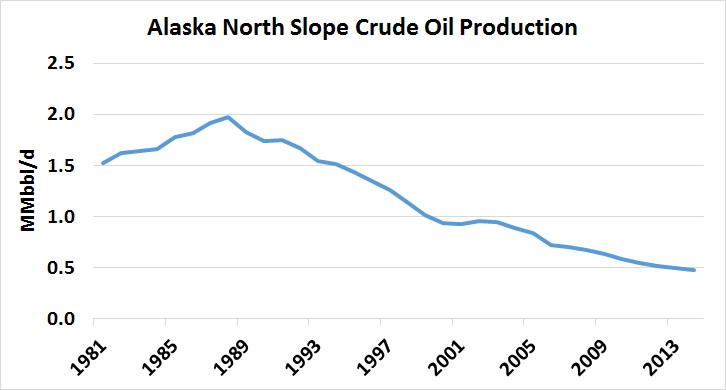
Alaska’s first oil well was drilled in 1898—yes, 117 years ago—but it was not until the mid-1970s that Alaskan oil started making its mark. Then, with the construction of the $7.7 billion Trans-Alaska Pipeline System from 1973 to 1977, oil production at Prudhoe Bay started in earnest in 1978 and quickly ramped up. As shown in Figure #1 below, North Slope oil production peaked at 2.0 MMb/d in 1988 and has been sliding ever since, falling below 1 MMb/d in 2000 and below 500 Mb/d in 2014. By July 2015, North Slope production was down to 431 Mb/d, less than one-third the production rate in the Eagle Ford and barely one-fifth the output of the Permian Basin. 

**************************************
California Crude

There's a story making the rounds about Governor Brown of California tasking state workers to determine if there is any oil on / under his land in northern California. I don't care one way or the other; it's a perk of being in office.

For me the bigger story is noting Brown's attitude regarding the oil and gas industry in his home state. He did not ban fracking like the governor of New York has, and considering the opposition to the oil and gas industry in California, one can argue that he has been about as fair as he can be on drilling in his state. I'm sure many will disagree with me. Whatever.

From the AP (same link):
Brown's request to oil regulators points to the complex way that the governor, an internationally known advocate of renewable energy, approaches oil and gas issues in his own state.
While spearheading ambitious programs to curb the use of climate-changing fossil fuels, Brown has also sought to spur oil production in California, the country's No. 3 oil-producing state.
Even if his far-left supporters don't want to admit it, the state relies heavily on oil revenue, and Jerry Brown knows it. California's ranking is irrelevant if oil production overall is decreasing.

At its peak, back in 1985, California was producing around 35 million bbls of oil per month (about what North Dakota produces now in a highly choked-back environment).  California is now producing less than half that amount, below 17 million bbls of oil per month. Couple that with the huge price decline and California's oil revenue must be cratering. Throw in lost state income tax from oil workers laid off in the state and the situation must look a bit depressing for the governor.

XOM seems to be leaving California -- they sold their refinery in Torrance. OXY spun off its operations in California and moved its headquarters to Texas. Back in 2013, CVX moved 400 employees from its HQ in San Ramon (CA) to Houston; building a new building in Houston; says they are keeping HQ in San Ramon (CA).

The Monterey shale looks like a bust, but even if there is a lot of oil there, it's not going to be produced in this price environment. All of that is probably just the tip of the iceberg.

All of that is upstream.

California remains an "island" when it comes to oil. Midstream, risks of earthquakes minimize opportunities to bring oil into the state via pipeline. And downstream, California has uniquely interesting requirements for gasoline blends. [I would imagine California is VW/Audi's biggest market in the US -- but that's another story for another time.]

Jerry Brown looks at all of that, and then looks at the Alaska crude oil production graph, as seen above. Like most of us, Jerry Brown probably doesn't like movie sequels.

My hunch: before the end of 2016 we are going to see some shocking graphs of California oil production.

Wednesday, September 2, 2015

For The Archives: California's Dependency On Domestic Oil And Gas Industry -- September 2, 2015

For the archives. The Breitbart article has to do with fracking and California's drought. It's really a two-piece article. The first half of the article is on the Monterey Shale formation; the second half is one California's dependency on oil.

I linked this article earlier with the emphasis on Monterey Shale. This time, the stand-alone post has do with California's dependency on the oil and gas industry. If I was unaware of this, I assume most Californians were unaware of it, and certainly all of those "Jaywalkers" on Jay Leno's late night show are unaware of it.

Some very interesting data points:
The Sacramento Bee reported that up to half of the hundreds of new wells drilled each year in the San Joaquin Valley are being “fracked,” according to a study required by the 2013 law regulating the practice. [By the way, note the spelling of "fracked" by the Sacramento Bee.]
Zack Malitz of the environmental group Credo complained to Reuters: “Governor Brown is forcing ordinary Californians to shoulder the burden of the drought by cutting their personal water use while giving the oil industry a continuing license to break the law and poison our water.”
He added, “Fracking and toxic injection wells may not be the largest uses of water in California, but they are undoubtedly some of the stupidest.”
Gov. Brown has tried to sound high-minded about water use, but the real issue is that California’s State Budget is highly reliant on the oil industry revenues. 
The blog CalWatchdog.com calculated that the oil and gas industry contributed $21.55 billion to the state’s public fiscus. That amounts to over twice the salary compensation for state employees last year. If Brown cuts oil industry water, he will have to fire state workers.
Still, crude oil production in California has fallen for 27 of the last 30 years, from about 1.15 million to 566,000 barrels per day. California used to be self-sufficient, but now imports 62.8 percent of the petroleum it uses.
Last year, California spent about $32 billion to import 400 million oil barrels of oil.
The oil and gas industry contributes over $20 billion to the state coffers. You know that intermittent energy (wind, solar) takes money away from state coffers through tax breaks, subsidies, and grants.

Tuesday, July 14, 2015

#1 Story In Southern California This Week: $5 Gasoline; EIA Rubs Salt In The Wound -- July 14, 2015

Updates

Later, 9:11 a.m. Pacific time: moments after posting the original post -- that the #1 story in California is $5 gasoline, this EIA "energy cookie" pops up:
The average retail price for motor gasoline this summer (April through September) is expected to be $2.67 per gallon, the lowest price (in real dollars, meaning adjusted for inflation) since 2009, based on projections in EIA's July Short-Term Energy Outlook (http://www.eia.gov/forecasts/steo/) . This decline is mainly the result of the projected 41% year-over-year decline in the average price of North Sea Brent crude oil. --- EIA  
What? "This decline is mainly the result of the projected 41% year-over-year decline in the average price of North Sea Brent crude oil. What? 

Original Post
 
Breitbart probably has the best broad-brush explanation to date of the overall energy picture in California:
GasBuddy noted that an “extraordinary convergence of fuel supply problems this week in California prompted severe spikes in wholesale gasoline prices and experts say there’s no immediate relief in sight.” CEO Jason Toews sent Governor Brown a letter asking him to consult with the EPA and Department of Energy about a California gas regulation standards waiver due to “extreme and unusual fuel supply circumstances.”
Friday’s Gas Buddy call came after U.S. crude oil prices plummeted by -5% last week and the average price of gas in the U.S. slumped to $2.76 per gallon.
The International Energy Agency stated that the world is currently “massively oversupplied” with oil, mostly due to the US fracking boom.  Over the July 4 weekend, the U.S. national average price for gasoline fell to the lowest level since 2010.
But while the rest of the America enjoys almost $1 per gallon in savings, California drivers on Friday in the Bay Area drivers were surprised to see gasoline up-tick to $4 a gallon, and L.A. Basin drivers were stunned as some stations posted $5 a gallon gasoline.
When Governor Brown was leaving office after his first stint in 1983, California was America’s second-largest producer of crude oil at 1.025 million barrels per day (bpd) 32 years later, California has dropped to the third-largest producer of crude oil, as production plummeted to 545,000 bpd.
When Brown signed a bill in 2011 raising the minimum renewable portfolio standards (RPS) for utilities from 20% to 33% by 2020, he promised investments in wind, solar, biomass, and geothermal sources would cut energy prices and create tens of thousands of jobs. The only things stimulated so far have been higher energy prices.
State oil supplies are now at their lowest point in 12-months. Federal energy officials said that California refiners have been forced to run-down 1.1 million barrels held in their reserve storage tanks. Out-of-state crude oil imports had been averaging about  100,000 barrels a day, but no imports arrived last week, according to state records.
Other relevant links at this site:
Notice also the earlier tag: California_Spike_2014

Sunday, May 10, 2015

Update On Pricing For The Jerry Brown Bullet Train -- May 10, 2015

For the archives when our granddaughter are taking the Bullet Train from Los Angeles to San Francisco in 2030. 

The top story in today's Los Angeles Time: the price of ticket on the "bullet train" from Los Angeles to San Francisco:
  • seven years ago, riders were promised a $50 ticket-price
  • today, 2015, the tickets are projected to be priced at $86
  • at $86, about 20 cents/mile for the JBBT
  • best rate world-wide: about 20 cents/mile 
  • Beijing - Shanghai, 800 miles, 22 cents/mile, heavily subsidized
  • Milan - Salaerno, 400 miles, 25 cents/mile
  • Hannover (sic) - Wurzburg: 46 cents/mile 
  • Paris - Lyon: 52 cents/mile
  • Amtrak's Acela system, Washington, DC - Boston, 450 miles: 50 cents/mile
  • at 50 cents/mile, the Acela would be $225 one way
  • at Travelocity, Jet Blue, DC to Boston: $300 for purchasing ticket 24 hours in advance
  • at Travelocity, Jet Blue, DC to Boston: $68 for purchasing same ticket 2 weeks in advance
  • at Travelocity, United, LA to San Francisco: $198 for purchasing ticket 24 hours in advance
  • at Travelocity, Jet Blue, LA to San Francisco: $78 for purchasing ticket 2 weeks in advance
From the linked article:
The current $86 fare is calculated in 2013 dollars based on a formula that prices tickets at 83% of average airline fares to help attract riders. The rail fare is an average that includes economy and premium seats, nonstop and multi-stop trains, as well as last-minute and advance purchase tickets. A premium, same-day nonstop bullet train trip would cost more than $86. 
Nothing in the article suggests the bullet train will succeed and this is the top story in the most liberal newspaper in the US. Another example from the article, again, at the very end of the story:
"With a family, it's four train fares versus one car, and taking the train may require a car rental at the other end," said Genevieve Giuliano, director of USC's Metrans transportation program. "I don't see high-speed rail as competitive in the family market."
Note: I often make errors on posts like these. If you are planning a trip by rail or by air in 2030, either on the west coast or the east coast, do not make any travel plans based on what you read here. Go to the source. Prices are likely to be different in 2030 than currently "advertised."

Deep in the article this interesting tidbit;
Shortly after the ridership figures were updated last year, a problem was found with the complex mathematical model used by Massachusetts-based Cambridge Systematics, a state consultant. It predicted more short trips than seemed logical, according to Cambridge. One example: The model suggested travelers would drive from Sacramento to downtown San Francisco and board a bullet train for the airport. Koppelman's panel agreed to an adjustment and urged Cambridge to develop a new version of the model.
Okay, read that again. The consultants assumed (and placed in their computer model), folks who live in Sacramento would drive all the way to San Francisco, to board the bullet train there, simply to take the bullet train to San Francisco airport. Hello! Folks who drive from Sacramento to San Francisco to catch an flight out of SFO would would drive directly to the airport rather than the extra hassle involved in making the change at the train station.

Those shorter bullet train trips were put into the model to a) increase ridership; and, b) increase revenue to help finance the bullet train.

It's interesting: it seems strange the state did not contract with the Stanford Graduate School of Business for the study. Stanford's MBA program was ranked 1st in the United States by U.S. News & World Report in its 2015 rankings.

*****************************
The California Drought

Again, for the archives.

First, a Tim Rutten commentary from the Pasadena Star News.
As the historian William Karl has pointed out, “The history of California in the 20th century is the history of a state inventing itself with water.” In fact, the invention that makes possible the world’s seventh largest economy with its annual GDP of $2.2 trillion is the largest, most complex and productive system for moving and distributing water in the history of mankind. Each year, California’s water system moves enough water to maintain 30 million people and to irrigate 29 million acres of incredibly productive cropland.
Many scientists, however, now strongly suspect that this sustaining system was put together during an unusually wet period in the region’s natural history. The roughly 20-year period when California’s population doubled — from about 1970 to the late 1990s — was one of the wettest on record. Paleoclimatologists have come to realize that, for most of discernible history, California and the Southwest were usually much drier than they’ve been for the past 150 years and — more sobering — were subject to centuries-long mega droughts. The two most recent of these occurred in the 13th and 9th centuries and lasted 150 and 200 years, respectively.
Whether the prolonged dry spell now withering so much of the Southwest signals another of these epic events is unknown. In any event, the scientists who believe that we’re in a period of accelerated climate change induced by human activity — and they’re a cross-disciplinary majority — predict that global warming will make for a slightly wetter Northern California in the years ahead, while the state’s central and southern regions, along with most of the American Southwest, will become markedly drier.
His conclusions (recommendations) are spot on, but I wish he had steered clear of invoking climate change (though in his defense he seemed fair and balanced on the subject).

Second, to be filed under "no good deed goes unpunished," a long article on the situation in San Diego as reported by KCRA. San Diego started preparing for this drought back in 1991 and its residents have paid much upfront to conserve huge amounts of water, but this is what Sacramento thinks about San Diego:
San Diego's march to independence earned little sympathy from the State Water Resources Control Board, which approved the cuts to achieve Gov. Jerry Brown's target of reducing urban water use 25 percent. Board officials say those who prepared for drought will be better off in the long run.
"This is not about being fair, giving kudos for past performance," said board Chairwoman Felicia Marcus. "This is about dealing with what is an emergency out in front of us that may not be right here, but we can see coming at us."
*****************************
Texas Drought

Nine days out of current 10-day run we will be having rain in DFW area. This is perhaps the biggest day for rain. Several hours, now, of non-stop rain coming down in torrents.

Tuesday, October 21, 2014

Never Saw This Coming: Alaska Crude Oil "Piling Up" At Port -- Bloomberg; Ten (10) New North Dakota Oil Permits; BR Reports Two Nice Wells Today -- October 21, 2014

Bloomberg is reporting:
Stockpiles of oil from Alaska’s North Slope have surged to a five-year seasonal high as tanker maintenance slows loadings, forcing the grade to trade at a discount to U.S. crude for the first time since 2010.
Inventories at the Valdez terminal, the northernmost ice-free port in North America and the loading point for Alaskan oil, have averaged 4.38 million barrels this month, the most for October since 2009, data posted on the Alaska Revenue Department’s website show. Tanker repairs have shrunk the pool of vessels available. 
A couple of data points from the linked article:
  • California is bringing in a record volume of oil by rail from other states and the region has increased imports from countries including Iraq and Saudi Arabia.  
  • Alaska North Slope crude for delivery to the U.S. West Coast weakened by 50 cents a barrel to a discount of 40 cents relative to domestic benchmark West Texas Intermediate. It’s the first time the grade has been discounted against WTI since Dec. 9, 2010. The oil fell $1.53 a barrel versus the international benchmark North Sea Brent for prompt delivery to a $3.81 discount. 
  • Production of [Alaskan] oil has declined from a peak of 2.1 million barrels a day in 1988 to an average of 523,797 barrels a day this month, state data show.  
  • The tanker work is another blow for Alaskan oil producers as the West Coast replaces their output with less-expensive barrels from other states including Utah and North Dakota. California took 16,373 barrels of oil a day by rail in July, a record for the month.
And that's why I love to blog. Read the linked Bloomberg article above in context with one of my recent postings on the growing relationship between California and North Dakota
******************************************************

Active rigs in North Dakota:


10/21/201410/21/201310/21/201210/21/201110/21/2010
Active Rigs191182186195151

Wells coming off the confidential list Wednesday:
  • 27308, drl, BR, Lillibridge 21-27MBH, Johnson Corner, no production data,
  • 27581, 2,342, MRO, Viani USA 44-10H,  Chimney Butte, t6/14; cum 42K 8/14;
  • 27797, drl, Hess, AN-Evenson-152-95-1003H-8, Antelope, no production data,
  • 28112, 11, Legacy, Legacy Berge 13-31H, North Souris, a Spearfish well, t6/14; cum --
  • 28161, conf, Hess, BB-Budahn A-LS-150-95-0403H-1, Blue Buttes, no production data,
Wells coming off the confidential list today were posted earlier; see sidebar at the right.

Ten (10) new permits --
  • Operators: Hess (4), XTO (2), Whiting (2), Murex (2),
  • Fields: Robinson Lake (Mountrail), Dollar Joe (McKenzie), Grinnell (McKenzie), Temple (Williams)
  • Comments:
Nine (9) producing wells were completed:
  • 26382, 331, Oasis, Mallard 5692 21-20 9T2, Alger, t8/14; cum 3K 8/14;
  • 26769, 526, Mandaree 134-05H, Squaw Creek, t10/14; cum --
  • 26898, 548, Oasis, Delta 6093 24-15 3B, Gros Ventre, t9/14; cum --
  • 27059, 1,320, BR, Denali 21-4TFH, Johnson Corner, 4 sections, t9/14; cum --
  • 27580, 1,440, BR, Sequoia 41-4TFH, Hawkeye, t9/14; cum --
  • 27677, 290, Delta 6093 44-15 8T, Gros Ventre, t8/14; cum 5K 8/14;
  • 27767, 698, SM Energy, Todd 13X-35H, Camp, t9/14; cum --
  • 27769, 965, Tracy 13-35H, Camp, t9/14; cum --
  • 28480, 262, Dishon 5893 44-36 1T2, Enget Lake, t8/14; cum 2K 8/14; 

Friday, February 14, 2014

OXY Spin-Off; Headquarters Moving To Texas; Leaving California; OXY To Shed Assets "From North Dakota To The Persian Gulf"

Updates

February 15, 2014: OXY USA trying to put a positive spin on the new company they will spin off to develop the Monterey shale in California. Bloomberg is reporting
Occidental Petroleum Corp., the largest oil producer in the continental U.S., will split its operations in California into a separate publicly traded company in one of the final steps of a breakup plan. The new California company will be the biggest oil and natural gas acreage holder in the state with about 2.3 million net acres, Los Angeles-based Occidental said today in a statement.
[The new company] will have 8,000 employees and contractors and will establish its headquarters in the state.
“Creating two separate energy companies will result in more focused businesses that will be competitive industry leaders,” Chief Executive Officer Stephen Chazen said in the statement.
Chazen is targeting asset sales from North Dakota to the Persian Gulf to focus on Occidental’s most profitable operations after lackluster returns in 2011 and 2012. The California company could be worth as much as $19 billion and carry as much as $5 billion of debt, Tudor Pickering Holt & Co. analysts wrote today in a note to clients. The assets being spun off represent about 20 percent of total production.  
The new company will be more aggressive:
The company produces the equivalent of 154,000 barrels of oil and natural gas a day in the state and its operations there generated revenue of $4.3 billion last year with $1.7 billion of capital expenditure. Occidental plans to boost spending and debt at the California company, operating more as a traditional high-growth explorer, Leo Mariani, an analyst with RBC Capital Markets in Austin, Texas, wrote today in a note to clients. 
But, it is not going to be easy, from a companion article at Bloomberg:
“No one has found the secret sauce yet to the Monterey,” said David Hackett, president of Stillwater Associates, an energy consulting firm in the state. ’’Occidental is working hard at it, but they don’t understand it well enough to make it perform like everybody hopes it will.’’ 

“Historically, California has been a ‘hard to grow’ asset and suffers from severe regulatory constraints,” a factor that could weigh on how investors value the new company, Mariani said. The potential of the Monterey has been questioned by executives including Chevron Corp.’s John Watson and Continental Resources Inc.’s Harold Hamm. 
Also the environmental backlash, from the second Bloomberg article link:
Environmental groups concerned about the possibility of an oil renaissance are lobbying legislators and organizing protests against development. A federal judge in April ruled that the U.S. Bureau of Land Management violated the law by failing to sufficiently study the impact of fracking on the environment.
“If we go in the direction of North Dakota, the consequences for California would be devastating,” said Patrick Sullivan, a spokesman for the Center for Biological Diversity, which sued to invalidate government lease sales for drilling. ’’We’re determined to protect water, wildlife and public health.’’
Despite the obstacles, state oil production surged in February to the highest seasonal level in three years, according to U.S. Energy Information Administration data through November. Output climbed 13,000 barrels a day in the first 11 months of 2013 and rose 4,000 in 2012, marking the first annual rise since 1998.
Occidental plans to drill more than 1,000 wells in 2014, a 36 percent increase from 2013 that will help increase oil production by 11 percent, a growth rate that rivals some of the best onshore drillers. More than 10 percent of those wells will be in layers of shale rock, according to a Jan. 30 company presentation.
Original Post
 
This is a huge, huge story - I can't remember if I mentioned whether it was OXY or CVX or COP that the tea leaves suggested to me one of the three would be leaving California. I think I was thinking Chevron, but .... I digress. [Yes, based on this posting, I always thought Chevron would be the first of the three to leave California.]

The bigger story is just that: Rick Perry has done a great job enticing California companies to move (in some cases, back) to Texas.

Don sent me the link. I would not have seen it until later. This was worth waiting for. I was just getting to wrap it up for the day.

Reuters is reporting:
Occidental Petroleum Corp said it would spin off its oil and gas assets in California into a separately traded company and move its headquarters from Los Angeles to Houston, where it will be closer to its largest U.S. operations.
Occidental did not provide a valuation for the California business, but analysts at investment bank Tudor, Pickering, Holt & Co said it could be worth up to $19 billion. Analysts at Credit Suisse valued the unit at about $22 billion in October.
"Creating two separate energy companies will result in more focused businesses that will be competitive industry leaders," Chief Executive Stephen Chazen said on Friday.
Occidental, whose shares were up 3 percent at midday, said the California unit generated a pre-tax profit of about $1.5 billion in 2013.
The fruits and nuts hate Big Oil.

The California geology for fracking is very, very problematic.

The water for fracking is even more problematic.

OXY's Bakken wells, by the way, have been getting better and better. With all this restructuring, it seems this would have been a great time for OXY to sell off its Bakken assets if it were planning to do so. The tea leaves suggest to me that OXY is staying in the Bakken, but tea leaves have been known to be misinterpreted, even by the best readers.
I believe OXY has a huge play in the Eagle Ford. Have to look up some of this stuff later.

****************************
Video: the one who got away. 

The One That Got Away, Devil Doll


A man's gotta do, what a man's gotta do. It doesn't matter what you say.

Wednesday, October 30, 2013

For Archival Purposes: Analyst Thinks California Is Back In The Oil / Fracking Business; If So, It Won't Be Any Time Soon

Rigzone posts an analysis by John Kemp, a market analyst. He thinks now that California has approved fracking with stricter regulation, the state is back in the oil / fracking business.

The first few paragraphs of this five-page internet article:
LONDON, Oct 30 (Reuters) - California's lawmakers have ensured the state will remain a major oil and gas producer by approving new legislation allowing hydraulic fracturing and acid treatments to rejuvenate its ageing wells in exchange for strict controls and tougher enforcement. 
Senate Bill No 4 (SB 4), which Governor Jerry Brown signed into law on Sept. 20, directs the state Department of Conservation and other agencies to adopt new rules and regulations covering well construction, fracturing and other well stimulation treatments by the start of 2015
The chemicals used will have to be disclosed to regulators and published, subject to special treatment for trade secrets. Penalties for violating certain regulations on oil and gas operations were increased from $25,000 per violation to between $10,000 and $25,000 per violation per day. 
In another concession to environmental and community groups worried about the safety of fracturing and acidizing, the law directs the state's Natural Resources Agency, which focuses on environmental protection rather than oil and gas production, to conduct an independent scientific study into the hazards and risks.
I'm sure the anti-oil lobby can delay the publishing of these "new rules and regulations" well past the "start of 2015."

Posted for archival purposes only.

Thursday, March 21, 2013

Jerry: How's That Wind Energy Working Out Now?

Updates

June 7, 2013: San Onofre will close. It will be interesting to see how California will cope.

Original Post

Reuters is reporting:
California's electric grid agency warned on Wednesday that a second summer without output from the damaged San Onofre nuclear plant presents more challenges than last year and will force the agency to rely on voluntary conservation to avert rolling blackouts.
"This summer will be more difficult than last," Steven Berberich, president of the California Independent System Operator (ISO)...
The 2,150-megawatt San Onofre nuclear station, owned by Edison International and Sempra Energy, has been shut since January 2012 after the discovery of premature tube wear that damaged thousands of tightly packed tubes inside the large steam generators.
San Onofre, located halfway between Los Angeles and San Diego, is the largest power plant in southern California and its extended shutdown creates reliability problems in south Orange County and the San Diego area...
Grid officials are closely watching California's supply of hydro power for the summer which is expected to be about two-thirds of normal.
Regardless, it looks like Warren will do just fine...as you read through the linked article, remember:
PacifiCorp, a unit of MidAmerican Energy Holdings Co, operates utilities in California, Oregon, Washington, Utah, Wyoming and Idaho, and will invest about $2.1 million to set up its systems.
MidAmerican is a unit of Warren Buffett's Berkshire Hathaway.
The article mentioned "hydro power" but did not mention solar or wind energy. Cue up Connie Francis.

Sempra Energy, by the way, hit a 52-week high yesterday, and has been hitting highs regularly in the last few weeks, but it has to do with its natural gas play and Mexico, not the California energy debacle.

Friday, January 4, 2013

California -- Again

Regular readers will remember this story, and some of the comments it generated. I'm less interested in whether California will see another oil boom. What impresses me is that the governor was able to stand up to the faux environmentalists at least to some extent.
Governor Jerry Brown's administration released draft regulations Dec. 18, 2012 requiring oil companies for the first time to disclose where hydraulic fracturing is used in California after receiving tremendous pressure from state lawmakers and environmentalists.
The proposed rules released by the California Division of Oil, Gas and Geothermal Resources will require oil companies to reveal that information on a national fracking registry, FracFocus.org, after they use the procedure. The rules also require energy firms to test the integrity of the wells before fracking to guard against leaks and to report the test results to regulators before beginning operations.
Chemicals deemed "trade secrets" would only have to be publicly disclosed in the event of a spill or accidental release, as needed for an emergency response or for medical treatments.
"Experience in other states has shown that such trade secret exemptions are being widely used and likely abused," the Environmental Working Group's Bill Allayaud said in a prepared statement.
Regulators said trade secrets are not widely claimed in other states.

Tuesday, May 29, 2012

Monterey Shale Near Santa Barbara, California

Link here to Oil & Gas Journal

Several things attracted me to this story, not least of which I enjoyed many wonderful weekend outings with some nice southern California women -- ah, but that was a long time ago, in another galaxy, far, far away.
Underground Energy Corp., Santa Barbara, Calif., will attempt to complete the Monterey shale at the Chamberlin 3-2 well on the 7,750-acre Chamberlin lease in its Zaca field extension project in Santa Barbara County, Calif.
Some data points:
  • Depth: 7,685 feet (somewhat shallower than the Bakken, in general)
  • Cost: budgeted for $2.4 million (well below the $7 million to $10 million for Bakken wells)
  • Payzone in offset well: 1,700 feet (huge); more than 1,200 feet of continuous Monterey oil
  • Typical payzone in this area: 1,100 feet (huge -- the middle Bakken, I believe, is 50 - 100 feet)
  • Original Zaca field: 10-acre spacing; 61 wells
  • Original Zaca field: average IP -- 200 bopd; EURs > 540,000
Another rig in the area will drill to 4,350 feet (much shallower than the Bakken; and will offset two other wells have produced more than 500,000 bbls of oil.

A bit of competition for the Bakken, it appears, and suggests why some operators, like OXY say they have better prospects in California than North Dakota.

Note: I have no formal training in the oil and gas industry; no formal training in geology; I don't follow California oil industry; and I may have misread the story. Check out the link if you plan to make any investment decisions after reading this post.  I am well-known to make errors. This is presented, again, for my benefit and benefit of readers to try to sort out the Bakken.

******************
A Note for the Granddaughters

And speaking of long ago, far away:

Buffy, piaknowguy


A Long Time Ago, Waylon Jennings
And then he met Jessi:

Storms Never Last, Jessi and Waylon
I'm Looking for Blue Eyes, Jessi Colter