Showing posts with label Road_To_France. Show all posts

Saturday, April 16, 2022

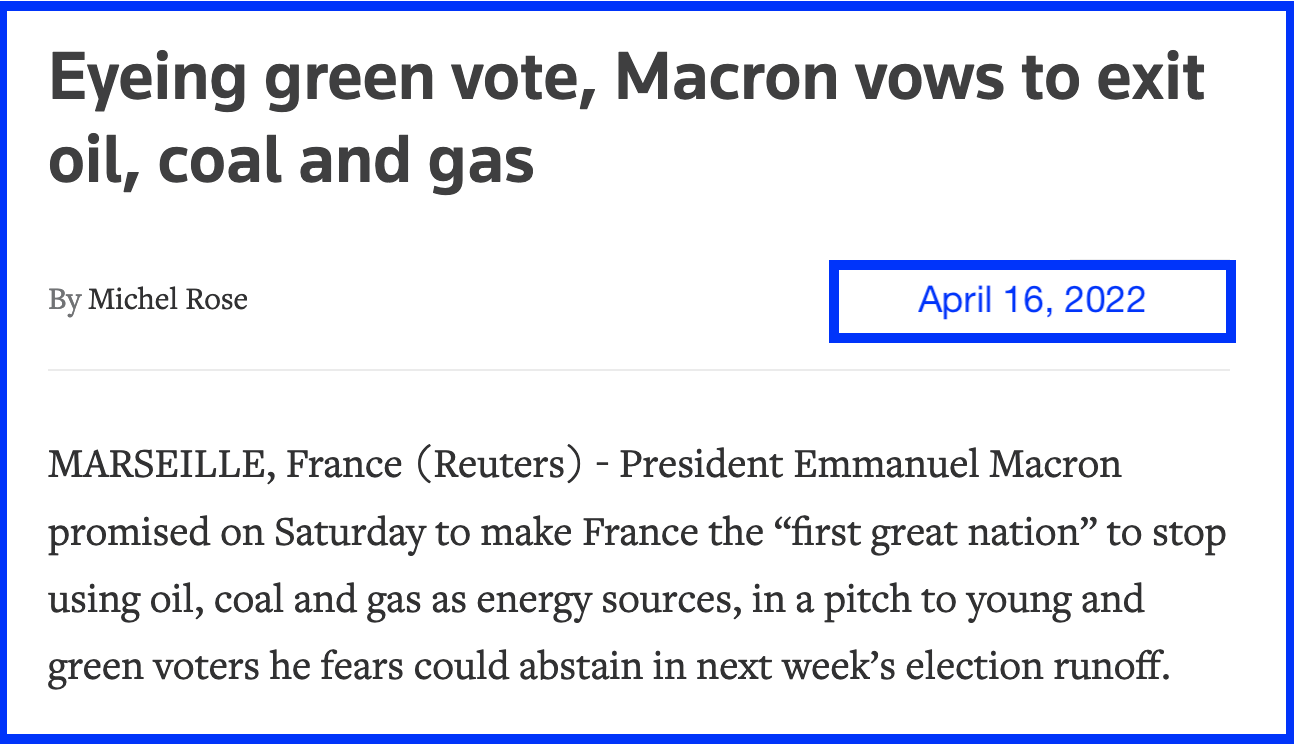
Like Biden, Macron Vows To Exit Oil, Coal, And Gas -- That Pretty Much Leaves Nuclear -- April 16, 2022

Link to Reuters.

Another doofus. 

They -- all EU leaders -- have the opportunity this year to ban all oil, coal, and gas from Russia. 

Let's go, Brandon.  This would be the month to give a Reagan-esque speech to the French and the Germans: "ban Russian oil, natural gas, and coal now."
Monday, February 1, 2021

Notes From All Over, Part 2 -- February 1, 2021

EOG: interesting story. A bit old. I missed it when it was first reported a few weeks ago. Oil drillers are taking their money and expertise off-shore and overseas now that the new CEO/CIC has banned new leasing on federal lands/waters in the US. EOG moving focus to Oman. Appears to be a pretty big story based on the coverage of this story. Apparently the new administration prefers to put Omanis to work and let our union workers draw unemployment and play the GME and silver markets. 

The road to France: for the archives. Something for Sophia to read in 2035. The numbers simply don't add up. There is not enough land or water to add all the renewable energy that would required to replace this many nuclear plants. From Tatiana Serova, one of my favorite columnists:

On Wednesday January 27th, the International Energy Agency released a long-awaited report called “Conditions and requirements for the technical feasibility of a power system with a high share of renewables in France towards 2050”. Yet, that document was given a cold welcome by the French nuclear industry, as behind this somewhat complex title hides a key message : a scenario of 100% renewable energy is “technically possible” in 2060 in France. This implies that the country would potentially no longer need nuclear energy to meet its domestic demand.

The nuclear sector accounts for around 70% of today’s French electricity mix, and over 40% of final energy demand. Back in the 1970’s, France decided to take the nuclear path, aspiring to move away from oil and achieving energy independence. Since then, not only did the country guarantee its own security of electricity supply, but it could also export it towards neighboring EU countries. Killing two birds with one stone, France boasted some of the cheapest electricity in Europe and was proud to have an almost fossil fuels free electricity generation system.

In 2020, the priority has shifted from nuclear power towards complying with the Paris-agreement goal of being net-zero carbon by 2050. In its pluriannual plan of energy, France gave itself the objective to reduce the share of nuclear power in the energy mix to 50% by 2035. In 2020, the government announced the upcoming closure of 14 nuclear plants to fulfill this objective. The closure of the Fessenheim plant, in June 2020 left a 1,7 GW capacity gap to be compensated for with other sources of power generation.

Thank you, Dr Fauci: three weeks to "flatten the curve." One year later and not much curve flattening but certainly a lot of waves. Mostly "waves goodbye" to a lot of service jobs. Link here

Monday, June 29, 2020

Supply Concerns Drive French 4Q Physical Power Premium -- ArgusMedia -- June 29, 2020

Words and phrases one does not like to see in one story when it comes to electricity, unless it's in French:
  • electricity
  • blackout
  • curtailment
  • concerns that demand will far exceed supply
  • physically delivered contract has been pushed to an unusual premium to the financially settled derivative
  • qué será será
Link here to ArgusMedia.

Amazing how many contracts exist:
A physical contract for electricity is a negotiated contract between a seller and a buyer in the over-the-counter (OTC) market. There is a range of different physical contracts for 15-minute delivery, hourly, spot, long-term or forward. Since electricity cannot be stored, this range of contracts is necessary to maintain supply-demand balance. 
Derivative contracts are used in European power exchanges. The value of a derivative will vary based on the changes in the price of the underlying power product. Companies that consume and produce energy use energy derivatives to help hedge against marketplace risks.
Background:
Supply concerns have been stoked by extended nuclear maintenance scheduled for the fourth quarter. In mid-April, France’s EdF reduced its 2020 nuclear output guidance to 300TWh to reflect the Covid-19 crisis and resulting drop in power demand. It then changed its nuclear maintenance schedule in late April — this shows that 19.4GW is expected to be off line in October-December.
But historical data show that during winter 2016-17, when nuclear unavailability averaged over 20GW, day-ahead hourly prices peaked at €874/MWh for delivery on hour 19 on 7 November 2016.
Can't they just spin the wind turbines faster?

At today's exchange rate, this works out to $980.72/MWh. Ouch.

Meanwhile in New England this morning: 90% of electricity provided by natural gas and nuclear; only seven percent by renewables. Cheap energy right now.

Electricity prices for households, December, 2019, around the world, kWh, US dollar, partial list follows:
  • Sudan: $0.00
  • Venezuela: $0.00
  • Iran: $0.01
  • Cuba: $0.01
  • Saudi Arabia: $0.05
  • Mexico: $0.07
  • China: $0.08
  • Taiwan: $0.10
  • Norway: $0.12
  • USA: $0.14
  • Sweden: $0.18
  • France: $0.20
  • Italy: $0.26
  • Germany: $0.36
  • Bermuda: $0.39

Thursday, July 25, 2019

Notes From All Over, Part 2 -- July 25, 2019

The road to Europe isn't going to be lined with wind turbines, folks. From NewsEurope --
  • with all the "stuff" that should positively affecting wind, Europe actually installed less onshore wind energy in 1H19 compared to same period last year
    • 1H19: new 2.9 GW wind installed in Europe; 
    • 1H18: new 3.3 GW wind installed in Europe;
  • installations were particularly poor in Germany, which had its worst first half of the year since 2000
    • Germany will pick up the 2H19 but as a whole will be lower than historical levels
  • of all European countries, France has the most onshore installations with 523 MW
    • France: 523 MW for the entire 1H19, and that was the biggest in Europe? give me a break -- in Williams County alone, one county in North Dakota --
From Geoff Simon's top ND energy stories this past week:

Work set to begin on Williams County wind far, Tradewind Energy; 300-MW Aurora Wind Farm; northeaster Williams County; up to 121 turbines spanning 44,000 acres; centered five miles northwest of Tioga; range in size from 2.0 to 4.8 MW; includes construction of a 20-mile 345 KV transmission line; will terminate at Basin Electric Power Cooperative's Tande Substation east of Tioga in Mountrail County; $385 million.
And that's on top of existing wind farms in Williams County.

From the linked NewsEurope article:
“With France, which had a good first 6 months, Spain, Norway and Sweden will now have to help pick up the slack in the second half of the year,” Tardieu said. “The EU has set a renewable energy target of 32% for 2030 and is talking about a net zero economy by 2050. The rate of installations we’ve seen so far this year won’t get us there,” he argued.
******************************
The Wildlife Page

Wednesday, December 5, 2018

Mexico Halts All New Upstream Auctions For At Least Three Years -- December 5, 2018

Mexico. When President Obama killed the Keystone XL it was clear he did not understand energy.

Now, just as clearly, Mexico's new president does not understand energy. The Mexican president has halted upstream auction rounds for three years.

He rationalizes why he has taken this move, but it is clear he does not understand how the oil business works.

Story at S&P Global / Platts.
The postponement of auction rounds will have a long-term, material impact on Mexico's oil and gas output, according to a transition report issued by the outgoing administration of Enrique Pena Nieto over the weekend.
According to the report, by halting auction rounds by two years, Mexico's output will only reach 2.46 million b/d by 2027, not 3.07 million b/d. Similarly, if auctions continue, Mexico would produce 7 Bcf/d of natural gas by 2028, 640 MMcf/d more than if the lease sales are shelved for two years, it said.
But does it matter in the big scheme of things? Nope. Look at what the outgoing administration is quibbling over: 2.5 million bopd vs 3 million bopd. Inconsequential in the big scheme of things.

One wonders how much Canada is losing due to faux environmentalists: Northern Gateway (killed); TransMountain (killed);  Keystone XL (killed); Line 3 (delayed, possibly killed).

******************************************
Macron Caves On Green Energy Tax

Updates

December 6, 2018: Considering how little France contributes to global CO2 this whole exercise seemed ludicrous. Add that to Macron's suggestion that France needs its own army to protect itself against Russia or  the United States makes me wonder how really "batty" this guy is. He's starting to make Occasional-Cortex look like an Einstein. Article at ABC News

Original Post

France: "most taxed" country in 2017, and still Macron not satisfied. France overtook Denmark as the most taxed country in 2017. Link here. The few examples given in the article are quite interesting.
The Organisation for Economic Cooperation and Development (OECD) said on Wednesday overall government tax revenue on average reached 34.2 percent of gross domestic product (GDP) last year among 34 developed countries for which the Paris-based body compiled data.
Though up only slightly from 34.0 percent in 2016, the figure was the highest average overall tax take since the international policy forum’s records began in 1965, it said.
In France, tax revenues rose to 46.2 percent of GDP, surpassing Denmark, where the ratio fell to 46.0 percent. 
  • Mexico: lowest at 16.2% of GDP
  • US: 27% of GDP; if one includes state and property income tax, one wonders how high the US tax rate would be
  • Israel: 32.7% of GDP

Tuesday, December 4, 2018

The Market, Energy, And Political Page, T+28 -- December 4, 2018

Updates

Later, 5:22 p.m. Central Time: I kind of had the same thoughts after Macron, France and the yellow vests:


Original Post 

We'll talk about this later. I'm a bit behind, so will come back to all of this later. Link here.


Macron will "re-consider." From Reuters.

The global carbon tax revolt, from The WSJ:
France’s violent Yellow Vest protests are now about many domestic concerns, but it’s no accident that the trigger was a fuel-tax hike. Nothing reveals the disconnect between ordinary voters and an aloof political class more than carbon taxation.
The fault line runs between anti-carbon policies and economic growth, and France is a test for the political future of emissions restrictions. France already is a relatively low-carbon economy, with per-capita emissions half Germany’s as of 2014.
French governments have nonetheless pursued an “ecological transition” to further squeeze carbon emissions from every corner of the French economy. The results are visible in the Paris streets.
The article has 684 comments so far. Some of these comments:
I'm not a climate change naysayer, but there's a lot of low-hanging fruit on the planet in terms of cutting carbon from the atmosphere.  That low-hanging fruit isn't France, especially at this time. [see data below]

We have been hearing this hair on fire doomsday hysteria for literally decades. Most all of it coming from those so easily duped into being led by government propaganda that more often than not is only an excuse to grab money from the producers and redistribute it while skimming much of it into their own pockets. Clean water, air and environment are good things and America has made great progress since my youth of smog hanging over Atlanta.

If you want to reduce dependence on carbon based fuels, don't tax carbon, don't regulate it, develop better alternatives so people willingly chose them. But I guess that defeats the purpose.

How Macron thinks a gas tax will counter "man-made global warming"? By making the population immobile? That is a genius solution in the 21st century.  And the French still think there would be no one better than Macron? Then you deserve what you got.

I’m sure all the money the government collects from these taxes will be used judiciously and effectively (sarcasm). This is a big wealth redistribution, money grab, and power play by the political elites. I’m so glad there is a growing community of folks who are not swallowing the ‘we must manage climate change with your money’ kool aid.  
CO2 emissions by country (data from 2015, most recent year in which data is available)
  • China:  9,000
  • US: 5,000 and leveling off, decreasing
  • India: 2,000 and growing by leaps and bounds
  • Russia: 1,500
  • Japan: 1,000
  • Gemany: 750
  • Saudi Arabia: 500
  • UK: 400
France: 300 or 3% of that of China; 1.5% of that emitted by the  top ten emitters
Folks, France is not the problem when it comes to global warming. One wonders what lobby is funneling money into Macron's coffers.

My hunch: more CO2 will be emitted by the elite traveling to Poland to attend the UN global warming conference now being held.

Personal note: why I never accepted the "manmade global warming story" from the beginning. Remember: we have been told repeatedly that if we do nothing, the earth will no longer be habitable for humans. At least as far back as ten years ago we were told we only had ten years to solve the problem. Data I'm reading suggests that, almost thirty years later, we have made no headway -- in fact, one could argue efforts have stalled/backtracked (e.g., France), so with that in mind, my reply to a reader, in a "not-ready-for-prime-time" e-mail why I never accepted the "manmade globale warming story":
In 1941 or thereabouts there was an existential issue for most of Europe and maybe even the entire world. Had Germany and Japan won the war, the world would have been divided between those two countries. It was so important to win that war, the US spent huge amounts of resources and money (including the Manhattan Project) to defeat the Germans/Japanese at any cost.

FDR and Churchill did not go on speaking tours and winning Nobel peace prizes for a PowerPoint presentation to raise money to fight Germany.

We are now being told that we are facing something much, much worse than what we faced in 1941. We are being told we have only ten years to save the world, and if the temperature jumps one or two degrees we are all doomed. Dead. The earth destroyed. Another Venus.

We've only had "ten years to save the earth" since 1994. By some accounts, even before 1994.

And yet, how do the smartest and most powerful people in the world go about saving us from something much worse than the Germans and the Japanese? Books, conferences, pledges of money to some committee in South Korea to disperse to South Pacific island nations; PowerPoint presentations.

This, more than anything else, tells me that the smartest and most powerful people in the world really don't believe we are in any trouble. Books, speaking tours, yada, yada, yada hardly seems sufficient if things are as bad as they say they are.

If manmade CO2 really was the problem, the best (and only solution) would be nuclear power plants. And no one is building nuclear power plants any more (with rare exception). There would be huge global efforts to plant more trees to absorb CO2. There would be "Manhattan Projects" to build "factories" that would suck CO2 out of the atmosphere. Coal would have been banned worldwide decades ago. Martial law around the world would fast-track solar/wind farms, transmission lines, etc., until nuclear power plants could be built.

No, the fact that the UN is simply hosting conferences around the world and not doing much more tells me everything I need to know about "manmade global warming." 
With France giving in to what are minor riots in the big scheme of things speaks volumes. Even France agrees that this inconvenience is not worth the effort to save the world.
New England is managing just fine. Link here. The folks kept the 0600 surge in electricity demand below $125/MWh. But it's just like clockwork. About 0600, the electricity demand begins to surge in New England. The natural gas plants kick in; wind and solar are unchanged -- not dispatchable. Natural gas hits its peak and a call goes in to have Canada "send" more hydro-electricity to New England. But that hydro-electricity spot price is incredibly expensive. So, to keep the price from surging further, the call goes in to fire up the coal-generated electricity plants. Day in, day out, just like clockwork.   

Sunday, November 18, 2018

Macaroni's Popularity Is Tanking; US Gasoline At Global Low -- Making America Great -- November 18, 2018

From this week's "Top Stories":
National: $2.00-gasoline; Trump takes credit; bait and switch
Meanwhile, Macaroni's popularity is plummeting --- after raising gasoline taxes. What in the world was he thinking?

The price of gasoline earlier this year: before the new French taxes went into effect, and before the current glut of oil in the US resulting in US gasoline selling for around $2.00/gallon. Link here. You will have to click on the graphic to enlarge it to see the country and the price of gasoline (or go to the linked article).


********************************
For The Archives: What Really Happened In Texas

Link here.

Data points:
  • turnout:
Over 8.3 million Texans voted in the 2018 midterm elections. It’s an astounding figure, especially considering that about 4.6 million voted in the midterms just four years ago. That difference — almost 3.7 million — says a lot about the changing face of the Lone Star State, but Tuesday’s result says more
  • margins:
Not only did O’Rourke dominate Cruz in the state’s five most-populous counties, encompassing the urban cores of Houston, Dallas, Fort Worth, Austin and San Antonio, he also won a higher percentage of the vote there than Hillary Clinton did, suggesting that O’Rourke was a more effective candidate in these key zones than Clinton was
  • four urban areas and five urban counties (Tarrant County - Ft Worth and Dallas considered one urban area):
A whopping 43 percent of all votes cast in Texas in 2018 came from these five urban counties. They represent the key to any Democratic hope in this state, and they are only becoming more significant; O’Rourke had to win big in these counties to have any shot at victory, and he did, taking 60.6 percent of the vote and putting himself almost 800,000 votes ahead of Cruz. For comparison, Hillary Clinton won 54.9 percent of the vote in these big counties and outpaced President Trump there by only about 563,000 votes
Two things not mentioned in the article:
  • money: most expensive US Senate race in history; it will be more expensive in two years
  • surprise: Cruz was surprised; didn't post enough lawn signs; came to the fight late; that won't happen again
    • by the way, to post a Cruz lawn sign, you had to buy one for $20; Beto's lawn signs were free for the asking
Strategy:
  • will Beto stay off the radar scope and jump in at the last minute, hoping to peak in November, 2020, or will he start his campaign in Iowa next summer; I'm betting on the latter; he will say he is testing the waters; campaigning on behalf of Hillary, others 
***********************************
Crazy Arms

Crazy Arms, Bill Price

Without question the best radio station in the metroplex (DFW/north Texas) is KXT, 91.7, an NPR music station. The station plays music 24/7 without commercial interruption. And the best music ever -- very eclectic. Never the same loops.

Three times a year they have a "fund drive" to pay for their operations. As of Thursday, 2:00 p.m., three/four days ago, they said they had only $34,000 left. Once they raised that $34,000 they said their fall fund drive would be over. Tonight, threepointtwofive days later, they are still raising money -- interrupting commercial-free music with the same "non-commercials" to raise money.

$34,000 / 80 hours = $425/hour. My calculations based on their four-hour goals was a yield of about $100/hour. This fund drive will go on for another week it appears. 

Saturday, September 9, 2017

Miscellaneous List Of Items Under-Reported By The Mainstream Press -- September 9, 2017

For the archives. A list of miscellaneous data points that seem to get less attention in the mainstream media than they deserve.

Democrats in the US Senate appear that they don't want Catholics in the Federal judiciary. The press barely reported this.

End of crude oil exploration. Perhaps the most stunning news in the oil sector this past week was the announcement by France that exploration of crude oil is coming to an end for that country. The announcement was stunning. The reality is unchanged. The implications are staggering. It's not because France does not have oil (it does, and it has a lot of oil); it's a political decision. Imagine if the US had banned fracking ten years ago. This is going to be huge for US distillate exports (see graph at same link.)

Venezuela is imploding (will become a failed nation). Venezuela crude oil imports (into the US) have reached a new low. Likewise, imports from Saudi Arabia have dropped to half that we saw in 2003. Combing that with $45 oil and some suggest that Saudi Arabia could deplete its cash reserves in less than five years.

Easy money. 10-year-Treasury-bond yields have "never" been so low. Just look at that graph at this post. Staggering. The low was last year (1.51%, August 8, 2016); currently, 2.04%. The yield hit 5.03% on  June 25, 2007 and has been on a downward trend since then. One has to go all the way back to the 1960s when the yields were below 5%. From 1962 - 1966, yields ranged between 4% and 5%.

Economic indicators: folks seem a bit more optimistic with regard to GDP than might be realistic, but at least we're trending toward 3% growth rather than 1% growth. During the last few years of the Obama administration there was a fair amount of chatter worried about the US sliding into another recession; that talk ended after November 8, 2016.
  • Investor optimism is now at record highs.
  • The 30-year mortgage rate hit another 2017 low, now down near 3.75% (same link as above).
  • The US is now at "full employment" and has been for quite some time; there is little evidence of wage inflation. Politico noted that US tightening of work visas meant that US companies had to hire more Americans at higher pay during this past summer. And somehow that was seen as "bad." At full employment, it appears "underemployment" will get increased emphasis.
Strange bedfellows. The "sweet spot" for investors may occur when an alt-right president starts cutting deals with the alt-left. I do not recall in modern history how quickly and how quietly the US debt limit was lifted; government shutdown was averted; and, a huge amount of infrastructure federal money was approved by Congress -- all in two days, this past week. Expect another huge amount of infrastructure money to be released two weeks from now once Hurricane Irma is history.

ObamaCare: death by a thousand cuts. Regulatory rollbacks by the Department of HHS; minor tweaks by Congress; the end of "advertising" by the White House; insurance companies pulling out of states across the US. In everything but name, the program is essentially over. There is still much to do with regard to costs, but the market will take care of that.

Mideast:
  • the end of ISIS is near; the speed of its demise was staggering once the US ROE changed
  • Saudi is in deep financial trouble; did the unthinkable when it met with Iraq to discuss common enemy
  • the current issue of The London Review of Books has an incredibly good analysis of what's going on inside Saudi politics; hopefully I'll find time to post highlights
The Red Queen is dead: the number of onshore US rigs is trending down; crude oil production continues to increase; in the natural gas arena, it appears to be the same, perhaps more so. Mike Filloon is one of the very few analysts are talking about new completion strategies and how that will be the next shale story.

Re-balancing supply / demand crude oil: re-balancing has occurred much more quickly than I expected but a) we're still talking 30 weeks, which puts us well into 2018; and, b) there's not guarantee the situation will improve for the oil companies.

The Keystone XL is back in the news.

EVs: the jury is still out but California scrapped a $3-billion-EV-subsidy bill. Tesla missed August deliveries by 25% and no one noted that. Tesla guidance: 100 Model 3 vehicles in August, up from 30 in July, but, in fact, delivered only 75 Model 3 vehicles in August. Next milestone: 1,000 vehicles/week. If Tesla is unable to meet their goal, it suggests that those who talked about the wiring complexity in manufacturing EVs were right. The "real" price of the Tesla Model 3 is being under-reported.

EVs: the jury is still out but the graphic at this link is not reassuring for the EV industry

Wind energy: the just is still out, but the excitement seems to be over, at least in California. Iowa has more installed wind energy capacity than a state many times larger.

A bridge too far? We already know that Saudi Aramco is selling 2% - 5% of its "assets" as an IPO in the near future to shore up its financial situation. Is this a bridge too far: PDVSA - Rosneft - CNOOC with a 50% - 25% - 25%.  Or more likely, PDVSA, 51%; CNOOC, 49%. One can find many links to others suggesting this may not be "crazy thinking."

Saturday, July 29, 2017

From Reuters, Did Anyone See This Coming? Making America Great Again -- July 29, 2017

This article has so many story lines. I'm glad that Reuters was able to pick up on perhaps the most important one:
U.S. coal exports have jumped more than 60 percent this year due to soaring demand from Europe and Asia, according to a Reuters review of government data, allowing President Donald Trump's administration to claim that efforts to revive the battered industry are working.

The increased shipments came as the European Union and other U.S. allies heaped criticism on the Trump administration for its rejection of the Paris Climate Accord, a deal agreed by nearly 200 countries to cut carbon emissions from the burning of fossil fuels like coal.

The previously unpublished figures provided to Reuters by the U.S. Energy Information Administration showed exports of the fuel from January through May totaled 36.79 million tons, up 60.3 percent from 22.94 million tons in the same period in 2016. While reflecting a bounce from 2016, the shipments remained well-below volumes recorded in equivalent periods the previous five years. 
Wow, talk about EU hypocrisy. 

Additional data points:
  • United Kingdom (aka Great Britain, includes England): 175% increase in US coal shipments 
  • France: doubled its US coal shipments
France? What happened: the country had suffered a series of nuclear power plant outages that required it and regional neighbors to rely more heavily on coal.

Overall exports from US:
  • to Europe: 16 million tons in first five months of 2017 vs 10.5 million in same period last year (the increase in the amount imported by Germany is striking; other unlinked sources)
  • to Asia: 12.3 million tons vs 6.2 million tons in y-o-y comparison
The article includes this:
Trump had campaigned on a promise to "cancel" the Paris deal and sweep away Obama-era environmental regulations to help coal miners, whose output last year sank to the lowest level since 1978. The industry has been battered for years by surging supplies of cheaper natural gas, brought on by better drilling technologies, and increased use of natural gas to fuel power plants.
His administration has since sought to kill scores of pending regulations he said threatened industries like coal mining, and reversed a ban on new coal leasing on federal lands.
President Trump has been in office barely six months, T+190 to be exact (six months plus 10 days).

Again, this is a Reuters article; not a press release from the White House.

Tuesday, July 11, 2017

What ARE They Smoking Over There? -- France Could Close Up To 17 Nuclear Reactors -- July 11, 2017

Why? To move away from nuclear power dependency. LOL. Exactly what's wrong with nuclear power?

Data points:
  • France has 58 working reactors
  • plans still in flux
  • by 2025, France's electricity provided by nuclear plants would be capped at 50%
  • earlier in the week, France said it would ban gasoline and diesel cars by 2040
Most likely I won't live to see this debacle. Back to coal.

French national anthem, 2050:

Non, Je Ne Regrette Rein, Edith Piaf