Rigs: Chesapeake will increase 2017 CAPEX budget to raise rig count from 10 to 17. Saudi Arabia take note.
Operations: I continue to find it amazing how much production can jump by simply taking a Bakken well off-line for a few months. See #18219, BR, Everlades at this post: went from 3,000 bbls/month to 16,000 bbls/month by just taking the well off-line for about six (6) months. Even when this well was initially fracked, it never went over 13,777 bbls/month. Truly amazing. They need to take all Bakken wells off-line for a few months every so often.
millennials or generation Y: 1977 - 1995 (18-year span)
generation X: 1965 - 1976 (11-year span)
baby boomers: 1946 - 1964 (18-year span)
traditionalists or silent generation: born 1945 and before
In the linked Rigzone article, Generation Z was defined as born in 1998 or later. The challenge:
“This is the generation who grew up with an iPhone in their crib …
who never knew the world without the Internet,” said Newhouse. “How are
we going to ask these kids to go work for 28 days in a remote oilfield
and not be connected for 24 hours a day? That’s a real challenge.”
The value proposition for this group of workers has to include
technology, flexible working options and green energy, Newhouse said.
And the approach may need to change, too.
“My 13-year-old and my 11-year-old are both being recruited now by
professional gaming groups, but my kids have never once seen a Shell or
BP commercial on TV because they don’t watch TV. They watch YouTube,”
said Murphy. “We have to change our strategy a little bit if we want to
attract these young men and women into our industry.”
Comment: things are moving way too quickly. We have three granddaughters, born in 2014, 2006, and 2003. The two that were born in 2003 and 2006 are very similar and meet the criteria of the iGen as noted above, but there is no question that the third granddaughter, born in 2014, is clearly already in the next generation, for now, I guess, it would be called the "post-iGen generation." All three granddaughters may have been born with an iPhone in their crib, but clearly the iPhone our 3-year-old uses is a "whole-different animal" than the iPhones the older granddaughters grew up with. For one thing, the older granddaughters did not have Siri telling them "goodnight."
***********************************
A Valentine's Card From The DAPL Protesters
Native American Respect For Their Sacred Land At Standing Rock
Published today, Valentine's Day, February 14, 2017
Futures mean squat. The Dow has had an incredible run over the past few days. By all measures, one would have thought the market would have been down today, but it was up again. So, what are futures doing now? Up slightly, about 7 points (Dow Jones Industrials).
Disclaimer: this is not an investment site. Do not make any investment, financial, travel, job, or relationship decisions based on anything you read here or think you may have read here.
*****************************
Politics
After a day like today -- the "Flynn episode" -- this helps calm my nerves --
Based on the "intensity" of the argument, one would assume solar energy accounts for a lot of energy in Maine. Yup: 1%:
Yesterday’s ruling brings to an end a year-long conversation about how to modify net metering rules in Maine.
In January 2016, Central Maine Power Co. informed the commission that solar generation made up approximately 1.04% of its annual peak demand.
When I see "0.04%" tacked on to 1%, it tells me that someone is trying to obfuscate the issue. Give me a break: 1.04%.
"Approximately 1.04%." Wow, how much more exact can one get? 1.0358574%?
[Reminds me of "9944⁄100% Pure" -- the slogan for Ivory soap.]
Worse, after 20 years of doing this (advocating, protesting, tax breaks, tax credits, hoaxes, etc), the state of Maine has finally broken through the 1% threshold.
20464, 1,202/IA, Oasis/Zenergy, Rolfson 29-32H, Siverston, 28 stages, 2 million lbs, t12/11; cum 183K 12/16; taken off-line 6/16; off-line through 12/16; from sundry form suggesting start date of September, 2016, for this:
Oasis intends to refrack the Rolfson 29-32H well at the beginning of
the infill stimulations (sic) operations for the Rolfson S wells in the
29 and 32 sections of 151N98W. If [preparatory tests are
sufficient], the refrack design will consist of a bullheaded diversion
sequence treatment in a crosslinked fluid system with 50 diversion
sequences.
*****************************
Learning From Big Sister
Note: the small bruise on Sophia's upper lip is the result of a soccer injury one day earlier.
******************************
The Literature Page
Shakespeare's King Lear, from the Riverside anthology, c. 1974.
the subplot of Gloucester and his sons has no historical connection with the Lear story, and is borrowed from the story of the Paphlagonian King in Sidney's Arcadia
Paphlagonia: north-central Turkey, along the Black Sea; one of many, many provinces at the time
grafting the Gloucester episode on to British history augments the tragic thought in the greatest of his double plots
from Riverside:
Shakespeare removes the anachronistic Christianity of the old play, converts its storm from a signal that divine justice is impending into an image of evil chaos, allows Cordelia to be defeated and murdered, and will not allow Lear to enjoy the restored majesty offered him by Albany as he bends over the dead body of his daughter.
Gloucester's suffering, the wickedness of Edmund, the multiple role of Edgar, the brilliant commentary of the Fool, the sexual looseness of Goneril and Regan -- all this is new to the Lear story. Changes of such magnitude cannot be studied in isolation; one's view of Shakespeare's object in making them depends upon his view of the whole play.
Poll: in the January, 2017, NDIC Director's Cut, the number of DUCs in North Dakota was estimated to be 839. Will there be fewer or a greater number of DUCs reported in the February, 2017 (data for December, 2016), Director's Cut?
The
latest Drilling Productivity Report from the EIA, released yesterday
(February 13, 2017), shows that while the combined rig count in the
seven major U.S. shale plays rose about 25% in the fourth quarter of
2016 versus the previous quarter, and the number of wells drilled was up
29%, well completions were up a paltry 1%, leading to an increase in
the inventory of drilled-but-uncompleted wells (DUCs).
Completions
accelerated a bit in January 2017, but DUCs still continued to rise.
That certainly seems counterintuitive. With crude oil prices stable in
the low $50’s over the past few months you might think that producers
would be pulling DUCs out of inventory, and in fact there have been
statements to that effect in several producer investor calls. This is
not just an exercise in energy fundamentals numerology. If the DUC
inventory is increasing, then production will not be ramping up as fast
as the growing rig count would imply.
But what if, as some early signs
indicate, the historical relationships are out of whack and the DUC
inventory isn’t growing but rather declining? In that case, forecast
models could be understating the outlook for production growth, and the
market could be in for a more rapid and steeper rebound in oil and gas
production than many expect. In today’s blog, we delve into the DUC
inventory data and its potential upside risk to production forecasts.
So, what's the status of DUCs now?
Understanding the DUC inventory trend is critical to forecasting
production because it reflects the ability of producers to respond in
relatively short order to market fundamentals such as price and demand
without a single rig addition.
At any given time, there is always a substantial base inventory of DUCs
in the market due to the normal delay between drilling and completion
activities.
But increases or decreases in the DUC inventory can speed or
slow the rate of production growth (or decline) in the short- or
mid-term. When crude oil prices crashed in 2014 through early 2016, we
saw an increase in DUCs as producers continued to drill, but deferred
completing wells due to economics, contractual commitments and other
factors. It was generally expected that as prices increased, many
producers would start competing those previously drilled wells (i.e.,
taking DUCs out of inventory) to start generating cash from their
drilling investment.
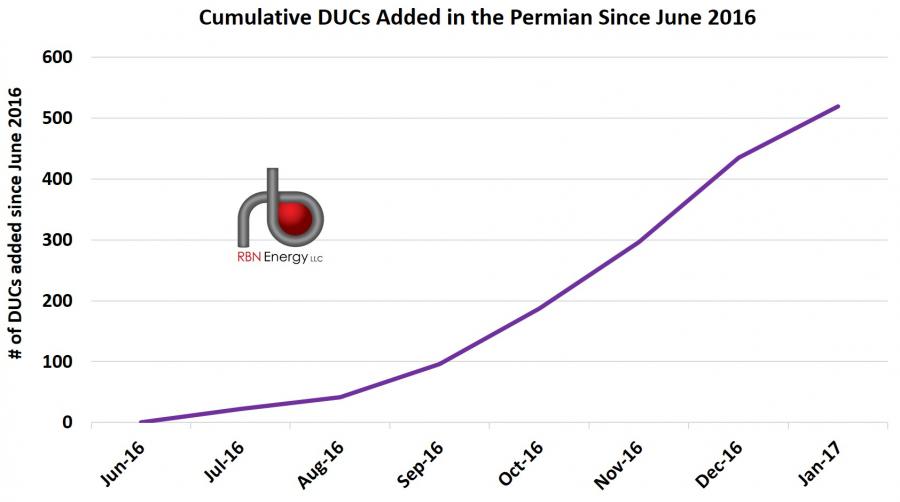
But as shown in Figure 1, (according to EIA’s DUC
inventory and Drilling Productivity Report data) that was not the case,
particularly in the most prolific of plays – the Permian.
Since June
2016, more than 500 DUCs have been added to inventory, far out of
proportion to the increase in the total Permian rig count.
the growth in DUCs is accounted for almost entirely in the Permian
of the 92 DUCs added last month, 84 were in the Permian
Challenge:
RBN Energy notes that official data is about two months old; the EIA has to "model" data based on historical relationships between rig counts to drilled and completed wells -- but those relationships are constantly in flux, says RBN Energy, "and even more so in the past few months as prices jumped and producer activity rapidly accelerated."
RBN noted an interesting phenomenon in late 2016: an increase in delineation wells away from the "sweet spots." This obviously was happening more in the Permian, and not so muchin the Bakken.
RBN suggests that:
while the EIA is projecting an increase in the number of DUCs,
in fact, perhaps producers are working off their inventory of DUCs
Pad drilling: and then something that regular readers will recognize -- the same thing is happening now in the Permian that was happening in the Bakken -- pad drilling necessarily results in an increased number of DUCs simply because operators will drill eight wells on a pad before fracking any of them.
Bottom line: US shale production is likely to see a significant jump in late 2017.
Perhaps OPEC realizes that also: the "cartel" has suggested that production cuts will have to be extended into 2H17.