Locator: 50785CAT.

Locator: 50784LDCs.
Locator: 50784TEXAS.
Query:
Flex is an international multiconglomerate out of Singapore. It provides solutions, AC to DC, for LDCs. Who competes with US LDCS for that same support?
Reply:

Query:
Specifically, what does FLEX and its subsidiaries do for LDCs?


Locator: 50783ARCHIVES.
Macron: this tells me all I need to know about the standoff in the strait. Link here.


Locator: 50782INVESTING.
Iran: more and more the market looks like it's ignoring Iran.
WTI: backed down from its high overnight.
Fed's Jay Powell to step down as Chairman this Friday, but says he will remain on the Federal Reserve Board of Governors until 2028.
AAPL: down 0.8%.
Wendy's: under huge pressure. Some talk that "it may not make it." Did I hear that correctly? Needs to be fact-checked. See below.
QCOM: is this the proxy for this market right now? Up 13% today; up $28 at the open. Cramer and Faber: there's not one reason for QCOM to be up this much this morning, or up at all.
GLW: up 4%; up $8 at the open.
SCCO: up 2.5%; up $5 at the open.
MU:

Query:
Did someone suggest Wendy's is at risk of failing?
Reply:

**********************************
Disclaimer
Briefly
Briefly:
I am inappropriately exuberant about the Bakken and I am often well out front of my headlights. I am often appropriately accused of hyperbole when it comes to the Bakken. I am inappropriately exuberant about the US economy and the US market. I am also inappropriately exuberant about all things Apple. See disclaimer. This is not an investment site. Disclaimer: this is not an investment site. Do not make any investment, financial, job, career, travel, or relationship decisions based on what you read here or think you may have read here. All my posts are done quickly: there will be content and typographical errors. If something appears wrong, it probably is. Feel free to fact check everything. If anything on any of my posts is important to you, go to the source. If/when I find typographical / content errors, I will correct them. Reminder: I am inappropriately exuberant about the Bakken, US economy, and the US market. I am also inappropriately exuberant about all things Apple. And now, Nvidia, also. I am also inappropriately exuberant about all things Nvidia. Nvidia is a metonym for AI and/or the sixth industrial revolution. I've now added Broadcom to the disclaimer. I am also inappropriately exuberant about all things Broadcom. Now, I've added Amazon. Longer version here.
Locator: 50781B.
Saudi: says it will soon be able to export 12 million bopd -- that exceeds what they actually exported in the past.
********************************
Back to the Bakken
WTI: $98.12. US rejects Iran's proposal for ending war.
New wells reporting:
RBN Energy: surge in US crude exports ups estimates of what Gulf Coast terminals can handle. Link here. Archived.
The monthslong closure of the Strait of Hormuz has spurred a dramatic ramp-up in crude oil exports from the U.S. Gulf Coast (USGC) this spring as a wide range of international buyers scrambled to replace oil stranded in the Persian Gulf. That surge in U.S. exports has prompted two big questions: (1) how much crude oil can USGC marine terminals reliably send out on a sustained basis and (2) does the region need more crude export capacity, especially if the Iran conflict drags on and buyers increasingly turn to U.S. suppliers to fill the gap. In today’s RBN blog, we’ll discuss recent USGC export volumes, what they reveal about the region’s true export limits, and how the region’s export capacity could be impacted by Sentinel Midstream’s newly sanctioned Texas GulfLink project.
Estimates vary, but given that some 12 MMb/d of crude oil had been transiting the Strait of Hormuz prior to the Iran conflict, it’s safe to say that more than 800 MMbbl of predominantly light and medium sour oil has failed to exit the Persian Gulf region since hostilities began on February 28 (70-odd days times ~12 MMbbl). There’s no way that massive volume of crude can be replaced in short order, but the countries that had been the most dependent on oil from Saudi Arabia, Iraq, the United Arab Emirates (UAE), Kuwait and Iran have been doing their best to find alternative sources — and fast! — for as much replacement oil as they can get their hands on.
The U.S. has, of course, been a primary source due to its abundance of mostly light sweet shale oil and — thanks to the ongoing release of 172 MMbbl from the Strategic Petroleum Reserve (SPR) — substantial volumes of medium sour oil too. (Of the 86 MMbbl the U.S. offered in its first SPR tranche in April and May, a hefty 76 MMbbl was medium sour; the other 10 MMbbl was light sweet.) According to RBN’s weekly Crude Voyager report, USGC terminals sent out more than 5 MMb/d for a record three weeks in a row: more than 5.1 MMb/d the week ended April 17, an all-time high of 5.8 MMb/d the week ended April 24, and nearly 5.7 MMb/d the week ended May 1. As shown in Figure 1 below, terminals in Corpus Christi sent out nearly 3.1 MMb/d the most recent week (light-blue layer), while Houston-area terminals exported just over 2 MMb/d and terminals in Beaumont, TX, (orange layer) and Louisiana (lavender layer) shipped 214 Mb/d and 350 Mb/d, respectively.
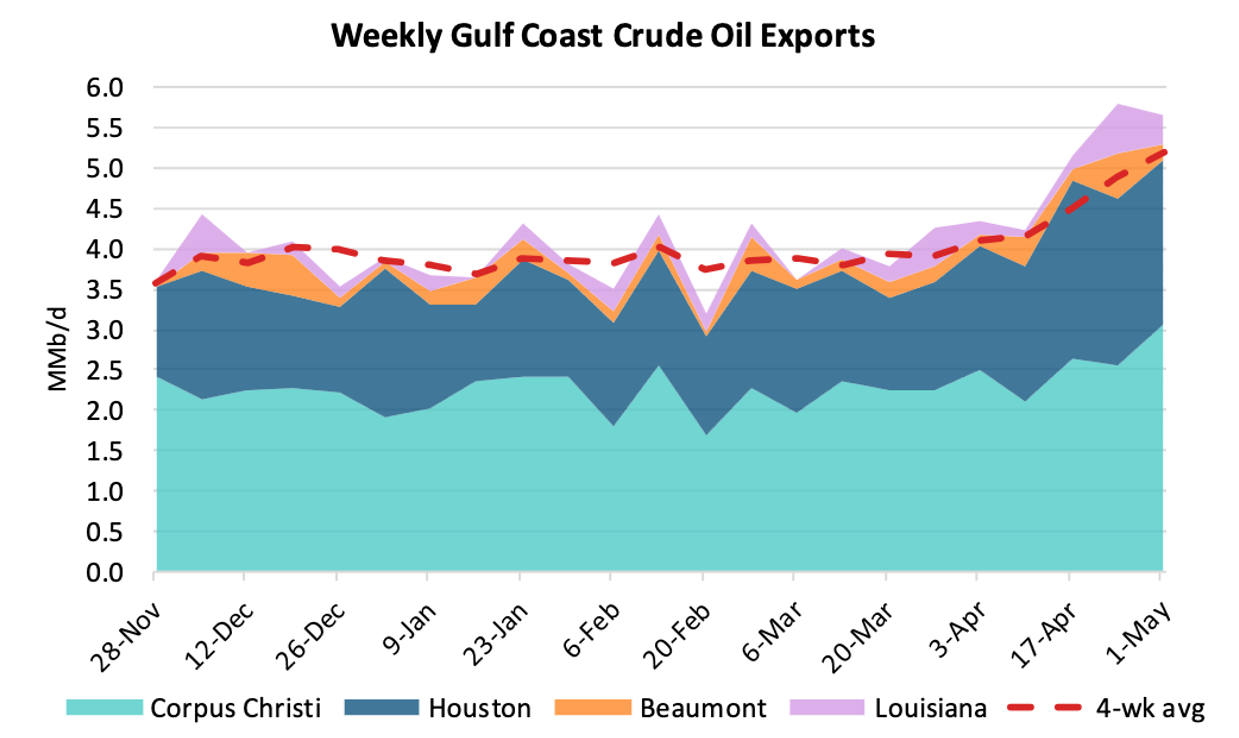
Figure 1. Weekly Gulf Coast Crude Oil Exports. Source: Crude Voyager