Locator: 50781B.
Saudi: says it will soon be able to export 12 million bopd -- that exceeds what they actually exported in the past.
********************************
Back to the Bakken
WTI: $98.12. US rejects Iran's proposal for ending war.
New wells reporting:
- Tuesday, May 12, 2026: 25 for the month, 125 for the quarter, 282 for the year,
- 42262, conf, Petro-Hunt, John Williams 143-97-5B-8-3H,
- 42199, conf, Kraken Operating, Turbodiesel 19-30-31-9H,
- 41591, conf, Hess, EN-Trout-157-93-3130H-5,
- 41450, conf, Devon Energy, Wagenman 32-29 4H,
- Monday, May 11, 2026: 21 for the month, 121 for the quarter, 278 for the year,
- 41641, conf, Devon Energy, Marvin 27-34-XW 1H,
- 42239, conf, Petro-Hunt, Edgar Lea Weems 144-97-32C-29-3H,
- 42200, conf, Kraken Operating, Turbodiesel LE 19-30-31 10H,
- Sunday, May 10, 2026: 18 for the month, 118 for the quarter, 275 for the year,
- 41739, conf, Hess, EN-Rohde-LE-157-94-3625H-1,
- Saturday, May 9, 2026: 17 for the month, 117 for the quarter, 274 for the year,
- 41844, conf, Hunt Oil, Kandiyohi 159-90-5-17H-2,
RBN Energy: surge in US crude exports ups estimates of what Gulf Coast terminals can handle. Link here. Archived.
The monthslong closure of the Strait of Hormuz has spurred a dramatic ramp-up in crude oil exports from the U.S. Gulf Coast (USGC) this spring as a wide range of international buyers scrambled to replace oil stranded in the Persian Gulf. That surge in U.S. exports has prompted two big questions: (1) how much crude oil can USGC marine terminals reliably send out on a sustained basis and (2) does the region need more crude export capacity, especially if the Iran conflict drags on and buyers increasingly turn to U.S. suppliers to fill the gap. In today’s RBN blog, we’ll discuss recent USGC export volumes, what they reveal about the region’s true export limits, and how the region’s export capacity could be impacted by Sentinel Midstream’s newly sanctioned Texas GulfLink project.
Estimates vary, but given that some 12 MMb/d of crude oil had been transiting the Strait of Hormuz prior to the Iran conflict, it’s safe to say that more than 800 MMbbl of predominantly light and medium sour oil has failed to exit the Persian Gulf region since hostilities began on February 28 (70-odd days times ~12 MMbbl). There’s no way that massive volume of crude can be replaced in short order, but the countries that had been the most dependent on oil from Saudi Arabia, Iraq, the United Arab Emirates (UAE), Kuwait and Iran have been doing their best to find alternative sources — and fast! — for as much replacement oil as they can get their hands on.
The U.S. has, of course, been a primary source due to its abundance of mostly light sweet shale oil and — thanks to the ongoing release of 172 MMbbl from the Strategic Petroleum Reserve (SPR) — substantial volumes of medium sour oil too. (Of the 86 MMbbl the U.S. offered in its first SPR tranche in April and May, a hefty 76 MMbbl was medium sour; the other 10 MMbbl was light sweet.) According to RBN’s weekly Crude Voyager report, USGC terminals sent out more than 5 MMb/d for a record three weeks in a row: more than 5.1 MMb/d the week ended April 17, an all-time high of 5.8 MMb/d the week ended April 24, and nearly 5.7 MMb/d the week ended May 1. As shown in Figure 1 below, terminals in Corpus Christi sent out nearly 3.1 MMb/d the most recent week (light-blue layer), while Houston-area terminals exported just over 2 MMb/d and terminals in Beaumont, TX, (orange layer) and Louisiana (lavender layer) shipped 214 Mb/d and 350 Mb/d, respectively.
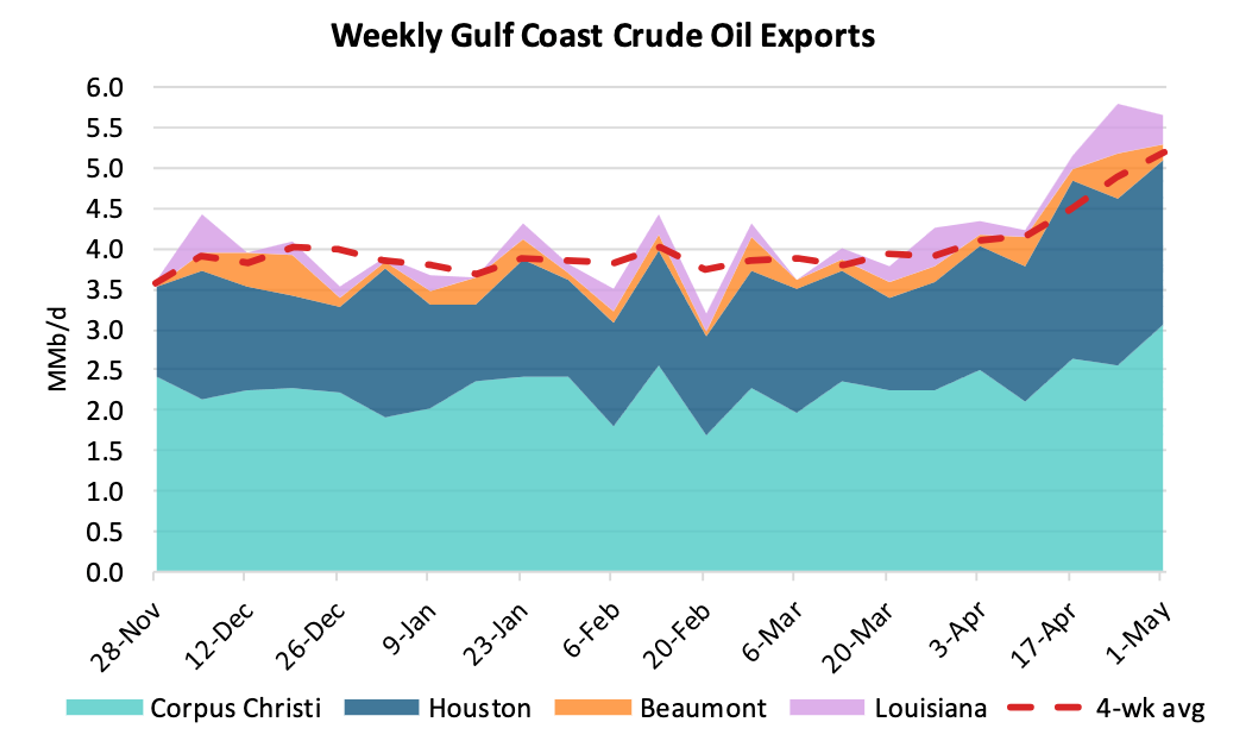
Figure 1. Weekly Gulf Coast Crude Oil Exports. Source: Crude Voyager
