Tuesday, February 18, 2014

The Light Crude Oil - Refinery Need For Heavy Oil Continues -- RBN Energy

Active rigs:


2/18/201402/18/201302/18/201202/18/201102/18/2010
Active Rigs18518019917193


RBN Energy:
Natural gas production in the Lower 48 has surged 40 percent since 2005 – hitting record levels in recent months in spite of low prices and a drilling migration away from dry gas to liquids plays. Following a similar trajectory, natural gas liquids (NGLs) output from gas processing plants jumped 40 percent since 2009 as drilling for wet (high BTU) gas accelerated. Crude oil production from shale did not take off until the end of 2011 but since then has surged an astronomical 56 percent to 7.8 MMb/d. While this winter’s harsh weather has placed a temporary slow down on these skyrocketing production numbers, RBN fully expects the growth trend to continue - putting the U.S. within sight of energy independence in the not too distant future.

As a result of new pipeline capacity and rail deliveries, a crude surplus is now building at the Gulf Coast – the biggest refining center in the US. That surplus is complicated by two factors in particular. The first is a mismatch between refinery configuration biased toward heavy crude processing and new supplies that are predominantly light crude. The second is a Federal ban on crude exports except to Canada. The refinery mismatch is putting downward pressure on prices for light sweet crude at the Gulf Coast that many refiners are not able to process without modifications to their configurations. The export regulations are not helping because they prevent excess supplies of light crude and condensate from finding a home in international markets.
A related industry challenge that we have followed closely is that of processing very light crude condensate being produced in increasing volumes in shale basins such as the South Texas Eagle Ford. A number of new build condensate splitters are under construction and planned to process condensate supplies that are a poor fit for Gulf Coast refineries.
In the absence of crude exports, regional refiners are processing the glut of domestic crude headed to the Gulf Coast into refined products for export. That’s in large part because US domestic markets for refined products like gasoline and diesel are flat at best while demand for these products is growing in Latin America, Europe and Asia. Blessed with cheap natural gas fuel supplies and low price domestic crudes, Gulf Coast refiners have become the marginal refined product suppliers to the world and this trend will continue.
The Wall Street Journal

When President Obama killed the Keystone XL 2.0 North, he screwed up plans for a lot of folks. A similar thing, but for different reasons, is affecting shippers with the problems associated with widening the Panama Canal. This is incredibly bad news for shippers; someone is going to take a huge loss:
Shipbuilders are cranking out ever-bigger container vessels and the world's major ports are dredging deeper, all on account of an ambitious multibillion-dollar project to widen the Panama Canal—an endeavor currently stalled by a contract dispute.
More than just the canal is tangled up in the acrimonious battle between Panama and the builders over $1.6 billion in cost overruns.
"There are many cities, countries and port authorities who are spending billions of dollars in anticipation of the traffic that will come from that newly expanded canal," said Adam Putnam, Florida's commissioner of agriculture.
"So, there will be an impact if there is an extended delay." The dispute so far has halted construction for two weeks and now threatens to delay the project by at least three years beyond the proposed completion date of December 2015. Negotiators say they are hopeful of a settlement as soon as Tuesday.
Lamborghini looks to expand. I'm only posting this because of the I-98 series. 

This was reported on the blog over the weekend; it's a huge story in today's WSJ. Chinese jewelry company buys US oil and gas company.

Is it a health-law rewrite or a legitimate delay? And when thinking about that, just remember, the Vietnam "war" was green-lighted with an executive order and a congressional resolution.

Don't look now, but investors have pushed the S&P 500 stock index back almost to a new record. The most ridiculous link I saw yesterday was the DrudgeReport link suggesting George Soros had bet against the market. When you got to the link, it turned out to be somewhat misleading. The link, that is. Drudge has his place, but he risks losing his credibility. Actually, the financial analyst commenting on George Soros' so-called bet against the US stock market told me all I need to know about financial analysts who blog. That's why this is not an investment site.

The Los Angeles Times

Nothing.

Monday, February 17, 2014

Catching Up On The News -- Two Stories: In-Depth Article On CBR Derailments; Oil Near $101

The AP has a four-page internet story over at Rigzone on CBR derailments, spills, explosions, and fires. It begins:
BILLINGS, Montana (AP) — At least 10 times since 2008, freight trains hauling oil across North America have derailed and spilled significant quantities of crude, with most of the accidents touching off fires or catastrophic explosions.
The derailments released almost 3 million gallons of oil, nearly twice as much as the largest pipeline spill in the U.S. since at least 1986. And the deadliest wreck killed 47 people in the town of Lac-Megantic, Quebec.
Those findings, from an Associated Press review of U.S. and Canadian accident records, underscore a lesser-known danger of America's oil boom, which is changing the global energy balance and raising urgent safety questions closer to home.
Experts say recent efforts to improve the safety of oil shipments belie an unsettling fact: With increasing volumes of crude now moving by rail, it's become impossible to send oil-hauling trains to refineries without passing major population centers, where more lives and property are at risk.
Adding to the danger is the high volatility of the light, sweet crude from the fast-growing Bakken oil patch in Montana and North Dakota, where many of the trains originate. Because it contains more natural gas than heavier crude, Bakken oil can have a lower ignition point. Of the six oil trains that derailed and caught fire since 2008, four came from the Bakken and each caused at least one explosion. That includes the accident at Lac-Megantic, which spilled an estimated 1.6 million gallons and set off a blast that levelled a large section of the town. After recent fiery derailments in Quebec, Alabama, North Dakota and New Brunswick, companies and regulators in the U.S. and Canada are pursuing an array of potential changes such as slowing or rerouting trains, upgrading rupture-prone tank cars and bolstering fire departments.
Company executives were expected to offer a set of voluntary safety measures in the coming days at the request of U.S. Transportation Secretary Anthony Foxx.
The second story, also over at Rigzone: oil nears $101 --
The price of oil extended gains above $100 a barrel Monday as the cold weather in the United States increased demand for heating fuels and solid Chinese credit numbers eased concerns over the world's second-biggest economy. By midday, benchmark U.S. crude for March delivery was up 62 cents to $100.92 a barrel in electronic trading on the New York Mercantile Exchange. On Friday, the Nymex contract fell 5 cents to close at $100.30.
**********************************

La Japonaise, Barcelona, The Opera, Freddie Mercury, Montserrat Caballe

Active Drilling Rigs In North Dakota On George Washington's Birthday

Oil was up today; approaching $101.

Active rigs in North Dakota:


2/17/201402/17/201302/17/201202/17/201102/17/2010
Active Rigs18518119717293

Wells coming off the confidential list for the long weekend, to be reported Tuesday:

Tuesday, February 18, 2014:
  • 24524, drl, SM Energy, Koeser 4X-26H, Siverston, no production data,
  • 25259, drl, XTO, Bully Federal 44X-20E, Bear Den, no production data,
  • 25312, drl, Hess, EN-Weyrauch A 154-93-1720H-8, Robinson Lake, no production data,
  • 25699, drl, Hess, AN-Evenson 152-95-0310H-4, Antelope, no production data,
  • 25827, drl, CLR, Akron 5-34H-1, Banks,  no production data,
  • 26026, 2,049, Newfield, Moberg Federal 149-95-29-32-4H, Bear Den, t11/13; cum 21K 12/13;
Monday, February 17, 2014:
  • 24903, 1,319, KOG, Smokey 3-17-20-14H3, Pembroke, t12/13; cum -- 
  • 25260, drl, XTO, Bully Federal 44X-20A, Bear Den, no production data,
  • 25417, drl, XTO, Rolfsrud State 14X-36F, Sand Creek, no production data,
  • 25953, drl, Fram Operating, Alexander 10-1, West Greene, no production data, 
  • 26008, 427, Whiting, McDanold 33-11, Wildcat, 11-142-105, producing, a vertical well based on name, t10/13; cum 17K 12/13;
Sunday, February 16, 2014:
  • 22344, 239, CLR, Metz 1-33H, Ukraina, t10/13; cum 5K 12/13;
  • 24447, drl, SM Energy, Lucille 1X-27H, Siverston, no production data, 
  • 24904, 2,002, KOG, Smokey 3-17-20-14HA, Pembroke, t1/14; cum --
  • 25151, 1,038, Whiting, Tescher State 11-25PH, Bicentennial, t8/13; cum 30K 12/13;
  • 25157, drl, CLR, Tallahassee 3-16H, Baker, no production data,
  • 25311, 970, Hess, EN-Weyrauch A 154-93-1720H-9, Robinson Lake, t1/14; cum --
  • 25700, drl, Hess, AN-Evenson 152-95-0310H-3, Antelope, no production data,
  • 25992, 524, HRC, Pasternak Federal 2-2-11H, Strandahl, t10/13; cum 12K 12/13;
  • 26027, 434, Newfield, Moberg Federal 149-95-29-32-11H, Bear Den, t12/13; cum 4K 12/13;
Saturday, February 15, 2014:
  • 20643, 1,816, EOG, Van Hook 104-1218H, Parshall, t11/13; cum 51K 12/13;
  • 25056, 1,815, EOG, Van Hook 33-1218H, Parshall, t11/13; cum 54K 12/13;
  • 25093, 745, EOG, Wayzetta 150-1509H, t8/13; Parshall, cum 158K 12/13;
  • 25261, drl, XTO, Bully Federal 44X-20F, Bear Den,
  • 25401, 1,523, Whiting, Fajewski 14-12-2H, Lonesome, t8/13; cum 42K 12/13;
  • 25402, 1,908, Whiting, Fajewski 14-12H, Lonesome, t8/13; cum 45K 12/13;
  • 25416, drl, XTO, Rolfsrud State 14X-36E, Sand Creek,
  • 25666, 305, Hunt, Alexandria 161-100-18-19H-1, Alexandria, t11/13; cum 4K 12/13;
Comment:
The Whiting wildcat, the McDanold (#26008), 11-142-105, looks interesting. It is three miles north of:
  • 25466, 148, Whiting, Williams 24-25, a wildcat, a Deadwood well, only 13,000 feet, a vertical well, t9/13; cum 10K 12/13; producing, 2,500 bbls/month
It is about three miles northwest of another Whiting well:
  • 24910, 45, Whiting, Meyers 31-19, Bonnie View field, a Red River well, only 12,000 feet, a directional well, t5/13; cum 5K12/13; 
and about two miles WNW of another well,
  • 8324, 109, Encore, Barkland 1-18-2A, Bonnie View field, a Red river well, only 12,000 feet, a vertical well; t8/82; cum 250K 12/13;

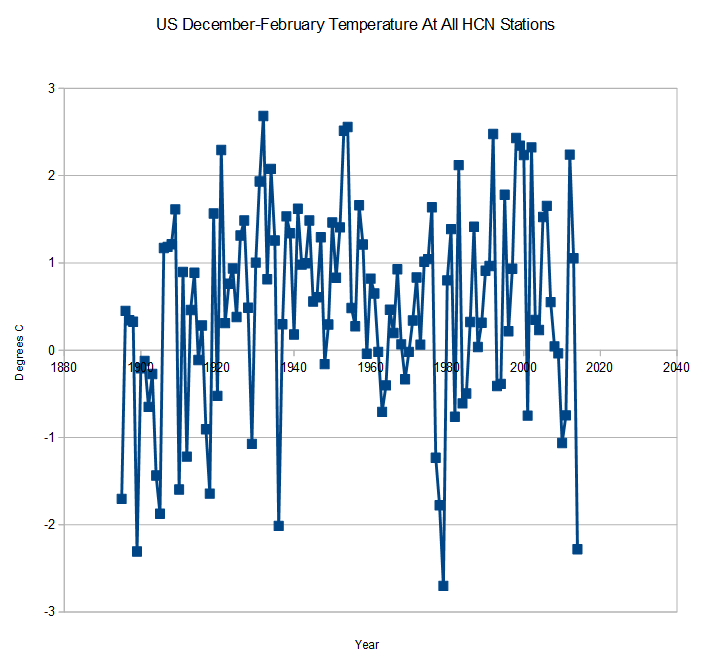
For The Warmists: This Is A Most Interesting Graph

From Real Science, look at that very interesting graph. The link:
http://stevengoddard.files.wordpress.com/2014/02/screenhunter_70-feb-16-12-51.gif
This is the third coldest winter on record for the US so far.

Look at that graph. A few things jump out at me.

First, the three coldest winters, including this one, are not even "kinda cold" compared to previous winters. The three coldest winters are practically off the scale.

Second, if one eliminates the first two decades (1890 - 1910), one would not even notice anything that looks anything like "warming." Only because of those first two decades, would a least-squares straight line slant "upward" (warming). And we have no idea what the temperatures were prior to 1890 based on this graph.

Also, look at that temperature scale, the "y" axis: the warmest winters did not even exceed 3 degrees Celsius off the baseline. The vast majority of "figures" were within two degrees Celsius, either warmer or colder than the baseline.

And the warmists are concerned about a one-degree rise over a century, conveniently forgetting that the earth has had no warming for 18 years, going on 19. The warmists also conveniently forget the #1 greenhouse gas is water vapor which accounts for about 97% of greenhouse gases in the atmosphere. CO2 accounts for less than 3% and manmade CO2 accounts for a fraction of that. And no one is telling us to limit our water vapor emissions.

**********************************
O Karen O
Highway 61 Revisited, Karen O and the Million Dollar Bashers


The Immigrant Song, The Girl With The Dragon Tattoo, Karen O and Trent Reznor

Chinese Buy Into More US Oil And Gas Assets

Bloomberg is reporting:
Goldleaf Jewelry Co., a Chinese jewelry retailer with gold mining investments, plans to buy U.S. oil and gas operator ERG Resources LLC for at least $665 million.
The Beijing-based company will pay for the acquisition with a private share placement, raising as much as $940 million from no more than 10 investors, Goldleaf said.
Buying closely held ERG would give Goldleaf a foothold in oil assets along the Gulf Coast and California, adding to $16 billion of oil and gas deals announced by Chinese companies in the past year, according to data compiled by Bloomberg. ERG sold 13 oilfields to Australia’s Linc Energy Ltd. in 2011 for $236 million.
The number of producing acres was not provided in the press release, at least that I could see.