Locator: 48655B.
May 19, 2025: Taiwan supercomputer, Nvidia, announced. Link here. Superconductors are tracked here.

***************************
Back to the Bakken
WTI: $62.42.
New wells:
- Tuesday, May 20, 2025: 49 for the month, 149 for the quarter, 346 for the year,
- 40830, conf, Hess, EN-Horst-154-93-0310H-9,
- Monday, May 19, 2025: 48 for the month, 148 for the quarter, 345 for the year,
- 40684, conf, XTO, HBU Lizette State 21X-16E,
- Sunday, May 18, 2025: 47 for the month, 147 for the quarter, 344 for the year,
- 41040, conf, XTO, HBU Lizette State Federal 21X-16G,
- 40861, conf, Hunt, Alexandria 161-100-23-35H-3,
- 40860, conf, Hunt, Alexandria 161-100-23-35H-2,
- 40494, conf, Oasis, Lee N 5201 21-5 6B,
- 37576, conf, BR, Keene 21-2 MBH,
- Saturday, May 17, 2025: 42 for the month, 142 for the quarter, 339 for the year,
- 41039, conf, XTO, HBU Lizette State Federal 21X-16C,
- 40542, conf, Hess, EN-Horst-154-93-0310H-8,
RBN Energy: backlog for natural gas turbines expends on surging demand, supply constraints. Archived.
There is tremendous buzz around natural-gas-fired turbines right now with backlogs reportedly stretching five years into the future due to supply-chain bottlenecks, labor shortages and a surge in demand. The power generation industry is poised for a major upswing as data center development and overall electricity demand continue to accelerate, driving an even greater need for gas turbines. In today’s RBN blog, we will explore why gas turbines are so challenging to build and why there’s such a manufacturing backlog.
As we noted recently in Only Happy When It Rains, there’s been a lot of talk the past few months about artificial intelligence (AI) and plans by Amazon, Google, Microsoft and others to build a slew of data centers — energy hogs that require vast amounts of around-the-clock electricity. Developers have been considering the full gamut of power-generation sources — everything from renewables to nuclear — but almost everyone understands that gas-fired plants will be a big part of the solution. A number of major gas producers and just about every big midstreamer with a gas pipeline network have been talking up their plans to serve these new power plants, and several gas-fired projects — many tied directly to data centers — have already been announced. And while there are other fundamental factors stimulating demand for gas-fired power generation, the high profile of the data center development has put a spotlight on the prospects for acquiring the turbines needed to run a gas-fired power plant, a bigger challenge than it might appear.
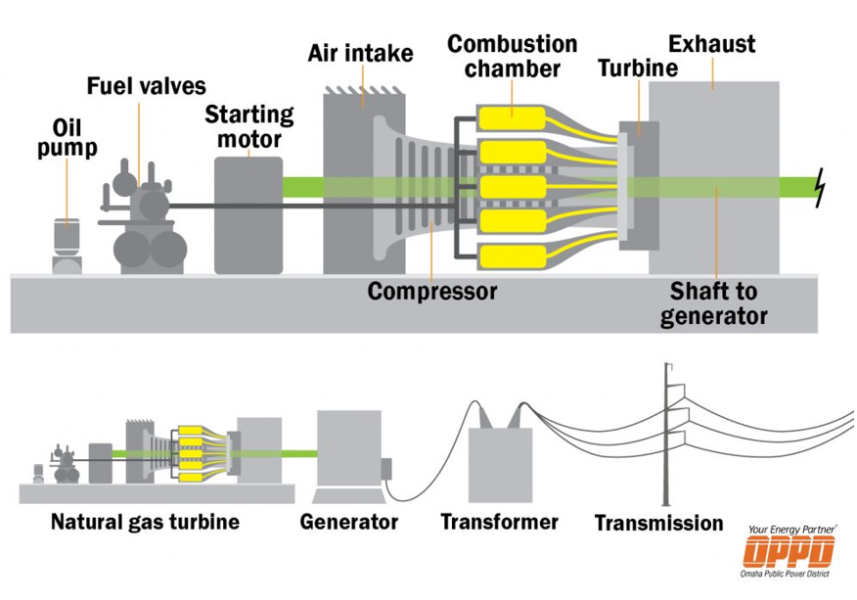
Before we get into what’s behind the turbine bottleneck, let’s start with some basics on turbines and how they work. A gas-fired turbine is a giant engine that transforms the energy in natural gas into electricity using a continuous, high-speed process. As shown in Figure 1 below, it works by taking in air, squeezing it tightly and mixing it with fuel — creating a fiery (but controlled) explosion in its combustion chamber. The blast of hot, high-pressure gases rushes through and spins the turbine’s blades. The spinner on the turbine turns a shaft connected to a generator (bottom portion of graphic), where the mechanical energy is then turned into electricity. It then heads to a transformer, which increases the voltage, and then to a transmission line. (High-voltage lines allow electricity to be transmitted over long distances with minimal losses.)
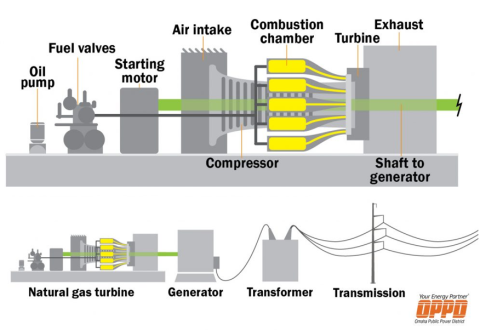
Figure 1. How a Natural Gas Turbine Generates Electricity. Source: Omaha Public Power District