A reader was nice enough to remind me of some data points regarding the Hess Vantage pipeline.
I replied that I was lazy this week/this weekend -- just too much to blog and I did not take the time for a proper update. Sorry. This all started with updates on Hess yesterday, these two links:
The Vantage pipeline to Alberta
from the Hess plant is probably the longest ethane pipeline in North
America. OneOK y-grade pipe line takes Bakken NGLs to Conway, Kansas,
where the propane is fractionated and sent to north to Iowa and points
north. The rest of the NGLs are sent to Mt Belvieu, TX, where the rest of
the fractionations occur.
The Vantage Pipeline is a high vapour pressure
(HVP) pipeline carrying ethane from a source near Tioga, North Dakota, extending northwest, through Saskatchewan, Canada, and
terminating near Empress, Alberta, Canada. The pipeline links a growing
supply of ethane from North Dakota to markets in Alberta.
The Vantage Pipeline is 445 miles steel pipeline, with an outside diameter of 10 inches.
Pembina Pipeline Corporation is pleased to announce that it has entered into agreements to
acquire the Vantage pipeline system and Mistral Midstream
Inc.'s interest in the Saskatchewan Ethane Extraction Plant for total consideration of US$650 million.
Vantage is a recently constructed, approximately 700 kilometre ("km"),
40,000 barrel per day ("bpd"), high vapour pressure pipeline that
originates in Tioga, North Dakota and terminates near Empress, Alberta.
Vantage provides long-term, fee-for-service cash flow and strategic
access to the prolific and growing North Dakota Bakken play for future
natural gas liquids (NGL) opportunities.
The Vantage pipeline can be increased to 60,000 bpd with minimum costs.
From July 16, 2013: Canada's biggest plastic producer will purchase all the ethane that Hess produces at its Tioga plant; US State Department approved the international pipeline to complete the deal.
Now, newtoday: to say the least, the Vantage Pipeline really excited me when it was announced and then completed. But I was remiss re-posting all that for newbies. Again, a big apology. The notes above might be a bit disjointed, but one can probably sort it out.
Now, putting all that together from the reader today:
Hess moves ethane on this pipeline from Tioga to Empress, Alberta, where the Alberta Ethane Gathering System takes it to Nova Chemical's petrochemical complex at Joffre, Alberta.
Hess is just completing the fifth year, I believe it is, of a ten-year deal supplying ethane to Nova.
So I doubt they want to move ethane off this pipeline in the immediate future.
And then this, which I had completely forgotten:
You may recall you previously mentioned one Bakken "tidbit", that Nova Chemicals is a subsidiary of IPIC (International Petroleum investment Company) which is wholly owned by the government of Abu Dhabi, United Arab Emirates.
Another Bakken amazement - supplying the UAE ethane!
June 16, 2015: personal note from reader provides update on plastics factory; site still not determined; still on track but could be delayed one year longer than planned.
Ohio’s Utica shale is generating enough liquid ethane to support
several processing plants that can carry a price tag of several billion
dollars.
At least four of the so-called cracker plants that turn ethane into
ethylene, a key ingredient in making plastic, have been proposed in
Ohio, West Virginia and western Pennsylvania.
Natural gas wells in the Utica and Marcellus shale formations in
those three states are producing enough ethane to support three large
cracker plants, said [Cleveland State University economist Iryna] Lendel, whose comments were based on a preliminary
economic assessment of the Utica Shale.
About 60 percent of the liquids derived from Utica wells are ethane, she said.
Cracker plants cost from $1 billion to $7 billion, depending on size.
It probably will take five to seven years before the first plant opens
in the Appalachian Basin, Lendel said.
October 14, 2014: Bismarck. There is talk -- from message boards, e-mail -- that more than one plant might be possible.
Original Post
The Dickinson Press and KXNET are reporting a $4 billion petrochemical plastics plant coming to North Dakota:
A company announced plans Monday to
build a $4 billion manufacturing plant in North Dakota that will
convert a byproduct of natural gas processing into an ingredient for
making plastic products, representing what Gov. Jack Dalrymple called
the largest private investment in state history.
Badlands
NGL’s LLC and two partners are developing the facility, which will
convert ethane into polyethylene, which is used to make a wide variety
of plastics for consumers and industry.
The plant will
produce 3.3 billion pounds of polyethylene annually and employ 500
people, company CEO Bill Gilliam said. He said the partners hope to be
cranking out the finished product – little white plastic beads – by the
end of 2017.
Gilliam said more than two sites are being
considered in North Dakota but he wouldn’t say where, except that they
aren’t in active oil drilling locations in western North Dakota. The
plant is expected to cost $4 billion to $4.2 billion and will require a
“substantial footprint” of more than 1,000 acres, he said.
One
of the project partners, Madrid, Spain-based Tecnicas Reunidas, a major
contractor for petrochemical plants, is doing a preliminary engineering
analysis that is scheduled for completion this year and will include a
final site selection for the facility.
The Vantage pipeline to Alberta
from the Hess plant is probably the longest ethane pipeline in North
America. OneOK y-grade pipe line takes Bakken NGLs to Conway, Kansas,
where the propane is fractionated and sent to north to Iowa and points
north. The rest of the NGLs are sent to Mt Belvieu, TX, where the rest of
the fractionations occur.
The Vantage Pipeline is a high vapour pressure
(HVP) pipeline carrying ethane from a source near Tioga, North Dakota, extending northwest, through Saskatchewan, Canada, and
terminating near Empress, Alberta, Canada. The pipeline links a growing
supply of ethane from North Dakota to markets in Alberta.
The Vantage Pipeline is 445 miles steel pipeline, with an outside diameter of 10 inches.
"I know that the American people are concerned about the possibility of
an Ebola outbreak, and Ebola is a very serious disease. And the ability
of people who are infected who could carry that across borders is
something that we have to take extremely seriously," Obama said. "At the
same time, it is important for Americans to know the facts, and that is
that because of the measures that we’ve put in place, as well as our
world-class health system and the nature of the Ebola virus itself —
which is difficult to transmit — the chances of an Ebola outbreak in the
United States is extremely low."
CDC spokesman Tom Skinner said the agency is
still investigating the case of the Dallas nurse, but stressed that
"meticulous adherence to protocols" is critical in handling Ebola. "One
slight slip can result in someone becoming infected."
[This was taken to be a "blame the victim" comment; nurses outraged; Skinner has now apologized.]
*******************************
The Gift That Keeps On Giving
The Los Angeles Times is reporting: Orange County, California, will refinance new toll road -- now drivers can expect to pay tolls through 2050:
An Orange County toll road that has struggled to build ridership will
be refinanced for a second time -- a move that will add years to the
period motorists will have to pay tolls to ride it.
On a 12-2
vote, the board of the San Joaquin Hills corridor approved restructuring
at least half of the $2.2 billion in bonds that were sold to build the
highway, which courses through the coastal hills from Newport Beach to
San Juan Capistrano.
The plan by the Transportation Corridor Agencies in Irvine is expected
to improve the road's bottom line, but motorists might have to pay tolls
until 2050 to retire the debt.
***********************************
The Other Gift That Keeps On Giving
I talked about this from the beginning. To keep premiums "low" -- the deductibles and co-pays are very, very high. And more health care facilities (clinics and hospitals) want their money up front. The AP is reporting:
They have health insurance, but still no peace of mind. Overall, 1 in
4 privately insured adults say they doubt they could pay for a major
unexpected illness or injury.
A new poll from The Associated Press-NORC Center for Public Affairs
Research may help explain why President Barack Obama faces such strong
headwinds in trying to persuade the public that his health care law is
holding down costs.
The survey found the biggest financial worries among people with
so-called high-deductible plans that require patients to pay a big chunk
of their medical bills each year before insurance kicks in.
Such plans already represented a growing share of employer-sponsored
coverage.
Now, they're also the mainstay of the new health insurance
exchanges created by Obama's law.
Edward Frank of Reynoldsville, Pennsylvania, said he bought a plan
with a $6,000 deductible last year through HealthCare.gov. That's in the
high range, since deductibles for popular silver plans on the insurance
exchanges average about $3,100 — still a lot.
"Unless you get desperately ill and in the hospital for weeks, it's
going to cost you more to have this plan and pay the premiums than to
pay the bill just outright," said Frank, who ended up paying $4,000 of
his own money for treatment of shoulder pain.
"The deductibles are so high, you don't get much of anything out of it," said Frank, who is in 50s and looking for a new job.
The bigger problem: folks don't really understand the concept of "insurance." Frank bought catastrophic health insurance; he did not buy a policy to pay for his day-to-day expenses. Folks understand auto insurance (apparently) but can't make the leap to health insurance.
********************************
It's Counterintuitive
Prediction: analysis of the results of the mid-term elections will show that President Obama was correct. If the Dems are to hold the Senate, Mr Obama needs to be on the ballot. The fact that Mr Obama is not on the ballot is the Dems biggest challenge this year.
November 7, 2025: officials approve WMB-NG pipeline into NYC and Long Island. WMB has scrapped plans after originally being disapproved by same officials. Link here. Called the NESE Pipeline -- the Northeast Supple Enhancement project -- NESE for short.
August 21, 2025: MDU wins the lottery: link here. A $500 million guarantee to build a new pipeline from the Bakken to the Red River of North Dakota.
February 22, 2025: KMI, Hiland, Outrigger deal closed. Link here.
PennEast Pipeline Co. said that although it received federal approval
for the 116-mile pipeline from Luzerne County to Mercer County in New
Jersey and some permits, it has not received water quality certification
and wetlands permits required under the Clean Water Act.
November 6, 2018: Voyager Pipeline proposed. Cushing to Houston; perhaps Corpus. Would ultimately connect Bakken directly to Gulf Coast refineries, export terminals.
September 18, 2018: Iowa Supreme Court has heard both sides for/against the DAPL. We will get judgment in four to six weeks. Very, very bad news. To say the least.
February 28, 2018: update on Enbridge Line 3 over at SeekingAlpha. This has dragged on so long, I had completely forgotten about it. I'm not holding my breath on this one. Pretty frustrating.
May 16, 2017: there are reports suggesting that oil is now flowing through the DAPL. Also, a third lawsuit against the DAPL asking for a court injunction to stop the flow has been filed within the last 24 hours.
August 12, 2016: how others see the Dakota Access Pipeline, a pipeline that is only 7 miles shorter than the Keystone XL would have been. Mother Jones has a nice overview. August 5, 2016: update on the Bakken Pipeline System -- the Dakota Access Pipeline from North Dakota to Illinois via Iowa; and the Energy Transfer Crude Oil Pipeline from Illinois to Texas; funding complete; calls Sandpiper into question
October 28, 2014: update on new Bakken pipeline. ETP to take pipeline from the Bakken, through South Dakota, through Iowa, to Illinois (the Dakota Access Pipeline); and then a second pipeline from Patoka to Nederland, Texas. First mentioned at the blog by RBN Energy.Update at BizJournals:
Energy Transfer Partners announced a joint venture with Phillips 66 to build two pipelines to move crude oil out of North Dakota (75% / 25% respectively). Dakota Access Pipeline (DAPL) from the Bakken to Pakota; ETP Crude Oil Pipeline (ETCOP) south from Patoka.
April 4, 2013: Harold Hamm to build the Double H pipeline, should be on-line by August, 2014. $300 million. Initially 50,000 bopd; to reach 100,000 bopd. Dore, ND, to Baker, MT; joins the Butte Pipeline south to Guernsey, WY; new pipeline from Guernsey down to Tallgrass Pony Express pipeline (converted from natural gas to crude during this time period); to Cushing, OK.
August 30, 2012: Enterprise Products offering additional capacity on ATEX Express
ethane pipeline: Co announced the start of a
binding open commitment period to determine additional shipper demand
for capacity on the partnership's Appalachia-to-Texas ("ATEX Express")
pipeline. The 1,230-mile system will deliver growing ethane production
from the Marcellus/Utica Shale areas of Pennsylvania, West Virginia and
Ohio to Mont Belvieu, Texas. [See January 23, 2012, entry.]
June 8, 2012: EPD has begun accepting deliveries for and commissioning the first phase of its Eagle Ford crude oil pipeline between Wilson County and Sealy, TX.
A project that beefs up pipeline capacity to move crude from the U.S. Midwest to the world's largest refining market by Enbridge Inc. and Enterprise Products Partners LP is set to lift heavily discounted U.S. oil prices but won't boost even cheaper Canadian barrels, Enbridge chief executive Pat Daniel said Tuesday.
The more than doubling of a previously planned expansion of the Seaway pipeline between Cushing, Okla., and the Texas Gulf Coast,
announced by Enbridge and Enterprise Monday night, will eat away at
stockpiles of crude in the Midwest to bring U.S. oil prices closer in
line with global barrels, but will not reduce Canada's reliance on one
customer - the United States, Daniel said.
Calgary-based pipeline operator Enbridge has launched projects to add 10,000 barrels per day of rail oil capacity to its Clearbrook terminus by July, with another 70,000 barrels per day planned by 2013.
Simmons forecasts the congestion may see some relief in May, when Enbridge and Enterprise Products Partners begin to fill their reversed Seaway Pipeline, from Cushing, Okla., to the Gulf Coast, which will require two to three million barrels of capacity.
delivering ethane production from the Marcellus-Utica shale areas of Pennsylvania, West Virginia, and Ohio to the US Gulf Coast. ATEX Express will transport as much as 190,000 b/d from Appalachian production areas to EPP’s storage and distribution assets in Texas.
Originating in Washington County, PA, the system’s first leg would involve construction of about 595 miles of new pipeline extending to Cape Girardeau, MO, closely paralleling an existing Enterprise pipeline. At Cape Girardeau, EPP will reverse a 16-in. OD pipeline and place it into ethane service.
At the southern terminus of the ATEX Express pipeline, EPP will build a 55-mile, 16-in. OD pipeline providing access to its NGL storage complex at Mont Belvieu, TX. Expected operational date: 1Q14.
December 9, 2010: Keystone XL hearings in Nebraska.My hunch is the Keystone XL pipeline will not be completed in my investing lifetime. Any state from Montana to Oklahoma can scuttle the deal; and even if the states allow it, getting the necessary rights of way will take forever in light of recent Gulf of Mexico spills.
July 20, 2010: Kinder Morgan to go public; Questar to spin off its E&P division, QEP; TransCanada Pipeline delivers its first oil to Chicago; TransCanada Keystone XL project on track but political issues may cause delays.
May 5, 2010: Enbridge's Alberta Clipper project on-line, April 1, 2010.
... the 85-mile Four Bears pipeline
through McKenzie, Dunn and Billings counties in western North
Dakota later this year, according to state Public Service
Commission filings.
The proposed line is intended to connect with three pipeline
networks that supply crude to the Tesoro Corp. refinery at Mandan,
and to refineries in Minnesota and Wyoming.
January 5, 2010: ENB upgrade completed; ND still short on capacity. Actually, it's EEP -- EEP's principal crude oil system is the largest transporter of oil production from western Canada. The system's deliveries to the United States account for approximately 11 percent of total U.S. oil imports.
December 1, 2009: EPD bought another pipeline, probably small news item in the big scheme of things, but linked here just to be complete. The pipeline originates in Odessa, west Texas, and 265 miles later connects with a Pemex pipeline at the Mexico-US border near El Paso. EPD is NOT in the Bakken.
October 14, 2009: ENB: 52-week high; pays 3.5%. Compare with money market funds. Nice Barron's article on ENB, T. 2010 Guidance Conference Call scheduled for December 2, 2009.
November 3, 2009: EEP: $0.99/share payable November 13 for those holding the shares November 5, 2009. Ex-div: November 3, 2009. Pays 8.3%. I use EEP as a place to hold funds while deciding what to buy. If dividend looks questionable, will look for other high dividend payers in the oil patch.November 28, 2009: In addition to the 570 new wells requested by EOG in case 11939, I count about 241 additional wells by EOG and other producers.
Note: until this month, I had never paid attention to "dockets." It turns out that a docket with 19 pages is not unprecedented. The July 21, 2009, docket had 19 pages, and in that same month (July 29, 2009), there was another docket with 14 pages. In 2009, there were an average of 18 pages of requests if one excludes the month of July. In July, there were 39 pages of requests, total. The number of pages by month shows a trend: Jan (16 pages); Feb (14); Mar (13); Apr (14); May (16); Jun (15); Jul (39); Aug (24); Sep (18); Oct (21); Nov (28); and, Dec (29). This continues to validate my hunch that 2010 is going to be a watershed year for the North Dakota oil industry if oil stays above $70/barrel. CLR has hedged 5,000 bopd for $80 between January and July, 2010.
For investors, I think the pipeline companies are going to be able to charge a surcharge to transport all the oil that will be produced.
November 4, 2009: The Mountrail County Promoter states that North Dakota, already the 4th leading oil producer in the United States, would produce more oil if pipeline capacity was adequate. The writer notes that there is talk of two more pipelines in the Stanley area: one would take oil into Canada and then back into the states through another pipeline; and the second additional pipeline would take oil out of the local area. I have opined elsewhere that one starts to get the feeling that the Williston Basin could become another "Tulsa" over the next two decades.
*****
Pipeline, The Ventures (I couldn't resist.)
*****
American Pipelines
Morgan Kinder to go public in 2010.
ENB, EEP, EEQ (family): ENB and EEP are my favorite (as noted below, I don't follow EEQ). I have ENB as a long-term hold, and I trade in and out of EEP for the distribution. Stand-alone page.
STR: Questar -- an E&P company but a conglomerate focused on energy; one of its five core competencies is pipeline. Might be a better alternative to MDU during current recession. March 9, 2010. Questar will spin off its E&P division at end of July, 2010: QEP.
MDU: If interested in pipelines, this is a very interesting play. Safe, conservative, Fortune 500, nice dividend, particpating in the Bakken in many ways. Has had some tough quarters during the 2008 - 2010 recession; I used to hold / accumulated shares, but sold all my MDU during the recession. Switched to ENB and EEP.
EPD: not in North Dakota, as far as I know, but I follow and often invest in due to high dividend and good outlook. [With the June 24, 2014, announcement, EPD will now be building a pipeline in North Dakota.]
The distribution
of economic benefit is another important issue. Operators who control
processing and gathering infrastructure will obviously be in a better
position to receive the highest value for their product. Hess Corp. and
Whiting Petroleum are two examples of large operators taking significant
control of
infrastructure development in their operating areas. Hess' midstream
solution is the most comprehensive and integrated: it includes a
large-scale processing and fractionation facility, a dedicated ethane
pipeline (Vantage pipeline), and an anchor shipper position on a new
lateral interconnection to an interstate gas pipeline.
The U.S. State Department has
approved construction of the North Dakota portion of a gas pipeline from
Tioga into the Canadian province of Alberta, Sen. John Hoeven said Tuesday.
The proposed $300 million, 430-mile Vantage Pipeline is slated to supply ethane from North Dakota's oil patch for Alberta's petrochemical industry beginning later this year, the Republican lawmaker said in a news release.
North Dakota's portion of the pipeline is about 80 miles long. A
presidential permit from the State Department is required because the
pipeline would cross the U.S.-Canadian border.
Ethane is colorless and odorless and extracted from raw natural gas.
It's used to make plastics and for welding, and as an anesthetic and an
agent for ripening fruit.
Then, note this:
Nova Chemicals Corp., Canada's
biggest plastics producer, announced in 2010 that it had signed a
long-term agreement to purchase all of the ethane produced at Hess
Corp.'s natural gas plant in Tioga, in northwest North Dakota. Nova
Chemicals at that time also signed a shipping agreement with Mistral
Energy Inc.
Justin Kringstad,
director of the North Dakota Pipeline Authority, says North Dakota's
Bakken shale produces high-quality ethane but that the valuable gas has
not had a viable market until now. In Canada, ethane supplies have been
shrinking, he said.
Can you spell Ka-ching?
A huge "thank you" to two readers who caught this story. This is a huge story.
ONEOK's newly opened 100,000 mcf/d Garden Creek II natural gas processing facility in eastern McKenzie County, North Dakota, may add another 18,000 b/d of natural gas liquids production to the region, a Platts analysis found Wednesday.
ONEOK Partners on Tuesday announced the plant is now operational, doubling capacity at the Garden Creek complex from 100,000 mcf/d to 200,000 mcf/d.
According to Maria Mejia, an analyst at Bentek, a unit of Platts, the Garden Creek I plant became operational in mid-2011 and has been operating at or above its nameplate capacity of 100,000 mcf/d since August 2012.
Be careful on this one. The second paragraph says the capacity was doubled to 200,000 -- as noted in the paragraph, that's for the entire complex which has Garden Creek 1 and Garden Creek 2. There is a Garden Creek 3 proposed/under construction which may / may not be part of the same complex.
Pembina Pipeline Corporation is pleased to announce that it has entered into agreements to
acquire the Vantage pipeline system and Mistral Midstream
Inc.'s interest in the Saskatchewan Ethane Extraction Plant for total consideration of US$650 million.
Vantage is a recently constructed, approximately 700 kilometre ("km"),
40,000 barrel per day ("bpd"), high vapour pressure pipeline that
originates in Tioga, North Dakota and terminates near Empress, Alberta.
Vantage provides long-term, fee-for-service cash flow and strategic
access to the prolific and growing North Dakota Bakken play for future
natural gas liquids (NGL) opportunities.
The Vantage pipeline can be increased to 60,000 bpd with minimum costs.
Dakota Plains Holdings, Inc. today announced that its Board of Directors and joint
venture partner have approved the expansion of oil storage at its
Pioneer Terminal in New Town, North Dakota. Construction of a third
90,000 barrel storage tank is set to immediately commence; regulatory
permits and engineering design are complete and Dakota Plains expects
the storage tank to be operational by summer 2015.
The Pioneer Terminal is located in the heart of the Bakken and Three
Forks formations and currently has sustainable throughput capacity of
45,000 barrels of oil per day with onsite oil storage of 180,000
barrels. The addition of a third storage tank, recently announced Hiland
Partners gathering pipeline, and anticipated expanded rail service will
facilitate increasing the sustainable throughput rate to a unit train
per day - equivalent to 80,000 barrels of oil per day.
On August 18, 2014, I posted an earlier story related to this announcement. Wow, it's nice that these projects can all be done in-state, and not have to include Minnesota or Iowa to weigh in on these projects. This represents a lot of jobs for American men and women.
Dominion Resources, Duke Energy and other partners are proposing a $5
billion natural gas pipeline to connect the Southeast with the
prodigious supplies of natural gas being produced in Pennsylvania, Ohio
and West Virginia.
********************************
Nothing About The Bakken
This is an interesting psychological insight that historians may address thirty years from now with regard to US presidents using President Obama as a case study.
It's pretty much agreed that the president has checked out of day-to-day world events, concentrating more on golf and fund-raisers. (Their analysis, not mine.)
There is a "feeling"among some that the president realizes that he does not have much leverage at this point. He has no strategy for Syria (his words, not mine), and Putin says he can take Kiev in two weeks and Obama has no military plans for Ukraine (his words, not mine). In response, he phones it in, or ignores it completely.
My interest is pretty much energy-related, and Bakken-centered. I doubt the US has ever been in a better position, compared to the rest of the world, with regard to energy. We have it all: nuclear, thermal, hydroelectric, solar, wind, biomass, ethanol, coal, natural gas, oil, and yet, I don't recall the president talking about US energy policy except to say a long time ago, something about "all of the above." Except coal. And no Canadian oil. From my perspective, he has failed to use North American energy as leverage to frame world events going forward, not just one or two years into the future, but decades into the future.
It appears that the president has "interpreted" his loss of leverage (a lame duck president with looming mid-term elections, and a White House strategy to keep him out of toss-up states [their words, not mine]) to affect his legacy as a loss of leverage for the US to affect / frame global events. In psychiatry that is called "transference."
He appears to see the future of the United States what he sees in his own personal future. I doubt this is unique for this president.
The phenomenon was noted in Jimmy Carter's "malaise speech."
Obama has been giving Americans a pep talk, essentially counseling
them not to let international turmoil get in the way of the domestic
economic recovery. “The world has always been messy,” he said Friday.
“In part, we’re just noticing now because of social media and our
capacity to see in intimate detail the hardships that people are going
through.”
So we wouldn’t have fussed over Russia’s invasion of
Ukraine if not for Facebook? Or worried about terrorists taking over
much of Syria and Iraq if not for Twitter? This explanation, following
Obama’s indiscrete admission Thursday that “we don’t have a strategy
yet” for military action against ISIS, adds to the impression that Obama
is disengaged.
From that article, the following pertains to the Bakken:
Pembina has said another important avenue for enhancing ethane
supplies could involve increased utilization of its wholly owned Vantage
Pipeline (blue lines in Figure 1) that imports ethane from a gathering
point in Tioga, ND, in the heart of the Bakken, along with very small
amounts that come from an ethane-extraction plant in Saskatchewan.
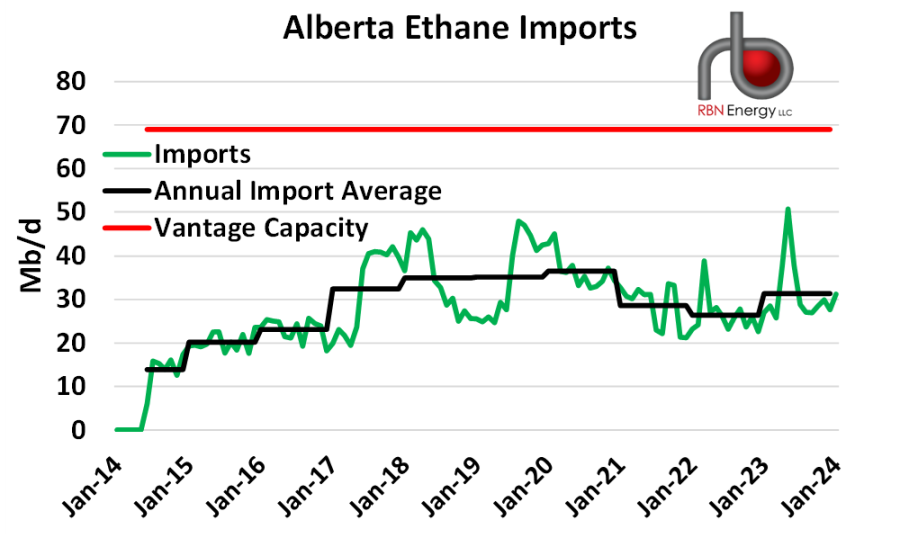
Vantage’s capacity is pegged at 69 Mb/d (red line in Figure 4 below) and
the AER’s data puts January 2024 and full-year 2023 ethane imports at
31 Mb/d (right end of green line and black line, respectively), although
flows have reached as high as 51 Mb/d. With 2023 imports averaging 31
Mb/d, less than half of the pipeline’s capacity is typically being
utilized and suggests that up to 38 Mb/d of additional supply could be
sent to the Dow site via Vantage, or to supply Nova’s Joffre site, with a
portion of existing Joffre-bound ethane supplies being diverted to Dow.
Figure 4. Alberta Ethane Imports. Source: AER
There is certainly some potential for more ethane to come from the Bakken. Back in August, ONEOK sanctioned a 100-Mb/d expansion of its existing 300-Mb/d Elk Creek NGLs Pipeline
that will increase NGLs takeaway for Bakken gas producers and ship
these volumes southeast to a market hub in Bushton, KS. ONEOK also owns a
30-Mb/d pipeline (the Tioga Lateral) that connects to Elk Creek and
ties back to the Tioga connection with Pembina’s Vantage Pipeline.
Although no specific expansion of this lateral has been announced, this
could be an easy bolt-on for ONEOK, especially with the assurance that
more ethane demand is soon to be on tap in Alberta. Our point here is
that, with steadily rising amounts of associated gas production in the
Bakken (i.e., gas that is rich in NGLs), producers will benefit from
more NGLs takeaway capacity, and the Tioga connection to Vantage could
form part of that solution, as well as Pembina’s in terms of tapping
into more ethane imports.
Tesoro Logistics LP announces
that in response to interest from a higher than expected number of
potential shippers, it is extending its binding open season for firm
priority capacity on the Tesoro High Plains Pipeline system until Apr 4,
2014 at noon central time.
TLLP
also announced that to maximize the number of potential shippers on the
system, the size of bid tranches would be reduced to 5,000 barrels per
day (bpd), for both Phase 1 and Phase 2. As previously announced, the
proposed THPP capacity expansion would be executed in two phases:
Phase
I will provide incremental capacity to transport up to approximately
70,000 barrels per day of crude petroleum from various locations south
of Lake Sakakawea, including Johnson's Corner, Keene, Blue Buttes and
Charlson Station, to Ramberg Station by July 1, 2014.
Phase II
will provide incremental pipeline capacity of up to 90,000 bpd from
Ramberg to Stampede, with an expected in-service time frame of second
half of 2015.
The in-service time frames are subject to THPP
obtaining sufficient commitments from shippers as well as regulatory and
internal approvals. Concurrent with the start of the open season, TLLP
also announced its proposal to expand the Bakken Area Storage Hub terminal facility.
TLLP is also extending the time for potential customers to submit offers for BASH storage space until April 4, 2014.
Justin Kringstad, director of the North Dakota Pipeline Authority in
Bismarck, said in his Feb. 14 report of production and transportation
that an estimated 20 percent of the Williston Basin crude oil is
transported by pipeline. The report used December 2013 information, the
most recent available.
The remainder of the transportation is:
1 percent by truck to Canadian pipelines.
6 percent to the Tesoro Refinery in Mandan.
An estimated 73 percent by rail.
Besides
the Sandpiper project, the proposed Dakota Pipeline, Vantage Pipeline
and Alliance Pipeline are also major pipeline projects in North Dakota.
WBI
Energy, the pipeline and energy services subsidiary of MDU Resources
Group, Inc. announced on Jan. 30 that it was holding an open season for
its proposed Dakota Pipeline, a 375-mile natural gas pipeline from
western North Dakota to northwestern Minnesota, according to company
information.
*************************************
The Wall Street Journal
The downed airliner: looks like another "Lockerbie."
The West tries to loosen Russian's natural gas grip. Good luck. All that EU investment in renewable energy certainly looks foolhardy in hindsight. I guess it was a choice between supporting the activist environmentalists and "realpolitiks" and the environmentalists won.
Western officials are scrambling to loosen Russia's energy stranglehold on Ukraine, the latest sign of growing pressure on Moscow to end the crisis.
The options being considered by officials from Brussels to Washington include larger exports of U.S.-made natural gas, reversing the flow of natural gas through pipelines from Western Europe back into Ukraine, and accelerating plans across Europe to buy more energy from countries other than Russia.
"If no solution to this can be found," European countries will "recast their approach to energy and economic links with Russia over time," U.K. Foreign Secretary William Hague said Sunday.
Western officials also have threatened sanctions against Russia if the Kremlin continues its occupation of the Crimea region of Ukraine.
The threats have failed so far, with Russian President Vladimir Putin declaring his support Sunday for Crimea's move to secede from Ukraine. The region could join Russia as soon as this month, a Kremlin-backed leader in Crimea said.
I personally don't think the Obama administration can act quickly enough to help the Europeans with natural gas. It's only been six years for him to make a decision on one pipeline, the Keystone. Oh, that's right, he hasn't made a decision on that pipeline either.
The share of new homes being built as rental apartments is at the highest level in at least four decades, as an improving jobs picture spurs younger Americans to form their own households but tighter lending standards make it more difficult to buy.
Residential construction—a pillar of the economy and employment—is starting to ramp up again overall, but in previous years the growth was driven by single-family homes.
Last year, according to census data, construction was started on a little less than one million new residential units, and about one in three of those was a rental in a multifamily building, the highest share since data began in the mid-1970s. Single-family homes accounted for about two-thirds of housing starts last year, down from their peak of 87% in 1993 and about 80% in the years leading up to the recession, the census data showed.
An Environmental Protection Agency review board was pressured by officials at the agency to soften its challenges to an EPA plan for dealing with a highly contaminated radioactive waste site in this St. Louis suburb, a former board member and other people familiar with the matter said.
In what some saw as a sign of the intensity of the dispute, the EPA turned a 2012 review of the site from a public process to a confidential one. Some people familiar with that move believe it was done to save the EPA the potential embarrassment of the dispute becoming public.
The EPA, in written responses to questions, denied that pressure was put on the review board or that there were attempts to hide its views. The agency said a nonpublic "consultation" on the plan was more appropriate than a full public "review" because it was determined that more sampling and testing needed to be done at the site. It acknowledged, however, that a switch from a review to a consultation had never before happened.
In the original report on this pipeline, the company said it could increase capacity to 60,000 bpd. The company has announced it will do the expansion, and will actually exceed the original 60,000 bpd -- bringing capacity up to 68,000 bpd. A big deal considering the concerns about the Bakken and the slump in oil prices.
Pembina Pipeline Corp. has announced plans to expand the Vantage
pipeline system which would link Bakken’s growing supply of ethane with
the petrochemical market in Alberta.
The recently constructed high-vapor-pressure Vantage pipeline runs
from a gas processing plant in Tioga, North Dakota, and extends 430
miles to Empress, Alberta. From there it connects to the Alberta Ethane
Gathering System pipeline. The $85 million expansion will increase the
mainline capacity from 40,000 barrels per day (bpd) to roughly 68,000
bpd. The additions will include new pump stations and a new 50-mile
8-inch gathering line.
Economy: I may be interpreting this incorrectly but this seems like good economic news. Link here. This doesn't look like an economy teetering on recession.
Let's put the October, 2025, Empire Manufacturing Index in bullet form:
EMI: +10.7% vs a minus 1.8% estimate -- holy mackerel! Prior was a minus 8.7%.
new orders: +3.7% vs a minus 19.6 prior -- holy mackerel!
shipments: +14.4% vs a minus 17.3 prior -- another holy .... well, you get the picture!
prices paid: +52.4 vs +46.1 prior
prices received: +27.2 vs +21.6 prior
employment: +6.2 vs a minus 1.2 prior -- wow.
Banks: blowing away earnings.
Morgan Stanley's profits surged a whopping 45%, reinforcing what looks to be a robust 3Q25 for big banks
net income: $4.6 billion
BofA: profits surged 23%
net income: $8.5 billion
both figures were more than $1 billion higher than what analysts saw coming
ARM Energy Holdings has reached a final investment decision (FID)
for the 2.5-Bcf/d Mustang Express Pipeline, which will support Sempra
Infrastructure’s Port Arthur LNG Phase 2, the latest of several major
LNG projects in the Sabine River area to reach FID. The pipeline is
intended to act as a regional header system with a route designed to
offer maximum optionality and connectivity. In today’s RBN blog, we’ll
discuss the pipeline’s strategy and what it could mean for regional gas
flows.
Let’s
start with the biggest story in the gas market. The surge in associated
gas production from the crude-oil-focused Permian Basin has prompted a
wave of new pipelines to move gas to major demand centers, especially
existing and planned LNG export terminals along the Texas and Southwest
Louisiana coast. The 2.5-Bcf/d Matterhorn Express came online in October 2024 to take gas from the Permian to the Katy Hub just west of Houston; so will the 2.5-Bcf/d Eiger Express when it starts up in 2028. Also planned are the 2.5-Bcf/d Blackcomb Pipeline from the Permian to near Corpus Christi, the 2.2-Bcf/d Hugh Brinson Pipeline to near Dallas, and a handful of new pipes along the coast, including the Traverse and Trident projects. (For insights on gas flows throughout Texas and Louisiana, check out RBN’s Arrow Model.)
The
latest entry, ARM Energy Holdings’ 236-mile, 42-inch Mustang Express
(dashed blue line segments in Figure 1 below), would play a pivotal role
in moving Permian gas to the coast because it would run from Colorado
County, where it connects to the header system for the Tres Palacios
storage facility (green line), to the Katy Hub and then to Port Arthur
Phase 2 (red-striped diamond) on the easternmost edge of Texas’s Gulf
Coast (more on the route below). Port Arthur Phase 2, which was sanctioned in September,
will include two liquefaction trains, each at 6.5 MMtpa (about 1
Bcf/d), bringing the site’s total capacity to about 26 MMtpa (3.8
Bcf/d). It is expected to start up in two stages: the first train in
2030 and the second in 2031.
Kinder Morgan’s Options for Moving Bakken NGLs to Conway and the Gulf Coast
Kinder Morgan’s ongoing conversion of the Double H Pipeline to NGL
service is only part of a larger plan by the midstream giant to move
significant volumes of Bakken-sourced Y-grade from western North Dakota
to fractionation centers in Kansas and the Texas Gulf Coast. The Double
H, which until recently transported crude oil, runs only to eastern
Wyoming, so how will NGLs on the pipeline — renamed Hiland Express — get
from there to Conway, KS; Mont Belvieu, TX; and maybe Sweeny, TX, too?
In today’s RBN blog, we discuss the likely flow paths for southbound
Y-grade on Hiland Express, a new NGL takeaway alternative for Bakken gas
processors.
First, some background. As we said a while back in Take It To The Limit,
crude-oil-focused wells in the Bakken generate large volumes of
NGL-packed associated gas that need to be processed. There are five main
ways to move NGLs out of the Bakken: (1) moving mixed NGLs south to
Conway on ONEOK’s Elk Creek and Bakken NGL pipelines (purple and
dark-pink lines, respectively, in Figure 1 below); (2) piping ethane
north to Canada on Pembina’s Vantage Pipeline (light-orange line); (3)
trucking or railing out so-called C3+ NGLs (propane, butanes and
pentanes) — ethane can’t be transported that way; (4) entraining mixed
NGLs within “wet” gas on Pembina’s Alliance pipeline (red line) to the
Chicago area (where the NGLs are separated via fractionation); and (5)
rejecting ethane into gas on the Northern Border pipeline (dark-blue
line).
Figure 1. Selected Pipelines Out of the Bakken. Source: RBN
The
four pipeline options have been close to maxed out for a while now and
C3+ by rail is a strategy for some but an expensive last resort for
others. The Bakken’s NGL takeaway constraints in January 2024 led ONEOK
to announce a 135-Mb/d expansion to its 20-inch-diameter, 300-Mb/d Elk
Creek pipeline; that project was completed this past spring. (The
capacity of ONEOK’s 12-inch Bakken NGL Pipeline to northeastern Colorado
is 140 Mb/d.)
I'm still getting caught up with stories sent to me by readers some time ago. This one is a huge story. The WSJ is reporting, from June 13, 2014:
NOVA Chemicals Corporation announced that the
first barrels of ethane supplied from natural gas associated with oil
production from Bakken Shale are being utilized at its Joffre, Alberta
complex.
The ethane was produced at Hess Corporation's Tioga, North Dakota
plant and transported across the border into Alberta via the Vantage
Pipeline.
The Vantage Pipeline connects to the Alberta Ethane Gathering
System (AEGS) in Empress, Alberta, for the final journey to Joffre.
The Vantage Pipeline has an initial design capacity of 40,000 bpd but
is expandable to greater than 60,000 bpd, a volume that reflects more
than 20% of Alberta's existing installed ethylene production capacity.
Ethane extracted from associated gas produced from Bakken Shale is
expected to be a growing and stable feedstock supply source for the
Alberta petrochemical industry.
"The introduction of Bakken Shale-based ethane into the feedstock
diet at Joffre marks an important milestone in the diversification of
our ethane sources for the region and our NOVA 2020 strategy to
capitalize on North American demand," stated Todd Karran, NOVA Chemicals
Acting CEO and CFO.
"The new supply sources we recently began to use,
together with those currently in development, should enable us to run
our existing polyethylene plants at full capacity, as well as support
our PE1 Expansion project in Joffre and position us well for potential
further growth."
*******************************
We Need The Kurds To Save Iraq -- John Kerry
How bad are things in Iraq? Pretty badly if we're relying on the Kurds "to save Iraq." Reuters is reporting:
U.S. Secretary of
State John Kerry urged leaders of Iraq's autonomous Kurdish region on
Tuesday to stand with Baghdad in the face of a Sunni insurgent onslaught
that threatens to dismember the country.
Security forces fought
Sunni armed factions for control of the country's biggest oil refinery
on Tuesday and militants launched an attack on one of its largest air
bases less than 100 km (60 miles) from the capital.
At least three story lines:
no matter how you spin it, things are going badly for the home team
SecState confirms that the home team is on its own; the US is not sending in any reserves or substitutions; there is no bench
SecState should have played professional basketball (see photograph at the linked article); everyone would have been better off
Actually there's a fourth story line, the most important story line. Did anyone else catch it? If not, re-read the very first phrase in the very first sentence in the very first paragraph. One word ... drum roll ... autonomous.
That says it all.
This will be John Kerry's quid pro quo to the short guy in the photograph: "If you save Iraq, I will personally bring to the floor of the UN a binding mandate to declare Kurdistan a sovereign nation. If you say "no," I will orate for two hours on global warming. Now, how about a game of one-on-one?"
Have often theorized the Hess and Targa want to deliver ethane to a
cracker and convert the ethane pipeline to propane as Alberta has a
propane cracker to be built. Targa owns half of the Little Missouri gas
plant and is a supplier for Gulf Coast crackers.
There has been almost no word on a cracker for years- either dead or in the quiet phase.
April 27, 2019: see first comment below --
The Alliance pipeline, which only has conditioned Nat gas, ends in
Illinois where that huge Nat gas is. Palermo, ND, has a lateral to that
pipeline. Conditioned gas has all the sulfides, chlorides and non
carbon gases removed.
It's a good way to deliver propane and
butane etc to industrial parts. Nat gas delivered to users has an upper
BTU limit, so they must be removed.
Original Post
See tag, "NG_Plants_ND," although I have failed to tag a lot of posts that should have been tagged. My bad.
For gas plants in North Dakota, the "official site" of the North Dakota Pipeline Authority, link here.
I could be wrong, but when one thinks of natural gas processing in North Dakota, this is sort of the status in chronological order:
Hess is the oldest; has always been there; has made Tioga what it is -- the oil capital of ND (Williston is "Boom Town, USA"); if Hess was "ND Gas" it was somewhat local;
ONEOK was the big "outsider" to come into North Dakota at the very beginning of the boom; it probably did more than any other company to move the Bakken natural gas industry along; it deserves a lot of credit for having so much "faith" in North Dakota
Oasis: one of the independent, small operators who saw the potential for NG plants; may have the largest plant (at one time it did, apparently, but I've lost track of who has the biggest plant now); updated below;
CLR: does a lot of natural gas gathering but not known (at least in my mind) as a NG operator in the Bakken
All of that as background for newbies. If others have a different perspective on history of NG gathering and processing in the Bakken I would love to hear that, and post it (anonymously, of course, if so desired).
Disclaimer: I estimate that I understand 1% of all that is going on in the Bakken with regard to crude oil; I understand even less about the natural gas industry.
Hess to expand its natural gas processing capacity at its Tioga Gas Plant by 150 million cubic feet per day, creating a total of 400 million cfpd processing capacity north of the Missouri River. Link here.
cost: the expansion to cost approximately $150 million gross; or,
$30 million net to Hess Midstream
will add residue and y-grade liquids processing capacity to the existing full fractionation and ethane extraction capability of the current plant
I've forgotten but I believe Hess has a huge pipeline moving ethane from its Tioga plant to Canada (one pipeline not killed by the Obama administration)
Digression: this is really cool. For newbies, I have always divided the ND oil footprint into two geographic areas, the north and the south. The north would be the Bakken boom on both sides of the river; the south would be the legacy Red River wells and some Bakken in the southwestern part of the state. But looks like one can be a bit more specific, with four geographic areas:
north of the river, Bakken boom (CLR)
south of the river, excluding the reservation, Bakken boom (everyone)
the reservation, south of the river, Bakken boom (KOG, now Whiting, Senator Dorgan)
southwestern North Dakota: legacy Red River, and some Bakken boom (CLR)
Now back to Hess.
Again, repeating: for gas plants in North Dakota, the "official site" of the North Dakota Pipeline Authority, link here.
At that link, scroll down to see the spreadsheet. You can click on the spreadsheet to make it bigger. The spreadsheet now goes out to 2021. Oasis had bragging rights: it has the largest natural gas processing plant -- Wild Basin had a capacity of 320 million cfpd. The Oasis Wild Basin plant is in McKenzie County, south of the river.
But now Hess has reclaimed bragging rights. With its planned expansion, it will have a capacity of 400 million cfpd.
How does 400 million cfpd compare with other natural gas processing plants across the US? I'm glad you asked.
See the EIA summary at this link. Wow, make my day. Making America great. Yeah, 400 million cfpd is huge, but there are plants out there with 1 billion and 2 billion cfpd capacity. The west has a few huge plants, but look at the number and size of the plants in Texas.
Okay, hold that image.
Now, move up to the northeast. Hard to make that out? Go to this link with this graphic:
Pretty impressive, huh?
Besides the "blue dots," there is something else of interest. Look at all the grey -- the shale plays. The graphic did not break out conventional plays and many (most?) of the shale plays overlap/extend the conventional plays.
Most surprising "data points" on that graph, at least for me, two:
the size of the Illinois blue dot; and,
that huge shale play in Michigan; see this link; the narrative is very, very good
Well, that should keep enthusiasts busy all weekend. Go to the links, which will take you to more links, and before you know it, you will be in so deep in a rabbit hole, you will never get out. LOL.