Locator: 50837STR.


Walter Isaacson: said there were three.
******************************
The Book Page
The Mystery of Charles Dickens, A. N. Wilson, 2020.
The Annotated A Tale of Two Cities, Charles Dickens, Susanne Alleyn, c. 2014.
Locator: 50837STR.

Locator: 50836B.
Google Gemini / Spark AI introduced.
Qeshm Island: explosions heard overnight. Mum's the word.
WTI: spikes to $108.80 mid-morning. Later, $107.70. CVX up $2.70 today; trading at $197.06/
****************************************
Back to the Bakken
WTI: $103.30, but there are reports that WTI has hit $107.10 overnight.
New wells reporting:
RBN Energy: After years of declining interest, the Anadarko is now an M&A hotbed. Link here. Archived.
The prospect of procuring steady-as-she-goes production assets at reasonable prices has been spurring interest in the sprawling Anadarko Basin. In just the past few weeks, two privately held producers closed on deals totaling more than $4 billion, and earlier this month, publicly held Diversified Energy — in partnership with Carlyle Group, the global investment firm — announced an agreement to buy a big set of assets from Camino Natural Resources for nearly $1.2 billion. In today’s RBN blog, we discuss the big-money M&A happening in the Anadarko and the drivers behind it.
The 50,000-square-mile Anadarko Basin, which is centered in western Oklahoma but extends into the Texas Panhandle and western Kansas, has seen its ups and downs during the Shale Era. Back in the early-to-mid 2010s — after the booms in the Bakken and the Eagle Ford, and before the Permian took (and held) the spotlight — it seemed for a moment that all eyes were on the Anadarko’s SCOOP/STACK (see Figure 1 below; we’ll make brief mention of the adjoining Ardmore Basin in Part 2). Production from horizontal wells in the Anadarko continued rising through 2019, with crude oil output peaking at about 500 Mb/d and natural gas production approaching 7 Bcf/d.
But a combination of the Covid shock and better rock (and economics) elsewhere — especially the Permian — took the wind out of the Anadarko’s sails; so did the determination there was “pressure communication” between the STACK’s Meramec and Woodford formations, complicating development there. (Put simply, pressure communication means that wells in one formation are interfering with the other rather than behaving independently — a bad thing.) E&Ps in the play ratcheted down their Oklahoma capex; production sagged and then plateaued at less-impressive levels: about 300 Mb/d of oil and 5 to 5.5 Bcf/d of gas in recent years.
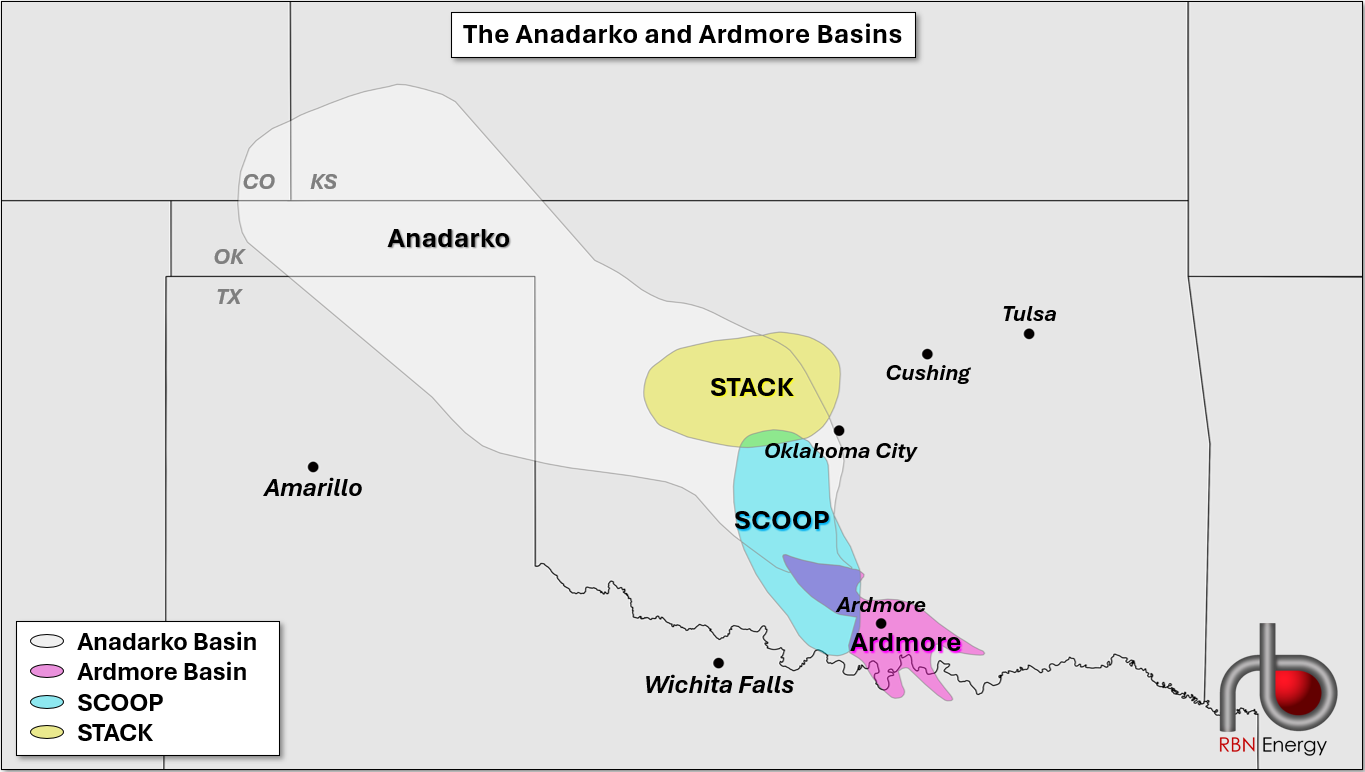
Figure 1. The Anadarko and Ardmore Basins. Source: RBN
Locator: 50835GOOG.
"You can howl at the wind, but AI is not going away." -- Amazon CEO Andy Jesse.

From the linked article:
Alphabet’s Google and Blackstone plan to create an artificial-intelligence cloud company to rival the likes of CoreWeave using Google’s specialized chips, according to people familiar with the matter.
The duo plans to launch the unnamed U.S. company with $5 billion in equity capital from Blackstone, which will be the majority owner, the people said. The deal is set to be announced later Monday.
The venture, the biggest attempt yet by Google to sell and monetize its own chips to external parties, will sharpen a rivalry with Nvidia, the market leader in AI computing.
The new company aims in 2027 to bring 500 megawatts of capacity online—roughly the same amount of electric power required to serve a midsize city—and substantially increase capacity over time, the people familiar with the matter said.
The companies are forming the venture as demand for computing power to train and run advanced AI models reaches unprecedented levels. Most of the major AI companies currently rely, at least in part, on computing infrastructure from CoreWeave, which uses Nvidia’s chips. A class of smaller so-called neocloud companies have also cropped up in response to ravenous demand.
Google last month introduced a new processor that is customized for AI inference, or the computing required to run models rather than train them. Demand for that type of processing has exploded as businesses embrace AI. Google also introduced a new version of its chips that is specially designed for training models.
Google will supply hardware—including its specialized chips known as Tensor Processing Units, or TPUs—as well as software and services to the venture, the people said. Benjamin Treynor Sloss, a longtime Google executive, will serve as the new company’s CEO.
Google and Blackstone have identified data centers that will likely be part of the venture, some of which are in the process of being built.
Industry observers have wondered for years whether Google will commercialize its TPUs for widespread use. The technology giant has signed two major deals with outsiders: one to give Claude-maker Anthropic access to about one million of its chips, and another with Facebook owner Meta Platforms.
News Corp, owner of The Wall Street Journal, has a commercial agreement to supply content on Google platforms.
Locator: 50834B.
Back to the Bakken
WTI: $104.40.
Active rigs: 22.
Five new permits, #42946 - #42950, inclusive:
Eight permits renewed:
Locator: 50833B.
Bonds: everything points to a bull market!
Deal: holy mackerel! NextEra Energy to buy Dominion!
WNBA: Another day, another record for Indiana Fever star Caitlin Clark, who is now the WNBA's all-time leader in 20-point, 10-assist games.
Clark, who had 21 points and 10 assists on Sunday, now has 12 20-and-10 games -- in just 57 career appearances. Clark technically broke the record on Friday night in the team's overtime loss to the Washington Mystics but just for good measure, she had another big night on 5-of-10 shooting from the field in the Fever's 89-78 victory over the Seattle Storm on Sunday.
******************************
Back to the Bakken
WTI: $102.90.
New wells reporting:
RBN Energy: after a long, steady decline, Alaska oil production is on the rise. Link here. Archived.
Last year, Alaska produced only 421 Mb/d of crude oil, barely one-fifth the more than 2 MMb/d that wells there were churning out back in 1988, when North Slope production peaked. It’s been a long, steady decline, but two new projects — one already producing and the other only weeks away from “first oil” — will add a combined 100 Mb/d once both are fully up and running. And Alaska’s biggest new project in years, ConocoPhillips’s massive Willow effort, will contribute another 180 Mb/d by 2030. In today’s RBN blog, we discuss the ongoing rebound in North Slope production and the prospects for even more growth going forward.
As we said five years ago in The End?, it’s been a challenging few decades for producers in the 49th state. Back in the 1970s and ’80s, Alaska was seen as the next big thing for U.S. crude oil production. With the 1977 completion of the 800-mile Trans-Alaska Pipeline (TAPS) from Prudhoe Bay in the north to Valdez in the south, Alaska North Slope (ANS) production took off (blue line in Figure 1 below), and just 11 years later the state not only accounted for 25% of total U.S. crude oil output, it also briefly knocked Texas off its perch as the #1 oil-producing state. Alaska crude oil production was all downhill from there, however. By 1995, it had fallen to less than 1.5 MMb/d, and by 2000, it was below 1 MMb/d. The slide didn’t end there. Through the mid-2010s, production was hovering around 500 Mb/d, and so far in the 2020s it’s been averaging less than 450 Mb/d — or just over 3% of total U.S. output.

Figure 1. Alaska Crude Oil Production. Source: EIA