Monday, April 6, 2026

KODA Resources Completes Its First Four-Mile Lateral -- 142 Frack Stages -- April 6, 2026

Locator: 50445B.

The well:

  • 42395, drl, KODA Resources, Ale 2436-1BHN, East Goose Lake.  

A reader just sent me this note ... "a well in Daneville Township in Divide County has just been fracked with 142 stages.  It is located at 161-103-13-12-1 and 162-103-36 which is the first four-mile spacing unit for KODA.  No IP yet but expect it around April 28th.  The permit number is 42395."

The reader is wondering if this number of frack stages -- 142 -- sets a new record in the Bakken? I have no idea but it's the most I have ever seen. Also noteworthy --  this is KODA Resources first four-mile lateral. 

The permit:

The plat: 

Frack data yet to be scanned in by the NDIC.

Haystack Butte -- Unitized -- BR's HBU Badlands, HBU Hazel Wells -- April 6, 2026

Locator: 50444B.

The BR HBU Badlands and HBU Hazel wells will be tracked here. 

It's a bit unclear, but I believe the entire Haystack Butte is unitized. As another example, the Grinnell-Bakken Unit is managed by XTO.

The wells:

The Hazel wells: 

  • 41731, ros, BR, Hazel 10S MBH,
  • 41723, conf, BR, HBU Hazel 5N MBH, Haystack Butte, npd,
  • 41730, conf, BR, HBU Hazel 9S MBH, Haystack Butte, npd,
  • 41722, conf, BR, HBU Hazel 4N MBH, Haystack Butte, npd,
  • 41729, conf, BR, HBU Hazel 8S MBH, Haystack Butte, npd,
  • 41721, conf, BR, HBU Hazel 3N MBH, Haystack Butte, npd,
  • 41720, conf, BR, HBU Hazel 2N, MBH, Haystack Butte, npd,  
  • 42718,
  • 41727, 
  • 41719, conf, BR, HBU Hazel 1N MBH, 

 The Badlands wells:

  • 41639, ros, BR, HBU Badlands 10S MBH-ULW, 
  • 41638, conf, BR, HBU Badlands 5N TFH-ULW, Haystack Butte, npd,
  • 41637, conf, BR, HBU Badlands 9S MBH, Haystack Butte, npd,
  • 41636, conf, BR, HBU Badlands 8S MBH, Haystack Butte, npd,
  • 41631,
  • 41630,
  • 41629,
  • 41628,
  • 41627, conf, BR, HBU Badlands 6S MBH, 

Monday -- April 6, 2026

Locator: 50443B.

Presidential speech today: link here. 

California bullet train:over the weekend it was revealed that the new estimate has now hit $126 billion; link here.

In a 60 Minutes report, officials now put the cost at $126 billion. That is more than Amtrak has received from the federal government since 1971. It also far exceeds the $33 billion figure given to voters in 2008. 

Amtrak: the entire nation -- from the --

  • from the Northeast Corridor to Florida;
  • from Florida to Texas to California;
  • from California to Seattle;
  • from Seattle to Chicago to NYC.

Massive mistake and mismanagement. This rivals anything the Minnesota state government did: 

  • an aide admits it was a blunder; link here.
  • no track has been laid yet;
  • massive cement (stone) pillars rising from the ground remind folks of "Stonehenge" and thus the new nickname: "Stonehenge" or "railhenge." 

Governor Newsom did not return calls to the 60 Minutes producers. The tea leaves suggest:

  • Gavin is distancing himself from the project as he nears decision to announce US presidential run; and,
  • it is more and more unlikely this project will ever be finished;
  • it most likely will simply not get more funding and attention will turn elsewhere. 

Fortunately the Federal government saw fit to quit funding: 

As of early 2026, approximately $15 billion to $16 billion has been spent on the California High-Speed Rail project. The funding has come primarily from state sources, with roughly $2.5 billion to $3.6 billion provided by federal grants, while a significant portion of planned federal funding was rescinded.

***************************
Back to the Bakken

WTI: $112.60

Active rigs: 24.

One new permit:

  • 42814, conf, BR, HBU Sagebrush 1N MBH, Haystack Butte, NWNW 23-148-98, to be sited 980 FNL and 1081 FWL; the map:

The wells:

The Hazel wells: 

  • 41731, ros, BR, Hazel 10S MBH,
  • 41723,
  • 41730,
  • 41722,
  • 41729,
  • 41721,
  • 42718,
  • 42720,
  • 41727, 
  • 41719, conf, BR, HBU Hazel 1N MBH, 

 The Badlands wells:

  • 41639, ros, BR, HBU Badlands 10S MBH-ULW, 
  • 41638, 
  • 41637,
  • 41636,
  • 41631,
  • 41630,
  • 41629,
  • 41628,
  • 41627, conf, BR, HBU Badlands 6S MBH, 

The Speech -- The Deadline Was Extended 24 Hours -- 1:11 P.M. CT -- April 6, 2026

Locator: 50442EPICFURY.

Updates

 Later, 6:53 p.m. CT: link here. 


Original Post 

The speech was devoted to the rescue of the two airmen.

It took awhile, but what most interested the press finally came up in the Q&A. 

In the Q&A after the speech, President Trump clearly said the Iranians have until 8:00 p.m. ET tomorrow night April 7, 2026.

Prior to the speech, President Trump clearly said that Iran has made a significant offer, but it was not enough.

That sounds like President Trump has extended the deadline.

Later in the Q&A, a reporter suggested that President Trump had extended the ultimatum 48 hours and the president did not "correct" that.  

Later, the president reiterated the extension for 24 hours, until tomorrow night, April 7, 2026, 8:00 p.m. ET -- no bridges, no power plants. He extended the deadline/ultimatum by 24 hours, he said, because he felt it was not appropriate to "do this" the day after Easter.  

Tea leaves: Trump will keep his word if anything short of Iran saying clearly:

  • we have opened the strait; and,
  • we will quit firing on our Arab friends in the Mideast 

Tea leaves: Trump said he could take out all bridges and all power plants by 12:00 midnight -- four hours after the deadline tomorrow night ... and then paused ... saying he could; not that he would. The tea leaves suggest such escalation would be step wise.  

President Trump raised the possibility if the US might put tolls on the strait. Not Iran.  

Most interestingly, the president connected the "extraction" of the two airmen with the extraction of Maduro. Two incredible successes; no one asked the question which "extraction" was more dangerous. Both were equally successful. 

He ended the press conference with absolute contempt for the countries that refused to help the US in OperationEPICFURY.  In order, he mentioned: South Korea, Australia, and Japan. (NATO was a given: he reiterated multiple time that NATO was a "paper tiger." He is particularly upset with Great Britain but did not mention that at the end; that was implied early on in the Q&A.

Most pleasantly, earlier in the Q&A he dissed The NYT. It appears the writers / editors of The NYT were not aware of what the 8th Air Force bombed during WWII. And, it appears they missed the history of the bombing of Japan in WWII, also. 

Turning to the "breaking news stories": all about Artemis II -- that the astronauts gave now traveled farther than any human beings before. I'm serious. Not one "breaking news" to my inbox about EPIC FURY or Trump's remarks.

Meanwhile, over on x, Tehran Ted: 

Meanwhile, after the speech: 

*************************************
The Market

WTI:
 

LNG (Cheniere):


Monday Morning -- April 6, 2026

Locator: 50441B.

WTI: $112.70. Very volatile. One-half later, 9:31 a.m. CT, down to $111. 

Wells coming off confidential list:

  • Tuesday, April 7, 2026: 13 for the month, 13 for the quarter, 170 for the year,
    • 41985, conf, Formentera Operations, Wildcat Hollow 16-16-PGN N115DW, 
  • Monday, April 6, 2026: 12 for the month, 12 for the quarter, 169 for the year,
    • 42371, conf, Kraken, Charity 3-10-15 5H, 
    • 41926, conf, Oasis, Anderson 5402 12-18 3BJ,
    • 41925, conf, Oasis, Anderson 5402 12-18 2BJ,
  • Sunday, April 5, 2026: 9 for the month, 9 for the quarter, 166 for the year,
    • 42175, conf,  BR, Omid 1-8-7-TFH, 
    • 41502, conf, Hess, RS-Sorenson-155-92-0105H-2, 
  • Saturday, April 4, 2026: 7 for the month, 7 for the quarter, 164 for the year,
    • None.

RBN Energy: upgrader repairs could offer surest route to higher Venezuelan crude oil production. Link here. Archived. 

There’s no shortage of work to be done to revive Venezuela’s crude oil industry, much of which suffered from years of poor management and minimal investment. One rehabilitation effort that may well provide a lot of bang for the buck would be to repair and restart the industry’s crude upgraders, which process Venezuela’s extra-heavy oil to produce a lighter synthetic crude that can then be piped, shipped and refined. In today’s RBN blog, we’ll discuss how improving the upgraders could make a massive difference for U.S. Gulf Coast refiners.

We’ve written extensively this year about Venezuela’s oil sector in the wake of the U.S.-backed removal of President Nicolás Maduro, starting with Take Me Money and Run Venezuela, where we recapped how the country went from supplying more than 1 MMb/d of heavy sour crude to Gulf Coast refiners in the late 1990s and early 2000s to overall production of less than 1 MMb/d today — roughly one-quarter of its former output. We then dug into the unique characteristics of Venezuela’s crude slate in Orinoco Flow, noting that most reserves lie in the 21,000-square-mile Orinoco Belt and are extra-heavy (API as low as 8-14 degrees), making the oil difficult and costly to move and refine. In When Love Comes to Town, we compared Venezuelan and Canadian heavy crudes. Finally, in Round and Round (which previewed our first Drill Down Report of 2026, which is available here), we laid out the practical steps Venezuela would need to take to boost crude production.

This is the second in our new series on Venezuela. The first piece focused on the refining sector, which is so far gone that we see little interest from Western companies in making the large investments needed to restore it, especially given the growing surplus of refined products from the Gulf Coast. (Check out our biannual Future of Fuels report, where we discuss this in more detail.)

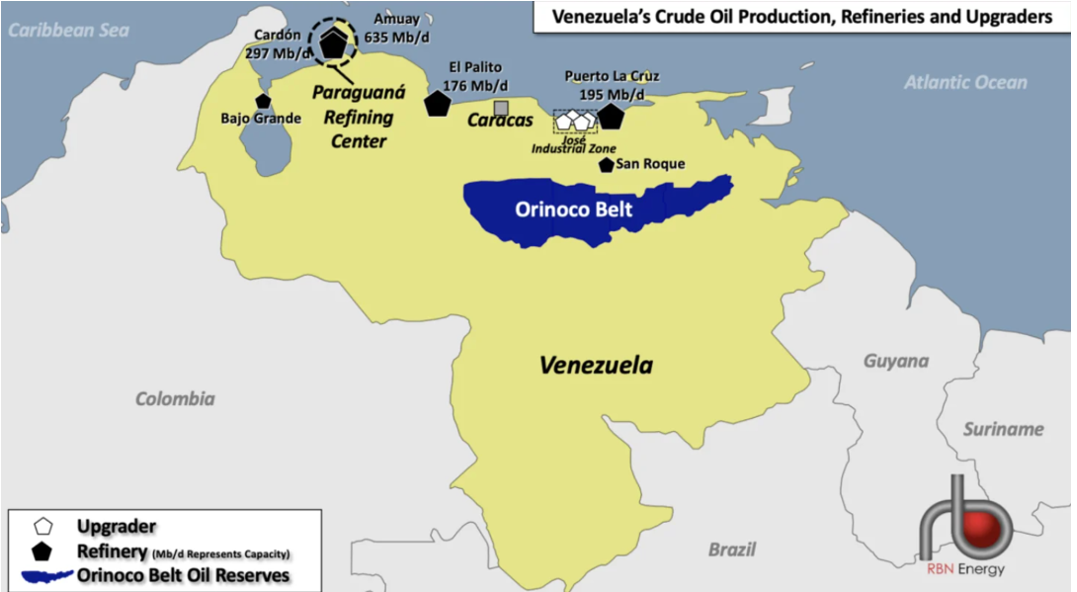
But the situation with Venezuela’s crude upgraders is quite different from the country’s refiners (black pentagons in Figure 1 below). While the country’s four upgraders (white pentagons along the coast) are also dilapidated after years of underinvestment and barely operable — if at all — they are critical to increasing production from the Orinoco Belt (blue-shaded area). The extra-heavy crude produced there must be either upgraded into synthetic crude oil (SCO) or blended with a diluent like condensate or natural gasoline before it can be exported. Given that the vast majority of the diluent used in Venezuela needs to be imported, the lack of operable upgrading capacity is a major constraint on crude production.

Figure 1. Venezuela’s Crude Upgraders. Source: RBN