Showing posts sorted by relevance for query "venture global". Sort by date Show all posts

Wednesday, January 29, 2025

RBN Energy: Evaluating Venture Global -- January 29, 2025

Locator: 48428RBNVG.

RBN Energy: assessing Venture Global's assets in the wake of its $1.75 billion IPO. Archived.

Venture Global put U.S. LNG on center stage after going public on January 24. The company, now listed as VG on the New York Stock Exchange (NYSE), launched one of the largest initial public offerings (IPO) in U.S. energy history. The IPO shares were priced at $25 each, raising $1.75 billion but valuing the company at $60 billion, a significant drop from the company’s initial target of up to $110 billion. While Venture Global was able to capitalize on some truly fantastic timing, going public just as President Trump took office and lifted the export permit ban, the market remains cautious about LNG and the energy sector. While Trump will certainly smooth the path at least somewhat to new LNG buildout, lawsuits and regulatory hurdles won’t simply disappear overnight. In addition to the general regulatory uncertainty facing the industry, there is also the matter of Venture Global’s contentious relationship with its original customers: Shell, BP and others have brought arbitration cases against the company that have yet to be resolved. In today’s RBN blog, we take a closer look at Venture Global, its assets and what its IPO says about U.S. LNG. 

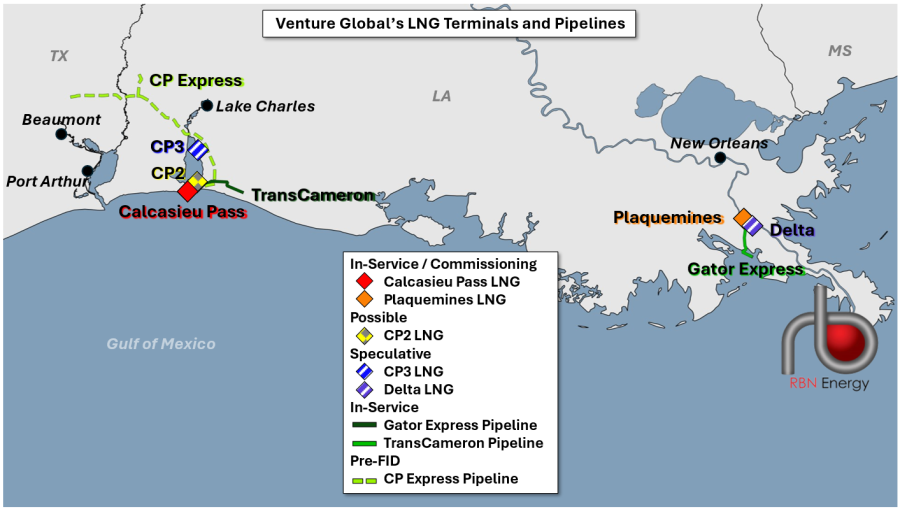
Venture Global is one of the largest players in U.S. LNG, with the 10-MMtpa (1.32 Bcf/d) Calcasieu Pass operational, although still technically commissioning (more on that shortly); the 20-MMtpa (2.65 Bcf/d) Plaquemines LNG under construction or commissioning now; CP2 in the late stages of development and nearing a final investment decision (FID); and two more speculative projects to pursue after CP2. Between Calcasieu Pass and Plaquemines, the company will own and operate 30 MMtpa (4 Bcf/d) by the end of 2027, leaving it second to only Cheniere Energy when it comes to U.S. LNG output (see King Creole for more on the big three players in U.S. LNG). And with more projects in the queue, Venture Global is obviously shooting for Cheniere’s crown. All of Venture Global’s LNG projects use midscale modular technology rather than traditional large-scale trains, promising investors shorter construction timelines and requiring less startup capital to build these smaller, factory-fabricated, but scalable units.

  Venture Global’s LNG Terminals and Pipelines

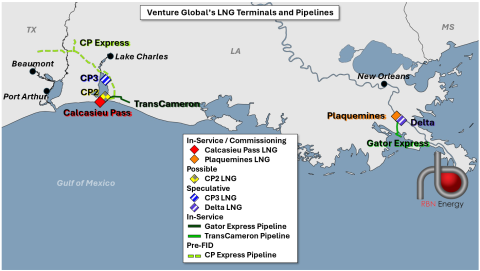
Figure 1. Venture Global’s LNG Terminals and Pipelines. Source: RBN

Venture Global took FID on its first U.S. LNG terminal, Calcasieu Pass (red diamond in Figure 1 above), in August 2019, although the project had been under construction since February of that year. The terminal has 18 mini trains, grouped into nine blocks, for a total nameplate capacity of 10 MMtpa (1.32 Bcf/d) and an expected peak capacity of 12.4 MMtpa (1.64 Bcf/d). Nameplate capacity is what is guaranteed by the design of the project by the engineering partners, but all LNG terminals have the ability to produce above that level. 

WTI Trending Toward $73, Again -- January 29, 2025

Locator: 48428B.

Trump's classified document case: DOJ drops cases against Trump's co-defendants.

Hess earnings:

Trump / Schwab: link to The WSJ. 

Gen Z: burned out over work. Business Insider.  Behind a paywall. Good luck.

EVs: heavy-dut trucks hitting regulatory result in California. Link here.

Colombia, link here:

Note: there are three really good writers / contributors for oilprice.com. Alex Kimani is one of the three. The other two: Charles Kennedy and Simon Watkins.

***************************************
Back to the Bakken

WTI: 473.07.

New wells:

  • Thursday, January 30, 2025: 46 for the month, 46 for the quarter, 46 for the year,
    • 40488, conf, Grayson Mill, Wahus 12-1F XE 1H,
  • Wednesday, January 29, 2025: 45 for the month, 45 for the quarter, 45 for the year, 
    • 38940, conf, CLR, Harms West Federal 4-32H, 

RBN Energy: assessing Venture Global's assets in the wake of its $1.75 billion IPO. Archived.

Venture Global put U.S. LNG on center stage after going public on January 24. The company, now listed as VG on the New York Stock Exchange (NYSE), launched one of the largest initial public offerings (IPO) in U.S. energy history. The IPO shares were priced at $25 each, raising $1.75 billion but valuing the company at $60 billion, a significant drop from the company’s initial target of up to $110 billion. While Venture Global was able to capitalize on some truly fantastic timing, going public just as President Trump took office and lifted the export permit ban, the market remains cautious about LNG and the energy sector. While Trump will certainly smooth the path at least somewhat to new LNG buildout, lawsuits and regulatory hurdles won’t simply disappear overnight. In addition to the general regulatory uncertainty facing the industry, there is also the matter of Venture Global’s contentious relationship with its original customers: Shell, BP and others have brought arbitration cases against the company that have yet to be resolved. In today’s RBN blog, we take a closer look at Venture Global, its assets and what its IPO says about U.S. LNG. 

Venture Global is one of the largest players in U.S. LNG, with the 10-MMtpa (1.32 Bcf/d) Calcasieu Pass operational, although still technically commissioning (more on that shortly); the 20-MMtpa (2.65 Bcf/d) Plaquemines LNG under construction or commissioning now; CP2 in the late stages of development and nearing a final investment decision (FID); and two more speculative projects to pursue after CP2. Between Calcasieu Pass and Plaquemines, the company will own and operate 30 MMtpa (4 Bcf/d) by the end of 2027, leaving it second to only Cheniere Energy when it comes to U.S. LNG output (see King Creole for more on the big three players in U.S. LNG). And with more projects in the queue, Venture Global is obviously shooting for Cheniere’s crown. All of Venture Global’s LNG projects use midscale modular technology rather than traditional large-scale trains, promising investors shorter construction timelines and requiring less startup capital to build these smaller, factory-fabricated, but scalable units.

  Venture Global’s LNG Terminals and Pipelines

Figure 1. Venture Global’s LNG Terminals and Pipelines. Source: RBN

Venture Global took FID on its first U.S. LNG terminal, Calcasieu Pass (red diamond in Figure 1 above), in August 2019, although the project had been under construction since February of that year. The terminal has 18 mini trains, grouped into nine blocks, for a total nameplate capacity of 10 MMtpa (1.32 Bcf/d) and an expected peak capacity of 12.4 MMtpa (1.64 Bcf/d). Nameplate capacity is what is guaranteed by the design of the project by the engineering partners, but all LNG terminals have the ability to produce above that level. 

Saturday, March 14, 2026

Venture Global -- RBN Energy -- One Year Ago -- Re-Posting -- March 14, 2026

Locator: 50222VG.

Compare this chart with the chart at the bottom of the blog.

*******************************
Re-Posting

This was from a year ago, January 29, 2025, link here: 

Locator: 48428RBNVG.

RBN Energy: assessing Venture Global's assets in the wake of its $1.75 billion IPO. Archived.

Venture Global put U.S. LNG on center stage after going public on January 24. The company, now listed as VG on the New York Stock Exchange (NYSE), launched one of the largest initial public offerings (IPO) in U.S. energy history. The IPO shares were priced at $25 each, raising $1.75 billion but valuing the company at $60 billion, a significant drop from the company’s initial target of up to $110 billion. While Venture Global was able to capitalize on some truly fantastic timing, going public just as President Trump took office and lifted the export permit ban, the market remains cautious about LNG and the energy sector. While Trump will certainly smooth the path at least somewhat to new LNG buildout, lawsuits and regulatory hurdles won’t simply disappear overnight. In addition to the general regulatory uncertainty facing the industry, there is also the matter of Venture Global’s contentious relationship with its original customers: Shell, BP and others have brought arbitration cases against the company that have yet to be resolved. In today’s RBN blog, we take a closer look at Venture Global, its assets and what its IPO says about U.S. LNG. 

Venture Global is one of the largest players in U.S. LNG, with the 10-MMtpa (1.32 Bcf/d) Calcasieu Pass operational, although still technically commissioning (more on that shortly); the 20-MMtpa (2.65 Bcf/d) Plaquemines LNG under construction or commissioning now; CP2 in the late stages of development and nearing a final investment decision (FID); and two more speculative projects to pursue after CP2. Between Calcasieu Pass and Plaquemines, the company will own and operate 30 MMtpa (4 Bcf/d) by the end of 2027, leaving it second to only Cheniere Energy when it comes to U.S. LNG output (see King Creole for more on the big three players in U.S. LNG). And with more projects in the queue, Venture Global is obviously shooting for Cheniere’s crown. All of Venture Global’s LNG projects use midscale modular technology rather than traditional large-scale trains, promising investors shorter construction timelines and requiring less startup capital to build these smaller, factory-fabricated, but scalable units.

Venture Global took FID on its first U.S. LNG terminal, Calcasieu Pass, in August 2019, although the project had been under construction since February of that year. The terminal has 18 mini trains, grouped into nine blocks, for a total nameplate capacity of 10 MMtpa (1.32 Bcf/d) and an expected peak capacity of 12.4 MMtpa (1.64 Bcf/d). Nameplate capacity is what is guaranteed by the design of the project by the engineering partners, but all LNG terminals have the ability to produce above that level. 

Friday, May 23, 2025

Venture Global: Top US LNG Firm With CP2 Project Approval -- Charles Kennedy -- May 23, 2025

Locator: 48659LNG.

Link here.

Venture Global is on track to surpass Cheniere Energy to become the biggest U.S. LNG company by liquefaction capacity if regulators approve the CP2 export project.

Venture Global is urging the Federal Energy Regulatory Commission (FERC) to greenlight its third liquefaction plant, CP2 in Louisiana, by the middle of the year.

The CP2 LNG facility will be located adjacent to Venture Global’s Calcasieu Pass LNG facility in Cameron Parish, Louisiana.

CP2 LNG was initially proposed to be a facility with a capacity of 20 million metric tons per annum (mtpa), but Venture Global has raised the maximum capacity to 28 mtpa.

Venture Global’s two operational LNG export terminals, Calcasieu Pass and Plaquemines, have a combined capacity of 38.5 mtpa. CP2 would add another 28 mtpa and raise the company’s total export capacity to 66.5 mtpa, above Cheniere’s 60 mtpa.

Venture Global more than doubled its first-quarter revenue from a year earlier as its Plaquemines and Calcasieu Pass plants have launched operations and exports in recent months.

Last month, Venture Global started contractual deliveries from its first LNG export project, Calcasieu Pass, to its long-term customers amid an ongoing dispute with major oil and gas firms over the delays to the official commercial operations date at the export project. 

Much more at the link.

*************************
LNG Termainals

From May 14, 2025: link here.

****************************************
North American LNG Project Tracker

Flashback: from November 6, 2023.

Locator: 45962LNG.     

Link here. 

Thursday, November 12, 2020

Calcasieu Pass -- November 12, 2020

Updates

November 13, 2020: see reader's comments at this post.

Original Post

This is so cool. I have around 35,000 posts over almost twelve years, and yet there are only a handful that I really, really remember well. One was the October 12, 2016, post: list of potential US LNG export facilities. I remember it well; I was blown away by it. A reader, on the other hand was not, suggesting the US LNG export story was over-rated. Whatever. 

Look at the list provided at the original post as well as updates. Was "Venture Global Calcasieu Pass" listed anywhere on that page? Is it there under a different name? I don't know. Whatever.

But here we go, another LNG export facility in the news. The Venture Global LNG website is here. 

The update is over at Rigzone: Baker Hughes ships LNG trains to Calcasieu Pass. Link here. 

The first two factory-fabricated liquefaction trains have arrived at the Calcasieu Pass LNG export facility in Cameron Parish, La., project developer Venture Global LNG, Inc. reported Tuesday.

Venture Global pointed out the two midscale, modular liquefaction trains and mixed refrigerant compressor skids were shipped to Louisiana from Baker Hughes’ (NYSE: BKR) manufacturing facility in Avenza, Italy more than two months ahead of the contractual delivery date. Each train boasts a capacity of 0.6 million tonnes per annum.

Look how much is yet to be done:

“Venture Global LNG is proud to demonstrate continued execution of the strategy we pioneered,” remarked Mike Sabel, executive co-chairman and CEO of the company. “Our factory-fabricated, modular liquefaction trains enable us to deliver the fastest construction schedule in the LNG industry while driving dramatic risk reduction across the entire project. We look forward to the successful delivery of Calcasieu Pass trains 3 through 18 and then 36 identical trains for (the) Plaquemines LNG (project along the Mississippi River south of New Orleans).”

According to Venture Global, the first two trains reached Calcasieu Pass “complete and ready to install.” The company stated that each unit was unloaded, transported to the site and positioned on its foundations in less than a day. It pointed out the trains will be connected to their respective Chart (NASDAQ: GTLS) brazed aluminum heat exchangers – also known as “cold boxes.” Eight cold boxes have already been installed, the firm added.

Venture Global observed the first pair of liquefaction trains arrived onsite less than 15 months after the final investment decision for Calcasieu Pass. The company expects the LNG facility to begin commercial operations in 2022.

More importantly, how to pronounce Calcasieu: link here -- 'calca-shoe.'

Meaning?

The name Calcasieu comes from the Atakapan word, "quelqueshue,” meaning "crying eagle.” It was originally the name of an Atakapa chief, but became the name given to what was formerly the Rio Hondo River (Rio Stondo or "Deep River"), now the Calcasieu River. The parish then inherited this name.

Monday, December 6, 2021

Venture Global LNG Export Terminals, Southwest Louisiana -- December 5, 2021

Location: 10010PLAQUEMINES.

Updates

March 13, 2026: immediately, upon authorization from Department of Energy, Plaquemines to increase LNG export by 13%, Venture Global. Link here.

December 15, 2024: Plaquemines up and running. Link here. 

March 13, 2023: FID for Phase II. See LNG export list tag.

February 4, 2022: RBN Energy: Venture Global's Plaquemines project could lead next wave of US LNG development.

It’s expected to be a big year for U.S. LNG. The U.S. was the top monthly exporter of LNG for the first time in December 2021 and is expected to hold onto that crown as new capacity at Sabine Pass and a new terminal, Calcasieu Pass, begin service this year. 
The chaos of European gas markets has made U.S. exports particularly attractive, especially after a year or more of high global demand, sky-high global gas prices, and an undersupplied market that has left offtakers clamoring for more. 
Last year saw those offtakers come back to the negotiating table for long-term sales and purchase agreements (SPAs) from new U.S. LNG capacity and several projects now have a realistic path to a positive final investment decision (FID) in 2022. In today’s RBN blog we begin a series taking a closer look at some of the projects most likely to reach FID this year, starting with arguably the most likely next contender, Venture Global’s Plaquemines LNG.

Original Post

Where do we begin? Where do we begin? 

This all started with an earlier post regarding US LNG exports. 

A reader alerted me to amazing projects under construction and under consideration by a company in Louisiana: Venture Global. Website here.

Early last year, RBN Energy had a great update on these export terminals: Holding On for Life - Second-Wave U.S. LNG Projects Stagnate Amid Market Uncertainty, April 16, 2020, more than a year and a half ago. The full article is archived.

Venture Global is working on projects, which when/if completed will produce about 50 mtpa vs "the much-ballyhooed expansion from Qatar" which is 49 mtpa. 

Once completed, I believe this will make the US the world's largest LNG exporter by capacity (2022). 

So, let's look at the projects.

First the map:

From a reader over the weekend:

  • 10 mtpa Calcasieu Pass is now in test phase and will export LNG within a few week's time.
  • Plaquemines Parish is identical to Calcasieu Pass but twice the size. (Essentially building 2 Calcasieu Pass on one site).
  • CP2 is identical to Plaquemines Parish and adjacent to Calcasieu Pass.
  • Cumulative output from these 3 projects will be ~50 mtpa, which surpasses the much ballyhooed expansion from Qatar which is ~49 mtpa.

From the VentureGlobal website:

Plaquemines (pronunciation here; "plak-a-mins"):

  • under development;
  • Plaquemines Parish, Louisiana; south of New Orleason
  • on mile marker 55 of the Mississippi River

Delta LNG:

  • under consideration;
  • on a 524-acre site in Plaquemines Parish, Louisiana on the Mississippi River

CP2 LNG:

  • proposed

Tuesday, November 11, 2025

Venture Global -- LNG Exports -- Setting Records -- November 11, 2025

Locator: 49395LNG. 

Link here. 

I have no position in this company, never have, unlikely I ever will.

I am posting this to help me keep track of LNG export facilities.  

From the linked article:

U.S. LNG exporter Venture Global booked a net income for the third quarter, compared to a loss a year earlier, as revenues and LNG exports soared amid rising liquefaction capacity at its plants.

Venture Global, the second-largest U.S. LNG exporter behind Cheniere, on Monday, November 10, 2025, reported a net income attributable to common stockholders of $429 million for the third quarter, versus a loss of $347 million for the same period of 2024. Wow.

Revenues soared by 260% and income from operations surged by 598% as Venture Global’s exported LNG volumes jumped by 237% to 100 cargoes in the third quarter of 2025, up from 31 cargoes exported in the same period last year.

Venture Global has been ramping up its Plaquemines export project, and 34 of 36 liquefaction trains at the site are now producing LNG.

34 of 36 trains! Wow.

Tracking LNG export, US vs Qatar:

Sunday, December 15, 2024

Plaquemines LNG: Venture Global Starts LNG Production At Second Louisiana Plant -- December 15, 2024

Locator: 44464LNG.

Venture Global starts LNG production at second Louisiana plant; Plaquemines LNG becomes eighth LNG export facility in the US to come online since 2016.  

Link here.

According to a Reuters report, Venture Global’s Plaquemines LNG export facility (Plaquemines Parish, Louisiana) could start to liquefy natural gas as early as today. It will mark the first new U.S. LNG export plant to come online in two years. The 20 million metric tons per annum (MTPA) export plant was set to draw over 100 million cubic feet (MMcf/d) of natural gas for the first time yesterday. When fully online, it will use 2.6 billion cubic feet per day (Bcf/d) of natural gas. We suspect some (much?) of the gas comes from the Marcellus/Utica as the plant has an interconnection with the Texas Eastern Transmission Company (TETCO) pipeline---a pipeline that flows M-U gas southwest. However, we're not elated with the news of Plaquemines' startup.

Link here. And also here.

As mightily as U.S. LNG exports have impacted global trade dynamics, so have U.S. natural gas flows been reshaped by the pull toward Gulf Coast export terminals. The next new terminal on deck is Venture Global’s enormous Plaquemines facility in Louisiana, which could begin taking feedgas as early as late fall 2024 and will eventually ramp up to more than 2.6 Bcf/d. For Southeast Louisiana, home to a massive industrial corridor along the Mississippi River as well as the U.S. natural gas benchmark Henry Hub, the introduction of such a huge source of demand will change how gas flows into and out of the region — with knock-on effects across the Gulf Coast. In today’s RBN blog, we’ll turn once again to our Arrow Model to help illuminate what the path forward may look like. 

In our first blog in this series, My Aim Is True, we introduced the concept of the Arrow Model — a proprietary RBN analytical framework that organizes Texas and Louisiana into pipeline “corridors” that can be used to assess changes in regional inflows and outflows via groups of pipes that serve similar markets from comparable supply sources. These pipeline corridors are aggregations of pipelines connecting relevant market hubs — some within Texas and Louisiana and others outside the two states.

We also identified the LNG corridors through which gas exits the Gulf Coast. That brought us to a key takeaway of Part 1 — that we would see a mid-decade tightening in Louisiana gas markets relative to Texas. As we get down below the state level, into the more granular regional levels within Louisiana and Texas, it becomes increasingly challenging for anybody without a robust analytic framework to accurately parse out what’s going on. That’s because at the state level we can see aggregate supply and demand statistics from the Energy Information Administration (EIA) as well as detailed natural gas flow statistics for FERC-regulated interstate pipelines. (See Shall We Gather at the River for a disambiguation of interstate and intrastate gas pipelines.) Within a state, particularly ones as big as Texas or with as many legacy gas pipelines as Louisiana, modelling how gas flows becomes much more interesting. At RBN, we refer to this as the “big circle, little circle” problem; meaning that it’s much easier to develop a directionally correct model for a large geographic area than it is for a much smaller one. But that’s just exactly what we will do in this and subsequent pieces concerning the Arrow Model.

Thursday, August 17, 2023

Looking Good For A Thursday -- Triple-Digit Day For Texas -- Again -- August 17, 2023

Locator: 45485B.

Now? It's a "richcession." This obsession-recession is quite amazing. It's almost as if 30-y/o business writers have just discovered the business cycle. Link here.

Best advice ever: stay the course.

Quick picks: it's been a great month for investors and traders.


***************************
Back to the Bakken

WTI: 

Friday, August 18, 2023: 35 for the month; 237 for the quarter, 482 for the year
39555, conf, Neptune Operating, Gibbins 11-2 2H,
39451, conf, CLR, Edward 11-23H1,
37881, conf, BR, Kermit 1-8-32UTFH,

Thursday, August 17, 2023: 32 for the month; 234 for the quarter, 479 for the year
39554, conf, Neptune Operating, Gibbins 11-2 3H,
38903, conf, Enerplus, MC-Kudrna 144-95-10-3-2H,
37880, conf, BR, Rink 2-1-5UTFH,
35470, conf, Oasis, MHA 1-29-30H-150-92,

December 15, 2024: Plaquemines up and running. Link here.
Venture Global reached a final investment decision (FID) on Plaquemines LNG Phase 1 in March 2022, making it the first new LNG project to get the green light post-COVID and kicking off a massive expansion period for U.S. LNG. In fact, more than 61 million tons per annum (MMtpa) of new U.S. LNG capacity has been given the go-ahead in the past 17 months, including the full 20-MMtpa Plaquemines LNG project from Venture Global, plus projects from Cheniere, Sempra and, most recently, NextDecade’s Rio Grande LNG. 
Even if no new LNG projects are sanctioned after this — which seems unlikely, given the progress seen on some pre-FID projects — the U.S. will have the capacity to export 167.5 MMtpa, or more than 22 Bcf/d, by later this decade. 
This unprecedented level of buildout continues to be dominated by our “Big Three” of U.S. LNG — Cheniere, Sempra and Venture Global — which not only already operate LNG export terminals in the U.S. and have projects currently under construction, but all still have more capacity under development and working toward eventual FIDs. 
In today’s RBN blog, we wrap up our series with a look at the newest member of the Big Three, Venture Global, its projects under development and the controversy surrounding the commissioning of Calcasieu Pass LNG.

LNG Buildout -- Update -- RBN Energy -- August 17, 2023

Locator: 45486LNG.

December 15, 2024: Plaquemines up and running. Link here.
Venture Global reached a final investment decision (FID) on Plaquemines LNG Phase 1 in March 2022, making it the first new LNG project to get the green light post-COVID and kicking off a massive expansion period for U.S. LNG. In fact,, more than 61 million tons per annum (MMtpa) of new U.S. LNG capacity has been given the go-ahead in the past 17 months, including the full 20-MMtpa Plaquemines LNG project from Venture Global, plus projects from Cheniere, Sempra and, most recently, NextDecade’s Rio Grande LNG. 
Even if no new LNG projects are sanctioned after this — which seems unlikely, given the progress seen on some pre-FID projects — the U.S. will have the capacity to export 167.5 MMtpa, or more than 22 Bcf/d, by later this decade. 
This unprecedented level of buildout continues to be dominated by our “Big Three” of U.S. LNG — Cheniere, Sempra and Venture Global — which not only already operate LNG export terminals in the U.S. and have projects currently under construction, but all still have more capacity under development and working toward eventual FIDs. 
In today’s RBN blog, we wrap up our series with a look at the newest member of the Big Three, Venture Global, its projects under development and the controversy surrounding the commissioning of Calcasieu Pass LNG.

Wednesday, April 8, 2026

Venture Global (VG) -- Printing Money -- WSJ -- April 8, 2026

Locator: 50466VG. 

Link here. 

VG could be / will be "bigger" than Qatar and Cheniere.

Venture Global is positioned for a repeat (see linked article) scenario that could boost its ambition to not only surpass Cheniere, but also overtake Qatar, the tiny Middle Eastern nation that sits on some of the world’s largest gas reserves and has become an LNG juggernaut.

The Strait of Hormuz remains closed to most tankers, which has clogged LNG flows, and Iran’s missiles have crippled Qatar’s facilities that liquefy and ship natural gas. [The writer forgot to mention the damage to Qatar's export terminal / liquefaction capacity in Qatar due to the war; estimates: three years to get that terminal back to "normal."]

That has turned Venture Global’s available cargoes into a hot commodity. Unlike Cheniere, which sells most of its cargoes under long-term contracts, Venture Global reserves a large share of its volumes for spot markets, where prices can fluctuate widely. 

Wednesday, September 5, 2018

Making Texas Great Again -- September 5, 2018

Making Texas great again: see notes below regarding Canadian railroad ordering 60 more locomotives from GE. It turns out that these locomotives will be made in the GE plant in .... Ft Worth. Beautiful, beautiful facility and beautiful, beautiful location.


Fast and furious:
  • Mother Nature canceled hurricane season this year: Gordon blew through becoming nothing more than a summer shower; next drenching won't enter the Gulf for ten days.
  • Open book test: we've been talking about this ever since the TransMountain Pipeline Expansion project was killed -- CN orders 60 more locomotives from GE Transportation. Didn't GE sells it GE rail business?  See next data point.
  • Exit. Under the terms of the deal, GE -- in a story dated just four months ago-- will be required to unload its "railroad" stake within three years, making an exit from the rail business.
    GE's rail business was booming in 2014 thanks in part to high prices for metals and oil. However, the industry hit a snag in recent years as commodities slumped, leading GE to decide to back away.
  • CNI dropped 1.5% yesterday; paying 1.55% 
  • Permian growth to slow: according to Schlumberger; due to takeaway constraints. Saw the same thing in the Bakken at this point in the cycle. Yawn.
  • How important is the Trans Mountain Pipeline for Canada? Justin sums it up nicely:
    Speaking at an event in Vancouver today, Prime Minister Justin Trudeau said his government is committed to moving ahead on the project "in the right way" — but did not offer a timeframe.
    "All we have to do is look at the headlines to understand that being a prisoner to the United States for our resource exports, knowing that right now we only have one market, the U.S., for our oil exports, is simply not a wise strategy for Canadians moving forward," he said. "We need to get new markets for our oil resources."
    [Comment: his very nuanced/calm response suggests he is, behind the scenes, scrambling to get this done.]
  • Graphic of the day: at this link. X-rated; for adults only. Sort of.
Overused but I need some music to feed my brain (with apologies to Hunter S. Thompson) --

I Won't Back Down, Tom Petty

API weekly crude oil inventories, this afternoon: link here. The build of 1.551 million bbls was slightly greater than the 1.460 million bbls forecast. Mostly background noise, in the big scheme of things.

Costs to drill an oil well: from 2016, but looks pretty good.

Making America great again: two Louisiana projects would double US LNG exports -- wow, see below.

Tariffs? What tariffs? From Reuters. China appears set to once again boost its purchases of liquefied natural gas (LNG) for the northern winter, but unlike last year's rush, this time the process is likely to be more organised and stable.

**********************************
Back to the Bakken

One well coming off the confidential list today (it was miserably cold and harsh in North Dakota six months ago):

Wednesday, September 5, 2018
  • 34232, SI/NC, Crescent Point Energy, CPEUSC Lloyd 3-27-34-157-100W MBH, Marmon, no production data,
Active rigs:

$69.10→9/5/201809/05/201709/05/201609/05/201509/05/2014
Active Rigs62573375196

RBN Energy: Venture Global's two Louisiana projects would double US LNG exports.
December 15, 2024: Plaquemines up and running. Link here.
The race is on to be the first to reach a Final Investment Decision (FID) for the next round of U.S. liquefaction/LNG export terminals along the Gulf Coast. And like the Kentucky Derby, being first — or, at worst, second or third — is a do-or-die proposition, because only a very small number of these projects are likely to line up the multibillion-dollar commitments needed to push them over the FID line.
The tried-and-true approach of LNG project financing has been to secure a stack of long-term Sales and Purchase Agreements (SPAs) from international LNG trading companies or huge overseas utilities, and that’s the tack being taken by Venture Global LNG, which is developing two projects near the Louisiana coast that, if built, would consume a total of nearly 4 Bcf/d of U.S. natural gas. Today, we continue our series on the next round of liquefaction/LNG export terminals “coming up” with a look at Venture Global’s Calcasieu Pass and Plaquemines projects.
This is the third episode. Earlier we reviewed the dramatic shift in U.S. expectations regarding LNG a few years back. Through the 1990s and the first two-thirds of the 2000s, U.S. natural gas production was close to flat, so the general thinking was that U.S. gas output had peaked, and that over time, increasing amounts of LNG would need to be imported to keep pace with gas demand. In 2005, the Energy Information Administration (EIA) estimated that the U.S. would be importing the LNG equivalent of nearly 12 Bcf/d by 2015 and 18 Bcf/d by 2025, and a number of LNG import terminals were built to handle the expected inflow. 
It became clear by 2010-11, however, that the Shale Revolution — and the resulting boom in U.S. gas production — had eliminated the need for LNG imports. In a flash, many of the companies that had just finished building LNG import terminals started exploring the possibility of adding liquefaction plants at those sites to export LNG instead. Since then, six liquefaction/LNG export projects advanced to FID and construction — Cheniere Energy’s Sabine Pass and Corpus Christi, Dominion’s Cove Point, Cameron LNG, Freeport LNG and Elba Liquefaction — and five liquefaction trains (four at Sabine Pass in southwestern Louisiana and one Cove Point in Maryland) with a combined capacity of more than 23 million tonnes per annum (MMtpa) are up and running. 
Then, we did a deep dive on Tellurian’s Driftwood LNG, a 27.6-MMtpa liquefaction/LNG export terminal planned for an 800-acre site in Louisiana’s Calcasieu Parish, south of Lake Charles. 
Several aspects of Tellurian’s project bear repeating here. One is that, in contrast to the large-scale liquefaction trains now operating at Sabine Pass and Cove Point and under construction along the Gulf Coast (generally with capacities of 4 MMtpa or more each), Driftwood LNG will consist of as many as 20 much smaller, modular-based trains (1.38 MMtpa each). Also, Tellurian is acquiring natural gas reserves that will be tapped to produce gas for the LNG project, and it is developing two 2-Bcf/d long-haul pipelines (Permian Global Access Pipeline, or PGAP, and Haynesville Global Access Pipeline, or HGAP) — and a 96-mile, 4-Bcf/d connector called Driftwood Pipeline — to deliver most of the natural gas that the Driftwood trains will demand. 
Most important, perhaps (and most relevant to today’s discussion of the Venture Global LNG projects), is that to help finance its project Tellurian is seeking a handful of customer/partners that would take a combined 60% to 75% equity interest in Driftwood Holdings, which consists of Tellurian Production Co. (a gas producer), Driftwood Pipeline Network (the pipelines discussed above) and Driftwood LNG Terminal (the liquefaction trains and export docks). Those stakes — at an estimated cost of about $1.5 billion per MMtpa of liquefaction capacity — would give the customer/partners equity LNG at the tailgate of the liquefaction trains at cost, with the variable and operating costs estimated to be about $3.00/MMBtu FOB (free on board — that is, with the LNG owner responsible for shipping the LNG to its destination). Tellurian will retain the remaining 25% to 40% equity interest in Driftwood Holdings, and will market its share of LNG production on its own. It also will manage and operate the pipelines, liquefaction trains and export docks.

Wednesday, May 29, 2019

Big Drop In WTI -- Now Below $58; RBN Energy Looks At The New Washington State Law Aimed At The Bakken -- May 29, 2019

Louisiana LNG: $1.3 billion project. Data link here:
  • Calcasleu Pass LNG export facility
  • Cameron Parish, LA
  • 10-million tonne per annum 
  • will use mid-scale, modularly, factory-fabricated liquefaction trains from Baker Huges, a GE company
  • Stonepeak Infrastructure Partners will exclusively provide $1.3 billion equity investment in Venture Global LNG's venture
  • total committed capital to fund construction now totals $2.2 billion
  • more than $250 million has already been spent on preparation work
But there's more:
  • Venture Global also anticipated FERC approval for its 20-mtpa Plaquemines LNG project along the Mississippi River near New Orleans
And, there's more:
  • Venture Global has also proposed developing a second 20-mtpa facility, Delta LNG, nearby
The list: the list of potential US LNG export facilities is here.

Snarky: when I first posted that list, I vividly recall a reader writing me that just because something is proposed, doesn't mean it's going to happen. Whatever.  I'm now thinking that was an anonymous note from President Obama.
 
***********************************
Back to the Bakken

Wells coming off the confidential list after the long weekend and today -- Wednesday, May 29, 2019: 94 for the month; 188 for the quarter --
  • 35378, SI/NC, Newfield, Skipjack 149-98-11-2-4H, Pembroke, no production data,
  • 35096, 795, Liberty Resources Management Company, LLC, Stanley W 158-91-30-6-1MBHX, Kittleson Slough, t12/18; cum 67K 3/19;
  • 34907, SI/NC, Hess, SC-JCB-LE-154-98-1720H-1, Truax, no production data,
  • 34803, 1,299, Nine Point Energy, Erickson 155-102-26-25-6H, 60 stages, 10 million lbs, Squires, t12/18; cum 108K 3/19;
  • 30485, 500, BR, Jerome 14-10MBH, North Fork, t4/19; no production data,
Tuesday, May 28, 2019: 89 for the month; 183 for the quarter --
  • 35738, SI/NC, Newfield, Skipjack 149-98-11-2-12H, Pembroke, no production data,
  • 35457, SI/NC, WPX, Minot Grady 26-35HWL, Squaw Creek, no production data,
  • 34043, 484, Lime Rock Resources III-A, L.P., Harstad 44-9-2H, Stanley, t11/18; cum 38K 3/19;
  • 30486, 178, BR, Merton 14-10MBH, North Fork, t4/19; no production data,
Monday, May 27, 2019:
  • 35296, SI/NC, WPX, Minot Grady 2635HZ, Squaw Creek, no production data,
  • 30487, 77, BR, Merton 14-10TFH ULW, North Fork, t3/19; no production data,
Sunday, May 26, 2019:
  • 35361, SI/NC, Hunt, Halliday 146-92-19-18H-6, Werner, no production data,
Saturday, May 25, 2019:
  • 35298, SI/NC, WPX, Minot Grady 26-35HD, Squaw Creek, no production data,
  • 35297, SI/NC, WPX, Minot Grady 26-35HZ, Squaw Creek, no production data,
  • 34906, SI/NC, Hess, SC-JCB-154-98-1720H-9, Truax, no production data,
Active rigs:

$57.225/29/201905/29/201805/29/201705/29/201605/29/2015
Active Rigs6465502980

RBN Energy: will a new Washington State law hurt Bakken crude oil producers? Archived.
Refineries in Washington state have been reliable buyers of Bakken-sourced crude oil during the Shale Era, receiving an average of about 145 Mb/d — all of it by rail — over the past two-plus years. But a newly approved Washington law slashing the allowable vapor pressure limit for crude being unloaded from rail tank cars could hinder future growth in crude-by-rail shipments from North Dakota to the Evergreen State, or force Bakken producers to remove more butane and other “light ends” from the crude oil they rail west. It’s such a big deal that the state of North Dakota has indicated it will file suit to kill the new law. Today, we discuss Washington’s new law and its potential effects on Bakken crude oil producers.

Tuesday, September 11, 2018

Another Incredible CLR Mountain Gap Well To Be Reported Today -- September 11, 2018

Tuesday morning, September 11 .... cyclic, not linear ...


Time for another road trip?

On Route 66 to Oatman, going south from Kingman, Arizona

Disclaimer: this is not an investment site. Do not make any investment, financial, job, travel, or relationship decisions based on what you read here or think you may have read here.

Headline: stocks slump as China plans trade retaliation. Nice to be overweight in dividend-paying equities with automatic reinvestment. Just saying.

Really fast. And really furious:

API weekly crude oil inventories: pending later today.

So, we'll see how relevant Iran is. I doubt very relevant. The pundits suggest crude oil could surge in price due to Iranian sanctions. My hunch: a big nothing sandwich. But if there is a surge in prices, it has to do with heavy oil / light oil imbalance.

Fast and furious:
  • South Korea: grants US wish for zero oil imports from Iran; link here;
  • today's article in The WSJ on peak oil demand is amateurish and irrelevant; just saying; link here; any doubt? see LNG story below and the comments at the linked article
  • speaking of amateurish and irrelevant: Serena Williams, also at The WSJ; she's not even a millenial; a loser; Martina Navratilova got it right;
It's all about LNG
  • see RBN Energy below
  • PetroChina and Qatargas sing 22-year LNG supply deal; link here; 
    • around 3.4 million tonnes of LNG annually
    • a million tonnes LNG = 48 billion cubic feet NG; 22 x 48 = 1,056 billion cubic feet, or 1 trillion cubic feet? 
    • China requires LNG for its push to replace coal with cleaner burning natural gas, a way to reduce air pollution. After Beijing started the program last year, China has overtaken South Korea as the world’s second-biggest buyer of LNG.
    • China’s LNG imports may surge 70 percent to 65 million tonnes by 2020, according to consultancy SIA Energy. Last year, China imported a record 38.1 million tonnes, 46 percent more than the previous year.
    • Meanwhile Qatar, the world’s biggest LNG producer, is seeking buyers for a planned expansion of its output.
  • Exxon, BP reach deals with state of Alaska to provide 23 trillion cubic feet of natural gas, mostly from the North Slope, for the Alaska LNG Project; link here;
    • still in talks: COP: for 9 trillion tcf
    • Alaska LNG: a $43B-plus project; 800-mile gas pipeline from the North Slope to planned liquefaction plant in Nikiski ("Pat, I'd like to buy a vowel") on the Kenai Peninsula south of Anchorage
    • 23 trillion cubic feet of natural gas = eleven (11) years of Bakken production (boe) with Bakken at 1 million bopd and conversion factor of 6001
****************************
Back to the Bakken

Wells coming off the confidential list today --
  • 34545, 3,425, MRO, Hartvig 14-8TFH, Killdeer, 45 stages; 6.4 million lbs, t8/18; cum -- 
  • 34072, SI/NC, Petro-Hunt, JL Moberg 153-95-18C-20-1HS, Charlson, no production data,
  • 34355, SI/NC, XTO, Bobcat Federal 14X-35E2, Bear Creek, no production data,
  • 33847, 2,462, WPX, Otter Woman 34-27HP, Mandaree, Three Forks, 51 stages; 8.5 million lbs, t8/18; cum -- 
  • 33123, 2,904,  CLR, Mountain Gap 10-10H, Rattlesnake Point, 63 stages; 15 million lbs, a huge, huge well; Mountain Gap wells are tracked here: t6/18; cum 127K 7/18;

DateOil RunsMCF Sold
7-20187230473769
6-20185281651466
5-20181232832
3-2018760

Malaguena Salerosa, Chingon

Active rigs

$67.75→9/11/201809/11/201709/11/201609/11/201509/11/2014
Active Rigs66563769198

RBN Energy: Part 4, plentiful Permian gas drives NextDecade's Rio Grande LNG export project.
Each of the “second wave” liquefaction/LNG export projects along the U.S. Gulf Coast now closing in on a Final Investment Decision (FID) believes it has an edge — that special something that will enable it to cross the finish line ahead of its competitors.
Things like a prime location, access to an existing network of natural gas pipelines, lower capital costs, or going with smaller “midscale” liquefaction trains instead of traditional big ones. Some tout the experience and depth of their executive teams, while others claim that thinking outside the box is key. Time will soon tell which two or three (or four) projects advance to FID. Today, we continue our series on the next round of liquefaction/LNG export terminals “coming up” with a look at NextDecade’s plan for the Rio Grande LNG project in Brownsville, TX, which would export large volumes of Permian and Eagle Ford gas.
By this time next year, there’s a good chance that at least one new greenfield liquefaction/LNG export project will get the financial go-ahead and start construction. And, given the expectations that global LNG demand will keep growing and that U.S. shale plays like the Permian and the Marcellus/Utica will remain highly competitive sources of gas supply, it would be a fair bet that we’ll see several projects under way by the end of 2020.
This blog series is a primer on the projects that appear to be in the running. Earlier, we reviewed the dramatic shift in U.S. expectations regarding LNG a few years back. Through the 1990s and the first two-thirds of the 2000s, U.S. natural gas production was close to flat, so the general thinking was that U.S. gas output had peaked, and that over time, increasing amounts of LNG would need to be imported to keep pace with gas demand. It became clear by 2010-11, however, that the Shale Revolution — and the resulting boom in U.S. gas production — had eliminated the need for LNG imports. In a flash, many of the companies that had just finished building LNG import terminals started exploring the possibility of adding liquefaction plants at those sites to export LNG instead. Since then, six liquefaction/LNG export projects advanced to FID and construction — and five liquefaction trains (four at Cheniere Energy’s Sabine Pass in southwestern Louisiana and one at Dominion’s Cove Point in Maryland) with a combined capacity of more than 23 million tonnes per annum (MMtpa) are up and running.
Later, we began our second-wave project with a deep dive on Tellurian’s Driftwood LNG, a proposed 27.6-million metric tons per annum (MMtpa) liquefaction/LNG export terminal in Louisiana’s Calcasieu Parish, south of Lake Charles. In contrast to the large-scale liquefaction trains now operating at Sabine Pass and Cove Point and under construction along the Gulf Coast (generally with capacities of 4 MMtpa or more each), Driftwood LNG will consist of as many as 20 smaller, modular-based trains (1.38 MMtpa each). Also, Tellurian is acquiring natural gas reserves that will be tapped to produce gas for the LNG project, and it is developing two 2-Bcf/d long-haul pipelines — and a 96-mile, 4-Bcf/d connector pipe — to deliver most of the natural gas that the Driftwood trains will demand. To help finance its project, Tellurian is seeking a handful of customers/partners that would take a combined 60% to 75% equity interest in a holding company that will own all those assets, which will give the customers/partners equity LNG at the tailgate of the liquefaction trains at cost (an estimated $3.00/MMBtu).
Then we turned our attention to Venture Global’s plan for two large projects, also along the Louisiana coast: the 10-MMtpa Calcasieu Pass project in Cameron Parish (south of Lake Charles) and, after that, the 20-MMtpa Plaquemines project along the Mississippi River southeast of New Orleans. Venture Global is “going small” too, planning a total of nine liquefaction “blocks” at Calcasieu Pass, each with two 0.6-MMtpa liquefaction trains, for a total of about 11 MMtpa of capacity. The modular design of the trains is aimed at accelerating the pace of construction and minimizing project costs. (The Plaquemines project will have 18 liquefaction blocks, again each with two 0.6-MMtpa trains.) Unlike Tellurian, however, Venture Global is taking the same approach to project financing taken by the first round of U.S. liquefaction/LNG export projects, namely lining up a number of long-term, “take-or-pay” Sales and Purchase Agreements (SPAs) with international LNG traders, foreign utilities and other major LNG buyers. (Venture Global announced on September 7 that it has just lined up a new, 1-MMtpa SPA with Repsol.)
Today, part 4.
Slim Whitman


A 7-mile walk from RAF Menwith Hill to Pateley Bridge, Yorkshire, England -- many, many times.

Lodging while stationed at RAF Menwith Hill:


A Fool Such As I, Baillie and the Boys

Tuesday, September 27, 2022

Update On Another LNG Export Terminal -- September 27, 2022

RBN Energy: NextDecade eyes FID on Rio Grande LNG project with carbon capture, part 4. Archived.

December 15, 2024: Plaquemines up and running. Link here.
The world needs more LNG and the U.S. is answering that call. Two U.S. liquefaction projects, Venture Global’s Plaquemines LNG and Cheniere’s Corpus Christi Stage III, have already reached a final investment decision (FID) on a combined 23.3 MMtpa (3.1 Bcf/d) of export capacity, which will be online by mid-decade. But by the looks of it, we are just getting started. Next up could be NextDecade’s Rio Grande LNG, which has sold 75% of its first two trains’ capacity — enough to take FID, possibly by the end of the year. If it moves forward, not only will the project add another 10.8 MMtpa (1.43 Bcf/d) or more of export capacity to the Gulf Coast, it could also come with a new carbon capture and sequestration (CCS) facility, which has long been a selling point for the project. In today’s RBN blog, we continue our series on the U.S. LNG projects most likely to move forward, this time with a look at Rio Grande LNG.

From August 28, 2022:

Link here.

Most important data point is at this link. See if you can spot it.

See LNG_Export_US_List.

From RBN Energy today:

Part 1: Venture Global’s Plaquemines LNG, which became the first U.S. project to take FID in the post-COVID wave of LNG expansion;

Part 2: Cheniere’s Corpus Christi Stage III, whose developer has also since committed to its construction. Both projects are now being built and targeting startups in the 2024-25 timeframe. Beyond that, however, both have continued to sell capacity and are likely to see additional trains take FID before construction is complete. 

Venture Global so far has taken FID on 13.3 MMtpa (1.8 Bcf/d) of export capacity, but the full project is 20 MMtpa and total capacity is nearly 90% sold out. Cheniere sold 2.8 MMtpa (0.4 Bcf/d) of capacity from an unnamed expansion at Corpus Christi this summer, which it later said would come from two additional mini-trains at Stage III totaling 3.3 MMtpa (0.44 Bcf/d). The project has just started its FERC application process and is already nearly sold out.

Part 3: Driftwood LNG, Tellurian’s 11-MMtpa project, which began construction in Louisiana earlier this year but was finding it extremely difficult to secure financing. The project was underpinned by three 10-year deals with no liquefaction fee, which was in part why Tellurian has found financing so challenging, and now two of those deals have been scrapped. Shell pulled out of its agreement with Tellurian last week at the same time Tellurian said it was cancelling its contract with Vitol. This leaves only the 3-MMtpa, 10-year contract with Gunvor intact and means the project’s future is murkier than ever. 

Part 4, today: While Plaquemines and Corpus Christi were in the spotlight, other projects continued to progress ... that look poised for a near-term FID, with NextDecade’s Rio Grande LNG now at the top of the list. 

Rio Grande LNG is a five-train, 27-MMtpa (3.6 Bcf/d) LNG terminal proposed for the Port of Brownsville in Texas. The company will likely take FID on two or three trains first, with commitments on the others to follow once construction has begun. The project has secured 8.25 MMtpa (1.1 Bcf/d) of its capacity in binding, long-term sales purchase agreements (SPAs), which is equal to 75% of the first two trains. The project first sold 2 MMtpa (0.26 Bcf/d) to Shell back in 2019 and at the time was also in negotiations with French utility Engie for additional volumes. Engie backed out of the deal in November 2020 but later restarted negotiations and signed a 1.75-MMtpa (0.23 Bcf/d) SPA this spring. The project has also secured 3.5 MMtpa (0.46 Bcf/d) of SPAs with Chinese offtakers and 1 MMtpa (0.13 Bcf/d) with ExxonMobil.

Wednesday, September 16, 2026

Apollo In Talks With SoftBank To Double An Existing $4.5 Billion Loan To Aggressively Push Support For OpenAI / ChatGPT -- Thursday, September 17, 2026

Locator: 51744B.

Japan, US: in talks for Japan to invest $550 billion in US for chip factory construction. You can howl at the wind, but AI is here to stay.  

Holy mackerel: S&P 500 up 70 points at 6:44 a.m. CT, September 17, 2026; Dow could open up close to more than 500 points. NAS could open close to 400 points higher. 

Treasuries are down: that's the soundbite but "10-years" are at 5% for all practical purposes.  

At the moment, 4:13 a.m. CT, September 17, 2026 -- 

Thursday Night Football tonight.  

Is AI dead? Apollo Global Management is currently in talks with SoftBank to increase an existing loan to $9 billion (up from $5.4 billion) to help the Japanese tech giant expand its investments in OpenAI. The $9 billion figure represents a loan extension rather than a fresh $9 billion slice of cash directly from SoftBank's pockets. It is part of SoftBank's massive, aggressive push to back the ChatGPT creator.

US politics: US House Democrats break ranks; joining GOP in passing "a sweeping Russia sanctions" bill. Link here. India not happy.

Canada part of the EU: wow! Canada won't become the 51st state but looks forward to becoming a member of the EU which means it would cede its sovereignty to an unelected bureaucracy in Brussels. Wow. Obviously that's hyperbole but that's what it boils down to in a 30-second soundbite.

Apple: India's iPhone factories are up all night according to reports. This is the first time "made-in"India" Pro iPhones will hit global shelves from day one, as Apple expands it India manufacturing and export push. 

Higher interest rates: yes, that will encourage home-buyers; help the blue-collar worker; bring more oil through the Strait of Hormuz. Exactly what is the Fed thinking? Link here.  Bankers, of course, will make out like bandits with higher interest rates, but what was the Fed thinking!!?? Link here. From a Stanford University economist:

The Federal Reserve has spent more than five years promising the American public that policymakers will bring inflation sustainably back to the central bank’s 2% annual target. On Sept. 16 the Fed raised interest rates in pursuit of that goal.

John Cochrane, a prominent economist and senior fellow at the Hoover Institution at Stanford University, thinks that higher rates are a short-term solution, at best. His research suggests that inflation will resume climbing unless fiscal policy also changes and the U.S. brings its borrowing and spending under control. Without more restrictive fiscal policy, he says, the Fed can only rearrange inflation in the face of a mountain of federal debt that recently surpassed $40 trillion. That’s because higher rates push up the government’s interest costs, leading to higher inflation in the long run.

Delayed reaction: the market did not react immediately yesterday when the Fed announced the first rate hike since 2023. Most likely the market sell-off came after / during the subsequent press conference when it became clear as mud that the Fed would likely raise rates again in December. At least won't have a recession before the mid-terms; that will come next year. See disclaimer.

To the extended family: some time ago, maybe six months ago, I suggested a pivot from tech (AI) to health care and banks might make sense. See disclaimer.

*******************************************
Back tot he Bakken
 

WTI: $101.87. WTI continues to fall, based on "I think the war is soon to end." -- President Trump. 

Oh, oh, now the Saudi pipeline has been hit and Saudi warned that some oil has stopped flowing.  
QatarEnergy has officially declared force majeure on long-term liquefied natural gas (LNG) supply contracts following attacks on its production facilities at Ras Laffan. What would happen if Saudi did that on oil? Iraq has and Kuwait Petroleum Corporation and Saudi Aramco have similarly (to Iraq) suspended or cancelled crude oil loadings and deliveries, but the country has technically not declared a force majuere as far as I can tell. Link here. What happens if the US SPR or supplies at Cushing continue to decline?

New wells reporting:

  • Friday, September 18, 2026: 40 for the month, 120 for the quarter, 477 for the year,
    • 41721, conf, BR, HBU Hazel 3N MBH, 
    • 41638, conf, BR, HBU Badlands 5N TFH-ULW, 
  • Thursday, September 17, 2026: 38 for the month, 118 for the quarter, 475 for the year, 
    • 41728, conf, BR, HBU Hazel 7S MBH,
    • 41637, conf, BR, HBU Badlands 9S MBH, 

Lots of work left in the Bakken, McKenzie County, about 15 miles south of Watford City; about 45 miles east of US-85. Out in the middle of nowhere? God's country.

RBN Energy: US LNG returns to China, but this time the game is different. Link here. Archived.

The nice thing about LNG trading is that cargoes do not get offended, pack their bags and disappear if they are not immediately needed in one port; they can be simply redirected to another. The trade tensions between the U.S. and China have created exactly this kind of rerouting story in the LNG market. As tariffs, trade restrictions and geopolitical tensions reshaped flows between the two countries, sellers were pushed to find new buyers, buyers had to find new suppliers, and traders had to find new routes. In today’s RBN blog, we look at how this shift has reshaped U.S.-China LNG trade and whether the new trading pattern is likely to stick around.

Direct LNG trade between the U.S. and China had been dormant since February 2025, but just when it looked like things would remain quiet, a cargo from the U.S. reached China again. The QatarEnergy-operated LNG carrier Al Fat’h arrived at PipeChina’s Yangpu LNG terminal on Hainan Island in mid-July with a cargo loaded at Venture Global’s Plaquemines LNG facility in early June. It may sound like a routine LNG delivery, but it was anything but ordinary. The most interesting part was not simply that U.S.-origin LNG had returned to Chinese shores; instead, it showed how U.S. LNG could physically reach China even though the commercial barriers remain in place, enabled by market flexibility and arbitrage.

The cargo was moved through QatarEnergy Trading, while the Yangpu terminal has bonded status for two of its 160,000-cubic-meter LNG tanks. That’s key, because in a bonded facility an LNG cargo can be unloaded and stored without it being designated as an import unless it is regasified and sent into the pipeline network. This allows for cargoes to be re-exported, or loaded onto bunkering vessels, without attracting the Chinese import tariffs that have largely dried up the flow of U.S.-sourced LNG to China. (The Yangpu terminal is one of eight operated by state-owned PipeChina, which could be the first to develop a true Asian LNG hub, a subject we’ll explore in a future blog.)

To understand why the Al Fat’h cargo matters, we need to look at the players behind the U.S.-China LNG trade and their long-term contracts. On the U.S. side is Venture Global, which developed and operates the Plaquemines LNG and Calcasieu Pass facilities in Louisiana. On the Chinese side, Sinopec and CNOOC Gas & Power stand out. Both signed long-term LNG supply agreements with Venture Global years before trade tensions between the U.S. and China intensified. In 2021, Sinopec signed two separate sale and purchase agreements (SPAs) to buy a combined 4 million tons per annum (MMtpa, 0.52 Bcf/d) of LNG from Plaquemines for 20 years. Sinopec’s trading arm, Unipec, also signed a separate agreement to purchase 3.5 MMtpa (0.46 Bc/d) of LNG from Calcasieu Pass. CNOOC agreed to purchase 2 MMtpa (0.26 Bcf/d) from Plaquemines for 20 years, while it also has a separate 1.5 MMtpa (0.2 Bcf/d) agreement for Calcasieu Pass.

Because the contracts are structured on an FOB (free-on-board) basis, the buyers have the flexibility to take delivery at the U.S. terminal and place the LNG in different markets. (Destination flexibility has been the key feature of the U.S. LNG industry from the start; for more, see our Steady as She Goes series and Should I Stay or Should I Go?) That means U.S.-sourced cargoes that reached — or did not reach — China cannot be viewed solely through physical trade between the two countries. ­­While the contracts remain in place, a cargo’s final destination can change; LNG can be sold into another market instead of China, and Chinese demand can be met — or “backfilled” in trading parlance — from other, closer sources. This is where the distinction between physical flows and commercial relationships becomes important. To see why, we need to look at when and how much U.S. LNG actually reached China.

As shown in Figure 1 below, U.S. flows to China have been highly variable since the U.S. began exporting LNG in 2016. Flows strengthened rapidly in 2017 and were more consistent in 2018, with a monthly high of 17,509 MMcf recorded in April. The relationship between U.S. LNG and China had gone from a standing start to a rapid courtship in just a few years, although there is some nuance to that. Companies that signed up for U.S. cargoes immediately looked to place their large U.S. exposure with Asian buyers on Henry Hub indexation, which they did. However, hardly any cargoes under those contracts were actually sourced from the U.S.; instead, they were supplied from closer sources to China, saving costs. In that regard, the U.S. was a virtual supplier to China.