Thursday, May 23, 2019

Batteries: Making America Great -- US Energy Storage Capacity Set To Double This Year -- May 23 2019

Link here to PV magazine.
Energy storage is increasingly finding its place in the sun. As a technology, it simply offers too many advantages and meets too many needs to be overlooked: it can ramp faster than a gas plant, it can stabilize voltage and frequency, and it can carry electrons from solar generation to deliver power after dark.
When you add to this the dramatic cost declines for lithium-ion batteries, the combination becomes unstoppable.
Regulators, utilities and state governments are beginning to understand this, and among other policies the Federal Energy Regulatory Commission’s Order 841 is opening wholesale markets to the participation of energy storage. Add in the tax advantages of coupling energy storage with solar under the Investment Tax Credit (ITC), and you have the perfect storm.
712 MW.

Is that equal to about one coal plant? 

Bottom line: solar and wind farms can no longer be "sold" by developers if they don't include storage. And storage is not inexpensive. In Minnesota it's prohibitively expensive.

And so we move on.

The Gig Economy -- May 23, 2019

Updates

June 12, 2019: Amazon out of the food delivery business.

May 25, 2019: well, that did not take long. The "original post" was posted two days ago. Today, from The Wall Street Journal, "Wall Street isn't buying what Silicon Valley is selling." Gig economy start-ups mentioned: Uber, Snap, Dropbox, Cloudera, Pinterest, Lyft, DoorDash, Twilio, Okta, Zoom.

Disclaimer: this is not an investment site. Do not make any investment, financial, job, travel, or relationship decision based on what you read here or think you may have read here.

Original Post 

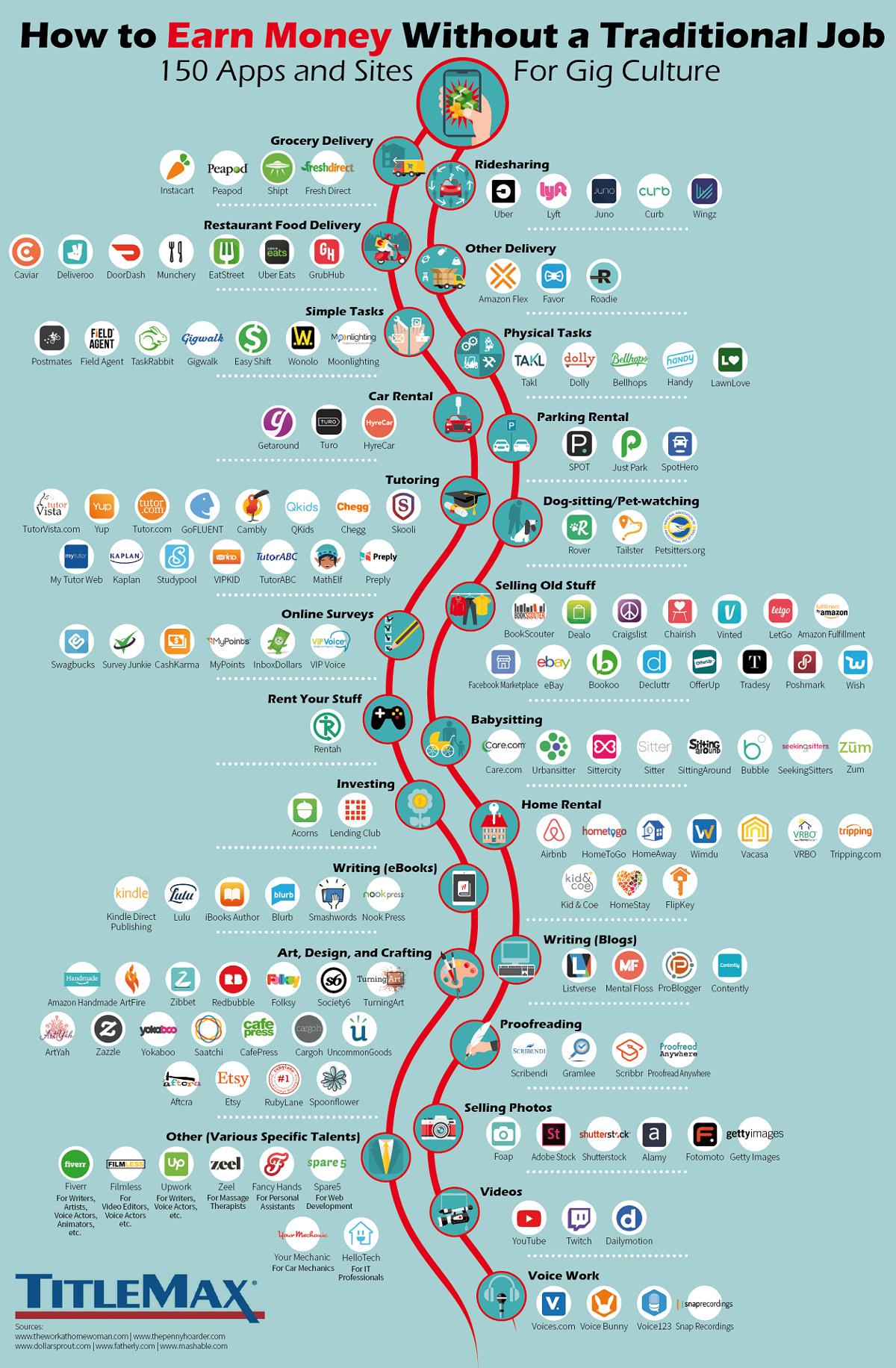
Previously posted, this item from zerohedge:
Link here. At this link, click on the magnifying glass to zoom in. It will be interesting to see how this plays out ten years from now. My hunch is that there may be many more apps in the gig economy ten years from now but most will not make good investments. Many of the apps provide services that Walmart, CVS, Target, Amazon, others already provide. My hunch: Hertz, Avis, Enterprise will get into the ride-hailing business. 
Watching television commercials suggests to me there are a lot of "web-page" start-ups that won't be going anywhere. They are part of the "gig economy." From what I can tell, they simply aggregate data that is freely available, then offer some value-added service, and market it. Most of them seem like get-rich-quick schemes employing five or six executives / Harvard MBA-types and a dozen IT coders. Many probably do what Trivago is accused of doing. Google is accused of the same thing. As are others.
Some will do well; most will simply fade away. There will be consolidation. A dozen "food-delivery" app-companies will "round down" to one or two. A dozen "hotel-finder-app-companies" will round down to one or two. For the investor, the question is finding the needles in the haystacks. 

Example: from The Wall Street Journal, May 20, 2019: GM will scale back its Maven car-sharing business. [To see just how tough this business it, I consider myself somewhat well-read, and yet, I do not ever recall hearing about "Maven."] From the linked site:
Maven is the latest example of a traditional car maker facing challenges while movinginto new transportation ventures. Maven plans to terminate its service in eight of 17 North American cities, including Chicago and Boston. It will continue to operate in Los Angeles, Washington, D.C., Detroit,  Toronto, and other [unnamed] cities.
Example: there are countless hotel-booking websites. SmarterTravel lists the ten best such sites. And hidden in that list of ten, one company, Expedia owns two others: Travelocity and Orbitz. Not listed, of course, are loyalty programs which I assume are huge. And my hunch is that the margins are huge for loyalty programs as opposed to the ten listed at SmarterTravel which all cater to those trying to get the best deal. But twelve hotel-booking websites. Really?

This won't help:


Other high profile names.
  • Uber: facing its own difficulties; see WSJ link above; Uber with steep loses and stock has slumped;
  • Chariot: Ford Motor Company's private-shuttle service that was shuttered in January, 2019; Ford had bought the company several years ago in a push to diversify;
  • Cadillac: dabbling in subscription service for cars that let customers pay one monthly fee to swap in and out of models; Cadillac canceled that subscription business last year (2018) but says it will re-launch with adjustments
  • Blue Apron:
    • May 21, 2019: a reverse stock split won't save Blue Apron, Motley Fool;
    • May 20, 2019: Blue Apron latest to suffer in tough market, The Seattle Times;
  • HelloFresh:
    • January 23, 2019: breaking through or breaking down, SeekingAlpha; almost ten years old; tea leaves suggest it will go the route of BlueApron

Bakken Census -- Update -- May 23, 2019

Maine: for what it's worth. The state is looking at nationalizing its power grid. Op-ed here.

Bakken census: from a reader, thank you. At this rate, North Dakota will surpass the population of California in 2325. Link here.

Minot’s population dipped somewhat in the latest estimates released by the U.S. Census Bureau today.

The estimate of 47,370 as of July 2018 is down 1% from 47,885 in 2017 and down nearly 4.4% from the peak estimate of 49,531 in 2015. The official 2010 census was 40,888.

Although communities such as Minot and Stanley have seen declines from their oil boom highs, significant growth still is occurring in northwest North Dakota’s oil patch. That growth is concentrated around Williston, which saw an estimate increase of 5.7%, and Watford City, up 8% in 2018.

Watford City’s new estimate of 7,080 is lower than the community believes is its true population. Vawnita Best, community development director, said the community estimates its population around 8,500. Working with the Census Bureau, the city learned its error rate on the 2010 count could have been off as much as 25 percent, which if carried over in the estimates would put the 2018 population at 8,750, she said. That compares with 1,744 residents counted in 2010.

New energy website: https://bakkenmidstream.com/. 

Disclaimer: this is not an investment site. Do not make any investment, financial, job, travel, or relationship decisions based on what you read here or think you may have read here.

WTI Slides; Will Test $60; Jobless Claims "Surprise" On The Downside -- America Stays Great -- May 23, 2019

Updates 

Later, 9:52 a.m CT: here we go -- WTI solidly below $60. Now at $58.45, having dropped 5% so far today, losing about $3.00, currently trading at $58.45. 

Later, 7:53 a.m. CT: WTI sinks to $60.06.

Original Post

Weekly jobless claims: link here or here.
  • prior: 212,000
  • forecast: 217,000
  • actual: 211,000 
  • 4-week moving average: 220.25K (note the false precision)
CLR: April, 2019, presentation. Interested in the Springer shale.  The latter mentioned in slide 9.

OXY: the only good news -- activist investors seem to be quiet right now, but lots of work to be done to swallow Anadardo.

Disclaimer: this is not an investment site. Do not make any investment, financial, job, travel, or relationship decisions based on what you read here or think you may have read here.

Oh-oh! the cost keeps going up -- data points:
  • Sasol
  • Lake Charles Chemical Project (LCCP)
  • world-class ethane cracker
  • now estimated to cost as much as $13 billion (rounded)
  • up from original estimate of $12 billion (rounded) just a couple of months ago
  • it may not sound like much, but
    • it is an 8% increase in just a few months; and, 
    • Sasol didn't give any reassurance:  “This increase in the anticipated LCCP capital costs is extremely disappointing"
  • project began in 2014
  • project:
    • 1.5 million tons of ethylene annually
    • six on-site downstream chemical manufacturing plants
Sasol story: the story above has always been of marginal interest to me but with talk of a plastics plant in the Bakken, the story has become much more interesting, much more relevant.

Turkey: stung by Trump's reaction to that country buying Russian anti-defense missiles, Turkey blinked this time: Turkey stopped purchasing Iranian oil as of May (wink, wink); no links; story everywhere;

India: says it ended its oil imports from Iran and Venezuela on May 3 (twitter).


WTI: could continue to fall -- Rigzone; The best model to explain all this at this post. "Everybody" talks about oil going back to $90 but the tea leaves certainly don't suggest that will happen any time soon. When analysts start invoking Venezuela, Libya, and Iran, one knows they are grasping at straws. Canada, Russia, and Saudi Arabia can meet any shortfall.

Brent: off which Saudi bases its price, has dropped below the all-critical $70 threshold.

Disclaimer: this is not an investment site. Do not make any investment, financial, job, travel, or relationship decisions based on what you read here or what you think you may have read here.

Tesla; after a  6% drop yesterday, futures suggest another 3% drop today. Now trading below $190. Rare buying opportunity.

**************************************
Back to the Bakken

New wells reporting -- Thursday, May 23, 2019:
  • 35319, SI/NC, MRO, Sears USA 21-16TFH, Reunion Bay, no production data,
  • 35300, SI/NC, WPX. Minot Grady 26-35HC, Squaw Creeky, no production data,
  • 31563, SI/NC, Slawson, Submariner Federal 5-23-20TFH, Big Bendy, no production data,
Active rigs:

$60.415/23/201905/23/201805/23/201705/23/201605/23/2015
Active Rigs6465512582

RBN Energy: the international factors influencing US propane exports, part 2.
It’s impossible to know for certain what will happen next in the international markets for propane, butane and ethane — there are too many variables and vagaries. What is very doable, though, is to gain a better understanding of the broader market forces at play.
For example, the U.S. now has a few years under its belt as a major propane exporter, so it’s feasible to assess trends in where that propane is going — or no longer going — and to examine how propane exports to various parts of the world are impacted by everything from a high-stakes trade war to governmental efforts to encourage the use of cleaner cooking fuel. Today, we continue our deep-dive into propane, butane and ethane exports with a look at where propane exports from the U.S. East, West and Gulf coasts are heading, and why.