Locator: 44656USECONOMY.
Certainly doesn't look like a recession or depression.


Locator: 44656USECONOMY.
Certainly doesn't look like a recession or depression.

Locator: 44654REALITYSUCKS.
Today, BlackRock joins the group. Flees "net-zero financing." Link here. The story, with a bit of spin, I assume. The practice caused confusion. LOL:
BlackRock, the world’s largest asset manager, is quitting the Net Zero Asset Managers initiative in the latest exit of a major financial institution from a climate finance alliance since Donald Trump was elected U.S. President in November.
BlackRock has decided to leave the voluntary Net Zero Asset Managers initiative, which launched in December 2020 and aims to “support the asset management industry to commit to a goal of net zero emissions in order to mitigate financial risk and to maximize long-term value of assets.”
The world’s top asset manager has quit the initiative because its membership has “caused confusion regarding BlackRock’s practices and subjected us to legal inquiries from various public officials,” Vice Chairman Philipp Hildebrand wrote in a letter to institutional clients seen by the Financial Times.

This warms the cockles of my heart. The entire story. This story -- but not this article -- has been reported frequently on the blog.
Another tailwind for the market.
Within the span of a month, Wall Street’s biggest banks have quit what had been one of the most popular clubs inside global finance.
The Net-Zero Banking Alliance — a group dedicated to helping lenders reduce their carbon footprints — has in quick succession been abandoned by Goldman Sachs Group Inc., Wells Fargo & Co., Citigroup Inc., Bank of America Corp. and Morgan Stanley. JPMorgan Chase & Co., the largest US bank, looks to be next in line.
The moves reflect US banks’ desire to shield themselves from increasing political pressure as Donald Trump returns to the White House, according to people familiar with the matter who asked not to be identified discussing private deliberations. And NZBA is bracing for more US exits, Secretariat Lead Sarah Kemmitt told members in a Dec. 31 letter seen by Bloomberg. She cited the “political environment.”
At the same time, the real-world impact of the NZBA defections is unclear. According to data compiled by Bloomberg, banks have collectively stepped up their financing of the fossil-fuel industry since the alliance was formed in 2021.
Membership of NZBA was likely more a case of “virtue signaling” than “meaningful climate impacts,” said Jill Fisch, a business law professor at the University of Pennsylvania.
Activists are now demanding that the government intervene to target Wall Street. Environmental Advocates NY, a nonprofit, says it’s urging New York state officials to introduce regulations and laws that would compel banks operating in the world’s biggest financial hub to take climate action.
The wave of NZBA exits follows behind-the-scenes tensions that have been brewing for more than two years, Bloomberg’s reporting has shown. In 2022, JPMorgan and Morgan Stanley were among banks pushing back against binding targets on climate finance. NZBA then watered down some requirements, and members stayed put. But as the Republican Party grows more hostile toward climate-friendly organizations, the finance industry is repositioning itself.
Global temperatures are rising fast, yet banks continue to reap short-term profits by sticking with fossil fuel producers. It’s therefore both “distressing and unsurprising” that Wall Street is turning it’s back on net zero alliances, said Ken Pucker, who teaches sustainability at the Fletcher School at Tufts University in Medford, Massachusetts.
***********************************

The whole house of cards, to mix metaphors, is now going to fall, in quick succession.
******************************
Net-zero banking? Dead. Link here. Along with ESG and DEI.

Also, WSJ link:

Also, the "Rainforest Action Network" is apoplectic:

Locator: 44653DIVIDENDS.
Maybe I'm missing something but this is what I'm seeing / reading. Needs to be fact-checked.
This story is being reposted today on Benzinga though they reference a dividend increase almost a year ago.
Black Hills Corporation (NYSE:BKH) is an energy company that operates through its Electric Utilities, Gas Utilities, Corporate and Other segments. These segments operate in states in the Midwest and mountain regions in the U.S.
On Jan. 26, Black Hills announced that its board of directors approved a quarterly dividend of $0.65 per share, an increase of $0.025 per share over last quarter's dividend.
"This dividend increase showcases our long-standing commitment to reward shareholders with a sustainable, growing dividend," said Linn Evans, president and CEO of Black Hills Corp.
The new annualized rate represents 54 consecutive years of annual dividend increases, the second-longest track record in the electric and natural gas utility industry.
So that story is being recycled today by Benzinga.
But note this, link here:


BKH announced a dividend increase for calendar year 2021, but in fact paid out significantly less by skipping a payment, if the information above is accurate.
**********************************
Disclaimer
Brief
Reminder
The wells:
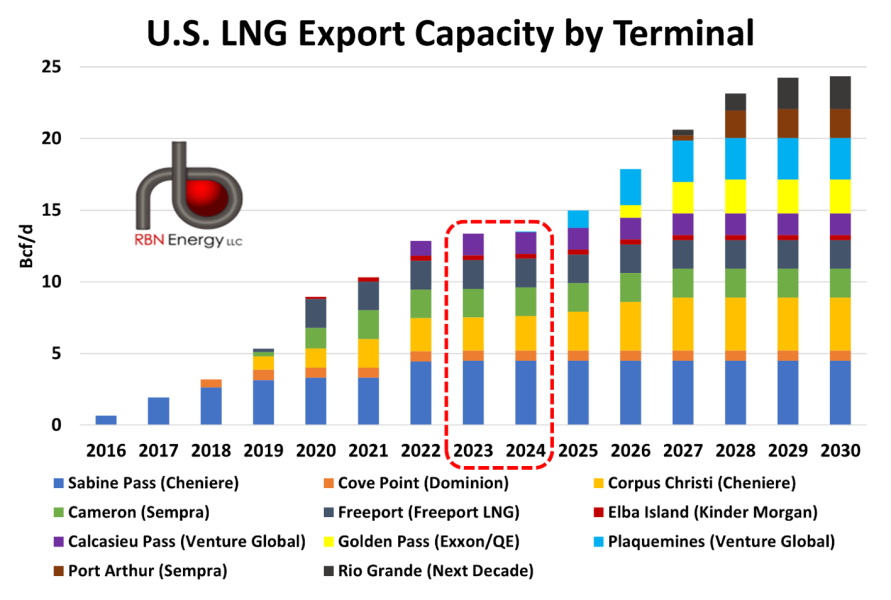
Russia’s invasion of Ukraine and Europe’s subsequent pivot away from Russian natural gas caused a huge resurgence in interest in U.S. LNG. That led to nearly 60 MMtpa (7.9 Bcf/d) of new U.S. LNG capacity reaching a final investment decision (FID) in 2022-23. But regulatory delays at the Federal Energy Regulatory Commission (FERC), the Biden administration’s pause on non-free-trade-agreement (non-FTA) export licenses, and legal challenges to the FERC approval process have essentially halted LNG development in the U.S. There are several LNG projects with enough commercial momentum to move forward that are stuck in regulatory or legal limbo, but even projects that have reached FID are not safe from legal challenges. In today’s RBN blog, we conclude our series on LNG delays by looking at recent court rulings and other regulatory issues and their impact on U.S. LNG development.In Part 1 of this mini-series we talked about how LNG construction delays caused 2024 to be the first year that U.S. LNG feedgas demand did not see meaningful year-on-year growth since U.S. exports began in 2016 (see dashed red box in Figure 1 below). Major construction delays at Golden Pass LNG (yellow bar segments) and the bankruptcy of the terminal’s engineering, procurement and construction (EPC) partner, Zachry Holdings, in the spring of 2024 delayed its startup by at least a year. Minor delays at Venture Global’s Plaquemines LNG (light-blue bar segments) pushed back the final stages of commissioning and startup at the terminal, although “first LNG” — the term of art for the first output from a plant — was achieved on December 14 and the terminal exported its first commissioning cargo on December 26. Flows at the terminal will ramp up this year as additional units come online.
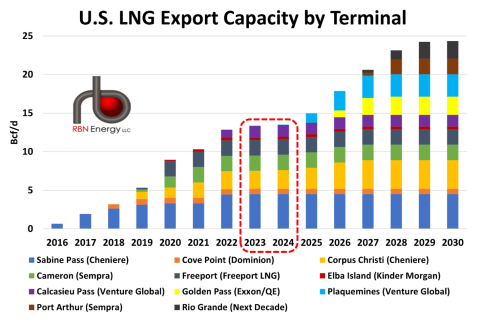
Figure 1. U.S. LNG Export Capacity by Terminal. Source: RBN
Feedgas growth from near-term U.S. LNG projects may have been pushed back, but it’s still coming, with at least 1 Bcf/d of demand— and potentially more than 2.5 Bcf/d — expected by the end of the year, depending on the exact ramp schedule for the commissioning terminals. By the end of 2026, feedgas demand could approach 19 Bcf/d with Corpus Christi Stage III online, Plaquemines LNG Phase 1 online and Phase 2 commissioning, and Golden Pass ramping online. While construction issues can cause timing delays at the terminals, the three near-term projects appear to be secure in their path forward, but things become more uncertain further out. Regulatory and court challenges have made it increasingly difficult for new projects to take FID and, given that court challenges actually happen after projects are approved —sometimes even after FID — it’s a very unsettled world right now.