Showing posts sorted by relevance for query cameron lng. Sort by date Show all posts

Wednesday, October 12, 2016

List Of Potential US LNG Export Facilities -- RBN Energy -- October 12, 2016

Sources

Port Arthur, TX: Sempra, Saudi Aramco -- joint ventures and expansions. Update: on hold -- May 22, 2020.

EIA: US liquefaction capacity additions by project and train, release date -- March 2, 2017

Updates

Cameron: to expand; update; Sempra, April 4, 2022.

Driftwood: near FID.

How close is Cheniere to FID on further expansion, March 8, 2022. 

Cheniere has sold out all LNG through 2040, March 7, 2022.

Sabine Pass train 6 commissioned, November 1, 2021.

US LNG: FERC authorizes / okays feedgas flows to Sabine Pass train 6. Link here. 

September 19, 2021: Cheniere Energy, Inc: asked for FERC approval for a sixth train at Sabine Pass LNG in Louisiana. Approval was requested by Tuesday, September 21, 2021 (good luck with a Dem-dominated FERC). Train 6 is expected to be complete in 1Q22. Link here.

September 2, 2021: Golden Pass, Sabine; first liquefaction train; joint venture, Qatar and XOM; in-service, 2024. Link here.

August 26, 2021: US LNG exports smashing records.

May 18, 2021: update of export terminals

March 19, 2021: US LNG feedgas demand sets another all-time record. Venture Global LNG's Calcasieu  Pass terminal, Louisiana, slated to ship first cargo later this year. Cal-cashew.

March 16, 2021: floating liquefaction natural gas export terminals. At same link, Gibbstown, NJ.

November 12, 2020: Calcasieu Pass update. Huge story.

August 31, 2020: contractor to resume construction at Sabine Pass' Train 6 and the Third Berth project following Hurricane Laura one week ago.

August 13, 2020: update on Tellurian's Driftwood facility here.

May 22, 2020: Sempra Energy delays decision on Part Arthur, TX, project. Saudi Arabia delays decision on securing five huge LNG tankers scheduled for loading in 2025. Link here.

May 20, 2020: Cameron's train 3 starts producing LNG; Hackberry, LA.

September 9, 2019: behind schedule? In the graphic above, EIA shows Cameron to have "T3" by 3Q19. A couple of weeks ago, SRE announced that the first train of the Cameron LNG liquefaction-export project had initiated service, located in Hackberry, LA. The article does confirm that the Cameron facility will have three trains. It's hard to say from the story, but it sounds like the capacity of all three trains combined is 12 million tonnes per annum of LNG, or nearly 1.7 billion cubic feet per day. Conversion at this site.

September 4, 2019: Cheniere declares 2nd train at CC completed; this marks Cheniere's 7th train at CC and Sabine Pass; a 3rd train at CC under construction; estimated completion, 2H21; at Sabine Pass, Cheniere has announced it will build a sixth train. Total now projected: 9. Note: in the graphic above only five trains were projected as of 3Q19.

June 3, 2019: Cheniere to add 6th train at Sabine Pass, Louisiana. Note: in the graphic above only five trains were projected as of 3Q19.

May 30, 2019: of all the proposals in the original list, the most prominent one likely not to proceed any time soon is the G2 LNG proposal for a liquefaction/LNG export facility; up to 14 MTPA; Cameron Parish; according to a 2019 - 2010 Louisiana Economic Outlook white paper.

May 30, 2019: update on the Rio Grande LNG project at this post; this project was on the original list (scroll down).

May 29, 2019: three new LNG export facilities near New Orleans, LA; Venture Global; two of the three were in the original list below;

May 23, 2019: update -- Sempra Energy begins operations at its Cameron export terminal

May 6, 2019: update -- Sempra's Port Arthur LNG wins federal "okay" to start exports. SeekingAlpha -- can export to countries that don't have a free trade agreement with the US; SRE can export almost 2 billion cfpd; two liquefaction trains. SRE to make FID later this year.

April 19, 2019: update -- a Florida project hits a milestone; Tellurian and Sempra updated.

February 11, 2019: update -- link here -- 


April 16, 2019: SRE's Cameron LNG has begun pipeline feed gas flow to the first liquefaction train of the liquefaction-export project as it prepares to begin production of liquefied natural gas (LNG) at the facility in Hackberry, La. This is the final commissioning step for Train 1 of Cameron LNG Phase 1.

December 16, 2018: Qatar plans to expand.

November 2, 2018: Cameron/SRE/Louisiana -- commissioning process begins.

August 14, 2018: Cheniere ready to fire up its second LNG export terminal; Corpus Christi; will be country's third export terminal; many others under construction. If you add up the capacity in the graph above dated March 2, 2017, it adds up to 7.1 Bcf/day. Now, Platts estimates 4 Bcf/day by the end of the year (2018) and 8 Bcf/day by the end of 2019.

May 23, 2018: see November 14, 2017, update below. Cheniere okays third train at Corpus Christi.

November 21, 2017: Tellurian will build a 20 train LNG facility on Lake Charles for $15 billion ... half the historical price for these plants. The LNG project is the Driftwood, being built by Bechtel.

November 14, 2017: Cheniere to make investment decision over a third planned liquefaction train at its Corpus Christi terminal. 

November 4, 2017: Dominion's Cove Point should be up and running this week

October 27, 2017: update of Sabine; 4th train completed. Pretty awesome. 

September 18, 2017: FERC approves Kinder Morgan's Savannah, Georgia, Elba Island LNG export terminal.

May 6, 2017: update. Texans for Natural Gas said in a report that seven LNG export projects proposed or under construction in the state could raise $20 billion or more in tax revenue, create more than 135,000 jobs and have a total economic impact of roughly $145 billion.

April 30, 2017: RBN Energy update. Archived.
  • Cheniere Energy's Sabine Pass, southwestern Louisiana: three liquefaction trains are operating; a fourth is gearing up to run; a fifth is nearing completion
  • Alaska: newly filed plan by state-owned Alaska Gasline Development Corp to develop a $40-billion-plus LNG export project; would include an 800-mile gas pipeline from Prudhoe Bay to Nikiski, AK; three liquefaction trains at Nikiski; two export loading docks
  • second-wave proposals (similar to first-wave projects now in operation at Sabine Pass ; Cameron LNG, Louisiana; Dominion's Cove Point LNG, Maryland; Freeport LNG and Cheniere's Corpus Christi LNG, Texas; all projects feature liquefaction trains with capacities between 4 and 5.2 MTPA each; most are located at existing LNG import terminals, eliminating some of the port-related costs that projects at greenfield sites would face
  • Brownsville, TX; and, Texas City, TX: NextDecade LLC's; the tried-and-true approach; each site would have several 4.5-MTPA trains; online in the early 2020s
  • Texas LNG Brownsville LLC: a second category of second-wave projects; smaller-scale proposals; trains would have capacities of 1 to 2 MTPA each; at Brownsville: plans to build two 2-MTPA liquefaction trains; some appeal; more interest since first announced
  • Another second-wave example: Cheniere's plan to build seven 1.4-MTPA trains to meet the incremental LNG needs of international LNG buyers
  • Veresen's Jordan Cove project, Oregon: up to five 1.5-MTPA trains
  • third category: the Alaska LNG proposal; would require installing some 800 mies of new, 42-inche-diameter pipeline across Alaska
March 4, 2017: update on Texas LNG (Third Point LLC / Samsung consortium) mentioned in the original post below.

February 1, 2017: Louisiana's Port Fourchon may add LNG terminal, over at Rigzone.

January 28, 2017: Exelon has applied for an LNG export facility permit for Brownsville, TX. 

November 28, 2016: from FuelFix -- see 5th bullet below -- "Tellurian Investments / Driftwood LNG" -- GE has invested a $25 million equity stake in Tellurian Investment's Driftwood LNG project.
 
Original Post
 
The list of US LNG export projects at various points along the regulatory process, as reported by RBN Energy. First, Louisiana, mostly near Lake Charles:
  • Cheniere: to build a sixth 4.5 MTPA liquefaction train at Sabine Pass LNG site
  • Cameron LNG: has proposed two additional 4.5-MTPA liquefaction trains at its Hackberry facility south of Lake Charles, LA
  • Lake Charles LNG: has proposed a three-train, 16.2-MTPA liquefaction/LNG export facilty in advanced stages
  • LNG Ltd: has proposed the development of the Magnolia LNG project; as many as four 2-MTPA liquefaction plants, near Lake Charles [Update, DOE approved, December 2, 2016]
  • Tellurian Investments: developing Driftwood LNG, total capacity up to 26 MTPA; also near Lake Charles
  • Louisiana LNG Energy LLC: has proposed construction of a 6-MTPA liquefaction/LNG export terminal on Mississippi river southeast of New Orleans
  • Venture Global LNG: two proposed liquefaction/LNG export terminals in Louisiana; one 20-MTPA facility and one 10-MTPA facility
  • Southern California Telephone & Energy: developing the Monkey Island liquefaction/LNG export project; south of Lake Charles; at least three 4-MTPA trains
  • G2 LNG: has proposed a liquefaction/LNG export facility; up to 14 MTPA; Cameron Parish
  • CE FLNG: proposed project; two floating LNG vessels; each vessel up to 4 MTPA
Now, Texas:
  • Cheniere: plans to build three more 4.5-MTPA liquefaction trains at its Cheniere's Corpus Christi facility
  • Freeport LNG: developing a possible fourth 4.4-MTPA train at its Freeport site; completed; online December 16, 2016;
  • Port Arthur LNG, an affiliate of Sempra: leading the development of a proposed two-train, 10-MTPA liquefaction/LNG export terminal along the Sabine-Neches Waterway in Port Arthur; Woodside Petroleum is also participating in this project
  • Annova LNG: has proposed a six-train, 6-MTPA liquefaction/LNG export facility planned by Exelon Generation for Brownsville
  • Third Point LLC (a NYC-based investment fund) and Samsung Engineering are developing Texas LNG, a proposed 4-MTPA liquefaction/LNG export terminal in Brownsville
  • Golden Pass LNG: a joint venture of Qatar Petroleum and Exxon Mobil; a 15.6 MTPA plant at its existing LNG import terminal at Sabine Pass
  • Rio Grande LNG, being developed by NextDecade LLC: up to six 4.5-MTPA liquefaction trains and two LNG loading berths along the Brownsville Shipping Channel
In other states:
  • Kinder Morgan: two 5-MTPA trains in Pascagoula; and, a 2.5-MTPA Elba Island project in Chatham County, GA (near Savannah, Georgia)
  • Veresen: a proposed 6-MTPA Jordan Cove LNG project in Coos Bay, OR
  • Maryland, Cove Point (not mentioned in this RBN article)
Bottom line:
  • those projects would add more than 220 MTPA of capacity
  • those projects would require more than 30 billion cubic feet of gas / day
  • it's safe to say, according to RBN Energy, that most of these projects will never get to the FID stage
  • RBN Energy: does not imagine more than a few new liquefaction trains would be financed and built by by the mid-2020s

Tuesday, December 30, 2014

Update On LNG Global Exports - Imports -- RBN Energy -- December 30, 2014; Excelerate Energy's Texan LNG Terminal Canceled Due To Price Slump

The RBN Energy story by Housley Carr down below  was posted early on the morning of December 30, 2014. Later that afternoon Reuters was reporting that Excelerate Energy's Texan liquefied natural gas terminal plan has become the first victim of an oil price slump threatening the economics of U.S. LNG export projects.
A halving in the oil price since June has upended assumptions by developers that cheap U.S. LNG would muscle into high-value Asian energy markets, which relied on oil prices staying high to make the U.S. supply affordable.
The floating 8 million tonne per annum (mtpa) export plant moored at Lavaca Bay, Texas advanced by Houston-based Excelerate has been put on hold.
The project was initially due to begin exports in 2018.
Excelerate's move bodes ill for thirteen other U.S. LNG projects, which have also not signed up enough international buyers, to reach a final investment decision (FID). Only Cheniere's Sabine Pass and Sempra's Cameron LNG projects have hit that milestone.  
*************************************************

Spouse of the Rising Sun—No LNG Divorce Imminent, Despite It All Monday, 12/29/2014 
Published by: Housley Carr

It would be an understatement to say that the worldwide market for liquefied natural gas (LNG) is in flux. LNG production is up and heading higher, oil—and LNG--prices are down sharply from a few months ago, and Japan and other big consumers of LNG are more interested than ever in mitigating price and supply risk. All this comes as Japan, a primary target of prospective U.S. and Canadian LNG export projects, is grappling with the need to restart dozens of idled nuclear units so it can reduce the oil and LNG imports that have hurt its trade balance since the Fukushima disaster nearly four years ago. Today we consider recent developments and how they may affect Japan and its potential LNG suppliers on the North America side of the Pacific.

Despite recent setbacks, Japan remains an undisputed economic powerhouse, the third-largest economy in the world behind the U.S. and China. But the island nation depends more than ever on imported oil and natural gas (in the form of LNG) to run its power plants and factories and to heat its businesses and homes. As we said in the First Episode of our “Spouse of the Rising Sun” series, Japan was already the world’s leading LNG importer (accounting for about one-third of all LNG imports) in March 2011, when a 9.0 earthquake triggered a tidal wave that devastated Tokyo Electric Power Co.’s six-unit Fukushima Daiichi nuclear station northeast of Tokyo. Within two months of the disaster, most of Japan’s other 48 nuclear units were offline, and by September 2013 all of them were. Given that nuclear power had been providing 30% of Japan’s electricity prior to Fukushima (with fossil-fired units providing almost all the rest), the industry-wide nuclear shutdowns forced wrenching change. Oil and LNG imports rose to fill the nuclear gap and, as we said in Episode Two, the pace of nuclear-unit restarts is likely to be slow and the heightened need for oil and LNG is likely to continue. What’s changed over the past few months though, is that a lull in LNG demand (in Japan and elsewhere in Asia) has created a supply surplus and a buyer’s market. Also, as we know all too well, the price of oil has fallen precipitously and shows no sign of a quick rebound. These changes (and rising LNG production in Papua New Guinea, Australia and—soon—in the U.S.) have given Japan the hope of reining in its fuel-import costs in general, and its LNG costs in particular.

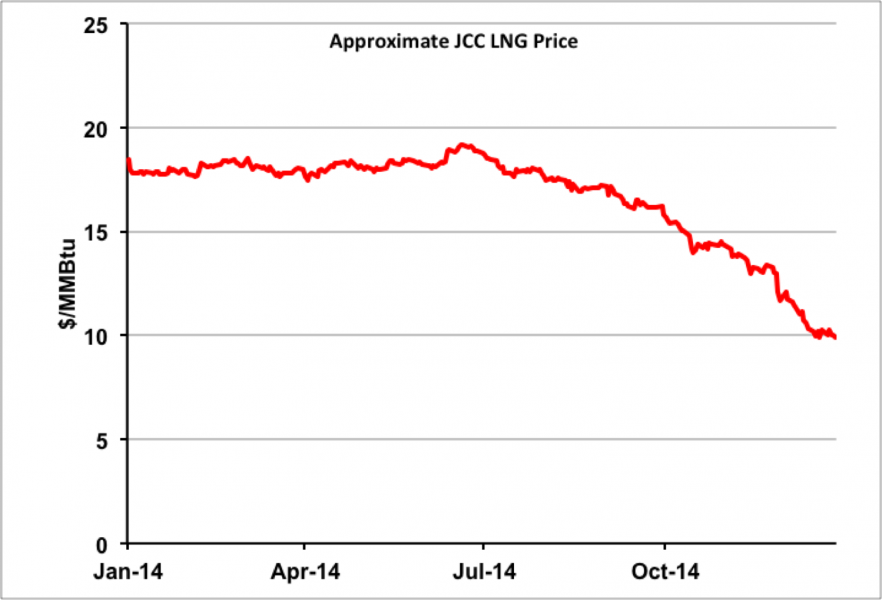
The very liquid worldwide market for oil enables Japan and other Asian oil importers to take advantage of currently low oil prices. In addition, because the vast majority of Asian LNG contracts index LNG prices to a basket of imported oil known as the Japanese Crude Cocktail (JCC - see “Courtesy of the Red, White and Blue”), LNG-importing countries also are benefiting from much lower prices in recent months. Figure #1 shows an approximation of the JCC based on Brent prices since the start of 2014, falling from close to $20/MMBtu in July to $10/MMBtu in December. Add to that the facts that demand for LNG in Japan and South Korea this past summer and fall has been flat, and that new LNG production expected online soon will add to market supply (fully one-third of the output of Chevron’s mammoth Gorgon LNG project in Australia—set to start exporting in mid-2015—is not under long-term contract so will hit the open market) and you have yourself an LNG price-sag of major proportions. In December 2014, spot LNG prices in Asia (a better leading indicator than the JCC contract price) are below $10/MMBTU and they could fall even more by the spring of 2015 if it’s a mild winter and LNG stockpiles continue to build.

Figure #1

Source: RBN Energy (Click to Enlarge)


That’s great news for LNG importers, of course, but it’s a real headache for companies trying to develop new LNG export facilities—and for U.S. and Canadian natural gas producers hoping to lock in long-term deals to sell gas for export as LNG. Consider a 20-year LNG contract that a Portuguese utility, Energias de Portugal (EdP), reached in December 2014 with Cheniere Energy’s planned Corpus Christi LNG export facility. Under the deal, EdP will take up to 0.77 million metric tons per annum (MTPA) of LNG (the equivalent of 108 MMcf/d of natural gas) and pay Cheniere a liquefaction and LNG loading fee of $3.50/MMBtu plus 115% of the final settlement price for the Henry Hub natural gas futures contract for the month in which the LNG shipment is scheduled. If a Japanese buyer made an identical deal, and if the Henry Hub gas price were, say, $4/MMBTU, the cost of gas delivered to Tokyo would be $4 (for the gas) plus $3.50 (for the base liquefaction fee) plus 60 cents (15% of $4, the supplemental liquefaction fee) plus $2 for shipping (roughly) and plus $1 (again, roughly) for regasification in Japan. That comes to about $11/MMBTU--a buck or more above the current LNG price in Asia. Then (for the Japanese LNG buyer) there’s the risk that U.S. natural gas prices could rise, putting U.S.-sourced LNG further out of the money in a low-price LNG market. It’s all more complicated than this, of course. For one thing, despite efforts by Japan, Singapore, China and others to establish a liquid trading market for LNG, that goal has proved elusive. For another, as part of Japan’s effort to mitigate LNG price and supply risk, its utilities and other buyers have been actively seeking U.S. (and Canadian) sources of LNG. Still, the current slumps in oil and LNG prices (and in Asian LNG demand) are generally not good news for companies trying to develop U.S. and Canadian LNG export facilities.

That doesn’t necessarily mean, however, that Japan (and South Korea, China and India) won’t commit to buying additional LNG from the U.S. and Canada in the future. As we said, LNG buyers (Japan being a prime example) want supply diversification, and adding a few gas-price-indexed LNG contracts into their mix wouldn’t be a bad thing from a risk-mitigation perspective. Also, it’s reasonable to predict that oil prices will be higher four to six years from now than they are today, and that’s the period in which most new Asia-focused LNG export projects in the U.S. and Western Canadian projects (like Veresen’s Jordan Cove project in Oregon; see “New Kid in Town” and below) would come online.

Jordan Cove LNG

 Source: Veresen (Click to Enlarge)


Then there’s the issue of Asian LNG demand—and, given the focus of this blog, Japanese demand in particular. Sure there’s been some recent softness in Japan’s demand for LNG (mostly tied to mild weather), but LNG imports in the Land of the Rising Sun remain well above their pre-Fukushima level (about 89 MTPA now, versus 71 MTPA in 2010), and its likely they will decline only slightly–or even stay flat--as most of Japan’s nuclear units are restarted over the next few years. (You may be wondering if, with oil prices so low, Japan will ramp down its use of gas-fired generation and ramp up its use of oil-fired generation. The answer is, “Not to any significant degree.” Japan has been trying to reduce its oil dependence for years, mostly with emission-reduction and climate-change goals in mind. And all of the new, highly efficient generating capacity being developed in Japan is fired by gas, not oil.) The bottom line is that while all this is clearly a challenging time for those interested in selling LNG at a solid profit to the Japanese, Japan is not in any way inclined to end its long-time marriage to LNG. As we said, LNG imports in the current Japanese fiscal year (FY2014, which ends March 31, 2015) are expected to total 89 MTPA (according to a December 2014 estimate by Japan’s Institute of Energy Economics), and even with the oil price decline and LNG demand slump factored in, LNG imports are only seen slipping to 85 MTPA in FY2015, which runs through March 2016. So, as Japan’s older, oil-indexed LNG contracts roll off and Japan seeks more supply diversification, there is probably room for a few more LNG-supply deals with the U.S. and Canada. Patience may be required though; the oil price collapse has everyone taking a deep breath and a second—and third—look at everything we previously assumed to be true in this market.

Wednesday, January 23, 2019

January 23, 2019

Tbe new normal, at least for now: New Englanders paying $125/MWh; anything above $35 is immoral but that's what you get with non-dispatchable renewable energy. Link here

************************************
Back to the Bakken
Wells coming off the confidential list Wednesday and yet to be reported, the "Tuesday wells":

Wednesday, January 23, 2019
  • 34197, 2,086, CLR, Norway 9-5H2, Fancy Buttes, t11/18; cum 10K 11/18; 
  • 33643, IA/n/d, CLR, Ransom 5-20H2, 33-053-08052, 8.7 million gallons water, 90.1% water by mass; Elidah, t--; cum --;  
Tuesday, January 22, 2019
  • 34879, 1,066, Newfield, Berg Federal 149-97-30-31-4H, 33-053-08527, 9.8 million gallons water; 92% water by mass;Haystack Butte, t11/18; cum 13K after 17 days;
  • 34878, 734, Newfield, Berg Federal 149-97-30-31-5H, Haystack Butte, t11/18; cum 9K after 16 days; 
  • 34613, SI/NC, WPX, Benson 3HC, 33-053-08425, no frack data at FracFocus as of 11/18; Squaw Creek, no production data, 
  • 34476, 386, Lime Rock Resources, Laura Sadowsky 2-1-36H-142-96, 33-025-03437, 9.1 million gallons, 92.9% water by mass; Manning, t7/18; cum 42K 11/18;
  • 34475, 389, Lime Rock Resources, Laura Sadowsky 3-1-36H-142-96, Manning, t7/18; cum 47K 11/18;
  • 23939, drl, XTO, FBIR Ironwoman 21X-10E, Heart Butte,
Active rigs:

$53.441/23/201901/23/201801/23/201701/23/201601/23/2015
Active Rigs63573847157

RBN Energy: part 5, how LNG exports will change gulf coast natural gas markets in 2019
One of the biggest factors affecting the U.S. natural gas market in 2019 will undoubtedly be the dramatic rise in LNG export demand. The slate of liquefaction and LNG export capacity additions this year will boost U.S. demand for feedgas supply to nearly 9 Bcf/d by the end of the year, almost tripling the 2018 full-year average of 3.1 Bcf/d and close to doubling the December 2018 average of 4.6 Bcf/d, with the lion’s share of that growth happening along the Texas and Louisiana Gulf Coast. Three liquefaction trains — one each at Cheniere Energy’s Sabine Pass and Corpus Christi terminals, as well as one at Cameron LNG — are likely to be fully operational in the first quarter, with five additional trains due in rapid progression later in 2019. That much new gas demand concentrated in one region is bound to disrupt physical flows and pricing dynamics. Today, we wrap up the series with a look at the timing and feedgas routes for the final two facilities: Freeport LNG in Texas and Kinder Morgan’s Elba Island project in Georgia.
This is Part 5 of our series detailing the LNG export capacity additions due online in 2019 and the feedgas pipeline capacity that’s lined up to serve them. Earlier, we looked at recent changes at the two operational terminals — Cheniere Energy’s Sabine Pass Liquefaction (SPL) and Dominion Energy’s Cove Point LNG facility in Maryland. SPL kicked off the 2019 LNG exports boom last fall when it began ramping up its fifth 4.5-MMtpa train, ahead of schedule. By December, SPL as a whole was taking more than 3.5 Bcf/d, with the help of a new feedgas delivery point via Kinder Morgan Louisiana Pipeline’s (KMLP) 600-MMcf/d Sabine Pass Expansion, which is fully contracted by Cheniere. Around that time, in mid-October, Cove Point LNG returned from a multi-week maintenance event and, with the in-service of upstream pipeline expansions — Williams/Transco’s Atlantic Sunrise and TransCanada/Columbia Gas Group’s WB Xpress — the 770 MMcf/d East Coast export facility began firing on all cylinders for the first time since it came online in early 2018. By late November, Cheniere’s Corpus Christi LNG (CCL) also began commissioning its first liquefaction train on the Texas Gulf Coast, also ahead of schedule, with Train 2 close on its heels.
Among these three facilities, feedgas flows ended 2018 above 5 Bcf/d, double where they started the year, near 2.5 Bcf/d. And SPL’s Train 5 and CCL’s Train 1 are just two out of a full eight new liquefaction trains due to be commercialized this year that will catapult U.S. feedgas demand for LNG exports to almost 9 Bcf/d by the end of 2019. That includes three new trains at Cameron LNG in Louisiana, the first of three trains at Freeport LNG near Freeport, TX, as well as the 10 mini-trains being developed at Elba Liquefaction in Georgia.
That much incremental demand growth in a relatively short span of time –– and mostly concentrated along the Gulf Coast –– is all but guaranteed to disrupt and reconfigure old gas flow patterns in the region. Recall that these LNG export projects need to line up three key commitments: 1) customer commitments for the train capacity (i.e. demand for LNG off-take); 2) supply contracts with gas producers to feed the trains, and 3) transportation capacity to get the gas there, including the capacity to move the gas those last few miles from the mainline delivery point to the terminal itself.
Most recently we examined the feedgas routes and pipeline projects lined up to deliver gas to Cameron LNG in Louisiana, where Train 1 is also gearing up to take feedgas this quarter.
Today, we conclude the series with a look at the timing and pipeline routes that will serve LNG production at the two other terminals that have plans to begin exporting this year: Freeport LNG and Elba Island LNG.
.

Thursday, June 18, 2015

Inappropriately Exuberant Update On US LNG Export Terminals -- June 18, 2015

The other day I made this catty remark in response to some new energy project in the US:
Just one more example of the "stuff" going on in the oil and gas industry in the United States while France bans fracking; Germany returns to coal; Spain asks "WTF" happened to solar; the Mideast blows itself up; and, Russia can't get anything going.  It's not even going well for the Norwegians.
Maybe I'm making too much of this, but Cheniere Energy's Sabine Pass story is absolutely incredible -- at least it seems to me -- by the way, with the market up 160 points today in early trading, what is SRE doing? Not much, up a little.

Okay, back to the Sabine, from RBN Energy (link here, but it will be archived), look at this:
The six liquefaction “trains” under development at Cheniere Energy’s Sabine Pass liquefied natural gas (LNG) terminal will demand nearly 4 Bcf/d of natural gas on average, the first 650 MMcf/d of that starting within a few months. And the five trains now planned at Cheniere’s Corpus Christi site—yes, now five, not three—will require another 3.2 Bcf/d. Taken together, that’s about 10% of current daily gas production in the U.S.; in other words, a monumental logistical task.
The development of the initial quartet of LNG export facilities on the Gulf Coast and East Coast continues.
Construction of the first project out of the gate—Train 1 at Cheniere’s Sabine Pass terminal in Cameron Parish, LA—is nearing completion, with initial LNG production likely by the end of 2015 and the first shipments in early 2016. Meanwhile, work on three other trains at Sabine is well along (they’ll start operating in 2016-17), and Cheniere is closing in on final investment decisions (FIDs) on two more trains at the same site (for a total of six).
A few miles to the east, Cameron LNG is building three liquefaction trains in Hackberry, LA, and in Freeport, TX, Freeport LNG is building two trains of its own.
On the East Coast, Dominion is building a one-train liquefaction plant at Cove Point, MD.
All four projects have something big going for them—namely, each is at the site of an existing LNG import terminal (developed before the shale era), so a lot of the docking and other infrastructure is already in place. That’s given what we’ve been calling these “First Four” LNG export projects a capital-cost edge that, in turn, has enabled them to offer attractively low liquefaction tolling fees and to reach long-term deals with a long list of international off-takers.
[On a side note, I was cleaning up the blog a little bit the other night and noticed I had a post "IN PROGRESS" from several years ago regarding LNG IMPORT terminals in the US. It looks like I quit updating that post literally as news came in that IMPORT terminals were going to turn the pumps around and become EXPORT terminals.

I cannot believe how fast this all happened.

So, four (4) sites above. But there's more:
Cheniere—a gutsy pioneer in the LNG-export business—remains decidedly upbeat. In mid-May (2015), the company gave its contractor the go-ahead to start building two liquefaction trains at a site in Corpus Christi; the final investment decision—on a third train is expected later this year).
Corpus will be the first “greenfield” LNG export project in the Lower 48 states (a small LNG export terminal near Kenai, AK came online in 1969 and is still operating).
And on June 10 (2015), Cheniere announced that it hopes to build two more trains at Corpus and—as if that weren’t enough—that it’s partnering with Parallax Enterprises on two somewhat smaller LNG export projects in Louisiana.
Cheniere estimates that each of the now 11 trains planned at Sabine and Corpus will demand 650 MMcf/d of natural gas, or a total of more than 7.1 Bcf/d. 
Meanwhile France bans fracking, Germany turns to coal, Spain asks WTF happened to solar, and Putin looks to Greece to save his country as he knows it. Think of all the jobs these LNG export terminals jobs are providing. 

Related:

From ArgusMedia, January 2, 2015:
The US has a much larger labor pool to draw from than Australia, which faced labor shortages for its LNG projects.
Expansions at existing US LNG terminals will have advantages over greenfield US LNG projects because of cost savings.
The Cameron LNG export project is being built at the site of an existing import facility and Sempra is considering adding two more liquefaction trains, in addition to the three already being built.
Labor pool issues, from wiki:
The construction cost of greenfield LNG projects started to skyrocket from 2004 afterward and has increased from about $400 per ton per year of capacity to $1,000 per ton per year of capacity in 2008.
The main reasons for skyrocketed costs in LNG industry can be described as follows:
  1. Low availability of EPC contractors as result of extraordinary high level of ongoing petroleum projects world wide.
  2. High raw material prices as result of surge in demand for raw materials.
  3. Lack of skilled and experienced workforce in LNG industry.
  4. Devaluation of US dollar.

Sunday, June 22, 2014

Random Update Of Sempra LNG Export Facility In Louisiana -- Seeking Alpha -- June 22, 2012

Updates

November 2, 2018: Cameon/SRE/Louisiana -- commissioning process begins.
September 11, 2014: final approval. Lawmakers want more.
 
Original Post

On June 15, 2014, I noted in passing, without providing a link that Texas LNG had been granted a license to export up to 2 million tons of LNG annually. I assume I posted the announcement that Sempra Energy was also granted an export license this past week to export LNG, but I can't find it. Never mind. Seeking Alpha is reporting:
  • On Thursday, Sempra's facility in Louisiana was approved to export LNG to other countries.
  • Because Sempra is only the second company in the United States to be approved, this presents a great opportunity for the company.
  • If sold at current prices, the LNG from the approved facility could bring in between $3 billion and $5 billion in revenue per year.
One of Sempra Energy's facilities was recently approved to start exporting liquefied natural gas (LNG). Because of the drastic difference in price between American natural gas and LNG import prices in European and Asian countries, Sempra could see large amounts of revenue from the facility.
There is a great photograph of the facility at the linked site above:
Sempra's approved facility (known as Cameron LNG) is located along the Calcasieu Channel in Hackberry, Louisiana. Because it lies only 18 miles from the Gulf of Mexico, it is in good position to quickly liquefy natural gas and move it to whoever needs it across the globe.
In terms of supply, Cameron LNG is within 35 miles of a pipeline hub that connects 5 natural gas pipelines which should be able to provide the facility with all the natural gas it needs.
And then this:
Sempra is only the second company approved to export LNG. Cheniere Energy was the first company to have a facility approved by both government agencies. Cheniere's Sabine Pass facility was approved back in April 2012. Construction on the facility began in late 2012 and the project is expected to be completed by late 2015.
Once the expansion of Sempra's facility is complete, Cameron LNG will be comprised of three liquefaction trains capable of exporting up to 12 million tons of LNG per year. Below is a graphic of the proposed facility.
Much more at the link, including some great graphics. SeekingAlpha is archiving more and more of their articles for paid subscription. 

Memo to self: page saved.

Monday, November 5, 2018

SRE, Total Sign LNG Agreement -- November 5, 2018

SRE and Total join forces: to develop North American LNG export projects
the other day it was reported that the US and Australia were in a race to become #1 in LNG exports, along with some Mideastern country (Qatar?)
it's being reported over at SeekingAlpha
  • Sempra Energy and Total sign a memorandum of understanding to develop North American liquefied natural gas export projects, which could see Total acquire a further stake in the sector
  • the MOU says Total could contract for as much as 9M metric tons/year of LNG offtake across SRE’s LNG export development projects on the U.S. Gulf Coast and west coast of North America, specifically the Cameron LNG Phase 2 and Energia Costa Azul LNG projects
  • Total, which is already a partner of Cameron LNG joint venture with a 16.6% stake, also may acquire an equity interest in the Energia Costa Azul LNG project
  • the $10B Phase 1 of the Cameron LNG project includes three liquefaction trains under construction in Louisiana, with commissioning of the first train now under way and all three trains expected to be producing LNG in 2019; Phase 2 encompasses up to two additional liquefaction trains and up to two additional LNG storage tanks.
Israeli natural gas, update on Leviathan: last update was posted here. Rigzone is reporting that Noble's project is now 67% complete.

Monday, December 19, 2022

21st Century: America's Century (Again) -- This Time -- Energy -- December 19, 2022

America's century: link here.

HOUSTON (Reuters) - The United States has become a global crude oil exporting power over the last few years, but exports have not exceeded its imports since World War II. That could change next year.

Sales of U.S. crude to other nations are now a record 3.4 million barrels per day (bpd), with exports of about 3 million bpd of refined products like gasoline and diesel fuel. The United States is also the leading liquefied natural gas (LNG) exporter, where growth is expected to soar in coming years.

But the United States consumes 20 million barrels of crude a day, the most in the world, and its output has never exceeded 13 million bpd. Until recently, the idea that it would be anything but a big crude importer was folly.

Last month, U.S. government data showed net U.S. crude oil imports fell to 1.1 million barrels per day (bpd), the lowest since record keeping began in 2001. That is down sharply from five years ago, when the United States imported more than 7 million barrels per day.

RBN Energy: Sempra will soon expand its LNG export capacity with Port Arthur LNG, part 5. Archived.

Thanks to a warm start to the season and low Asian demand for LNG, Europe has so far been able to stave off a worst-case scenario for natural gas supply this winter. Still, the European market is keeping a keen eye on the years ahead, when the continent will need to rely on new sources of LNG to meet demand and refill inventories with little chance of any Russian gas. The call for more LNG has ushered in a new wave of export-project development, with two U.S. projects reaching a positive final investment decision (FID) this year and LNG offtakers in Europe and elsewhere committing to an incredible 37 MMtpa (4.9 Bcf/d) of long-term contracts from pre-FID sites in North America. This momentum has revived a number of projects from the COVID-induced wasteland, including Sempra’s Port Arthur LNG. In today’s RBN blog, we continue our series on U.S. LNG projects by taking a closer look at Port Arthur, the one most likely to take FID next.

So far in this series we’ve looked at four different U.S. projects. Two of them — Plaquemines LNG and Corpus Christi Stage III, the subjects of Part 1 and Part 2 — have both now taken FID. In Part 4, we discussed NextDecade’s Rio Grande LNG, which closed multiple sales and purchase agreements (SPAs) over the summer and has now sold 75% of its Phase 1 capacity. NextDecade, which is still securing offtakers and financing for the project, raised $85 million in September through a private placement equity sale. Although taking perhaps a little longer than expected, the project remains likely to move forward at this point.

If you’re thinking, “Hey, you skipped Part 3,” there’s a reason for that. That blog covered Tellurian’s controversial Driftwood LNG, which at the time had already begun construction despite not having secured full financing. Since then, Tellurian and Driftwood publicly suffered a major setback after losing two of the project’s three offtakers and rescinding a bond offering due to lack of interest. But Tellurian’s drama has more to do with its project structure than the wider LNG market environment, and other projects continue to see support and make progress toward FID, including the project we’re looking at today, Port Arthur, which in the past few months has leap-frogged several other projects in development and is closing in on FID in the next few months.

Sempra already owns and operates Cameron LNG in Louisiana and has the first-ever Mexican LNG export terminal, ECA LNG, which is now under construction, with first LNG expected in 2025. The company also has a number of other projects under development, including another Mexican project, Vista Pacifico LNG, and potential expansions of Cameron and ECA. Port Arthur has been in development for a number of years and received Federal Energy Regulatory Commission (FERC) authorization in April 2019. Sempra had a non-binding equity agreement with Saudi Aramco for a 25% stake in the project and 5 MMtpa (660 MMcf/d) of LNG underpinning Port Arthur’s development but that deal fell apart in 2021. Shortly after, the terminal’s only other customer, PGNiG, also pulled out of its offtake agreement and Sempra paused development on the project. At the time, Sempra was re-evaluating its LNG strategy and project designs. It redesigned the Cameron expansion, necessitating further FERC permitting. That project is likely to move forward eventually, but with the FERC permits pending, Sempra turned back to Port Arthur, focusing on a two-train approach that will enable exports of up to 13.5 MMtpa (1.8 Bcf/d) of LNG, and is now closing in on FID. Sempra has said it is targeting about 10 MMtpa (1.3 Bcf/d) of long-term contracts for Phase 1.
Much more at the link.

Friday, March 4, 2022

The Importance Of Permian Natural Gas On A Global Scale -- One Almost Wonders If Mineral Acres Were Bought Cheap Two Years Ago -- The Ukraine Incursion Changes Everything -- March 4, 2022

There are several story lines here:

  • why did Sempra surge this past week?
  • what's the status of Costa Azul?
  • what's going on in Louisiana?
  • what just happened in Mexico?
  • the Ukraine-Russian conflict changes everything; this is not transitory; global impact on fossil energy
  • all of a sudden those high prices paid for mineral acres in the Permian don't look so high any more
  • only five LNG sources?
    • US, Qatar, Iran, Russia, Australia? Others?

Germany's decision to go ahead with two new LNG import terminals which the Green Party has tried to delay / prevent since 2009 is considered a game changer. Think about that: for the past decade Germany has moved away from fossil fuel to renewable energy and everything I've read suggests it has been a huge failure. Now, a decade later, Germany says it will start work on those two LNG import terminals.

Meanwhile, it turns out, the LNG story much closer to home is absolutely fascinating. 

Back in 2020 Sempra's Costa Azul announcement was huge. So, I was curious, how is that coming along. 

Several linked articles:

  • one: previously posted, seems like a downer but put in context with all that is going on, a feel-good story: Sempra's Cameron LNG downsizes expansion plans, touts emissions benefits -- S&P Global, January 19, 2022 -- just a couple of months ago:
    • from 12 million mt/year of LNG, to 6.75
    • from a two-train expansion to a single liquefaction train expansion (CP22-41)
  • two: Sempra developing LNG exports plants in Louisiana, Mexico, Reuters, November 5, 2021 -- last fall;
    • Costa Azul LNG export plant in Mexico "on time and on budge";
      • to produce first LNG by end of 2024 -- about 18 months from now; 
      • 3.3 million tons per annum (MTPA)
    • meanwhile, Cameron LNG 
      • to develop a roughly 6-MTPA four liquefaction train and optimize operations at the existing 15-MTPA, three train facility in Louisiana (which reminds me, I need a cup of Cafe de Monde) 
    • Sempra is also developing the roughtly 4.0-MTPA Vista Pacifico LNG export plan on Mexico's Pacific Coast located next to its refined products terminal in Topolobampo -- great trivia for tonight's cocktail party in Midland
      • Vista Pacifico would be connected to two existing pipelines and wold source gas from the Permain basin in Texas and New Mexico for export to Asian markets, where LNG demand is growing fast
      • at that time, Sempra noted that Europe was interested in more LNG .... and this was before the war, and before the announcement that Germany was going to go ahead with two new LNG import terminals
  • three: from Natural Gas Intelligence, March 3, 2022 -- that's like yesterday, folks -- pipeline imports of US natural gas unhindered amid Russia-Ukraine panic -- 
    • this time was a manic time in natural gas markets globally, and Mexico was not without its share of drama
    • last Friday, February 25, 2022, just one week ago, Mexico's Cenagas declared a rare critical alert on the Sistangas national pipeline system which meant some users would see see natural gas restrictions
    • this must have gotten the attention of Mexico's leadership
    • problems related to a gas processing center and was an isolated event
    • the situation was brought under control quickly but folks started worrying about natural gas supply and security in light of the Ukraine-Russian conflict
    • this speaks volumes about the importance of Permian natural gas on a global scale 

So, Sempra has at least three major projects:

  • Cameron, Louisiana
  • Costa Azul, Mexico
  • Vista Pacifico, Mexico

Investors: time to re-look at the railroads ... no, that's not a typo, not Freudian, but three or four dots and one can connect the natural gas and US-Mexico rail. 

  • unfortunately, the only good one is/was KSU and it's merger with CN is under review by the anti-business Biden administration, and I won't invest in Canadian companies;
  • may have to hold my nose and consider Norfolk Southern

Thursday, January 20, 2022

Sempra's Cameron LNG Downsizes Expansion Plans -- January 20, 2022

Link here.

Cameron LNG, the subsidiary that owns and operates the Louisiana LNG export facility capable of producing roughly 12 million mt/year of LNG, asked the Federal Energy Regulatory Commission in a January 18, 2022, filing to approve the amended plans. The amendment would let the company pursue a 6.75 million mt/year, single gas liquefaction train expansion, in place of an existing authorization for a two-train expansion that would have added a total 9.97 million mt/year of production capacity. FERC approved a permit for the two-train project in 2016.

The subsidiary estimated, in a project schedule included in the filing, that FERC could approve its permit amendment by January 2023 to facilitate the start of construction by April of that year. The developer said commercial service could begin in the third quarter of 2027, nearly three years later than the currently permitted time for completing the project.

Cameron LNG is a joint venture of Sempra Energy subsidiary Sempra LNG, TotalEnergies, Japan's Mitsui, and a company jointly owned by Mitsubishi and Nippon Yusen Kabushiki Kaisha. Sempra indirectly holds 50.2% of the Cameron LNG export project.

List of US facilities here.

***************************
Seventh Wonder Of The Modern World?

Link here. The Chesapeake Bay Bridge - Tunnel.

Monday, August 10, 2020

Notes From All Over -- Mid-Day Report -- Trump On Mount Rushmore -- August 10, 2020

First things first: AAPL now up 1.5%, or up almost $7/share, again trading above $451.

Sempra: Cameron LNG starts full commercial operations. Link here.

  • Sempra Energy says the Cameron LNG export facility in Louisiana has begun full commercial operations under Cameron LNG's tolling agreements.
  • commercial operations of Train 3 mark the beginning of full run-rate earnings under the facility's tolling agreements.
  • Cameron LNG achieved commercial operations of Train 1 and Train 2 in August 2019 and February 2020, respectively.
  • Sempra, which indirectly owns 50.2% of Cameron LNG, expects the facility to generate nearly $12B of after-debt service cash flows for the company during the 20-year contract period.

Market:

  • Dow holds; still up 260 points at noon
    SRE: up 1.2%; trading at $131.45; still well off its 52-week high
  • PE's
    • Alteryx: earlier this month, 1,400, now n/a
    • TSLA: 734
    • AMZN: 120
    • BRK-A: 51
    • FB: 32
    • Microsoft: 36
    • AAPL: 34
    • GOOG: 32
    • BAC: 13
    • MDU: 13
    • SRE: 9
    • F: n/a
    • GE: n/a

New record highs: FedEx and UPS.

Plastic bags: the other day it was reported that Walmart, Target and CVS have teamed up to spent $2 billion on researching a substitute for plastic bags. Hint: Americans have already found an alternative to plastic bags: Amazon cardboard boxes. 

ICYMI: Trump on Mount Rushmore -- 

Would he be willing to share a mountain with four other presidents? Probably not. He's probably just looking into the process. There are a lot of other granite "mountains" in the Black Hills. I hope they use orange agate for the hair.

Tuesday, June 24, 2014

More On The Sempra Energy LNG Export Story

Earlier I had a post on the story that the US approved Sempra's LNG export project. Based on the number of headlines over at SRE / Yahoo!Finance, this is a pretty big deal. Since the approval was announced June 18, 2014, there are no less than a dozen headline articles. Of course, what made me look at it again, was today's posting by RBN Energy on natural gas exports to Mexico and a fairly long paragraph in that story on Sempra.

Most recently, Investor's Business Daily:
Sempra Energy, one of the largest natural gas transportation companies in the country, won approval last week for a liquefied natural gas (LNG) export facility along the Louisiana coast.
The Federal Energy Regulatory Commission voted unanimously for the Cameron LNG project, which is estimated to cost $9 billion to $10 billion. Some members of Congress were pushing hard for a quick approval so that natural gas could be shipped to Europe to help end Russia's energy dominance in the region.
On Thursday when the facility won approval, Sempra's stock jumped more than 1% on above-average volume.
Spectra plans to begin construction later this year and to begin liquefying natural gas in late 2017, becoming fully operational in 2018.
Disclaimer: this is not an investment site. Do not make any investment decisions based on what you read here or what you think you may have read here. 
 
By the way, a thought in passing: Warren Buffett, back in 2013, I believe, talked about the big mistake he made buying COP back in 2008. That was so out of character: COP spun off PSX, perhaps one of the best investment stories in the past couple of years, and COP, itself, hit an all-time high yesterday. Warren Buffett sold his COP at a loss I believe, and did so prematurely, exchanging COP for XOM. This is so contrary to Warren Buffett's manatra of buying good companies for the long term. Idle chatter. Much more can be found by googling the subject.

Back to Sempra. 

The Federal Energy Regulatory Commission voted unanimously today to let Sempra’s Cameron LNG project in Louisiana move forward. The company said it plans to start building the estimated $9 billion to $10 billion terminal later this year.
“This is a landmark project that will bring economic prosperity and create thousands of jobs in Louisiana,” Sempra Chairman and Chief Executive Officer Debra Reed said in a statement. “Today’s approval is another important step in delivering natural gas to America’s trading partners abroad.”
Democrats and Republicans in Congress have pushed to expedite approval of the export terminals to send the fuel to Europe and reduce Russia’s energy dominance after it annexed Ukraine’s Crimea region. The Republican-led House Energy and Commerce Committee in April approved and sent the full House a bill that would speed Energy Department approval of LNG export applications.
Cameron “will position America as an energy superpower,” Senate Energy and Natural Resources Committee Chairman Mary Landrieu, a Louisiana Democrat, said today in a statement. 
And, of course, it might just save Landrieu her job. But I thought the US was already an energy superpower.

Sunday, January 17, 2021

US LNG Export Terminals Operating New Capacity; Shift From Coal To Natural Gas? US Gains -- January 17, 2021

US LNG export terminals here.  

Natural gas EIA weekly update: January 16, 2019

See also:  

US: six export terminals:

  • Sabine Pass -- Louisiana, Cheniere, 30 mtpa
  • Cove Point -- Maryland, Dominion/Buffett, 2.5 mtpa
  • Elba Island -- Georgia, 2.5 mtpa
  • Cameron -- Louisian, Sempra/others, 4.5 mtpa;
  • Corpus Christi -- Texas, Cheniere, 23.5 mtpa;
  • Freeport -- Texas, 15mtpa; a fourth train will bring it up to 20 mtpa;

Conversion:

  • Bcf to million tonnes LNG, multiply Bcf by 0.0208212107
  • million tonnes LNG per year (MTPA) to Bcf/d, multiply MTPA by 0.131584156
  • Bcf/d to MTPF, multiply Bcf/d by 7.59974192 

Costa Azul: Sempra, Baha Mexico, phase 1: 3.25 mtpa

 US LNG Exporters --
Near Capacity As Asian Prices Test New Heights -- Rigzone

Link.

Houston — US LNG export terminals were operating near capacity January 11, 2021, as the spot price for deliveries to Northeast Asia approached a staggering $30/MMBtu amid ongoing supply constraints and strong winter demand.

The benchmark S&P Global Platts JKM has soared to a record high from a record low in less than nine months.

The current trend suggests that Asia will remain the top destination for US LNG for months to come, following robust deliveries to the continent in 2020. Three of the top five destinations last year for US LNG, including No. 1 South Korea, are in Asia.

Despite the coronavirus pandemic's impact on demand last summer and widespread cancellations of US cargoes between April and November, total US LNG exports rose by 27% year over year in 2020, with 667 LNG cargoes delivered.

South Korea, the top buyer of US LNG last year, imported 86 US cargoes, a roughly 10% build over 2019. Japan retained its position as the second-largest buyer of US LNG, taking 71 cargoes in 2020, a 31% build from 2019.

Spain was No. 3, followed by the UK at No. 4. China, at No. 5, imported 44 US LNG cargoes in 2020, a 10-fold increase over 2019. While tariffs were still in place, China granted waivers to importers, allowing US deliveries to resume in April 2020 following a 13-month pause.

"Certainly serves as a reminder of how tight the market can get, after being lulled into semi-permanent pessimism amid consecutive warm winters over capacity and the pandemic," said Michael Webber, managing partner of investment research firm Webber Research & Advisory. "Between this reminder, that global LNG markets were closer to balance than many assumed, and the immediate supply curve sliding back amid consistent project slippage around the world, the outlook for LNG certainly looks more constructive."

Adding up the bars above, one gets about 1,465 Bcf. Dividing by 365 = 4 Bcf/day. 

The EIA predicted US LNG to average 5.5 Bcf/d in 2020 and expects LNG exports to jump to 7.3 Bcf/d in 2021.

******************************
US LNG Exports 

From Forbes, one year ago, January 26, 2020: American LNG exports jump to third place worldwide. Data points:

  • US LNG export boom began in February, 2016
  • now, January, 2020:
  • the US has six export facilities
  • 15 trains in service
  • 2019: domestic LNG exports averaged: 5 Bcf/d
  • 2018: domestic LNG exports averaged 3 Bcf/d
  • January, 2020: US LNG feedgas hit a record 9.5 Bcf/d
  • equates to over 10% of total US gas production
  • feedgas demand will reach 12 - 13 Bcf/d by end of 2020
  • for comparison, US gas for electricity averaged 31 Bcf/d with industrial use at23 Bcf/d
  • EIA expects US net natural gas exports to almost double by 2021
  • US accounted for over half of all new global liquefaction capacity added in 2019
  • passing Malaysia, the US is now the world's third largest LNG seller behind leader Australia and second place Qatar
  • at the time of this article, "with still a 25% tariff on our gas, China has not bought US LNG since March, 2019
  • 2020: remaining trains at Freeport, Cameron, and Elba Line were scheduled to come on line
  • 2021: a third train at Corpus Christi should come on line
  • but look at this: some ~ 23 projects with a capacity of 35 - 40 Bcf/d are looking to ride the second US wave of gas exports in another round of development  

And then this:

The boom in U.S. LNG exports really is: a giant global lifesaver. After all, natural gas is the go-to fuel for rich and poor countries alike to lower greenhouse gas emissions and backup naturally intermittent wind and solar power. Rich Germany is a perfect example of this clear reality. The Germans have spent literally hundreds of billions of dollars incorporating wind, solar, and battery storage at all costs, yet Germany is now looking at building at least four LNG import terminals.
The US is on a collision course with the natural gas triad of Russia, Iran, and Qatar -- the triad accounting for 60% of proven global gas reserves.

It will be interesting to see if President Biden elects to cede "control" to RIQ. Expect to see a full-court press in social media on how "bad" natural gas is for the environment. Paid for, of course, by RIQ.

Wednesday, October 3, 2018

Natural Gas May Well Be The Story Of The Year -- More Proof -- See RBN Energy Today -- October 3, 2018

Starbucks: arrived at Starbucks about 6:00 a.m. this morning. Happened to be within earshot of three young businessmen working major real estate issues between California and Texas. Their conversation validates everything we seem to intuitively feel regarding the two states when it comes to the economy. Seems the huge movement of Californians (businesses) to this part of Texas (Plano, Frisco, McKinney) continues; perhaps accelerating. Liberal politics in California seems to be scaring businessmen. Marijuana: the individual from California says not eager to getting into marijuana (legal, but it's not legal; lots of regulations); Texas businessmen think marijuana will be huge opportunity in California -- medically legal now. Texas businessmen think using old industrial buildings are perfect for growing marijuana. Argument: local growing (high cost) vs importing from equator. Austin (TX) much bigger challenge for new California business vs DFW. DFW and Austin very different markets; different philosophies. DFW still huge area to grow. Oracle moving into Austin; after 3-hour car tour of Austin bought huge riverside area. Will be 3 - 5 year buildout. Will be huge. Huge Japanese influence. More opportunity in Ft Worth than Austin but Austin has the "bigger" draw. That may change once people start looking at the metrics. Conversation coming down to California vs Texas. In Texas, coming down to Austin vs Ft Worth. Not mentioned: San Antonio; Houston; Odessa-Midland. I had completely forgotten the "bullet train" from Dallas to Houston -- should be operational within next few years. Schwab putting in huge campus just west of DFW; 3,000 Schwabians; already having huge positive effect on local Schwab retail businesses.

Mixmaster: intersection of highways 360, 114, and 121, at the apex of the Dallas, Ft Worth, Grapevine triangle. Starbcks; In 'N Out; new shopping center with millennial focus (we talked about Hopdoddy earlier this week); Texas light rail from Ft Worth to DFW via Grapevine;

Reminder for later: Brent, Equinor, Mariner, Brassey
 ********************************
Back to the Bakken

Wells coming off the confidential list today -- Wednesday, October 3, 2018 --
34664, conf, EOG, Wayzetta 164-23M, Parshall, no production data, 
34261, conf, MRO, Young Woman USA 44-12H, Reunion Bay, no production data,


Active rigs:

$75.2310/3/201810/03/201710/03/201610/03/201510/03/2014
Active Rigs65573368188

RBN Energy: part 5 -- the experienced, deep-pocketed team behind the Golden Pass LNG project.

Updates

February 1, 2019: COP pulls out of the Golden Pass project; will probably sell its interest to ExxonMobil.

Original Post
It’s crunch time in the race to advance the next-round of liquefaction/LNG export projects along the U.S. Gulf Coast to a Final Investment Decision (FID). And if we’re to assume that only a small number of these multibillion-dollar projects will get their financial go-aheads, it would seem eminently reasonable to put a win-place-or-show bet on a joint venture that includes the world’s leading LNG producer (by far) and one of the largest U.S. natural gas producers — oh, and the partners have very fat wallets too. Size and money aren’t everything, of course, but as we discuss in today’s blog, the team behind the Golden Pass LNG project plans to build its liquefaction trains at the site of an existing LNG import terminal with strong interconnections with coastal pipelines already in place.

2019 will be a pivotal year for the second wave of U.S. LNG export projects. Global demand for LNG continues to rise, and LNG marketers and customers — acutely aware of how much it takes to build new liquefaction capacity — are eager to line up the incremental LNG supply they will need in the early to mid-2020s. Want proof? Royal Dutch Shell, the lead partner in the LNG Canada project, on Tuesday (October 2, 2018) announced a FID on the 14-million-metric-tonnes-per-annum (MMtpa) liquefaction/export terminal in Kitimat, BC. (The project’s other partners are Petronas, PetroChina, Mitsubishi and Korea Gas.)
As it turns out, the U.S. is in many ways one of the best places in the world to locate a new liquefaction/LNG export project. There’s ample natural gas supply in the Marcellus/Utica, Permian and other U.S. plays, an extraordinary network of gas pipelines in place, and a skilled workforce capable of executing these very complicated facilities. By the end of next year, there’s a good chance that at least one new liquefaction/LNG export project will get the financial go-ahead and start construction. More may follow in 2020.
The Golden Pass LNG:
Today, we look at Golden Pass LNG, a joint effort by three global energy powerhouses — Qatar Petroleum, ExxonMobil and ConocoPhillips — to expand their existing LNG import terminal on the Sabine-Neches Waterway near Sabine Pass, TX, into a liquefaction/LNG export facility.
Much like Austin’s East Sixth Street is a mecca for live music and New Orleans’ Bourbon Street is a hub of late-night debauchery, the greater Sabine Pass area (on the border of Louisiana and Texas) already has drawn more than its share of liquefaction/LNG export facilities (Sabine Pass LNG, Cameron LNG and a number of second wave contenders, including Venture Global’s Calcasieu Pass), and for good reason. There’s easy, deep-water access to the Gulf of Mexico and large tracts of waterfront land, but just as important, there are few places on the planet with as many long-haul gas pipelines nearby to deliver large volumes of U.S.-sourced natural gas.
Like most of the initial round of U.S. liquefaction/LNG export projects now in operation or under construction, the Golden Pass LNG site already is home to an LNG import terminal that was developed in the 2000s, when almost everyone was expecting a flood of LNG from Qatar and other foreign sources. Having docks, storage tanks and connecting pipelines in place gives these brownfield projects at least a modest financial leg up over their greenfield-site competitors — their import-related investments were made and paid for years ago.
Qatar Petroleum (which owns 70% of Golden Pass LNG), ExxonMobil (with 17.6%) and ConocoPhillips (with 12.4%) are planning to build three 5.2-MMtpa liquefaction trains for a total of 15.6 MMtpa of capacity. That would require a total of about 2 Bcf/d of natural gas (using a rule-of-thumb ratio of 1 Bcf/d for each 7.6 MMtpa of liquefaction capacity). They also are planning onsite, gas-fired power plants with a capacity of 200 to 250 MW that would provide power for the liquefaction trains and other terminal operations.

Wednesday, September 5, 2018

Making Texas Great Again -- September 5, 2018

Making Texas great again: see notes below regarding Canadian railroad ordering 60 more locomotives from GE. It turns out that these locomotives will be made in the GE plant in .... Ft Worth. Beautiful, beautiful facility and beautiful, beautiful location.


Fast and furious:
  • Mother Nature canceled hurricane season this year: Gordon blew through becoming nothing more than a summer shower; next drenching won't enter the Gulf for ten days.
  • Open book test: we've been talking about this ever since the TransMountain Pipeline Expansion project was killed -- CN orders 60 more locomotives from GE Transportation. Didn't GE sells it GE rail business?  See next data point.
  • Exit. Under the terms of the deal, GE -- in a story dated just four months ago-- will be required to unload its "railroad" stake within three years, making an exit from the rail business.
    GE's rail business was booming in 2014 thanks in part to high prices for metals and oil. However, the industry hit a snag in recent years as commodities slumped, leading GE to decide to back away.
  • CNI dropped 1.5% yesterday; paying 1.55% 
  • Permian growth to slow: according to Schlumberger; due to takeaway constraints. Saw the same thing in the Bakken at this point in the cycle. Yawn.
  • How important is the Trans Mountain Pipeline for Canada? Justin sums it up nicely:
    Speaking at an event in Vancouver today, Prime Minister Justin Trudeau said his government is committed to moving ahead on the project "in the right way" — but did not offer a timeframe.
    "All we have to do is look at the headlines to understand that being a prisoner to the United States for our resource exports, knowing that right now we only have one market, the U.S., for our oil exports, is simply not a wise strategy for Canadians moving forward," he said. "We need to get new markets for our oil resources."
    [Comment: his very nuanced/calm response suggests he is, behind the scenes, scrambling to get this done.]
  • Graphic of the day: at this link. X-rated; for adults only. Sort of.
Overused but I need some music to feed my brain (with apologies to Hunter S. Thompson) --

I Won't Back Down, Tom Petty

API weekly crude oil inventories, this afternoon: link here. The build of 1.551 million bbls was slightly greater than the 1.460 million bbls forecast. Mostly background noise, in the big scheme of things.

Costs to drill an oil well: from 2016, but looks pretty good.

Making America great again: two Louisiana projects would double US LNG exports -- wow, see below.

Tariffs? What tariffs? From Reuters. China appears set to once again boost its purchases of liquefied natural gas (LNG) for the northern winter, but unlike last year's rush, this time the process is likely to be more organised and stable.

**********************************
Back to the Bakken

One well coming off the confidential list today (it was miserably cold and harsh in North Dakota six months ago):

Wednesday, September 5, 2018
  • 34232, SI/NC, Crescent Point Energy, CPEUSC Lloyd 3-27-34-157-100W MBH, Marmon, no production data,
Active rigs:

$69.109/5/201809/05/201709/05/201609/05/201509/05/2014
Active Rigs62573375196

RBN Energy: Venture Global's two Louisiana projects would double US LNG exports.
December 15, 2024: Plaquemines up and running. Link here.
The race is on to be the first to reach a Final Investment Decision (FID) for the next round of U.S. liquefaction/LNG export terminals along the Gulf Coast. And like the Kentucky Derby, being first — or, at worst, second or third — is a do-or-die proposition, because only a very small number of these projects are likely to line up the multibillion-dollar commitments needed to push them over the FID line.
The tried-and-true approach of LNG project financing has been to secure a stack of long-term Sales and Purchase Agreements (SPAs) from international LNG trading companies or huge overseas utilities, and that’s the tack being taken by Venture Global LNG, which is developing two projects near the Louisiana coast that, if built, would consume a total of nearly 4 Bcf/d of U.S. natural gas. Today, we continue our series on the next round of liquefaction/LNG export terminals “coming up” with a look at Venture Global’s Calcasieu Pass and Plaquemines projects.
This is the third episode. Earlier we reviewed the dramatic shift in U.S. expectations regarding LNG a few years back. Through the 1990s and the first two-thirds of the 2000s, U.S. natural gas production was close to flat, so the general thinking was that U.S. gas output had peaked, and that over time, increasing amounts of LNG would need to be imported to keep pace with gas demand. In 2005, the Energy Information Administration (EIA) estimated that the U.S. would be importing the LNG equivalent of nearly 12 Bcf/d by 2015 and 18 Bcf/d by 2025, and a number of LNG import terminals were built to handle the expected inflow. 
It became clear by 2010-11, however, that the Shale Revolution — and the resulting boom in U.S. gas production — had eliminated the need for LNG imports. In a flash, many of the companies that had just finished building LNG import terminals started exploring the possibility of adding liquefaction plants at those sites to export LNG instead. Since then, six liquefaction/LNG export projects advanced to FID and construction — Cheniere Energy’s Sabine Pass and Corpus Christi, Dominion’s Cove Point, Cameron LNG, Freeport LNG and Elba Liquefaction — and five liquefaction trains (four at Sabine Pass in southwestern Louisiana and one Cove Point in Maryland) with a combined capacity of more than 23 million tonnes per annum (MMtpa) are up and running. 
Then, we did a deep dive on Tellurian’s Driftwood LNG, a 27.6-MMtpa liquefaction/LNG export terminal planned for an 800-acre site in Louisiana’s Calcasieu Parish, south of Lake Charles. 
Several aspects of Tellurian’s project bear repeating here. One is that, in contrast to the large-scale liquefaction trains now operating at Sabine Pass and Cove Point and under construction along the Gulf Coast (generally with capacities of 4 MMtpa or more each), Driftwood LNG will consist of as many as 20 much smaller, modular-based trains (1.38 MMtpa each). Also, Tellurian is acquiring natural gas reserves that will be tapped to produce gas for the LNG project, and it is developing two 2-Bcf/d long-haul pipelines (Permian Global Access Pipeline, or PGAP, and Haynesville Global Access Pipeline, or HGAP) — and a 96-mile, 4-Bcf/d connector called Driftwood Pipeline — to deliver most of the natural gas that the Driftwood trains will demand. 
Most important, perhaps (and most relevant to today’s discussion of the Venture Global LNG projects), is that to help finance its project Tellurian is seeking a handful of customer/partners that would take a combined 60% to 75% equity interest in Driftwood Holdings, which consists of Tellurian Production Co. (a gas producer), Driftwood Pipeline Network (the pipelines discussed above) and Driftwood LNG Terminal (the liquefaction trains and export docks). Those stakes — at an estimated cost of about $1.5 billion per MMtpa of liquefaction capacity — would give the customer/partners equity LNG at the tailgate of the liquefaction trains at cost, with the variable and operating costs estimated to be about $3.00/MMBtu FOB (free on board — that is, with the LNG owner responsible for shipping the LNG to its destination). Tellurian will retain the remaining 25% to 40% equity interest in Driftwood Holdings, and will market its share of LNG production on its own. It also will manage and operate the pipelines, liquefaction trains and export docks.