Friday, November 6, 2015

Random Post On State Of The Bakken Relative To Recent Mainstream Media Stories -- November 6, 2015

A string of links that are of interest as we end the week. Let's start with this one:

Apache -- From Reuters/Rigzone, November 5, 2015:
Apache Corp reported a much smaller-than-expected quarterly loss and joined a growing list of US oil producers in raising full-year production forecast even as many of them cut spending. 

Increased efficiencies, a drop in service costs and low break-even levels in core US shale fields are all helping US oil companies increase production on reduced budgets. 

US producers ranging from Oasis Petroleum to Devon Energy have forecast higher production in their latest quarterly reports. 

Then, this one from Forbes that says less than 1% of the Bakken is viable at these prices: Only 1% of the Bakken play breaks even at current oil prices.

Then this upbeat report from SM Energy drilling Divide County in North Dakota: This is a most interesting and unexpected story. The Dickinson Press is reporting that SM Energy has opened a new Williston office complex; located north of Williston.

Indonesia: And then this Reuters/Rigzone story on Indonesia:
Indonesia's state-owned energy firm Pertamina plans to process more domestic crude oil in a bid to limit the impact on the country of declining production, a plight that is also affecting oil-rich neighbours Malaysia and Brunei.
All three countries, which rely heavily on energy revenues, are running out of oil. Reuters research based on government, industry and consultancy data shows they could run dry within the next 25 years.
Number of new permits issued by the state (North Dakota) so far this year. On November 5 for each of the following years, the number of oil and gas permits issued (does not include permits for salt water disposal wells). The numbers may be off, but not by much:
  • 2015: 1856
  • 2014: 2555
  • 2013: 2254
  • 2012: 2197

Jobs Report Friday, November 6, 2015

Jobs report for October:
  • 271,000 jobs added (remember the magic numbers)
  • unemployment rate at 5.0% (down from 5.1%)
  • forecast: 180,000 jobs with an unchanged unemployment rate
  • NY Times calls this a "very strong showing"
  • unemployment "rate close to full employment"
  • after strong gains of well over 200,000 jobs each in May, June, and July, the pace of job creation slackened considerably in August and September, falling well below 150,000 and far short of Wall Street had expected
From CNS News:
  • labor force participation remains at 38-year low
  • a record 94.5 million Americans not in the "visible/observable/measurable" labor force
  • unemployment ticks down to 5.0%
From US News two days ago:
A preliminary indicator for monthly jobs numbers dipped in October, potentially setting the stage for a third consecutive month of underwhelming employment data that could force the Fed to delay a long-deliberated interest rate increase into 2016.
The ADP National Employment Report released Wednesday showed the private sector of the labor market expanded by 182,000 jobs last month, down from September's revised 190,000 additions. Small businesses with less than 50 employees led job gains, adding 90,000 positions and accounting for nearly half of October's growth total. Such firms nearly doubled the 47,000 additions they posted in September.
Large companies with at least 500 employees, meanwhile, added only 29,000 jobs last month. In September, the small subset of firms with at least 1,000 employees added 100,000 jobs alone, and that huge jump in large-firm employment had alarmed analysts, as smaller companies have historically led monthly post-Great Recession gains.
Regardless of what the jobs report shows today, the fact is that the private sector of the labor market expanded by 182,000 jobs last month, down from September's revised 190,000 additions. Small businesses with less than 50 employees led job gains, adding 90,000 positions and accounting for nearly half of October's growth total. Such firms nearly doubled the 47,000 additions they posted in September.

Dots to connect:
  • ObamaCare premiums are soaring.
  • Firms with less than 50 employees are exempt from ObamaCare; the employees are not, but the firms are.

Friday, November 6, 2015; Getting LNG Out Of Alaska's North Slope

Active rigs:


11/6/201511/06/201411/06/201311/06/201211/06/2011
Active Rigs67190181187196

RBN Energy: An LNG Fix For Stranded North Slope Gas?
There’s been at least some progress the last two years on Alaska’s ambitious plan to pipe huge volumes of North Slope-sourced natural gas to the state’s southern coast, supercool it into liquid form, and ship the resulting LNG to Asia. Over that same period, however, the international LNG market has been rattled by weak demand, rock-bottom prices and an impending supply glut. Alaska is itching to become a major LNG supplier by the mid-2020s, but is anyone willing to buy what it’s selling? Today, we provide an update on Alaska’s LNG plan, including a newly approved state buy-out of TransCanada’s interest in key elements of it.
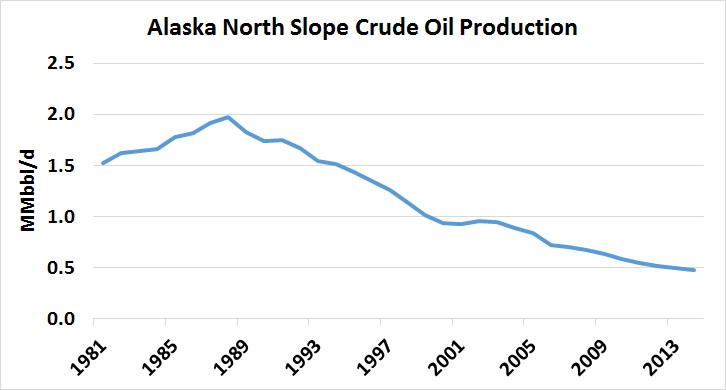
Alaska’s first oil well was drilled in 1898—yes, 117 years ago—but it was not until the mid-1970s that Alaskan oil started making its mark. Then, with the construction of the $7.7 billion Trans-Alaska Pipeline System from 1973 to 1977, oil production at Prudhoe Bay started in earnest in 1978 and quickly ramped up. As shown in Figure #1 below, North Slope oil production peaked at 2.0 MMb/d in 1988 and has been sliding ever since, falling below 1 MMb/d in 2000 and below 500 Mb/d in 2014. By July 2015, North Slope production was down to 431 Mb/d, less than one-third the production rate in the Eagle Ford and barely one-fifth the output of the Permian Basin. 

**************************************
California Crude

There's a story making the rounds about Governor Brown of California tasking state workers to determine if there is any oil on / under his land in northern California. I don't care one way or the other; it's a perk of being in office.

For me the bigger story is noting Brown's attitude regarding the oil and gas industry in his home state. He did not ban fracking like the governor of New York has, and considering the opposition to the oil and gas industry in California, one can argue that he has been about as fair as he can be on drilling in his state. I'm sure many will disagree with me. Whatever.

From the AP (same link):
Brown's request to oil regulators points to the complex way that the governor, an internationally known advocate of renewable energy, approaches oil and gas issues in his own state.
While spearheading ambitious programs to curb the use of climate-changing fossil fuels, Brown has also sought to spur oil production in California, the country's No. 3 oil-producing state.
Even if his far-left supporters don't want to admit it, the state relies heavily on oil revenue, and Jerry Brown knows it. California's ranking is irrelevant if oil production overall is decreasing.

At its peak, back in 1985, California was producing around 35 million bbls of oil per month (about what North Dakota produces now in a highly choked-back environment).  California is now producing less than half that amount, below 17 million bbls of oil per month. Couple that with the huge price decline and California's oil revenue must be cratering. Throw in lost state income tax from oil workers laid off in the state and the situation must look a bit depressing for the governor.

XOM seems to be leaving California -- they sold their refinery in Torrance. OXY spun off its operations in California and moved its headquarters to Texas. Back in 2013, CVX moved 400 employees from its HQ in San Ramon (CA) to Houston; building a new building in Houston; says they are keeping HQ in San Ramon (CA).

The Monterey shale looks like a bust, but even if there is a lot of oil there, it's not going to be produced in this price environment. All of that is probably just the tip of the iceberg.

All of that is upstream.

California remains an "island" when it comes to oil. Midstream, risks of earthquakes minimize opportunities to bring oil into the state via pipeline. And downstream, California has uniquely interesting requirements for gasoline blends. [I would imagine California is VW/Audi's biggest market in the US -- but that's another story for another time.]

Jerry Brown looks at all of that, and then looks at the Alaska crude oil production graph, as seen above. Like most of us, Jerry Brown probably doesn't like movie sequels.

My hunch: before the end of 2016 we are going to see some shocking graphs of California oil production.

Thursday, November 5, 2015

Canadian Crude Oil Imports Without The Keystone

Updates

November 5, 2015: yesterday I posted the "original post" below Today I updated the most recent US crude oil data. Look at how much oil is being imported from Canada despite the fact that the Keystone is not built. The Keystone issue is looking more and more irrelevant.
Imports from Canada:
  • August, 2013: 95.6 million bbls
  • August, 2014: 106.4 million bbls
  • August, 2015: 121.5 million bbls 
The "complete" Keystone XL would have had a capacity of 800,000 bopd, which is about 24 million bbls per month. Note that without the Keystone, the delta between August, 2015, and August, 2013, is almost 26 million bbls / month. Interesting, huh?

The most recent data shows the delta is actually increasing: in the original post below, note that RBN Energy noted that Canada is shipping an extra 1.2 million bbls into the US every days, 45% more than the original Keystone XL capacity.

Original Post

The Keystone XL Debate Becomes Tiresome

I was going to do a series of polls on the Keystone in light of a recent post by RBN Energy, but after seeing the story in today's WSJ, it's not worth the effort.

The "Keystone" is about two political parties raking in cash on this argument. The story itself no longer has any relevance.

I was concerned a bit after RBN Energy suggested that petcoke would be in short supply if the US did not have access to heavy oil, but that's a bit of hyperbole, also.

In today's WSJ, front page of section B: Pipeline delay unlikely to hurt refiners in US. The lede:
Oil imports from Canada set a record in August, averaging 3.4 million barrels a day, according to data released Monday by the U.S. Energy Department.
In fact, the U.S. has bought 64% more Canadian crude so far this year than it did in the same stretch of 2008, the year TransCanada first asked the U.S. government for permission to build the pipeline that would run from Alberta to Texas.
That is an extra 1.2 million barrels of oil flowing into the U.S. from Canada every day, or 45% more crude than Keystone XL would have carried had it been constructed.
Unless someone knows something I don't know about the US manufacturing base bursting forth at 10% GDP next year, it sounds like the US is getting all the heavy oil it needs.

We're Not Running Out Of Oil -- IBD -- November 5, 2015

"Earth Is An Oil-Producing Machine — We're Not Running Out" -- Investor's Business Daily. 
Ever since M. King Hubbert in the 1950s convinced a lot of people with his "peak oil" theory that production would collapse and we'd eventually exhaust our crude supplies, the clock has been running. And running. And it will continue to run for some time, as technology and new discoveries show that there's still an ocean of oil under our feet.

Engineering and Technology Magazine reported this week that BP — the company that once wanted to be known as "Beyond Petroleum" rather than "British Petroleum" — is saying "the world is no longer at risk of running out of resources."

Things are so good, in fact, that Engineering and Technology says "with the use of the innovative technologies, available fossil fuel resources could increase from the current 2.9 trillion barrels of oil equivalent to 4.8 trillion by 2050, which is almost twice as much as the projected global demand."
That number could even reach 7.5 trillion barrels if technology and exploration techniques advance even faster.