Locator: 51058B.
Mideast: regardless of what happens with regard to Iran and the strait, the fact is the US Navy is going to maintain a bigger presence in the Mideast than ever before and will become even more embedded with Israel.
Controlling the strait: don't let their war of words convince you otherwise -- Iran -- through its PGSA unit (previously known as IGRC) -- is going to control the strait and charge maintenance fees (previously called "tolls") for shippers to transit the Persian Gulf.
Micron: MU's market cap now exceeds the combined market cap of both ... wait for it .. META and TSLA.
Devon: Devon Energy’s recent portfolio review following its $58-billion merger with Coterra Energy puts several assets on the table.
The most likely divestment candidates identified by market analysts are Devon's Marcellus Shale and Anadarko Basin positions, with money manager Stone Ridge Asset Management already tabling a reported $8-billion offer for the Marcellus portfolio.
This is incredibly interesting.
A "talking head," a member of CNBC's panel for the network's "Half-Time Show" made an on-the-air last minute announcement to recommend Devon. This was about a week ago, just before crude oil fell significantly in price. This rumored asset sale for Devon could change things immensely for the company. One wonders if the CNBC "Half-Time Show" panel had some inside information. More likely, he just happened connect the dots when Devon's CEO suggested the same during an earnings call.
US LNG export terminal expansion proposed by NextDecade for its proposed Rio Grande LNG Train 6. Expansion:
- adding a new liquefaction train; and,
- a third main berth to the export terminal.
Ukraine: has Zelenskyy just made things so tough for Russia, Putin might actually engage in peace talks. Ukraine's drones are overwhelming Russia's air defenses and Russia seems to have no answer.
Israeli-US partnership strengthens: US considering moving some of its bases damaged to Iran to Israel. Source: TWSJ.
*********************************
Back to the Bakken
WTI: $70.32.
New wells reporting:
- Sunday, June 28, 2026: 37 for the month, 193 for the quarter, 350 for the year,
- 41609, conf, Hess, BL-Mortenson-156-95-2234H-2,
- Saturday, June 27, 2026: 36 for the month, 192 for the quarter, 349 for the year,
- 41522, conf, Enerplus, MHA Thorn 4894 43-16 6B,
- 41516, conf, Enerplus, MHA Holly 4894 43-16 5B,
- 41515, conf, Enerplus, MHA Nettle 4894 43-16 4B,
- 41514, conf, Enerplus, MHA Lilac 4894 43-16 3B,
- 41513, conf, Enerplus, MHA Hibiscus 4894 43-16 2B,
- Friday, June 26, 2026: 31 for the month, 187 for the quarter, 344 for the year,
- 41681, conf, Devon Energy, Johnson 27-34 7H,
- 41680, conf, Devon Energy, Johnson 27-34 6H,
- 41608, conf, Hess, BL-Mortenson-156-95-2234H-4,
RBN Energy: big changes ahead for where and how Louisiana refineries get their crude. Link here. Archived.
The 14 refineries in Louisiana and two just over the state line in southern Arkansas account for almost one-fifth of total U.S. refining capacity and can consume more than 3 MMb/d of crude oil from a wide range of domestic and foreign production areas. The sourcing of that crude has been shifting over the past few years and the pace of that shift is picking up as more U.S. Gulf production flows to Texas (and less flows to the Bayou State), new pipeline projects increase eastbound and southbound flows into Louisiana, and refineries modify their crude slates to optimize their economics. In today’s RBN blog, we begin a series on Louisiana’s refineries, the sourcing and delivery of their crude, and the forces that are shaking things up.
Everyone except dyed-in-the-wool Texans would admit that their Cajun and Creole neighbors in Louisiana serve better food — a feast of gumbo, jambalaya and crawfish trumps even the best brisket barbecue, right? They throw better parties, too — would you really rather go to Wurstfest in New Braunfels than Mardi Gras in the Big Easy? But let’s put those Texas vs. Louisiana rivalries aside for now because our focus in this blog series is Louisiana refineries, the crude oil they consume, where that oil comes from and how it’s delivered.
As we said in the introduction to today’s blog, there are 14 refineries in Louisiana and two in southern Arkansas. (Texas has 31!) For simplicity’s sake, the refineries can be put into one of three geographic buckets:
- Southeastern Louisiana. The eight refineries there (pink-shaded rows in Figure 1 below) have a combined capacity of more than 2.1 MMb/d; the largest by far are Marathon Petroleum’s 638-Mb/d refinery in Garyville and ExxonMobil’s 545-Mb/d facility in Baton Rouge.
- Southwestern Louisiana. The three refineries there (blue-shaded rows) — owned by CITGO, Phillips 66 and Calcasieu Refining — are all in the Lake Charles area; their capacities add up to 907 Mb/d.
- Northwestern Louisiana and Southern Arkansas. The five refineries there (green-shaded rows) are smaller — the largest is Delek US’s 85-Mb/d El Dorado Refinery (aka the Lion Oil Refinery) and two have a capacity of less than 10 Mb/d. Their combined capacity is 176 Mb/d.
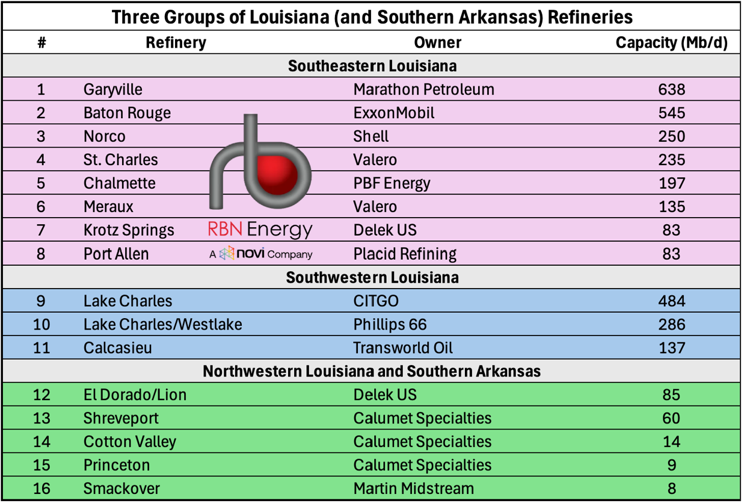
Figure 1. Three Groups of Louisiana (and Southern Arkansas) Refineries. Source: Novi Labs
