Showing posts sorted by date for query SABIC. Sort by relevance Show all posts

Thursday, January 9, 2025

Elon Musk -- Update -- January 9, 2025

Locator: 44650MUSK.

Link here.

The billionaire declared himself one of the world’s best players of “Diablo IV,” a blockbuster videogame set in a dark fantasy realm that involves making elixirs and slaying demons. 

“So many life lessons to be learned from speedrunning video games on max difficulty,” Musk wrote on his social-media platform X on Nov. 20, before going on to announce that he’d just cleared the highest tier of a section of the game called “The Pit” in under two minutes. He included a video clip of the milestone.

Such an accomplishment requires more than just expertise in monster slashing. It takes dozens of hours just to reach the highest tier, which is level 150. The Pit was only added to the game in May and the latest season kicked off on Oct. 7, resetting all players’ progression to level 1. That suggests Musk made his way to the top level in 45 days or less.

Musk oversees six companies, including brain-computer startup Neuralink, tunneling startup The Boring Company and artificial-intelligence startup xAI. He’s a prolific poster on the social-media platform X, which he bought in 2022. He is now helping oversee a sweeping revamp of the federal government as co-head of Trump’s Department of Government Efficiency, or DOGE.

His vast array of commitments have left everyone wondering: How on Earth did he find the time to do it?

Damir Sabic, a 29-year-old devotee of the Diablo franchise, said it took him about 80 hours to reach the 129th tier of the Pit in December. He said he stopped playing at that point because leveling up became tedious. He described Musk’s claim of clearing the 150th tier in November as “insane.” 

“It’s like sitting all day, every day, at your computer playing,” said Sabic, a 3-D printing artist in Houston. 

Much more at the link but the wrong question is being asked.

Looking at everything Elon Musk is doing, the obvious question is what in the world are the other billionaire CEOs doing to earn their pay?

 *******************************
Boring Under Las Vegas

Link here.

Elon Musk’s Boring Company spent years pitching cities on a novel solution to traffic, an underground transportation system to whisk passengers through tunnels in electric vehicles. Proposals in Illinois and California fizzled after officials and the public began scrutinizing details of the plans and seeking environmental reviews.

But in Las Vegas, the tunneling company is building Musk’s vision beneath the city’s urban core thanks to an unlikely partner: the tourism marketing organization best known for selling the image that “What Happens Here, Stays Here.”

The powerful Las Vegas Convention and Visitors Authority greenlit the idea and funded an 0.8-mile route at its convention center. As that small “people mover” opened in 2021, the authority was already urging the county and city to approve plans for 104 stations across 68 miles of tunnels.

The project is also realizing Musk’s notion of how government officials should deal with entrepreneurs: avoid lengthy reviews before building and instead impose fines later if anything goes awry. Musk’s views on regulatory power have taken on new significance in light of his close ties to President-elect Donald Trump and his role in a new effort to slash rules in the name of improving efficiency. The Las Vegas project, now well under way, is a case study of the regulatory climate Musk favors.

Because the project, now known as the Vegas Loop, is privately operated and receives no federal funding, it is exempt from the kinds of exhaustive governmental vetting and environmental analyses demanded by the other cities that Boring pitched. Such reviews assess whether a proposal is the best option and inform the public of potential impacts to traffic and the environment.

The head of the convention authority has called the project the only viable way to ease traffic on the Las Vegas Strip and in the surrounding area — a claim that was never publicly debated as the Clark County Commission and Las Vegas City Council granted Boring permission to build and operate the system beneath city streets. The approvals allow the company to build and operate close to homes and businesses without the checks and balances that typically apply to major public transit projects.

Much more at the link. 

Thursday, August 3, 2023

Earnings Rolling In; Enterprise Products -- RBN Energy -- August 3, 2023

Locator: 45308B. 

Saudis extend their current production cut for another month, through September. Link here.  More interesting thread here.

Oh-oh: Saudi's Sabic, world's largest chemical firm, reports a profit drop of 86%. Link here.

High-sulphur fuel oil: priced at a premium to ICE Brent for the first time since at least 2005 and probably ever. Link here. Do you remember all those stories some years ago that cargo ships were mandated to convert to cleaner fuels, like LNG?

WMB: nice. Reports a 2.5% beat. Earnings came in at $1.61 billion vs $1.57 billion.

BUD: nice. Predicted on the blog. LOL. Earnings beat expectations. CEO keeps his job.

AA: talking to Airbus and Boeing about ordering more jets. Now, they just need more pilots.

Rolls-Royce: really nice. Fivefold increase in profit.

SRE: really, really nice. EPS beat by 13 cents; $1.88. Revenue miss by $200 million; $3.34 billioon.

Most interesting story we might see today: link here. Stand-alone here.

*****************************
Back to the Bakken

WTI: $80.27. On back of Saudi news to extend cuts through September.

Friday, August 4, 2023: 9 for the month; 211 for the quarter, 466 for the year
39570, conf, Challenger Point Energy, Jacobsen 13-6, 
39539, conf, WPX, Two Shields Butte 16-8-7-13HA,
39480, conf, CLR, Meadowlark 12-6HSL1, 
39472, conf, Ovintiv, Newman 150-97-21-16-1H,
35018, conf, BR, Lillibridge 1C MBH,

Thursday, August 3, 2023: 4 for the month; 206 for the quarter, 461 for the year
39540, conf, WPX, Two Shields Butte 16-8-7-13H3U, 

RBN Energy: Enterprise's NGL and petchem distribution and export machine. Archived.

Enterprise Products Partners doesn’t just extract mixed NGLs from associated gas at processing plants, transport that Y-grade to the NGL hub at Mont Belvieu, and fractionate NGLs into “purity products” like ethane, propane and butanes. The midstream giant also distributes purity products to Gulf Coast steam crackers and refineries, converts propane to propylene at its two propane dehydrogenation (PDH) plants, distributes ethylene and propylene, transports propane and butane to wholesale markets across much of the eastern half of the U.S., and exports a wide range of products — ethane, LPG, ethylene and propylene among them — from two Enterprise marine terminals on the Houston Ship Channel. (Another export terminal in Beaumont, TX, is in the works.) Talk about a value chain! In today’s RBN blog, we continue our series on NGL networks with a look at Enterprise’s NGL and petrochemical production, distribution and export assets.


Thursday, January 5, 2023

Global Production -- For The Archives -- January 5, 2023

Iraq: link here.

Russia overtook Iraq to become the single-largest oil supplier to India in November, as Indian refiners raced to stock up on Russian oil ahead of the December 5 price cap and associated bans on transportation services for Russia’s crude.  

Saudi production:

When this graphic is updated one year from the December 5, 2022 (D5S), sanctions on Russia: January, 2024, it's going to be quite remarkable. We might see:

  • Saudi Arabia: flat 
  • Russia: significant decrease
  • US: continued increase

If global demand does increase after the much-talked about anticipated-recession, and, Saudi production does not exceed 12 million boepd, this will speak volumes about Saudi's production capacity. So, we'll see.

Saudi: link here.


US crude oil production, link here:

From 2021:  


One year, also link here:

Ten years:

From the EIA, Annual Energy Outlook 2014 (AEO2014), red line (s) and red dots added to the EIA graphic:


RBN Energy: you gotta have this map in your hands. Archived.

Over the past few years — and with a big boost from Permian production growth — the South Texas coast has transformed itself into a top-tier hub for hydrocarbons.

Crude oil exports stand out, of course, with marine terminals in Corpus Christi/Ingleside accounting for 60% of U.S. export volumes in 2022. But Corpus also is home to the nation’s second-largest LNG export terminal (which is now being expanded), as well as a half-dozen refineries, and the broader region has the Agua Dulce natural gas hub, nine NGL fractionation plants, and four massive, NGL-consuming ethylene plants, including ExxonMobil/SABIC’s giant new steam cracker in San Patricio County.

All of these assets are interconnected by a maze of crude oil, natural gas, NGL, “purity product,” and ethylene pipelines. And the region is well-positioned for additional growth as crude, gas, and NGL production in Texas continues to increase. In today’s RBN blog, we discuss our latest product: a digital, interactive map that helps makes sense of a spaghetti bowl of pipelines, plants and related assets in South Texas.

When discussing Corpus Christi and the rest of South Texas, it’s important to begin with two undeniable facts: (1) the region was already a noteworthy energy center before the Shale Revolution, with extensive upstream, midstream and downstream infrastructure already in place “pre-Shale”; and (2) South Texas didn’t become an energy “superhub” overnight or without a lot of planning and hard work — instead, producers, midstream companies, economic-development folks and others saw the opportunities and challenges presented by the Shale Era and made it all happen.
It hasn’t hurt that Texas is perhaps the friendliest state when it comes to developing energy-related projects, and that South Texas and Corpus officials have been aggressive in competing for new business, including energy, petrochemicals, and now clean hydrogen.

Natural Gas Trendiing Toward $3.75 -- January 5, 2023

Table-talk:

  • EV: Sony, Honda introduce a new EV.
  • Jobs report: huge.
  • CVX, Venezuala: something to talk about 
  • Ford sales: incredible.

ProFrac: adds six frack fleets

  • Rockies and Bakken
  • acquired REV Energy and Producers Services
  • link here:

*********************
Back to the Bakken

The Far Side: link here.

Active rigs: link here.

WTI: $73.86. Held. Up 1.4%; up $1.02.

Natural gas: trending toward $3.75.

Friday, January 6, 2023:
None.

Thursday, January 5, 2023:
36900, conf, Bowline, Shaffer 155-102-27-22-6H,

RBN Energy: you gotta have this map in your hands. Archived.

Over the past few years — and with a big boost from Permian production growth — the South Texas coast has transformed itself into a top-tier hub for hydrocarbons.

Crude oil exports stand out, of course, with marine terminals in Corpus Christi/Ingleside accounting for 60% of U.S. export volumes in 2022. But Corpus also is home to the nation’s second-largest LNG export terminal (which is now being expanded), as well as a half-dozen refineries, and the broader region has the Agua Dulce natural gas hub, nine NGL fractionation plants, and four massive, NGL-consuming ethylene plants, including ExxonMobil/SABIC’s giant new steam cracker in San Patricio County.

All of these assets are interconnected by a maze of crude oil, natural gas, NGL, “purity product,” and ethylene pipelines. And the region is well-positioned for additional growth as crude, gas, and NGL production in Texas continues to increase. In today’s RBN blog, we discuss our latest product: a digital, interactive map that helps makes sense of a spaghetti bowl of pipelines, plants and related assets in South Texas.

When discussing Corpus Christi and the rest of South Texas, it’s important to begin with two undeniable facts: (1) the region was already a noteworthy energy center before the Shale Revolution, with extensive upstream, midstream and downstream infrastructure already in place “pre-Shale”; and (2) South Texas didn’t become an energy “superhub” overnight or without a lot of planning and hard work — instead, producers, midstream companies, economic-development folks and others saw the opportunities and challenges presented by the Shale Era and made it all happen.
It hasn’t hurt that Texas is perhaps the friendliest state when it comes to developing energy-related projects, and that South Texas and Corpus officials have been aggressive in competing for new business, including energy, petrochemicals, and now clean hydrogen.

Thursday, February 3, 2022

Earthquakes, Texas Freeze, SABIC Missing Expectatiions. Good Morning. Four Wells Coming Off Confiidential List -- Febriuary 3, 2022

Texas grid faltering? Link to Irina Slav. Anything's possible I suppose but the "local investigative reporter" is confusing the website with the grid.   

Apparently 60,000 people have lost power in Texas and Arkansas, based on a national reporting agency much earlier this morning so that number will grow over the next 24 hours. 
Population of Texas and Arkansas: 35 million. 60,000 / 35,000,000 = 0.17%. For AOC folks, that means out of 100 people, 0.2 have lost power. Rounding to nearest whole number = 0. Having said that, I would not want to be one of the 60,000.
So far this has nothing to do with ERCOT or the grid, per se, it's the ice on trees falling on power lines. A neighborhood down the road from us is without power, but we are still fine. Our local utility, by the way, spent the summer clearing trees from power lines, which they do every summer but it's truly the "luck of the draw," as they say in Texas. All it takes is one tree.
We have not yet turned on the heat to our apartment. It's a toasty 65°F inside and 22°F outside. My wife will decide when we turn on the heat.
Forecast: generally it will get colder, down to a low of 18°F at 4:00 a.m. and then warm up to 44°F by Friday afternoon. By the weekend, it's all back to normal. 

SABIC: profits may fall in 2022 on tight supply chains. Inshallah. Link here. SABIC missed forecasts for 4Q21. This would have been my lead story today had it not been for Facebook and the Texas Freeze.

Saudi Basic Industries Corp., the world’s biggest chemicals maker by market value, said profit would probably fall this year as the global supply-chain squeeze pushes up costs.

The Riyadh-based company, known as Sabic, made net income of $1.3 billion in the fourth quarter, down 12% from the previous three-month period and below analysts’ estimates.

**********************************
Back to the Bakken

Active rigs:

$88.68
2/3/202202/03/202102/03/202002/03/201902/03/2018
Active Rigs32e
14546458

Thursday, February 3, 2022: 11 for the month, 66 for the quarter, 66 for the year

  • 38424, conf,  Crescent Point Energy, CPEUSC Reed 6-10-03-158N-100W-MBH-LL, Winner, no production reported;
  • 38386, conf, Hunt, Blue Ridge 159-100-6-7H3, Green Lake, some production reported;
  • 37980, conf,  CLR, Clear Creek Federal 2-26HSL2, Elidah, no production reported;
  • 37913, conf, CLR, Charolais South Federal 15-10H, Elm Tree, no production reported;

RBN Energyis seismic activity a threat to Permian crude production growth? The short answer: no.

Even through the market turmoil of the past couple of years, the Permian has been a production powerhouse, lately churning out an average of nearly 5 MMb/d of crude oil and 14 Bcf/d of natural gas. But is the Permian on shaky ground? Well, sort of. Distinct areas within both the Midland and Delaware basins in West Texas have experienced an increasing number of higher-magnitude earthquakes that have been linked to the saltwater disposal (SWD) wells that E&Ps use to get rid of the massive volumes of “produced water” their oil and gas operations generate. As a result, regulators have been ordering some of these disposal wells to be shut down and directing producers and midstreamers to develop “seismic response action plans” aimed at reducing the frequency and severity of quakes. In today’s RBN blog, we look at what has been happening on the earthquake front in West Texas and how E&Ps can deal with it.

We’ve seen this movie before, right? Through the first half of the 2010s, Oklahoma, home of the SCOOP/STACK production area, experienced a sharp increase in the frequency and magnitude of earthquakes — there were 585 tremors with a magnitude of 3.0 or greater in 2014 and 887 in 2015, compared to an average of only three per year in the 2000-09 period (see Figure 1). The trend was soon attributed to the injection of massive volumes of produced water from oil and gas production into deep SWD wells in specific geologic formations, especially the Arbuckle, the deepest sedimentary layer in the Sooner State. Oklahoma regulators stepped in, shutting down a number of SWD wells and establishing (and later updating) protocols for the use of existing and planned wells. The frequency of earthquakes has plummeted — fewer than 30 tremors of 3.0 or higher magnitude were recorded in 2021, and the state’s first quake of 2022 happened on January 31 (a 4.5!). The seismicity problem, while not fully resolved, is being carefully monitored and managed with only limited impact on oil and gas operations.

Friday, April 2, 2021

Pioneer; XOM; Saudi; Tesla; And All That Jazz -- April 2, 2021

Pioneer to acquire DoublePoint Energy assets, press release here:
  • bolt-on acquisition
  • Midland Basin
  • $6.4 billion
  • 97,000 high quality (tier 1) net acres
  • back of the envelope: $6.4 billion / 97,000 net acres = $66,000 / acre
    • 27.2 million shares of Pioneer common stock
    • $1 billion in cash
    • $0.9 billion in debt and liabilities
  • forward:
    • the deal "will lead to an increase in the expected per share variable dividend beginning in 2022"
At almost $70K/net acre, social media is having a field day with this one. Lots of talk that "we're" back to lack of fiscal discipline in the shale sector. 

Link here.

Link here.


***********************************
XOM vs BP
Reality vs Renewables


****************************
Saudi Aramco

Aramco may slash dividend -- not "cut," but "slash" dividend -- to boost Saudi economic growth plan. 
 

Saudi Arabia's de facto leader Crown Prince Mohammed bin Salman said on March 30, 2021, that 24 Saudi listed companies, including Aramco and Saudi Basic Industries Corp, or SABIC, and National Shipping Co. will reduce their dividend payouts to the government and redirect the money into the local economy. The plan targets the contribution of $1.33 trillion of domestic capital from the companies over the next ten years.

Government: code for "rich princes."

It was not clear when this decision was made. However, in Aramco's 2020 financial results presentation on March 20, CEO Amin Nasser stated the company intends to pay $75 billion in 2021.

The Saudi economy is floundering, with woes further compounded by the demand destruction caused by the pandemic, seeing its budget deficit widen to about $79 billion in 2020.

Some 40% of the Kingdom's GDP is derived from oil revenues generated by Aramco, according to data from the country's finance ministry.

As part of its pitch to investors during the 2019 IPO, Aramco pledged to issue a $75 billion dividend annually for five years. The Saudi government, which owns 98.5% of the company, is the primary benefactor of this payment. Therefore, the new scheme will see Aramco funds diverted away from the government's budget.

The burden of the $75 billion dividend plus the weak oil price environment due to the pandemic weighs heavy on the company's operations. This has meant it has had to delay payments to its contractors by several months, Platts reported in January.

Additionally, the company was forced to slash its 2020 capex budget in half, to around $25 billion. For 2021, its capex will be an estimated $35 billion, below previous guidance of $40 billion to $45 billion, Aramco said in March.

Meme: cost to lift Saudi oil is less than $5/bbl compared to $50 / bbl for US shale. US shale will cut CAPEX and maintain production (maybe increase production); and, here we have Saudi Arabia having to raise CAPEX to meet demand, much of it domestic, for air conditioning. 

Salman's announcement drew skepticism from analysts on whether it will provide an economic boost to the country.

"While this may drive diversification efforts, there is a risk that it leads to a misallocation of resources and damages economic growth in the long run," said Capital Economics, a UK-based consultancy.

Inshallah

******************************************
Luxury Used Car Worth $20,000;
Needs $22,000 Battery Replacement

Link here

The good news: the new battery will be even better.

And "no" maintenance according to the seller.

Predicted years ago on the blog. 

************************************
Tesla (Almost) Meets Delivery Goal
Two Years Late, But I Don't Think Anyone Cares

Link here.

Tesla announced today, April 1, 2021, April Fool's Day, that it finally almost reached 500,000 deliveries in a calendar year, with its 499,550 vehicles delivered globally in 2020, and that it finally hit its target of producing 500,000 vehicles a year – two years behind its promises. 

Back in May 2016, it had promised in its quarterly report that it would produce 500,000 vehicles in 2018. But it didn’t happen in 2018, far from it, and it didn’t happen in 2019 either. It finally happened in 2020.

That promise in May 2016, like so many of Tesla’s and CEO Elon Musk’s promises, had caused its shares to surge.

Tesla will report 1Q21 deliveries sometime next week, previously posted. The linked article provides projections of a few analysts. The number to watch: 150,000 units.

Tuesday, November 3, 2020

OPEC In Deep Doo-Doo -- Aramco's Profit Plunges -- November 3, 2020

I don't know when I first saw it coming. Certainly it was by 2016. But OPEC is in deep doo-doo and the House of Saud is in extremis

Data points:

  • 3Q20:
    • Saudi Aramco's net profit slightly less than $12 billion;
    • net profit down almost 45% y/y;
    • free cash flow: $12.4 billion
    • forced to pay a dividend of almost $20 billion for the quarter
  • first nine months of the calendar year:
    • net profit down almost 50%;
    • net profit down to $35 billion;
    • average production: 9.2 million bpd;
  • most interesting:
    • the $75 billion dividend paid by Saudi Aramco will not be able to cover Saudi's budget deficit;
    • the House of Saud won't be able to plug its deficit with the Aramco dividend as it did last year; 
  • tea leaves
  • Aramco:
    • its own budget commitments;
    • must meet requirements to buy petrochemicals giant SABIC
  • future? prices are too weak for OPEC to relax production cuts by another two million bopd next January
  • could it get worse? Yup. A Biden presidency.
    • the Biden wing supports Iran
    • sanctions on Iran will be lifted on humanitarian grounds
    • huge hit for Saudi Arabia when Iran gets back into the market

Link to Charles Kennedy.

Aramco reported a net profit of $11.8 billion for the third quarter of 2020, down by 44.6 percent on the year as low oil prices continued to bite into its financial performance.

The company also said it had free cash flow of $12.4 billion at the end of the three-month period and declared a dividend of $18.75 billion for the quarter.

For the first nine months of the year, the hit from low oil prices and depressed demand was stronger. Net profit was down by close to 49 percent to $35.015 billion.

In oil production, the Saudi major reported an average daily of 9.2 million bpd for the first nine months of the year as it continued capping output in compliance with the OPEC+ agreement.

Earlier this year, Aramco declared an annual dividend of $75 billion. That amount, however, will not be sufficient to cover the Saudi budget deficit, Moody’s said in a report last month. Now, with oil prices still low and likely to go lower still if the surge in Covid-19 cases continues in Europe and the United States, Aramco’s earnings will take a bigger hit.

This means that the government in Riyadh will not be able to plug the budget hole with the Aramco dividend as it has done previously.

“The government is unlikely to be able to repeat the maneuver beyond 2021,” Moody’s said in the report. Aramco will have its own capital expenditure needs and its commitment to buy petrochemicals giant SABIC to look after, according to the ratings agency.

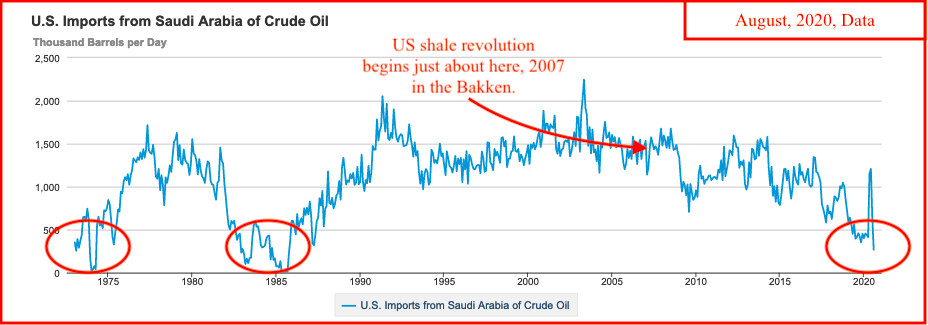
US crude oil imports from Saudi Arabia: huge plunge, not since the 1980s have we seen numbers this low. 

From the "milliondollarway" archives:

This might be good time to re-read this interesting story in Foreign Policy, May 5, 2020; still not behind a paywall; the writer of that article: Jason Bordoff, a former senior director on the staff of the US National Security Council and special assistant to President Barack Obama ... I first linked this article in September, 2020. It will be interesting to see how this plays out.

Wednesday, September 2, 2020

Saudi Aramco Slows Diversifiction -- Short Of Cash -- September 2, 2020

Updates

September 4, 2020: Saudi Aramco shelves plans for $20 billion petrochemical plant.

Original Post

Misstep after misstep after misstep. 

This will be the third misstep by Saudi Arabia since the advent of the Bakken revolution. The previous missteps:

  • the first attempt to kill US shale by flooding the world with oil;
  • the second attempt to kill US shale by flooding the world with oil:

Now, the third misstep: Saudi Arabia is delaying plans to expand at home and abroad due to:

  • sharply lower oil prices; and,
  • a heavy dividend burden.

Although they probably had no choice this time.

This story was previously posted -- just the headline -- but here's the story and the source, The WSJ. The numbers show just how badly things are going for Saudi Arabia right now, although this has gone on for much longer than just the last few months. Long-time readers will remember Saudi's plans for huge a huge renewable (solar energy) some years ago, but was canceled, due to the incredibly high cost. Anyone remember Paddy?

The linked article will be behind a paywall but probably accessible through various methods. Be that as it may, from the article at the link:

Saudi Arabia’s state oil giant is reviewing plans to expand at home and abroad in the face of sharply lower oil prices and a heavy dividend burden it assumed as part of its recent initial public offering.

Saudi Aramco is now slowing down and reviewing a $6.6 billion plan to add petrochemical output at its Motiva refinery in Texas.

It is also reviewing a big natural-gas project with Sempra Energy SRE 1.88% in the same state, and pausing investments in refineries in China, India and Pakistan.

At home, Aramco is delaying by a year plans, announced in March, to boost crude production capacity to 13 million barrels a day, from currently about 12 million.

In its December IPO, Dhahran-based Saudi Arabian Oil Co. promised shareholders $75 billion in annual dividends for the next five years. That pledge helped persuade private investors to pay a premium for the thin slice of Aramco shares the government floated on the local stock market. Other big oil companies, such as Royal Dutch Shell PLC and BP PLC, have cut their dividend in recent months to preserve cash, amid sharply falling oil demand and prices thanks to the pandemic.

Aramco’s flexibility to do the same is limited because the Saudi Arabian government—which still owns 98% of the company—relies on Aramco dividends for much of its funding.

Last month, Aramco said it would maintain its quarterly dividend at $18.75 billion, dwarfing free cash flow of $6.1 billion for the period. That was down from $20.6 billion a year earlier, when oil prices were higher. It also reported a 73% fall in net profit in the second quarter and said it would cut capital expenditures by about half, to between $20 billion and $25 billion. The spending will target domestic crude production, it said. That is a sizable turnaround from two years ago.

At the time, Aramco laid out plans to invest $100 billion in chemical manufacturing, and unveiled a separate ambition to buy as much as $160 billion in natural gas assets. The company said it wanted to become a competitor in the global natural-gas market and also balance its giant oil-production capacity with the ability to process crude into other products—a diversification strategy employed by most of the world’s biggest oil companies. As part of this push, Aramco paid $69 billion to buy a controlling stake in Saudi Basic Industries Corp., or Sabic, the kingdom’s biggest petrochemicals company. It also paid $1.2 billion for a stake in South Korean refiner Hyundai Oilbank in December. The Sabic deal sharply expanded debt at Aramco after it consolidated the petrochemical company’s liabilities.

Much more at the link. Archived.

Tuesday, August 11, 2020

Notes From All Over -- Saudi Aramco Update -- August 11, 2020

Before we get started. The price of gasoline in north Texas is about $1.85 / gallon, unleaded, least expensive. At our neighborhood service station, $1.64/gallon. 
 
Now back to the Saudi Aramco story.
 
I linked this article last week but it was behind a paywall, though, for some reason, it showed up on my iPad. Whatever. I tried to get to it this evening, but was stopped by the paywall. Then I googled the headline ("Saudi Aramco sticks to dividend pledge despite plunge in earnings") and it popped up on both the laptop and the iPad.

I find Saudi Arabia and the Saudi Aramco story fascinating. 

Saudi Aramco will pay $75 billion in demands this year despite the fact that their earnings probably don't cover the payout. But, to get the IPO approved by the king, the prince had to promise that the $75 billion dividend would be paid regardless of how well the oil company did. 

Look at this: in the most recent quarter, Saudi Aramco reported a net income of $6.6 billion, a 73% fall from the same period a year ago. So, three data points:
  • $6.6 billion net income in 2Q20;
  • a 73% fall in net income compared to a year earlier;
  • dividend payout: $75/4 = almost $20 billion -- well beyond the $7 billion in net income
And there's nothing to suggest the oil company will do any better in the next four quarters. Everyone says it is so incredibly cheap to drill for oil in Saudi Arabia as it is, which suggests to me that the company can't cut much more in expenses to improve their bottom line. 

It is true that the price of Brent has increased from $20 earlier this year to $40 and China is importing a lot more oil. But again: $7 billion in income in 2Q20, and the company needs almost $20 million to simply cover the dividend. From the article: 
Despite the uncertainty surrounding the global economy, Saudi Aramco said it would maintain the world's biggest quarterly dividend at $18.75 billion, most of it intended for the government in Riyadh, in line with its pledge for an annual $75 billion payout. 
The shareholder handout is far bigger than free cash flow for the period of $6.1 billion, which is down from $20.6 billion a year ago. 
But then this strange statement:
Mr Nasser told reporters that "our intention is to pay $75 billion, subject to board approval and depending on market conditions." Minority (i.e., non-government stockholders) shareholders, who own 1.5 percent of the company, will be "protected" for the next five years and given priority payments.
A new term for me: gearing ratio:
The company's gearing ratio -- a measure of financial leverage -- has already jumped to 20.1 percent, from minus 4.9 percent in the previous quarter. Saudi Aramco said this was related to the June acquisition of a majority stake in chemicals company Sabic from the Public Investment Fund, Saudi Arabia's sovereign wealth fund, for $69 billion. 
Saudi Aramco had expected the gearing to go up because of the deal, but the level far exceeded the company's longer-term target of 5 percent to 15 percent. 
Further, the government has already been forced to raise the kingdom's debt ceiling from 30 per cent of gross domestic product to 50 per cent, and Riyadh has borrowed more than $20 billlion on local and international markets this year.
I will quit there.

The article is worth a read. 

It's very possible that within my lifetime I will see the end of the House of Saud.
 
That's the number one reason I remain bullish on oil; the House of Saud will do what it takes to survive. 

And if you don't understand "gearing ratio," this is a great time to learn. Start here: Investopedia.
A higher gearing ratio indicate that a company has a higher degree of financial leverage and is more susceptible to downturns in the economy and the business cycle. This is because companies that have higher leverage have higher amounts of debt compared to shareholders' equity. Entities with a high gearing ratio have higher amounts of debt to service, while companies with lower gearing ratio calculations have more equity to rely on for financing.
The Recipe Page

I'm not sure if this beats salmon grilled on the Weber, but since I did not have a Weber but wanted salmon for dinner, I decided to give it a try. My notes to my wife in Portland, OR, who loves salmon:
On the drive home from Montana/Portland, I happened to catch a very, very interesting program on talk radio about bees and honey.

As part of the program, they talked about baking/grilling salmon with honey.

I tried this recipe.


I don't know if I would recommend it or not, but I found the crispiness very delicious and will do it again.

But warning: be sure not to over cook the salmon.

It does not say how long to cook on stove top. I was watching it very, very closely and made sure I kept spooning the butter/honey on the salmon and limited stove top to about five minutes.

Then the directions said 5 - 6 minutes in oven/broiler. I probably had it in the broiler/oven for four minutes and that was almost too long.

Anyway, I loved it and will do it again. Incredibly simple. It seems like it was done before I even started.
And, of course, you have to have a skillet that can go directly from stove top to oven.

Clean-up was very, very easy. I used a non-stick oven-ready skillet. By the time I got back to the skillet, the honey/butter residue was almost impossible to remove from the skillet. I put it back on the oven top, heated it up very carefully, and then, with a wooden spatula, the honey/butter residue was removed without any trouble.

Sunday, June 28, 2020

Saudi Aramco's Dividend Math Doesn't Add Up -- Bloomberg -- June 28, 2020

Over the years I've always gotten a kick out of analysts reporting the meme that due to low "lifting costs," Saudi Arabia has the price advantage.

Right, wrong, or indifferent, I put the country of Saudi Arabia, the House of Saud, and the publicly-traded Saudi Aramco company all in the same arena.

Add "this" to the "lifting costs" for Saudi Aramco: $75 billion in dividends every year.

From Bloomberg Quint today, the Saudi Aramco dividend math doesn't add up (archived):
It’s the mother of all payouts. The $75 billion that Saudi Aramco doles out in dividends every year dwarfs what any other listed company gives to shareholders. It’s roughly equivalent to the payouts from Exxon Mobil Corp., Royal Dutch Shell Plc, Chevron Corp., BP Plc, Total SA, PetroChina Co., Eni SpA, Petroleo Brasiliero SA and China Petroleum & Chemical Corp. or Sinopec — put together.

That makes Chief Executive Officer Amin Nasser’s promise ...

Running up debts to keep the dividend on track is standard practice for energy companies amid the carnage of 2020’s oil market — except for those, like Shell, which plan to cut payouts altogether ...

The core of Aramco’s profitability is its astonishingly low production costs, with operating expenses amounting to not much more than $8 a barrel of oil and equivalent products last year. It’s remarkable how quickly the spending adds up, though. Royalties paid to the Saudi state alone added another $10 a barrel or so, while corporate income tax came to around $19 a barrel and dividends swallowed a further $15. Once all those tolls were paid, Aramco didn’t have a lot of spare change left out of $60-a-barrel oil, let alone the stuff in the $40-a-barrel range it’s selling at the moment.

A firm dividend policy is an unusually inflexible cost ...

Perhaps in recognition of this, the Saudi state has from the start agreed to forgo its portion of any payouts to the extent that receiving them would get in the way of Umm-and-Abu investors getting their share. That may help maintain a theoretical $75 billion-a-year payout but it makes a nonsense of the idea that all shareholders are equal, not to mention the principle that a dividend policy is some sort of a commitment to future earnings. It’s not clear, either, why a company with this get-out clause would want to take on debt to meet its promised payments, although Aramco’s borrowing costs are essentially identical to those of the Saudi state.

Dividends aren’t the end of Aramco’s committed spending. Its purchase of a majority stake in chemicals company Saudi Basic Industries Corp., or Sabic, ...

Then there’s a potential $15 billion investment in Reliance Industries Ltd.’s Jamnagar refinery in India, $20 billion on a separate planned chemicals venture with Sabic, plus Sabic’s own $5 billion a year or so of capital spending which will now sit on Aramco’s balance sheet.

Add it all up and the picture is troubling...

For all that executives are confident ...

That path is likely to be constrained ...

Unlike most of its competitors, Saudi Aramco doesn’t really need to be so focused on dividends. All but 1.5% of its shares are held by the same state that’s hoovering up royalty and tax payments further up the income statement. Riyadh shouldn’t really care how it’s getting paid, as long as it’s getting paid.

That dividend policy looks more like a swaggering attempt to hold back the tide of an oil market on the edge of terminal decline. The quicker Aramco acknowledges that, the better equipped it will be to handle the coming turmoil.

Americans would call them "Mom-and-Pop shareholders."
Let's highlight those last three paragraphs:
Unlike most of its competitors, Saudi Aramco doesn’t really need to be so focused on dividends. All but 1.5% of its shares are held by the same state that’s hoovering up royalty and tax payments further up the income statement. Riyadh shouldn’t really care how it’s getting paid, as long as it’s getting paid.

That dividend policy looks more like a swaggering attempt to hold back the tide of an oil market on the edge of terminal decline. The quicker Aramco acknowledges that, the better equipped it will be to handle the coming turmoil.

Americans would call them "Mom-and-Pop shareholders."
No, it's not the government per se that is the focus or the story.

The story here: the "mom-and-pop" shareholders are the 15,000 Saudi princes who are literally stealing the wealth of their country from 98% of other Saudis.

And again, from the article:
The quicker Aramco acknowledges that, the better equipped it will be to handle the coming turmoil.  
I think "Aramco" (aka Prince MbS) has figured that out, and he's ensuring that he and his princes get their "cut" before the house of cards fall.

I was kind of surprised Bloomberg did not note that. Unless the writers thought that might be a bridge too far.

The graphics that Bloomberg provided for this article:


Tuesday, June 16, 2020

Seven Wells Yet To Report -- June 16, 2020

Pipeline: US Supreme Court upholds permit for Atlantic Coast Pipeline. In a "normal" world this would have implications for the DAPL. But it's not a normal world.

Bankruptcy: Extraction Oil & Gas files for bankruptcy.

BP: writes off billions.
BP Plc will make the biggest write down in a decade on the value of its business, as the British oil major predicts the coronavirus pandemic will hurt long-term demand and accelerate the shift to cleaner energy.
The company sees oil and gas being about 20% to 30% cheaper than before on average, and also expects the cost of carbon emissions to be more than twice as high.
In response, BP is undertaking a review of its projects that could result in some oil discoveries being left in the ground. This risk, of so-called stranded assets, is an issue of growing importance as the industry grapples with fundamental shifts in energy consumption trends.
Oilprice headlines:
OPEC basket, link here: $35.00. There are a ton of articles/headlines out there about how much OPEC is cutting and how much US shale production will drop in July, and yet, OPEC can't get the price of oil to $40.

Urals sour: down 5%; down $2.00; trading at $38.70.

*****************************************
Back to the Bakken

Active rigs:

$37.916/16/202006/16/201906/16/201806/16/201706/16/2016
Active Rigs1361625728

Seven wells yet to report:

Tuesday, June 16, 2020: 39 for the month; 184 for the quarter, 411 for the year:
37214, conf, CLR, Burian 3-27H1,
36878, conf, Equinor, Domaskin 40-31 4TFH
36075, conf, BR, CCU Zephyr 14-29TFH,

Monday, June 15, 2020: 36 for the month; 181 for the quarter, 408 for the year:
36879, conf, Equinor, Jack Cvancara 19-18 XE 1TFH, Alger,
36076, conf, BR, CCU Zephyr 14-29MBH, Corral Creek,

Sunday, June 14, 2020: 34 for the month; 179 for the quarter, 406 for the year:
None.

Saturday, June 13, 2020: 34 for the month; 179 for the quarter, 406 for the year:
37193, conf, CLR, Wiley 14-25HSL, Pershing,
35959, conf, Whiting, Arndt 14-5-2XH, Sanish, see this note;

RBN Energy: the Brent complex, linkages that make it work and implications for global markets, part 2. Archived.
Brent is by far the most important crude oil benchmark in the world, with well over 70% of all global crudes tied either directly or indirectly to the North Sea crude’s price. But the original Brent crude oil production is almost played out, with all of the offshore Brent producing platforms soon to be decommissioned. This might seem to be a big problem, but in the world of crude oil trading, it is a total non-issue, because Brent is no longer simply a grade of crude oil. It is a multi-layered matrix of trading instruments, pricing benchmarks, and standard contracts linked together by price differentials traded across a number of mechanisms and platforms that form the foundation of a robust, vibrant, and extremely important marketplace. Today, we delve further into the mechanics of the Brent complex, the key components that make it work, and the transactional glue that binds them together

Friday, June 12, 2020

The Bakken Vs Saudi: ExxonMobil's Decision -- June 12, 2020

Re-post, because I think it tells a story:
Saudi's petrochemical unit losing money: link here.
Saudi Arabia's state-controlled petrochemical giant Sabic last month declared a loss of 950mn riyals ($253mn) in the first quarter of this year, compared with a profit of $909 million in the first quarter of 2019.
The loss was partly the result of a fall in the average prices of its products.
Sabic is planning to cut its capital expenditure, in line with moves by other energy and petrochemical producers.
ExxonMobil has lowered its 2020 capex budget by 30pc, with the bulk of the reduction going to its Permian onshore shale operations in the US.
BP's spending cuts for this year include a reduction of around $1bn on short-cycle onshore investment and deferrals of exploration activity. Shell, Total and Chevron have also announced sharp reductions in their 2020 capex budgets.

Saudi Arabia, Iraq In Deep Doo-Doo, Update #23 -- June 12, 2020

Market sell-off yesterday and now this: price of oil keeps falling. Linked at the sidebar at the right.


Saudi called for a 2020 budget based on $110-oil when that budget released in late 2019.

Revised budget and revenue projections in early 2020 moved their target to $84-oil.

Last statement from Saudi Sam aka Alfalfa, former energy minister: "We are comfortable with $30-oil."

By the way, the new Saudi energy minister is Prince MbS's son, Prince AbS, or Prince ABBA as his friends call him.

Since then:
  • demand destruction;
  • plummeting prices;
  • foreign exchange reserves at historic lows 
Saudi's petrochemical unit losing money: link here.
Saudi Arabia's state-controlled petrochemical giant Sabic last month declared a loss of 950mn riyals ($253mn) in the first quarter of this year, compared with a profit of $909 million in the first quarter of 2019.
The loss was the partly the result of a fall in the average prices of its products.
Sabic is planning to cut its capital expenditure, in line with moves by other energy and petrochemical producers.
ExxonMobil has lowered its 2020 capex budget by 30pc, with the bulk of the reduction going to its Permian onshore shale operations in the US.
BP's spending cuts for this year include a reduction of around $1bn on short-cycle onshore investment and deferrals of exploration activity. Shell, Total and Chevron have also announced sharp reductions in their 2020 capex budgets.
********************************
The Big Question: Who Swoops In To Swallow Up Iraqi's Oilfields? 
China or Russia

Iraq fighting for its very survival. Link here. What did Iraq do with all that money the past several years?


Thursday, May 21, 2020

Three Wells Coming Off Confidential List Today -- May 21, 2020

Jobless claims, link here:
  • prior: 2.981 million
  • forecast: 2.375 million
  • actual: 2.428 million
OPEC Basket: $28.43. Despite the jump in prices, OPEC basket is still below $30.

*******************************
Fast And Furious

Headlines without links in most cases. Stories easily found through Google.

USC scandal: Actress Lori Loughlin, husband to plead guilty in college entrance exam. 

Dak Prescott: $175 million for five years. Not yet signed. Deadline July 15.

NASCAR: as predicted, huge television ratings.

BLM slashes royalties on federal oil, gas leases.

New Mexico: BLM abruptly postpones lease sales.

Saudi Aramco / SABIC deal in jeopardy.

American heartland desperate for pickup trucks.

Michigan: massive flooding has interesting back story.

******************************
Back to the Bakken

Active rigs:


$34.195/21/202005/21/201905/21/201805/21/201705/21/2016
Active Rigs1466615125

Thee wells coming off confidential list today  -- Thursday, May 21, 2020: 64 for the month; 114 for the quarter, 341 for the year:
  • 35930, drl/drl, XTO, Mandal Federal 41X-29DXA, Haystack Butte, t--; cum --;
  • 35231, 1,037, Nine Point Energy, Helling 150-101-7-6-6H, Pronghorn, t12/19; cum 98K 3/20;
  • 35448, drl/drl, Hess, BB-Federal B-151-95-2122H-11, Blue Butte, t--; cum --;
RBN Energy: what's ahead for northeast NGL production, exports and wintertime supply?
The Marcellus/Utica production region in the northeastern U.S. is not immune to the upheaval in global energy markets. There, a number of E&Ps are implementing further cutbacks in their natural gas production. That will result in lower NGL production, which may have serious implications for regional supplies of propane for heating this coming winter. LPG exports out of the Marcus Hook terminal near Philadelphia also may be impacted. Today, we look at recent developments in the Marcellus/Utica and the potential effects of lower NGL production in the region.
It has been a wild couple of months in energy markets, including the markets for NGLs.
For a few days in late April, a barrel of propane was worth more than a barrel of crude oil. That isn’t supposed to happen, folks. Partly it was a supply thing: production of crude oil and associated gas is declining, bringing propane supplies down with it. At the same time, though, demand for propane from U.S. steam crackers and from international markets has been relatively steady. As a result, we already are seeing flows, price relationships and differentials convulsing in response to the new reality, and projections of future supply/demand imbalances suggest a previously unthinkable possibility: a U.S. market that can’t get enough propane supply, especially if the winter of 2020-21 is a cold one.

Sunday, May 17, 2020

Week 20: May 10, 2020 -- May 16, 2020

Top of the list: Bakken oil to Belarus; departs on Syttende Mai;
 
Top story of the week: Saudi Arabia

Top energy story of the week: Saudi Arabia / Kuwait to stop Al-Khafji field production;

Favorite video:

Best news all week:
Biggest non-story of the entire week:

Top international non-energy story:
Top international energy story:
Top national non-energy story:
Top national energy story:
Top North Dakota non-energy story:

Top North Dakota energy story:
Geoff Simon's top ND stories (does not include stories posted elsewhere on this page):
  • ND wins CBR case with Washington state;
  • PSC approves Williams County gas plant; the B. Sanderson Gas Processing Plant; 
  • Williston D1 to accest D8 students this fall;
  • ND airline boardings plummet to record low;
  • Federal judge: handing DAPL a setback (?); judge rules that new pipelines crossing streams need more review;
  • Dickinson airport moves to next phase in bidding multi-phase project;
  • ND State Fair canceled
  • US was energy independent in 2019 for first time since 1957;
Operations:
Operators:
Advantaged oil:
Fracking:

Natural gas:
Bakken economy:

Commentary:

Tuesday, May 12, 2020

Saudi Arabia Update: The Winner Takes It All -- The Early Morning Edition -- May 12, 2020

If you have time to read only one article on Saudi Arabia today, read this article over at Zero Hedge; skip the post below. 

This is getting quite fascinating.

Back in 2014 when Saudi opened the oil spigots to crush US shale, they kept at it for almost two years before they finally gave up. The data is not yet all in, the fat lady has not yet sung, this is far from over, but at the moment the tea leaves suggest that after less than a month of trying to do the same, Saudi Arabia is in deep trouble and back-tracking as fast as it can.

There is also, interestingly, but not surprisingly, a race by two opposing sides to put their spin on this. It appears the US shale operators are reporting that they have seen the worst, they have weathered the storm, and they are starting to re-open wells that were shut in just weeks ago. On the other side of the Atlantic, we are getting stories that this is hogwash, that, in fact, Saudi will do just fine, and that it is the US shale operators that are in deep, deep trouble.

From this side of the Atlantic, or "in our corner":
From the other side of the Atlantic, or "in our opponent's corner":
What is the best way to determine which side is correct? It's really quite simple. Watch what Trump does. Not what he says but what he actually does. And watch what Harold Hamm does.

For me, everything suggests Saudi Arabia is in deep doo-doo.

Before this all happened, it was generally agreed that Saudi Arabia would be a net importer of crude oil by 2025, or thereabouts. I always thought that at some point in the near future, let's say 2025, or thereabouts, Saudi Arabia would be in huge economic trouble. That is the reason why Prince MbS came up with Vision 2030 to diversity his and his country's portfolio.

It is obvious that "2025" arrived five years early for Saudi Arabia. Vision 2030 is dead.

The headlines coming out of Saudi Arabia are startling:
The winner takes it all:

The Winner Takes It All, ABBA