Chatbots and blogs: currently the chatbots I use (several) do not search blogs -- at least they don't search my blogs. That's a pity.
Anthropic: what a mess. Leaked its own source code; source code posted on GitHub; Anthropic "shuts down Github by mistake." Github, wiki.
Overnight: I keep hearing pundits say that Trump has not offered a path (or an off-ramp) to end the war.
In fact, he's been quite clear about it. In fact, he's been too clear about the timeline which gives the Iranians TMI. Again, Trump telegraphed to Iran: in two weeks + two days this will all be over. Yeah, it will be a tough two weeks, but just wait it out. Iran will soon control the strait. Is that how the oil market interpreted the speech? Oil is up 8% in pre-market trading.
Who's pulling the strings? Netanyahu. Saudi Arabia. Hegseth, Marco Rubio. Probably not in that order. Without question Marco Rubio "gets it." That does not mean he will be rewarded. High stakes game, politically.
DOD: incredibly important war for DOD to be fighting. The focus on the US SPR may have been the wrong place to focus. My hunch: DOD is going to be stockpiling a lot more weapons in the future, and a different type of weapon. Or different types of weapons. Also, a new lease on life for the Warthog.
Baghdad Bob / Tehran Timmy: Iranian spokesperson says, in response to Trump's speech, and this is almost verbatim, as I remember the quote: "The Iranian military has not been degraded."
TACO: "Trump always chickens out" -- according to naysayers, Trump haters and "nattering nabobs of negativism -- well, after last night -- did we see the Un-TACO version?
TOTG: Peter Zeihan says "troops on the ground" are coming. If so, it will be fascinating to watch. But his is what US Marines live (and die) for.
******************************** Back to the Bakken
A great example of why the Bakken will be in the
catbird seat for quite some time, regardless of Nick's pessimism (see
original post). OPEC says $11 trillion invested needed to meet crude oil
demand through 2040. Source: CNBC and OPEC, both well known for
integrity and impartiality.
New wells reporting:
Friday, April 3, 2026: 7 for the month, 7 for the quarter, 164 for the year,
42219, conf, CLR, Louisville Federal 7-7HSL,
41683, conf, Hunt Oil, State A 156-90-9-16H-2,
41424, conf, Hunt Oil, State A 156-90-9-16H-3;
Thursday, April 2, 2026: 4 for the month, 4 for the quarter, 161 for the year,
42218, conf, CLR, Louisville Federal 6-7H,
RBN Energy: comparing data center development drivers across key states. Link here.
Data
centers are cropping up everywhere. Established markets like Northern
Virginia are expanding, and Texas has received a wave of proposals. But
while data centers have found new homes in Georgia and Ohio, mature
markets like California and Illinois are becoming less attractive to new
development. In today’s RBN blog, we’ll examine the factors that
influence data center development across seven key states — Arizona,
California, Georgia, Illinois, Ohio, Texas and Virginia — and show how
each stacks up.
We’ve been hard at work mapping the
what, the where, and the when regarding the U.S. data center buildout.
As data centers have come online across the country, the uncertainty
surrounding regional power and natural gas demand has only grown. In Won’t Get Fooled Again, we addressed how data centers will impact natural gas demand in Texas and Louisiana — a necessary data series for the Arrow Model,
our proprietary analytical framework built to assess both states’ gas
markets. But understanding data centers’ impact requires knowing where
they will be built in the first place.
Back in 2024, Where You Lead I Will Follow
examined the factors that influence data center development, focusing
on the importance of uninterrupted power supply in established markets
like Northern Virginia, Texas, Chicago and Silicon Valley. But the data
center map has changed significantly since then, with Georgia, Arizona
and Ohio emerging as important growth markets. Nationally, this growth
has coincided with a changing regulatory environment, particularly in
mature markets.
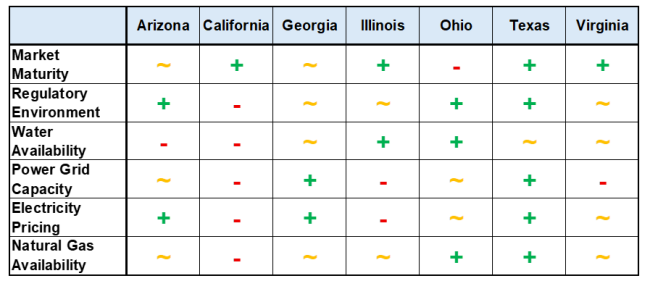
Figure 1 below offers our updated
view of the seven leading states for existing and new data centers,
comparing each on the key factors that determine where projects are
built. While we covered many of these topics for Virginia in Part 1 of our Sweet Virginia
blog series, any state’s strengths and weaknesses are relative to the
other markets developers may consider. As a result, the matrix in Figure
1 indicates whether a specific factor (rows) is a relative strength
(green plus sign), weakness (red minus sign), or neither (yellow tilde),
in each state.
Figure 1. Relative Strengths and Weaknesses of Key Data Center States. Source: RBN
This will be a stand-alone post because I have been posting any number of blogs on the very same subject.