Comparing Data Center Development Drivers Across Key States -- RBN Energy -- April 2, 2026
Locator: 50398LDCS.
RBN Energy: comparing data center development drivers across key states.Link here. Archived.
Data
centers are cropping up everywhere. Established markets like Northern
Virginia are expanding, and Texas has received a wave of proposals. But
while data centers have found new homes in Georgia and Ohio, mature
markets like California and Illinois are becoming less attractive to new
development. In today’s RBN blog, we’ll examine the factors that
influence data center development across seven key states — Arizona,
California, Georgia, Illinois, Ohio, Texas and Virginia — and show how
each stacks up.
We’ve been hard at work mapping the
what, the where, and the when regarding the U.S. data center buildout.
As data centers have come online across the country, the uncertainty
surrounding regional power and natural gas demand has only grown. In Won’t Get Fooled Again, we addressed how data centers will impact natural gas demand in Texas and Louisiana — a necessary data series for the Arrow Model,
our proprietary analytical framework built to assess both states’ gas
markets. But understanding data centers’ impact requires knowing where
they will be built in the first place.
Back in 2024, Where You Lead I Will Follow
examined the factors that influence data center development, focusing
on the importance of uninterrupted power supply in established markets
like Northern Virginia, Texas, Chicago and Silicon Valley. But the data
center map has changed significantly since then, with Georgia, Arizona
and Ohio emerging as important growth markets. Nationally, this growth
has coincided with a changing regulatory environment, particularly in
mature markets.
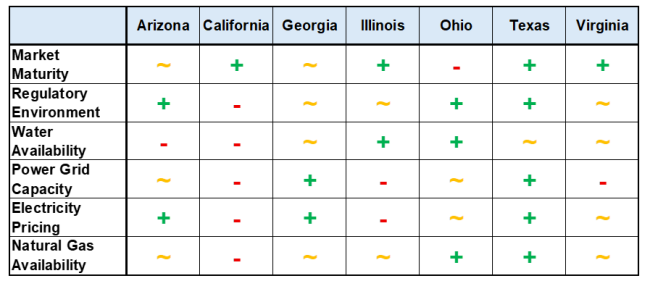
Figure 1 below offers our updated
view of the seven leading states for existing and new data centers,
comparing each on the key factors that determine where projects are
built. While we covered many of these topics for Virginia in Part 1 of our Sweet Virginia
blog series, any state’s strengths and weaknesses are relative to the
other markets developers may consider. As a result, the matrix in Figure
1 indicates whether a specific factor (rows) is a relative strength
(green plus sign), weakness (red minus sign), or neither (yellow tilde),
in each state.
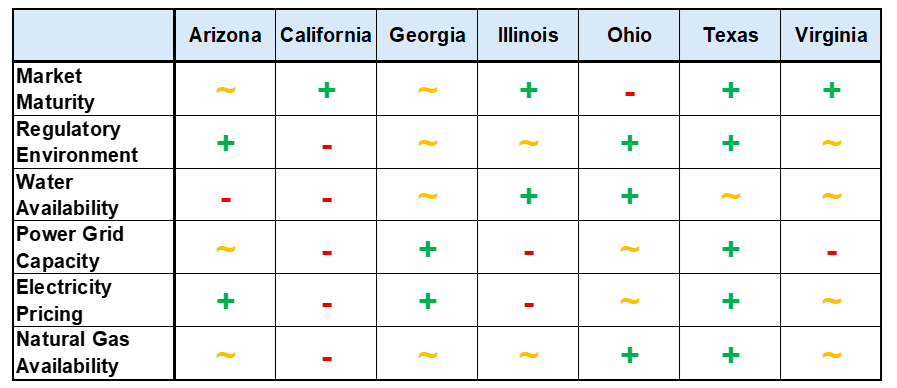
Figure 1. Relative Strengths and Weaknesses of Key Data Center States. Source: RBN