Locator: 50816B.
China says it will start buying US oil. Traders responded. WTI up $4.27.
*********************************************
Back to the Bakken
WTI: $105.50.
New wells reporting:
- Sunday, May 17, 2026: 44 for the month, 144 for the quarter, 301 for the year,
- 41955, conf, Kraken Dwyer EAst 26-35 7H,
- 41858, conf, Devon Energy, Finn 13-25F XW 1H,
- 41497, conf, Hess, BW-Wilson-149-99-3625H-6,
- 41496, conf, Hess, BW-Wilson-149-99-6325H-5,
- 41495, conf, Hess, BW-Wilson-149-99-3625H-4,
- 41452, conf, Devon Energy, Wagenman 32-29 6H,
- Saturday, May 16, 2026: 38 for the month, 138 for the quarter, 295 for the year,
- 41957, conf, Kraken, McCabe 24-13 5H,
- 41751, conf, KODA Resources, Stout 1301 2BH,
- Friday, May 15, 2026: 36 for the month, 136 for the quarter, 293 for the year,
- 41958, conf, Kraken, McCabe 24-13 6H,
- 41843, conf, Hunt Oil, Kandiyohi 159-90-5-17H-1,
RBN Energy: fuel waiver may lower costs, boost gasoline supplies. Link here. Archived.
By mid-May, the U.S. would typically be a couple of weeks into “summer refining season,” a monthslong period when refineries and refined product terminals are required to supply gasoline with lower Reid vapor pressure (RVP) — and a lot less butane. However, an emergency fuel waiver by the Environmental Protection Agency (EPA) is allowing them to market gasoline with an RVP of up to 10 pounds per square inch (psi) for E10 and E15 gasoline. In addition, the waiver streamlines compliance, making it easier for midstream operators to blend butane up to the RVP limit. As we discuss in today’s RBN blog, the waiver — temporary but likely to be extended — may well increase summertime gasoline supply and improve refinery and blender economics.
We’ll begin with a two-part warning, not to scare anyone off, but just to prepare you. First, producing and blending gasoline is complicated; second, government regulation of gasoline specifications only adds to that complexity.
As we said a couple of years ago in Wasting Away in Butane Blendingville, gasoline is among the most complex hydrocarbon products out there, with as many as a dozen specs — each with its own characteristics, such as octane, RVP, distillation points, aromatics, olefins, etc. — that when combined need to meet the exacting standards of regulators and, at the same time, turn as big a financial return as possible. And, to keep things interesting, federal and state regulations ratchet down the allowable RVP levels each spring and ratchet them up in late summer (often to different levels in different markets, and even at different dates).
Because of varying summer temperatures across the country and because certain parts of the U.S. face more serious challenges regarding smog than others, the EPA over the years has designated areas where even stricter summertime limits are enforced. Some states, like California, New York and Illinois — established even lower RVP caps of their own (with the EPA’s blessing) to address specific pollution concerns.
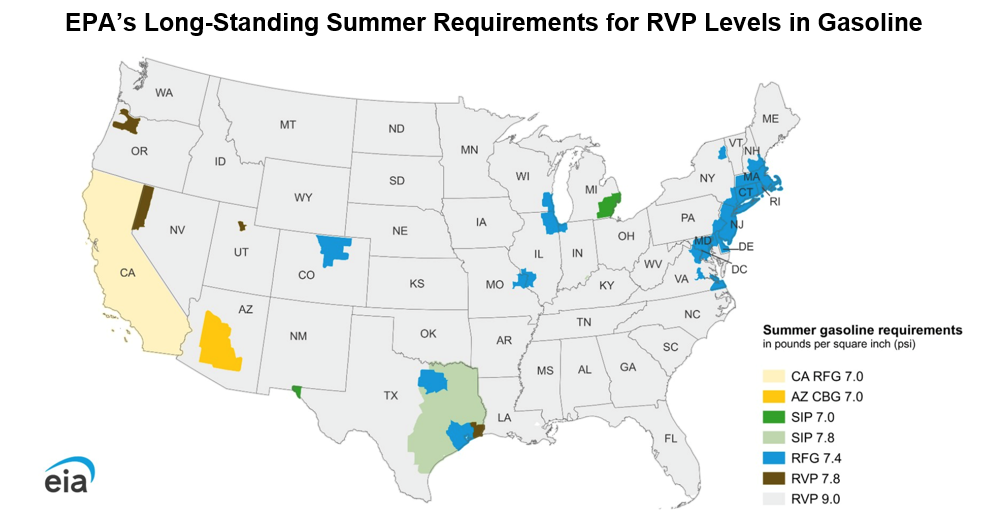
Figure 1. EPA’s Long-Standing Summer Requirements for RVP Levels in Gasoline. Source: EIA
