Locator: 50715B.
Updates
Later, 6:45 p.m. CT: after just two days, Project Freedom was so successful, Trump says he will pause Project Freedom (but not the blockade) to see if Iran and US can sign some kind of agreement to keep the strait open. My hunch: Saudi was in dire straights.
Original Post

Most interesting meme yesterday: Trump has gotten himself into a prolonged, unpopular war.
- that may be true; in fact, it probably is true.
- the questions are, does Trump care; and is Trump doing the right thing?
- I know one thing for sure: Israel / Netanyahu is happy as a lark.
State dinner for King Charles III ("no more kings") --
- one needs to remember that Secretary of the Interior, Doug Burgum, was one of the few Cabinet-level officials to attend:
- Secretary of State Rubio was there;
- on the other hand, Howard Lutnick was not.
*******************************
Back to the Bakken
WTI: $102.80.
New wells reporting:
- Wednesday, May 6, 2026: 15 for the month, 115 for the quarter, 272 for the year,
- 42102, conf, Hunt Oil, Burke 155-90-36-25H-1,
- 41890, conf, Oasis, Feiring State 5793 13-16 3BU
- 41889, conf, Oasis, Feiring State 5793 13-16 2BU,
- Tuesday, May 5, 2026: 12 for the month, 112 for the quarter, 269 for the year,
- 41359, conf, Devon Energy, Marvin 27-34 2H,
RBN Energy: how a prolonged conflict with Iran could disrupt US gasoline, jet and diesel markets. Link here. Archived.
The U.S. is seeing softer domestic demand for traditional fuels as efficiency improves and biofuels gain ground, but pockets of the country remain highly dependent on imported gasoline and jet fuel. If the Iran war drags on for an extended period, the key question becomes how much of each region’s gasoline, jet fuel and diesel demand can be covered by U.S. refineries and how much each still needs from international suppliers. Some parts of the country could face real product challenges if the disruption is prolonged. In today’s RBN blog, we’ll zero in on which PADDs are at the highest risk for shortages and price spikes.
As we’ve addressed in the RBN blogosphere, the war against Iran and closure of the Strait of Hormuz have seriously impacted the flows of refined products and LPG that underpin the Pacific Basin fuel market. With the strait effectively blocked to virtually all shipping for the last several weeks (see Eyes of the Ranger), large volumes of crude oil, LPG, naphtha and refined products bound for Asia were suddenly stranded, forcing refiners in South Korea and elsewhere to cut runs and curb gasoline and jet fuel exports (see Two Out of Three Ain’t Bad). As of May 4, the situation remains volatile and peace talks are uncertain.
In today’s blog, we use our Future of Fuels analysis to estimate how much gasoline, diesel and jet fuel demand is met by each PADD’s production compared to how much it relies on imports. From this, we identify which regions are most exposed if hostilities drag on for additional months or into this winter.
PADD 5 Jet Fuel and Gasoline
The biggest refined product risk from a prolonged conflict is gasoline and jet fuel in PADD 5 (gray section in Figure 1 below). The West Coast market is structurally tight and increasingly dependent on imports under normal circumstances, making it especially vulnerable to supply disruptions (see I Need More).
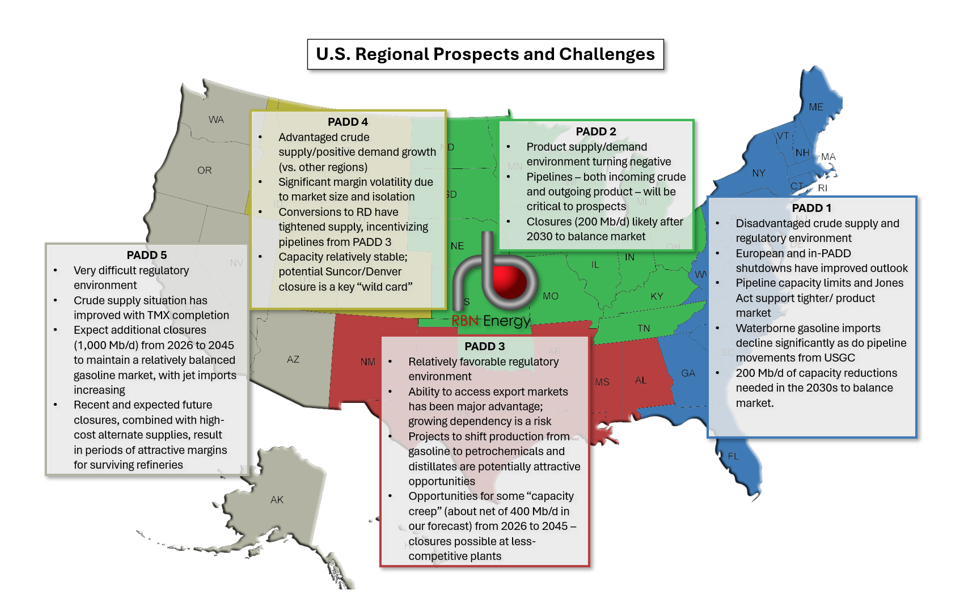
Figure 1: U.S. Regional Prospects and Challenges. Source: RBN Future of Fuels
