Thursday, May 7, 2026

Market Comments -- May 7, 2026

Locator: 50740CRAMER. 

Paul Tudor Jones on CNBC today.

Cramer: one gets the feeling he's the only one actually reading anything.

CNBC's Q and David Faber are out of their depth on AI. Q much worse than Faber. 

Today should have been an incredibly rough day for AI.

AAPL: up another $2.00 in pre-market trading.

GLW: up another 4% in pre-market trading. To invest $3.2 billion in Nvidia.

NVDA: clearly undervalued. 

Anthropic: first quarter; growing at 80x rate; unheard of. Absolutely unheard of. AMD, same thing.  

AAPL -- at the open: this is absolutely incredible -- the news yesterday drove this -- but I honestly didn't think that "average" investors would have realized this -- 


*********************************
AI Investing

Like all biological phenomena and revolutions, this current AI revolution will also follow the standard "S" curve.

Point A, about 2023: it had become obvious that one should have began investing heaving in AI by now. Interestingly, the term "Magnificent Seven" (Mag 7) was coined in 2023 by Bank of America analyst Michael Hartnett. He created the nickname to describe a group of seven dominant, high-performing U.S. technology stocks—Alphabet, Amazon, Apple, Meta Platforms, Microsoft, Nvidia, and Tesla. 

Point B, about 2028, will be the last opportunity to continue investing aggressively in AI. The Mag 7 will have greatly expanded by then. One might argue we'll see a resurgence of "a" Nifty Fifty

Between points A and B aggressive investors need to continue aggressively invest in AI, but transition from the Mag7 to the Towering 20

Many of these new twenty companies will be the results of IPOs between now (2026 and 2028).  

Unless there are indications that the growth/excitement of the current AI revolution continues beyond 2030, the investor needs to pivot. And pivot quickly. The market -- certainly the AI market -- could plummet 20 to 25 percent once the average investor sees what is going on. One may already need to consider pivoting from the current Mag 7 to something new.

Between now and then, keep reading everything you can on societal and geo-political changes. The trick will be to anticipate the next Mag 7. My own hunch: pharmaceutical companies that focus on "healthspan expansion" and even, perhaps, "biological age reversal." Beware charlatans.

It's not too late to invest in the current AI revolution, but by next year this time -- maybe sooner --  investing in the current Mag 7 will be challenging -- the real winners (investors) will be those who correctly anticipate the Towering 20 in 2030. Maybe we will see thirty such tickers by 2030 ... "thirty for 2030" --- "30 for 30."

**********************************
Disclaimer
Briefly

Briefly

  • I am inappropriately exuberant about the Bakken and I am often well out front of my headlights. I am often appropriately accused of hyperbole when it comes to the Bakken.
  • I am inappropriately exuberant about the US economy and the US market.
  • I am also inappropriately exuberant about all things Apple. 
  • See disclaimer. This is not an investment site. 
  • Disclaimer: this is not an investment site. Do not make any investment, financial, job, career, travel, or relationship decisions based on what you read here or think you may have read here. All my posts are done quickly: there will be content and typographical errors. If something appears wrong, it probably is. Feel free to fact check everything.
  • If anything on any of my posts is important to you, go to the source. If/when I find typographical / content errors, I will correct them. 
  • Reminder: I am inappropriately exuberant about the Bakken, US economy, and the US market.
  • I am also inappropriately exuberant about all things Apple. 
  • And now, Nvidia, also. I am also inappropriately exuberant about all things Nvidia. Nvidia is a metonym for AI and/or the sixth industrial revolution. 
  • I've now added Broadcom to the disclaimer. I am also inappropriately exuberant about all things Broadcom. Now, I've added Amazon.
  • Longer version here.   
  • Development Of Machine Learning -- Since 1943 -- Perceptrons -- Rosenblatt -- Machine Learning -- For The Archives -- May 7, 2026

    Locator: 50739MACHINELEARNING. 

    Probably the most difficult book I've read in the past several years and yet the most interesting:  

    Why Machines Learn: The Elegant Math Behind Modern AI, Anil Ananthaswamy, c. 2024/2025. 

    One of many concepts new to me in that book: perceptrons. Wiki

    Did aliens visit the earth under the cover of WWII?

    This is simply so incredible, defies explanation and understanding. Again, it's like an alien dropped in from another universe jump-starting humans' "invention" of machine learning. From the linked wiki entry.

    The artificial neuron and artificial neural network were invented in 1943 by Warren McCulloch and Walter Pitts in their seminal paper "A Logical Calculus of the Ideas Immanent in Nervous Activity."
    In 1957, Frank Rosenblatt was at the Cornell Aeronautical Laboratory. He simulated the perceptron on an IBM 704
    Later, he obtained funding by the Information Systems Branch of the United States Office of Naval Research and the Rome Air Development Center, to build a custom-made computer, the Mark I Perceptron
    It was first publicly demonstrated on 23 June 1960. The machine was "part of a previously secret four-year NPIC [the US' National Photographic Interpretation Center] effort from 1963 through 1966 to develop this algorithm into a useful tool for photo-interpreters." 
    Rosenblatt described the details of the perceptron in a 1958 paper. 
    His organization of a perceptron is constructed of three kinds of cells ("units"): AI, AII, R, which stand for "projection", "association" and "response." He presented at the first international symposium on AI, Mechanisation of Thought Processes, which took place in 1958 November. 

    "Attention Is All You Need," a 2017 research paper that has its own wiki entry

    "Attention Is All You Need" is a 2017 research paper in machine learning authored by eight scientists and engineers working at Google. 
    The paper introduced a new deep learning architecture known as the transformer, based on the attention mechanism proposed in 2014 by Bahdanau et al. The transformer approach it describes has become the main architecture of a wide variety of artificial intelligence, including large language models. At the time, the focus of the research was on improving Seq2seq techniques for machine translation, but the authors go further in the paper, foreseeing the technique's potential for other tasks like question answering and what is now known as multimodal generative AI.

    And then look at this:

    As of 2025, the paper has been cited more than 173,000 times, placing it among the top ten most-cited papers of the 21st century
    After the paper was published by Google, each of the authors left the company to join other companies or to found startups.

    And that brings us to this. From Medium, January 21, 2026 -- just a few months ago, an overview, link here

    Autonomous Trucks Across Texas -- May 7, 2026

    Locator: 50738TRUCKS. 

    Tag: BRK Texas 

    Link here

    *************************************
    Meanwhile, Out In Portland
    Dad Brought Home A Western Star

    Devon's Finn Wells -- Southwest Williams County -- Briar Creek -- Near Buford -- May 7, 2026

    Locator: 50737B.

    *********************************
    Well In Focus


    The wells
    : these all appear to be 1920-acre spacing in a relatively new area of activity; near Montana; very nice wells -- but again, three section spacing.

    • 41860, conf, Devon Energy, Finn 13-25F 2H, Briar Creek, far southwest corner of Williams County; 1920-acre spacing; standup;
    DateOil RunsMCF Sold
    3-20262479025120
    2-20263000325453
    1-20262372021732
    12-20252190618419
    11-20254593724385
    • There are actually five wells on that pad:
      • 41862, drl/A, Devon Energy, Finn 13-25F 4H, Briar Creek, very nice well; t11/25; cum 122K 3/26;
      • 41861, drl/A, Devon Energy, Finn 13-25F 3H, Briar Creek, very nice well; t11/25; cum 134K 3/26;
      • 41860, conf/producing, Devon Energy, Finn 13-25F 2H, Briar Creek, very nice well; 
      • 41859, conf/producing, Devon Energy, Finn 13-25F 1H, Briar Creek; very nice well;
      • 41858, conf/producing, Devon Energy, Finn 13-25F XW 1H, Briar Creek; nice well;

    McDonalds Earnings; Saudi; Projec Freedom; Bakken Update -- May 7, 2026

    Locator: 50736B. 

    Iran:WTI continues to drop but not much news coming out of thte Mideast. 

    Some strange note about Saudi Arabia very upset with Trump's "Project Freedom." Has denied US anti-Iran activities out of its air bases. I have no idea what this is all about. Saudi says they weren't contacted about "Project Freedom" before it was put in place. 

    Saudi -- another "fair weather" friend

    McDonalds (MCD):

    Earnings: net income for the quarter came in at $1.98 billion, or $2.78 per share, while total revenue jumped 9% to $6.52 billion. Stripping out restructuring charges, per-share earnings landed at $2.83 — topping the $2.74 Wall Street had penciled in, with revenue also clearing the $6.47 billion consensus estimate.

    Pre-market: up 3%; up about $10.00. 

    *********************************
    Back to the Bakken

    WTI: continues to drop -- now around $91. 

    New wells reporting:

    • Friday, May 8, 2026: 16 for the month, 116 for the quarter, 273 for the year, 
      • 41860, conf, Devon Energy, Finn 13-25F 2H, 
    • Thursday, May 7, 2026: 15 for the month, 115 for the quarter, 272 for the year,  
      • None.

    *********************************
    Well In Focus


    The wells
    :

    • 41860, conf, Devon Energy, Finn 13-25F 2H, Briar Creek, far southwest corner of Williams County; 1920-acre spacing; standup;
    DateOil RunsMCF Sold
    3-20262479025120
    2-20263000325453
    1-20262372021732
    12-20252190618419
    11-20254593724385
    • There are actually five wells on that pad:
      • 41862, drl/A, Devon Energy, Finn 13-25F 4H, Briar Creek, very nice well; t11/25; cum 122K 3/26;
      • 41861, drl/A, Devon Energy, Finn 13-25F 3H, Briar Creek, very nice well; t11/25; cum 134K 3/26;
      • 41860, conf/producing, Devon Energy, Finn 13-25F 2H, Briar Creek, very nice well; 
      • 41859, conf/producing, Devon Energy, Finn 13-25F 1H, Briar Creek; very nice well;
      • 41858, conf/producing, Devon Energy, Finn 13-25F XW 1H, Briar Creek; nice well;

    **************************************
    RBN Energy 

    RBN Energy: E&Ps face a new capital allocation cycle -- will debt reduction stay front and center? Link here. Archived.

    After several years of aggressive balance-sheet repair, U.S. E&Ps are entering a new phase — one defined not by constraint, but by opportunity. A surge in oil prices tied to the Iran conflict and a sharp rise in natural gas prices driven by an unusually cold winter have combined to generate a fresh wave of excess cash flow across the sector. Oil markets have been pushed higher by supply disruptions and geopolitical tensions, while natural gas prices have strengthened on weather-driven demand, reinforcing a powerful near-term earnings tailwind. The question posed in today’s RBN blog is a familiar one: What will companies do with these additional cash flows?

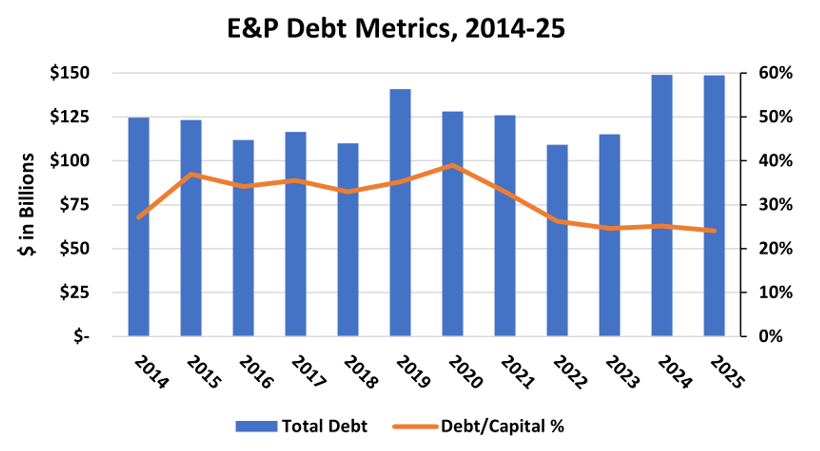
    The 35 E&Ps that we monitor held total debt essentially flat at just under $150 billion (blue bars and left axis in Figure 1 below) in 2025, while their collective debt-to-capital ratio (orange line and right axis) declined by 1 percentage point to 24%. Debt trended steadily lower from its 2019 peak through 2022 as companies shifted toward a cash-return model that prioritized free cash flow over reinvestment, enabling meaningful debt reduction alongside increased dividends and share repurchases. Debt moved sharply higher in 2024, driven by a surge in M&A activity (see Try Some, Buy Some), with our universe of E&Ps completing nearly $120 billion of asset and corporate transactions. Despite the increase in total debt, the debt-to-capital ratio remained stable, as companies funded acquisitions with a mix of debt and equity to preserve target leverage levels. In 2025, debt levels held steady, while the debt-to-capital ratio declined to 24%, supported by an expanding capital base.

    Figure 1. E&P Debt Metrics, 2014-25. 
    Source: Oil & Gas Financial Analytics LLC