Locator: 48817B.
Tea leaves: agreement between EU and the US on trade will miss the August 1, 2025, deadline.
United Health plummeting: down 12%in pre-market trading as reports come out that UnitedHealth is under criminal investigation for the way it "managed" Medicaid.
UNP: it is now confirmed that UNP and Nortolk Southern are in advanced conversations. UNP continues to fall; NSC is surging. Breaking on CNBC at 8:12 a.m., July 24, 2025. In pre-market trading, UNP down 3% and NFS up 3%. Under Hillary/Obama/Biden/Kamala there is not way this merger would be approved; times have changed. Cramer is giddy over this possibility: "the gilded age of rails."
Pennsylvania Data Center: Blackstone, $25 billion.
Columbia University agrees to pay $200 million suit to settle anti-Semitism suit. Link here.
BRK: Bright Rock sells 25,000 shares of BRK. Link here.

*********************************
Back to the Bakken
NOG: 2Q25 operational highlights; only part of what NOG released this morning.
- completed 22 ground game transactions by adding 4.8 net wells and 2,600 net acres
- acquisitions across all four of NOG's major basins; cost, $23.8 million now; $7.2 millin incremental
- wins lawsuit with unnamed ND producer regarding post-production costs previously deducted from revenues
- company gross: $82 million; nets $49 million after paying $33 million in legal costs
WTI: $65.66.
New wells:
- Friday, July 25, 2025: 34 for the month, 34 for the quarter, 464 for the year,
- None.
- Thursday, July 24, 2025: 34 for the month, 34 for the quarter, 464 for the year
- 41346, conf, CLR, Syverson 5-12H,
- 40550, conf, Hunt Oil, Redmond 157-89-19-30H 2,
- 40181, conf, Hunt Oil, Clearwater, 157-90-23-26H 4,
RBN Energy: data center developers increasingly exploring off-grid options for power generation.
Perhaps the most hyped-up topic in energy these days is how much electricity new data centers will need to keep up with the increased use of artificial intelligence (AI). And that’s prompting some big questions, such as where all the power will come from and how much natural gas demand will rise. But another crucial question may be whether these data centers will pull that power from the grid or generate it themselves on-site. In today’s RBN blog, we’ll discuss the benefits and challenges of each approach.
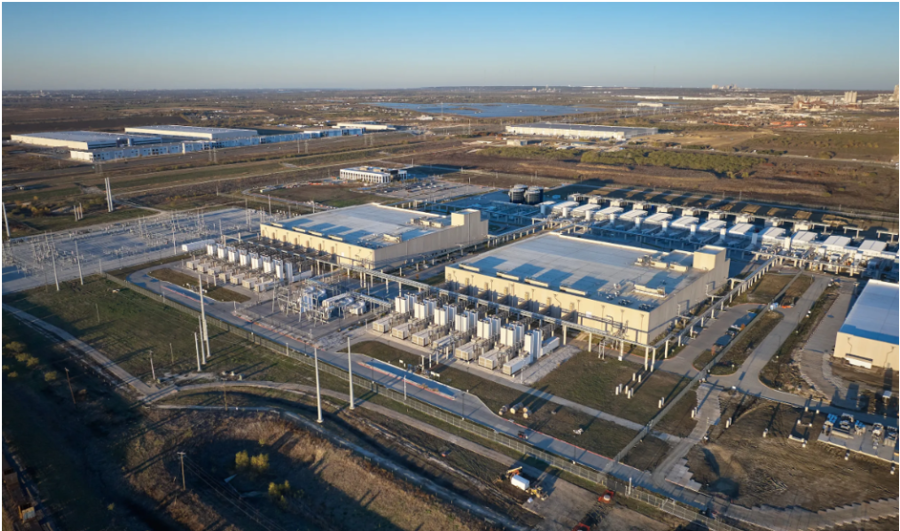
First, let’s offer a bit of background and some data-center basics. As we discussed in Storm Front, large-scale data centers (see photo below) can be home to thousands or even tens of thousands of networked computers that process, store and share data. Data centers — many of them owned and operated by tech giants — are among the most energy-intensive building types, consuming up to 50 times the energy per square foot of a typical commercial office building, with electrical demand at larger facilities ranging from 100 megawatts (MW) to 2,000 MW. (For perspective, as we noted in Just Can’t Get Enough, a city the size of Lubbock, TX, — population 267,000 — only requires about 700 MW.) Demand for data centers has grown exponentially with the expansion of AI tools like ChatGPT and Perplexity, which require far more computational power — and energy — than conventional Google searches.
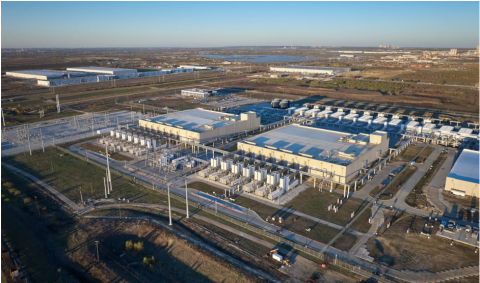
A Google Data Center in Ellis County, TX. Source: Google
As we discussed in We Should Be Friends, renewables like wind and solar often remain an important (if intermittent) part of the power mix for data centers (see Together In Electric Dreams) and nuclear power holds significant long-term potential (along with years-long red tape). But natural gas typically remains Option #1 because, as we noted in Dive In, it is a consistent source of around-the-clock power that can be deployed at scale, usually within a reasonable period of time.