Showing posts with label PanamaCanalExpansion. Show all posts

Wednesday, June 27, 2018

Wow, It Never Quits -- LNG, LNG, LNG, And More LNG; Making Panama Great Again -- June 27, 2018

Articles sent to me by readers. Thank you very much.

The first article, a press release: ONEOK will expand its natural gas pipeline infrastructure in the Permian Basin and Oklahoma to a total of 1.7 billion cubic feet per day. The press release goes on to list several projects.
  • 1.7 billion cubic feet per day / 6,001 = 285,000 boe per day
  • these are the projects
    • expansion: 150 million cf/d expansion, ONEOK's WesTex Transmission system, from the Permian Basin to delivery points in the Texas panhandle; if enough interest, could be expanded to 450 million cf/d; 4Q18;
    • expansion: 150 million cf/d expansion of the ONEOK Gas Transportation system from two NG processing plants in the STACK and SCOOP to eastern Oklahoma to join the interstate grid; 1Q19;
    • expansion: 100 million cf/d westbound expansion of the same system; 1Q19;
    • new: a project to make the Roadrunner Gas Transmission bidirectional; will supply 750 million cf/d of eastbound transportation capacity from the Delaware Basin to the Waha area; 1Q19;
  • most of this will be done with additional compression facilities
  • look how fast this will occur: we'll talk about this later when we talk about Canada
The second article, SFGate: Panama Canal opens way for more LNG tankers with US exports rising. But first, before we get to this story, do you remember the negative article by The NYT suggesting the Panamanians would not succeed with their Panama Canal project? The "Panama Canal expansion" tag will bring up The NYT article plus many related articles. The original post regarding The NYT article and updates are at this post.

Now back to the SFGate article, data points:
  • the Panama Canal Authority will ramp up the movement of massive LNG tankers through the canal beginning in October of this year (2018)
  • under new rules:
    • the ships can traverse the canal at night
    • two at a time can be on Gatun Lake
    • the changes will let two tankers move through the canal in different directions at the same time
    • the authority will also better identify "ghost bookings": companies that reserve slots in advance, then fail to show up
Other data points:
  • the US currently has two operating LNG export terminals; there will be four (4) more export terminals in 2020
  • China is now the world's largest natural gas importer
  • China is not putting any tariffs on natural gas imports
And more:
  • the canal celebrated it's second anniversary of the expansion yesterday (Tuesday, June 26, 2018)
  • so far: 
    • 372 LNG tankers have gone through the locks; 
    • 337 moved through on the same day they had reserved a slot; 
    • the remaining ships were tankers that showed up with no reservation, and all but five moved through on the same day; 
    • the rest waited three to four days at most
  • the canal is averaging less than a trip a day for these tankers
  • in October, a second daily slot will become available
  • the canal has a total of 10 slots per day available for reservations
  • a new analysis suggest the locks may be able to handle as many as 13 a day
Making Panama great again. Doing it on their own. Can you imagine the additional revenue this country will begin to take in after October?

Friday, April 20, 2018

Another First For The Expanded Panama Canal -- Making Panama Great Again! -- April 20, 2018

This has always been a burr under my saddle. I always thought the NY TImes article was a bit racist, suggesting the Panamanians attempt to widen the canal would go awry. The original post and updates are at this link.

Today, from Bloomberg: a first for the Panama Canal -- three LNG tankers crossed in one day. Wow.
Three liquefied natural gas tankers sailed through the Panama Canal on the same day this week, marking a first for the newly expanded waterway and highlighting the booming global gas trade.
All three ships -- Gaslog Hong Kong, Gaslog Gibraltar and Clean Ocean -- entered the canal on a staggered basis from the Pacific side Tuesday and had completed their crossings by early Wednesday, according to vessel tracking data compiled by Bloomberg. A representative for the canal authority confirmed the tanker moves.
The crossings underscore how the LNG trade has surged worldwide as new export facilities from the U.S. to Australia rumble to life and buyers in Asia boost their demand for the fuel. Since the canal completed a $5 billion expansion almost two years ago, traders and terminal developers have been closely watching the authority's ability to accommodate the jump in tanker traffic.
And more:
Dominion Energy Inc.'s Cove Point LNG terminal -- the second to send U.S. shale gas overseas -- started commercial service this week, roughly two years after Cheniere Energy Inc. opened up its Sabine Pass terminal in Louisiana. Thus far, Sabine Pass has shipped more than 300 cargoes to 26 countries.
As of March, the Panama Canal has seen 134 LNG vessels pass through it this fiscal year, according to a statement. Though this marks the first time three ships made the transit in one day, two ships have made the journey in 24 hours more than a dozen times.
********************************
Exonyms and Endonyms

From wiki:
An exonym or xenonym is an external name for a geographical place, or a group of people, an individual person, or a language or dialect. It is a common name used only outside the place, group, or linguistic community in question.
An endonym or autonym is an internal name for a geographical place, or a group of people, or a language or dialect. It is a common name used only inside the place, group, or linguistic community in question; it is their name for themselves, their homeland, or their language.
For instance, "Germany" is the English language exonym, "Allemagne" is the French language exonym, and "Deutschland" is the endonym for the same country in Europe.
Japan is an exonym. The Japanese names (endonyms) for Japan are Nippon and Nihon.

And now the dots start to connect:
Before modern styles of romanization, the Portuguese devised their own. In it, /zi/ is written as either ii or ji. 
In modern Hepburn style, iippon would be rendered as Jippon. 
There are no historical phonological changes to take into account here. Etymologically, Jippon is similar to Nippon in that it is an alternative reading of 日本. The initial character 日 may also be read as /ziti/ or /zitu/.
Compounded with /hoɴ/ (本), this regularly becomes Jippon. Unlike the Nihon/Nippon doublet, there is no evidence for a *Jihon.
Wow. There you have it. It appears the Portuguese, before the "modern styles of romanization," provided the direct link to the exonym: Japan.

One can stop here, but wiki continues:
As mentioned above, the English word Japan has a circuitous derivation; but linguists believe it derives in part from the Portuguese recording of the early Mandarin Chinese or Wu Chinese word for Japan: Cipan (日本), which is rendered in pinyin as Rìběn (IPA: ʐʅ˥˩pən˨˩˦), and literally translates to "sun origin". Guó (IPA: kuo˨˦) is Chinese for "realm" or "kingdom", so it could alternatively be rendered as Cipan-guo. 
The word was likely introduced to Portuguese through the Malay Jipang. Cipangu was first mentioned in Europe in the accounts of Marco Polo. It appears for the first time on a European map with the Fra Mauro map in 1457, although it appears much earlier on Chinese and Korean maps such as the Gangnido. Following the accounts of Marco Polo, Cipangu was thought to be fabulously rich in silver and gold, which in Medieval times was largely correct, owing to the volcanism of the islands and the possibility to access precious ores without resorting to (unavailable) deep-mining technologies. 
The Dutch name, Japan, may be derived from the southern Chinese pronunciation of 日本, Yatbun or Yatpun. The Dutch J is generally pronounced Y, hence Ja-Pan.

Friday, December 8, 2017

Trucking Sector's Shift To CNG And LNG -- RBN Energy -- December 8, 2017

Making America great again: US government report says stocks, home values helped total household net worth rise. Total household net worth rose to almost $100 trillion in 3Q17, larger gain than prior quarter. Tax bill could lead to greater gains.

Active rigs:

$57.58↑↑12/8/201712/08/201612/08/201512/08/201412/08/2013
Active Rigs534065191193

RBN Energy: can the trucking sector's shift to CNG and LNG survive low diesel prices?

From RBN Energy ....


... but CNG locater says there are CNG fueling locations in North Dakota: Williston, Dickinson, Minot, and Bismarck.

Don writes: with regard to the CNG fueling locations in North Dakota. These sites are all owned/operated by MDU. If one has an MDU account and a credit care you can use these fueling stations. That's probably true in other states, also. "So, available, but not really."

ICYMI: Basin Electric Power Cooperative recently started commercial operation of Phase III of its Pioneer Generation Station northwest of Williston. Units 1, 2, and 3 started commercial operation in 2014. Those three have a total generation capacity of 135 MW.  Phase III will feature first-of-its kind engines for Basin Electric: 12 natural gas-based reciprocating engines, each a generating capacity of 93 MW. Thus, a peaking generation station with total capacity of 247 MW which can provide fast-acting reactive power which will help stabilize the electric grid in the area, apparently necessary to offset the destabilizing effect of wind farms going up in the area.


Panama Canal: maybe The New York Times was correct about the Panama Canal: what if the Panama Canal does not work as advertised?

Monday, October 23, 2017

Making America Great Again -- It Never Gets Old -- New Energy Record -- Crude Oil Production Highest In 44 Years -- T+275, October 23, 2017

The Red Queen has not fallen off her treadmill.

US petroleum product demand hits 10-year September peak -- API -- Oil & Gas Journal, data points:
  • US petroleum product demand averaged more than 20.2 million b/d in September, 2017
  • 2.4% more than a year earlier
  • gasoline deliveries fell 0.8% from a year earlier to an average 9.4 million b/d -- still, second-highest for the month on record
  • distillate fuel deliveries: averaged 4 million b/d; up 3.4% from a year earlier
  • crude oil production: robust; highest September in 47 years, since 1970; highest production level for any month in 29 months, since April, 2015
  • crude oil production: first nine months of 2017 -- averaged 9.1 million b/d; 2.9% more year-to-year and the second highest for the period in 44 years, since 1973
I do believe "Peak Oil" theory is pretty much in shambles.

***********************************
West Coast Mexican Terminals Might Ship US LNG

From Bloomberg, another big story:
Since the first shale gas export terminal opened in Louisiana last year, America’s drillers have seen at least 75 cargoes of their fuel sail through the Panama Canal bound for markets in Asia.
Now they’re looking for a cheaper and quicker route. And they’ve turned to Mexico for help.
Aldo Flores, Mexico’s deputy energy secretary, said Thursday that the government’s in talks with shale drillers in West Texas about a potential pipeline that would send their gas straight to Mexico’s west coast, where it could then be liquefied and shipped overseas.
Such a pipeline could eliminate the need for gas tankers to navigate the Panama Canal and hand the U.S. another outlet for the bounty of gas that President Donald Trump has vowed to “unleash” upon the world.
It comes as at least one would-be U.S. gas exporter, Sempra LNG & Midstream, voices concerns about delays at the canal that threaten to cost gas traders thousands of dollars a day.
************************************
Conrad Hilton Quiz

Time to answer the quiz posted earlier:

1a. Who "discovered" Conrad Hilton's most famous granddaughter?  Most famous granddaughter, Paris Hilton, discovered by Donald Trump 1b. Before she was discovered, what did she want to be when she "grew up"? veterinarian (page 427)
2. Whom was Barron named after? Yes, that Barron. Conrad's second son, William Barron, (p. 414) Barron was his first wife's maiden name.
3. Who was Conrad Hilton's second wife? Zsa Zsa Gabor; his first wife, Mary Adelaide Barron, her fling with an athletic coach led to their divorce
4. The Melba was one of Conrad Hilton's very first hotels; in what city was it located? Ft Worth, TX
5. What hotel was the first hotel that Conrad Hilton built from the ground up? Dallas Hilton
6. Where did Conrad Hilton serve in WWI? Paris 6b. In what capacity? Quartermaster 6c. In what service and at what rank? US Army, 2nd Lt
7a. In what country was Conrad Hilton's dad born? Norway 7b. What was his Dad's middle name?  Halvorsen 7c. In what month was Conrad Hilton's father born? August 7d. In what state was Conrad Hilton born? (this is a trick question) Conrad was not born in any US state; he was born in San Antonio, Territory of New Mexico
8. Hilton Conrad's first child was a son, Conrad Nicholson, Jr. Whom did "Nicky" marry? his first wife was Elizabeth Taylor (yes, that Elizabeth Taylor; the marriage lasted from 1950 - 1951; second marriage to Patricia (Trish) McClintock
9. What major airline bought Hilton International in 1967? TWA
10. What was the first company registered with the New York Stock Exchange to operate gambling facilities (in Nevada). Hilton, 1970, purchased the Flamingo Hoel and the Las Vegas International, later named the Las Vegas Hilton

Sunday, October 8, 2017

Sunday, October 8, 2017 -- Nothing About The Bakken -- Traveling

OPEC: "extraordinary" steps will be required in 2018 -- Bloomberg. 

Panama Canal: How many remember this story by The New York Times: what if the Panama Canal expansion doesn't work. It was another fake news story and I had a bit of fun with it. Today, in The Wall Street Journal, the Panama Canal's big bet is paying off.
Ocean operators switch some sailing from Suez as bigger ships can cross new Panama locks to reach US East Coast. 
Panama’s $5 billion investment to expand its century-old canal is paying off as shipping lines send more U.S.-bound cargoes through the passage instead of the Suez Canal.
Ships nearly three times as large as the ones crossing before the expanded locks opened in June of 2016 are bringing tens of millions of additional dollars in tolls and a trading boom to U.S. East Coast ports, allaying some fears that investments to cater to the bigger vessels wouldn’t see enough returns.
Since the start of the year, transiting tonnage at the Panama Canal has increased by nearly 23%, canal executives say. Last week marked the 2,000th transit of a ship that wouldn’t have fit through the old locks.
Heard on the street: the truth is catching up on Tesla. Story here. CEO Elon Musk is a visionary, but there is a fine line between setting aggressive goals and misleading shareholders.
Tesla is inching closer to that line. Tesla was making three Model 3s on an average day in the third quarter. Mr. Musk should have known in August, when production guidance was reiterated, that the company wasn’t going to produce 1,500 Model 3s by the end of September.
There are other examples. At the Model 3 launch event in July, he told reporters that Tesla had received more than 500,000 customer deposits for the car. Five days later, after a series of questions from The Wall Street Journal, Mr. Musk revised that number to 455,000 on a conference call with investors. The earlier, higher figure he quoted had been “just a guess.” [By the way, this is quibbling on the part of The WSJ -- 500,000 vs 455,000.]
Investors approved Tesla’s decision to pay about $8 billion in stock and assumed debt to acquire Mr. Musk’s struggling SolarCity last fall, after Mr. Musk demonstrated roofs that could generate solar power for homes and promised production would begin in the spring. A year later, those roofs are conspicuously absent, beyond some installations for Tesla executives.
Last, but certainly not least, Mr. Musk told investors in May 2016 that he expected Tesla to produce between 100,000 and 200,000 Model 3s in the second half of 2017.
Why Tesla is struggling to build the Model 3 -- Business Insider. Five reasons given, but no real explanation except possibly reason #5 -- the Model 3 may not be that much simpler to build than the Model S or the Model X. The "learning curve" may be holding them back, but Elon Musk does not care.

Puerto Rico: by the way, this is why Elon Musk's offer to help Puerto Rico with its electricity problem is just that -- an (empty) offer: miles and miles of downed power lines. Install the solar panels but how does one get the electricity from the batteries to the homes? The problem is not electricity generation (diesel generators would be a lot more efficient than solar energy / batteries -- and if he's talking about installing solar panels on roofs -- there are no roofs in Puerto Rico any more -- well, not many.

Boeing in Seattle: see the comments at this article --
I am a retired Boeing executive and  have a bit of inside information. All space related business in now in Huntsville, Alabama; all military aviation except the C-17 is in Saint Lewis, Missouri; all electronics are in Southern California. In the Seattle area the wide body assembly plant in Everett and the narrow body assembly plant in Renton are all of the major programs left in Washington.  Total Seattle head count about 20,000 a far smaller number than at any time after 1941.
Reminiscing: I remember the good old days, waking up early to check the Drudge Report, to see where President Obama was golfing on the weekend/ now I wake up early to see if North Korea has launched another ICBM.

***********************************
Getting Ready For Halloween

... though this looks better for carnival/Mardi Gras:


This might be my last year to go trick or treating (but I say that every year).

Monday, September 25, 2017

OXY To Complete Corpus Christi VLCC Loading Facillity By End Of 2018

From Platts: OXY to complete Corpus Christi VLCC loading facility by end of 2018. Data points:
  • VLCC terminal 
  • current draft of 45 feet at the Corpus Christi Ship Channel
  • VLCC: 1.4 million bbls
  • Ingleside Energy Center facilty
  • at a greater water depth of 66 feet or more: capacity of 2 million bbls
  • the PCCA and the US Army Corps of Engineers will jointly invest $327 million to deepen the port  through an aggressive dredging program; will also expand the width of the channel entrance
  • also, the agency is pursuing a new bridge at a cost of $800 million
  • maximum fully loaded vessel that the channel can now handle is an Aframax (about 750,000 bbls)
Also, see this post from May 29, 2017.

Key points:
  • VLCC
  • 2 million bbls of crude oil (two days of North Dakota crude oil production)
  • Panama Canal Expansion 
Remember this NY Times article?

Monday, July 24, 2017

Connecting Bakken Crude Oil With Nation's Largest Port And Export To Asia -- July 24, 2017

Updates

February 13, 2018: US supertanker terminal set to export oil for the first time.

February 13, 2018: LOOP testing begins for bidirectional crude oil flows (loading/unloading) for supertankers in the GoM for export.
 
Original Post
 
Don sent me the link to this story. He wanted to point out that one VLCC can carry 2 million bbls of oil, or the equivalent of two days of North Dakota crude oil production.

I replied that this story is such a great story on so many levels, but for me, personally, it's almost a personal story.

Had it not been for the blog, I probably wouldn't have thought much more about the story than what the writers write.

The story is about LOOP, America's biggest oil port. I only know about it because of RBN Energy. I've blogged often on LOOP.

The post at this link is perhaps one of my favorite posts and it just happens to reference LOOP without mentioning it by name. The caption for the photograph at the linked story fails to mention:
  • that the ship was a VLCC -- a very large crude carrier
  • that the Louisiana port had to have been LOOP
There are also a couple of other data points not mentioned. More on that later. For now, back to the linked Bloomberg story. Data points:
  • LOOP: Lousiana Offshore Oil Port
  • the only terminal along the US Gulf Coast able to handle a fully laden VLCC
  • currently, an import-only port for VLCC's
  • considering become an export port also as early as next year
From the linked story:
Currently, shippers have to load oil onto smaller tankers in ports such as Houston or Corpus Christi, Texas, that then transfer their cargoes onto Very Large Crude Carriers sitting offshore. That adds cost and time to the shipments. While Corpus Christi received its first VLCC at the end of May, the port’s channel isn’t deep enough for a ship that size to load a full cargo.
All previously posted at the blog.

Earlier I mentioned that the linked Bloomberg article was remiss in not mentioning two other points:
  • all of this only works for the simple fact that it just turns out that the Panama Canal, recently expanded, is now able to handle VLCCs; and,
  • although the law was changed under President Obama to allow oil exports once again, I can only assume exports are going a whole more smoothly under the current president than things would be going under President Obama.
I could be wrong on that last note, but I doubt it. I'll leave it at that.

Oh, I almost forgot. The St James Hub in Louisiana is an important terminal for Bakken oil arriving by CBR. From St James, oil is then taken by pipeline to LOOP.

*******************************
Richard Burton

I am ambivalent about Richard Burton. I assume it has something to do with his off-camera life, his personal life. Whatever.

My "feelings" about Richard Burton have changed completely -- I'm watching The Night of the Iguana on TCM -- and Burton is simply a hoot. When Johnny Depp is at his best, it seems Depp is channeling Richard Burton in Iguana.

Interestingly, this is what one reviewer had to say about Burton in this movie (from wiki):
[Burton] was spectacularly gross, a figure of wild disarrangement, but without a shred of real sincerity. You see a pot-bellied scarecrow flapping erratically. And in his ridiculous early fumbling with the Lolitaish Sue Lyon (whose acting is painfully awkward), he is farcical when he isn't grotesque.
I can't speak to Sue Lyon's performance but I think the critic completely misread Burton's performance.  The very same thing happened in the first installment of The Pirates with the lead role played by Depp.

****************************************
Who's Gonna Fill Their Shoes?

George Jones

Monday, May 29, 2017

VLCC At Corpus Christi -- Successfully Tested -- OXY -- May 29, 2017

Updates

September 25, 2017: update on the OXY Corpus Christi terminal. To be complete by end of 2018.

Later, 11:35 p.m. Central Time: see comments from a reader.
Propane - propylene here: https://www.eia.gov/dnav/pet/hist/LeafHandler.ashx?n=PET&s=W_EPLLPZ_EEX_NUS-Z00_MBBLD&f=W.

Ethane - ethylene here: https://www.eia.gov/dnav/pet/hist/LeafHandler.ashx?n=PET&s=METEXUS2&f=A.
Original Post

This is pretty incredible. Earlier a reader sent me a link to a story reporting that this historic event had been delayed 24 hours due to a local thunderstorm.

Apparently, things are back on schedule. New link to a new story. Data points:
  • supertankers tested at Port Corpus Christi, TX
  • mammoth tanker docking Friday at Port Corpus Christi, historic and successful
  • 1,093-foot-long EuroNav tanker: Anne
  • docked at Oxy's crude oil export facility
  • classified as a Very Large Crude Carrier (VLCC) 
  • Belgian-owned ship: largest crude oil tanker to call on a Gulf of Mexico port
  • will boost crude oil exports from Texas
  • when fully loaded: the bottom of the hull -- 66 feet down
  • unfortunately, Corpus Christi Ship Channel is only 45 feet deep
  • so, they partially load the tanker dockside and then finish the loading in deeper waters using using a smaller ship and ship-to-ship transfer
  • will fill up to 60% capacity dockside
  • tanker at 100% capacity will hold 2.2 million bbls of crude oil for European and Asian markets
  • Port of Corpus Christi plans to deepen its channel; build a higher harbor bridge to accommodate larger vessels
Think about that:
  • ten years ago we were talking about Peak Oil
  • President Carter: "start wearing cardigan sweaters"
  • President Obama: "we can't drill out way to cheaper oil"
  • now, VLCCs are docking off Texas
  • Texas will dredge a channel to make it twenty feet deeper (20/45 = 44%)
  • will build a new bridge over the channel
  • all to export oil from the Permian -- an old basin thought to be dead ... until the Bakken revolution
  • not in a generation; not in a lifetime; in less than ten years

Thursday, April 6, 2017

Panama Regains Crown As Latin America's Fastest Growing Economy -- Expanded Canal -- Bloomberg -- April 6, 2017

Regular readers know that one of the burrs under my saddle is the slanted / shoddy / fake news reporting in The New York Times. For most recent rant, see this post from a couple of days ago. In that post I talked about The New York Times reporting on the expanded Panama Canal.

It turns out that, as predicted, the expanded Panama Canal has had a considerable effect on two countries. First, the US is going to really, really benefit from the expanded Panama Canal. With regard to LNG exports, it already has. RBN Energy has blogged about this on many occasions. Expanded cargo terminals along the Texas-Louisiana coast, and the large cargo terminals along the US east coast (e.g., South Carolina) are already taking advantage of the expanded Panama Canal.

The second country to have really benefited from the expanded canal is, of course, the country itself. A huge "thanks" to Don for sending me this link over at Bloomberg (and if it's "in Bloomberg, it must be true): Panama Seen Regaining Crown as Region's Fastest Growing Economy. Some data points:
  • increased trade through the Panama Canal will drive 5.8% growth
  • Panama will regain its crown as Latin America's fastest growing economy this year on a surge in trade through the newly-expanded canal
  • no concerns about global trade policy comments being made by President Trump 


Thursday, March 30, 2017

Making America Great Again -- Walmart To Build $135 Million Import Distribution Center At Mobile, AL -- March 30, 2017

From Benchmarkmonitor,
Wal-Mart Stores, Inc. has confirmed plans to build an $135 million import distribution center at Mobile, Alabama, that’s expected to help US Gulf ports expand their foothold in containerized shipments from Asia. Gulf ports’ share of full container imports from Asia grew to 2.85 percent in 2016.
From earlier posts:
My favorite, of course, is The New York Times article in which the reporters were not convinced the expansion will succeed. Sort of like the Times article on natural gas revolution (Marcellus and Utica) being a hoax/scam. Wow.

So much for slow-downs and strikes at the Los Angeles - Long Beach ports.

I know I'm making too much of this, but of all the business stories this week, I think this Walmart announcement to build a $135 million import distribution center at Mobile, AL, may be the biggest story of the week. Seriously.

****************************
4Q16 GDP 

Most recent estimate edged up from 1.9% to 2.1%. Break out the champagne. LOL.

************************
Too Little Too Late

From Wendy's via Twitter: "So you'll still use frozen beef in MOST of your burgers in ALL of your restaurants? Asking for a friend?" LOL.

But seriously, is that the reason you will decide to visit / not visit McDonald's? LOL. The hamburgers I get from Omaha Steaks are all frozen and they are incredibly good. Fresh vs frozen is obviously over-rated.

Saturday, February 4, 2017

It Just Keeps Getting Better And Better; Another Trump Success Story; Making America Great Again -- February 4, 2017

This is almost comical, if it were not so serious and wonderful, how projects that took years to review, are now being approved days after Trump takes office.

It sort of reminds me of the Iranian hostage situation. But instead of US diplomats being held hostage by a foreign nation, domestic big oil and natural gas projects were being held hostage by an angry president and a befuddled bureaucracy.

In addition to being angry, the former president was predictably unpredictable (unlike our current unpredictably unpredictable president): even if a project was approved, and even supported by his SecState, he would step in at the last minute, like a deus ex machina in a Greek tragedy and kill the project.

So, here we have an excellent example: a review that took almost two years which forced multiple delays, is approved within the first two weeks of the Trump presidency.

From Bloomberg, the data points:
  • Williams
  • $3 billion, 200 miles ($15 million / mile)
  • Atlantic Sunrise natural gas pipeline expansion project in the Northeast; along the Eastern Seaboard
  • will serve seven (7) million homes
  • 670 days for clearance; under Obama, the time to approve such projects jumped from 359 days to 429 days (let's see that number four years from now)
  • will begin construction in mid-2017
  • in time for the 2017 - 2018 winter heating season
Also, this:
Williams is among the U.S. pipeline developers proposing massive expansions of America’s gas pipeline system to accommodate supplies flowing out of the Marcellus and Utica shale basins in the eastern U.S. Production there has outpaced the capacity to deliver the fuel to markets.
If the review of Atlantic Sunrise had dragged on after Bay’s departure, Williams would have faced months of delays, according to David Wochner, a partner at the Washington-based law firm K&L Gates. It could take as long as 60 days for President Donald Trump’s administration to fill the vacancy on the energy commission and restore a quorum, he said.
And, as usual, much more at the link, including:
Cabot and Seneca Resources Corp. are among the largest gas producers with contracts for space on Atlantic Sunrise.
********************************* 
Japan's LNG Market Beckons US Exporters

WSJ, data points:
  • US LNG has been shipped to Japan for decades, but milestone --
  • January, 2016: first LNG from lower 48 states in the US; first LNG shipment derived from American shale gas
  • Japan is world's biggest buyer of LNG; 85 million tons/year on giant tankers
  • in response to Fukushima disaster in 2011; pushed most reactors offline; accounted for 44% of Japans electricity in year ended March, 2016
  • 2016: Japan; $30 billion importing LNG
  • US has $60 billion trade deficit with Japan in 2016
  • US competing with Australia for Japan's market
  • story mentions Rick Perry; LNG from Texas export terminals 
  • article does not mention expanded Panama Canal
Do you remember this New York Times article on the likely failure of the Panama Canal expansion?

Saturday, December 10, 2016

Another First: US Shale LNG To Japan; As Joe Biden Would Say: This Is A Big Freakin' Deal -- December 10, 2016

Updates

May 30, 2017: another story mentioning the Oak Spirit; an investment story.

Original Post
 
This article in Rigzone/Bloomberg connects three major dots:
The linked article, another milestone: The U.S. shale revolution that turned North American energy markets upside down is finally headed to the world’s largest consumer of liquefied natural gas: Japan.

Again: Japan is the world's largest consumer of natural gas and US natural gas now headed to Japan. Track the movement here.

Data points:
  • Jera Co: joint venture between Tokyo Electric Power and Chubu Electric Power
  • Jera Co: will get its first LNG cargo produced from US shale in early January, 2017
  • will be first supply to reach Japan from Cheniere Energy's Sabine Pass terminal
  • the contract was signed more than two years ago
  • contracts are tied to US natural gas prices and NOT to price of crude oil (which is how most LNG coming to Japan is priced)
  • also, contract allows fro switching cargo destinations; importers are pressuring producers for more flexibility
  • "a turning point" -- Wood Mackenzie
  • 70,000 metric tons in this first shipment
  • Oak Spirit
  • by the way, the Oak Spirit is a story of its own
  • a breadth of 46.4 m (152.231 feet); an overall length of 294.9 m, (819.88 feet) the design has been optimised for transits of the new, larger Panama Canal locks (see new canal capacity below)
Other articles on the Panama Canal expansion:
Previously posted, regarding the Panama Canal expansion:
  • Panama Canal Expansion Project: Third Set of Locks project, 9-year project; does two things:
    • creates a new traffic lane
    • first new line since canal built 100 years ago: allows for larger ships
  • previous restrictions: no longer than 965 feet; no wider than 106 feet; draft capped at 40 feet (ships up to this size and draft: Panamax vessels
  • new restrictions: 1,200 feet in length; 160 feet in width; 50 feet of draft: "New Panamax" or post-Panamax
  • ultra large crude carriers (ULCCs) nearly 5x larger than the maximum capacity of the current canal; most other big crude vessels won't fit
  • after the expansion: only 10% of LNG carriers won't fit (vs 90% currently)
  • the only LNG carriers that will not be able to use the canal because of their width are Q-Flex (164 feet wide) and Q-Max (180 feet wide) -- the larger vessels pioneered by Qatar Gas to move staggering volumes of LNG (up to 157 metric tons for the Q-Flex and almost 200 MT for the Q-Max)
  • it's possible, the Q-Flex will eventually be allowed to use the canal
  • for LPG (propane and butanes); "very large gas carriers" (VLGCs) are preferred; between 375 MBbl and 550 MBbl; currently only 20% of the 180 global VLGC's can fit through the cana; once the new canal is operational, virtually every VLGC will be able to use the waterway

Friday, July 29, 2016

The News Coming Out Of The Panama Canal Expansion Is Staggering -- To Say The Least -- It's Only Just Begun -- July 29, 2016

This story was linked earlier, but it will be lost in the chaff. Here is it again, as a stand-alone, from Platts.
It has been quite a year for the US LNG industry.
In February, Cheniere’s Sabine Pass LNG terminal exported the continental US’ first commercial cargo of LNG.
Since February, Cheniere’s Train 1 at Sabine Pass, the only fully commissioned operating US LNG export terminal, has exported 19 cargoes to eight different nations on three continents.
While South America has so far received more US LNG cargoes than any other region, the re-opening of the newly expanded Panama Canal could drive new competition from North Asian markets. While many expected the majority of Cheniere’s cargoes to end up on Europe, ten of the first 16 cargoes (three are out at sea) have delivered into South America, specifically Brazil, Chile and Argentina. Only two cargoes have delivered into Europe.

2016 US LNG exports (YTD)

Cheniere’s first cargo was delivered to Rio de Janeiro, Brazil’s furthest regasification terminal from Sabine Pass. Depending on what terminal you deliver into Brazil, shipping a cargo of LNG from the US Gulf Coast can take between 11 and 16 days. Delivery into either of Argentina’s two terminals takes roughly 21 days.
The expanded Panama Canal will allow US LNG producers to deliver their cargoes to select destinations in South America and Asia faster and cheaper. Chile is a good example: when travelling around the southern tip of South America, an LNG vessel departing from Sabine Pass must travel 9,507 nautical miles over 30 days to deliver into Chile’s Mejillones terminal. Through the Panama Canal, the trip is cut down to just 3,607 nautical miles, lasting about 11 days.
A shorter trip to North Asia through the Panama Canal means South American LNG importers will now face new competition for US LNG supply.
Before the opening of the Panama Canal, the idea of sending a cargo of US LNG to North Asia seemed like a pretty far off idea. Via the Suez Canal, a US Gulf Coast laden LNG vessel must travel around 47 days and 14,500 miles to reach Tokyo Bay. Around the Cape of Good Hope, the trip is 15,689 nautical miles, lasting 50 days. Through the Panama Canal, the trip is cut down to 29 days and a distance of 9,214 nautical miles.
Much, much more at the link. 

Coal To Newcastle? -- US Exporting LNG To The Mideast -- EIA -- July 29, 2016

I can't make this stuff up. Tag: Panama Canal Expansion. A big whoop.


**********************************
Asian Notes Over At Twitter

Japan's July fuel oil demand for power surges 22% year-over-year.

South Korea's crude oil imports from Africa and Latin America surge in 1H16 in efforts to diversify supply sources beyond the Middle East.

Panama Canal expansion opens premium Asian markets to US LNG: over at Platts.

Thursday, July 28, 2016

The Number Of New Panamax Ships In Range Of The Panama Canal Has Surged -- July 28, 2016

First, some definitions:
Panamax are the mid-sized cargo ships that are capable of passing through the lock chambers of the Panama Canal which are 1,050 ft (320.04 m) in length, 110 ft (33.53 m) in width, and 41.2 ft (12.56 m) in depth. These limits have influenced the ship building companies to build Panamax vessels strictly in accordance with the dimensions (width, length and depth) of the lock chambers and the height of the Bridge of the Americas. A Panamax shouldn’t exceed the dimensional limit of 294,13 m (965 ft) in length, 32,31 m (106 ft) in width and 12,04 m (39.5 ft) draught wise in order to easily and safely fit to the lock chambers and the height of the Bridge of Americas at Balboa. Panamax ships are in operation since the opening of the Panama Canal in 1914.
In 2009, the Panama Canal Authority published the dimensions for New Panamax. The authority has initiated the construction of the third lane of locks having bigger dimension of 427 m (1400 ft) in length, 55m (180 ft) in width and 18.3 m (60 ft) in depth, in order to accommodate larger ships called New Panamax. The new locks are expected to be operational from 2014. With this the Panama Canal will be equipped to handle large-sized New Panamax vessels with a cargo capacity of up to 13,000 TEU.
Currently, Panamax vessels have a cargo capacity of up to 5,000 TEU only. The new bigger locks will also help in reducing the locking time and thus significantly reducing the traffic congestion and the travelling time for ships crossing the Atlantic into the Pacific Ocean and vice versa. The completion of new locks in 2014 is expected to double the tonnage capacity of the Panama Canal.
Using filters one can see the large number of "new Panamax" tankers now in range of the Panama Canal. It appears there is currently one "new Panamax oil tanker" in the Canal.

US Shale Gas Shaking Up Global Markets As LNG Trading Surges -- July 28, 2016

From Bloomberg/Rigzone: US shale gas shaking up global market as LNG trading surges. The headline is great. Awesome. Tectonic changes. The Big Stories. My first post with this story as one of the "big stories" was posted on October 4, 2015. This really is a huge story. A lot of Americans are not paying attention but this is just the beginning of the 21st century as the century of American energy.
Shale drillers from Pennsylvania to Texas flooded the U.S. with so much natural gas over the past decade that prices slid to a 17-year low. Now they’re going global, with the potential to upset markets from London to Tokyo.

The U.S. began shale gas exports by sea this year and is projected by the International Energy Agency to become the world’s third-largest liquefied natural gas supplier in five years.
Gas will challenge coal at European power plants and become affordable in emerging markets.

LNG became the world’s second most traded commodity after oil last year and demand will keep growing. U.S. gas is adding to the global glut triggered by new Australian supply and weakening Asian consumption. Shale is having an outsized impact on how LNG is sold, prompting spot trading in lieu of long-term contracts.

"The U.S. clearly changed the picture," Costanza Jacazio, a senior gas analyst with the Paris-based IEA, said in a phone interview. "The US is going basically from zero to the third-largest LNG capacity holder in the space of five years and it brings a new flexible dimension to the LNG market."

With supplies growing, some Asian nations like Japan are contracted to buy more than they can consume, leaving surpluses to be sold. That’s lured major traders into the LNG market in recent years, including Vitol Group, Trafigura Group, Koch Industries Inc., Gunvor Group Ltd. and Noble Group.

The annual capacity of liquefaction plants, where gas is chilled and compressed for shipping, grew to 415 billion cubic meters in 2015 and will expand to 595 billion by 2021.

Cheniere Energy Inc. has sent 19 tankers of the liquefied gas abroad from its Sabine Pass terminal in Louisiana. By 2020, five terminals will be operating on the U.S. Gulf Coast and in Maryland. Global export capacity will surge 45 percent and the U.S.’s share will jump to 14 percent from nothing, according to Energy Aspects Ltd.

While U.S. supply is still relatively small, it’s having an impact because the American contracts are flexible. Australian and other foreign processors conclude long-term agreements to send gas to specific countries such as Japan and China. Asian buyers have contracted for more than half of the U.S. supply, but they have the freedom to ship the fuel to anywhere in the world, encouraging spot trading.
And then this, again, about one of my favorite stories:
The widening of the Panama Canal is going to have an impact as well. It’s now able to handle most of the world’s LNG tankers and will reduce time and costs for U.S. cargoes to destinations such as Chile and Japan.

This week, Maran Gas Apollonia became the first LNG tanker to pass through the newly enlarged Panama Canal after picking up a cargo at Cheniere’s terminal in Louisiana. It’s carrying the shale gas to the Far East, according to an official at Maran Gas Maritime Inc. By 2021, the U.S. may dispatch as many as 550 tankers a year through the waterway, the U.S. Energy Information Administration forecasts.
Talk about perfect timing, and completely unplanned: the US shale revolution and the widening of the Panama Canal. 

Are there any Newpanamax ships "at" the Panama Canal today? You can track them here. You can easily scroll down the data base and see if any ships are 300 x 48. 

At this link, scroll down to see the "original post" and The New York Times concern about whether the Panama Canal will work as advertised.

Friday, June 24, 2016

What If The Panama Canal Expansion Does Not Work As Advertised? -- June 24, 2016

Updates


December 3, 2020: traffic jams at the canal.

April 20, 2018: a first for the newly expanded Panama Canal -- three LNG tankers cross in one day. 

October 8, 2017: Panama Canal is a huge success -- The Wall Street Journal. Taking business away from the Suez Canal.

February 4, 2017: milestone -- first LNG tanker arrives at Japan from lower 48; from US shale; previously, all US LNG to Japan came from Alaska; 

August 25, 2016: first US LNG tanker arrives in China via Panama Canal.

July 30, 2016: apparently there have been some fender benders in the Panama Canal. It appears The New York Times has assigned several folks a single assignment: report on fender benders in the newly expanded Panama Canal. Currently the team is made up of Walt Bogdanich, Jacqueline Williams, and Graciela Mendez, all of whom wrote both articles, and were listed in the exact same order. This issue will soon become a meme. 

July 5, 2016: this is kind of cool, sort of a "human interest" story on the "historical passage of Cosco Shipping Panama" -- the first Neopanamax container ship through the expanded Panama Canal. 

The Chinese giant Cosco Shipping has made the inaugural transit on Sunday June 26, 2016, through the expanded Panama Canal expansion project, an event appreciated by thousands of people in Agua Clara lock province of Colon. 
Spectators watched as the Neopanamax cargo ship, Cosco Shipping Panama, made its way through the new Agua Clara locks, part of the Panama Canal expansion project, near the port city of Colon, Panama. 
The container vessel had set sail from the Greek Port of Piraeus today on its way to Panama to make history. 
The inaugural ship, Cosco Shipping Panama is a 158-foot-wide, 984-foot-long (slightly longer than three football fields) behemoth that is one of the modern New Panamax class of mega-vessels that are seen as the future of global shipping and will now be able to use the canal.
It carried some 9,000 cargo containers during the inaugural voyage and now heads to South Korea. Originally named Andronikos, the vessel was renamed by China COSCO Shipping to pay respect to the people of Panama and for the honor of the inaugural transit.
This ship was selected during a draw for the inaugural transit through the expanded waterway.
June 27, 2016: I don't think there's much new in this article for regular readers, but it's a nice analysis from The Oil & Gas Journal:
The opening of a new, third set of locks on the Panama Canal will cut the distance between the US and Far East by more than one-third for vessels that can now transit the waterway but hadn’t been able to before. A voyage from the US Gulf Coast to the Far East around the Cape of Good Hope typically takes 45 days vs. the 25-30 taken by passage through the canal.

Old Panamax vessels could measure up to 965 ft long, with a 106-ft beam and 39.5 ft draft. Neopanamax ships can measure 1,200 ft by 160 ft by 50 ft, boosting capacity to 400,000-600,000 bbl from 300,000-500,000 bbl.

This increase will allow passage of the very large gas carriers typically used to carry propane and other LPG and products tankers but falls short of the scale needed to accommodate fully loaded very large and ultra-large crude carriers, the vessels that haul the majority of crude shipments. VLGC passage will be far more efficient than the ship-to-ship transfers required until now to move LPG across the isthmus.

Distillate and gasoline led Atlantic-to-Pacific petroleum traffic through the canal last year, with a respective 9.5 million and 9.1 million long tons, according to the US Energy Information Administration. But net US length in these markets doesn’t compare to that in ethane and propane, for which the ability to move more volume more quickly will be a welcome relief. The continued strength of demand for refined products in western South America also is questionable.

China is already the biggest single customer for US propane and second-biggest for LPG and the ability to move these volumes more efficiently will likely only increase that flow.
EIA data show trade to both China and Japan having already accelerated before the canal expansion’s opening. LPG shipments to Japan more than tripled to 166,000 b/d in the first 3 months of 2016 from 49,000 b/d for the same period last year. Shipments to China jumped to 161,000 b/d from 66,000 b/d in the same window.

The first VLGC to pass through the new locks will be the Lycaste Peace, carrying propane from Enterprise Products Partners for discharge in Tokyo Bay in Japan. By 2018 US exports of LPG will likely equal those of Qatar and the United Arab Emirates combined.
June 26, 2016: if you can get pass the paywall (good luck), The Los Angeles Times had a great article on the highly successful inaugural "crossing." 
Chinese freighter laden with nearly 9,500 metal cargo containers transited the expanded Panama Canal on Sunday, inaugurating the interoceanic waterway and opening a new era in global trade. 
As midmorning clouds dissipated over the 50-mile-long canal, the vessel Cosco Shipping Panama began moving through the new Caribbean-facing Agua Clara locks, part of a $5.4-billion expansion to allow for the passage of bigger ships through the historic waterway. The expansion has been nearly a decade in the making.
Whereas the original canal opened in 1914 to accommodate ships carrying as many as 5,500 cargo containers, the new locks can handle ships ferrying 13,000 such containers. Operators say the expansion was necessary to keep the historic canal competitive in a global freight market.
The expansion ostensibly makes the canal a more efficient option for freight companies shipping goods from China to the Eastern Seaboard, which is the canal’s most important and lucrative commercial route.
June 26, 2016: so, how did the inaugural "crossing" go? Savannah Now is reporting:
Fireworks exploded as a huge container ship made an inaugural passage through the newly expanded Panama Canal on Sunday, formally launching the Central American nation’s multibillion-dollar bet on a bright economic future despite tough times for global shipping.
After crossing the Atlantic locks at Agual Clara under a cloudy sky in the early morning in the northern province of Colon, the Chinese-owned Cosco Shipping Panama, carrying some 9,000 cargo containers, approached the Cocoli locks near the capital in the afternoon under the guidance of several tugboats.
The Cosco Shipping Panama is a 158-foot-wide, 984-foot-long behemoth that is one of the modern New Panamax class of mega-vessels that are seen as the future of global shipping and will now be able to use the canal.
The waterway’s capacity doubles with the new locks, and canal authorities are hoping to better compete with the Suez Canal in Egypt and tap new markets such as natural gas shipments between the United States and Asia.
From the linked New York Times article below: 
But the locks’ size is the captains’ biggest concern — and they illustrate it on napkins, sheets of paper and blackboards. The new locks are 1,400 feet long and 180 feet wide. Big container ships are 1,200 feet long and 160 feet wide. Tugboats fore and aft measure nearly 100 feet each. Do the math, they say.
Okay, so now you can do the math.
Original Post
 
A reader sent me this link to a New York Times article on the newly expanded Panama Canal and asked whether I had any concerns about the "negative impact" or risks that might be associated with the canal as noted by the authors of that article with regard to the American LNG export industry.

The NY Times article suggests that things are not as rosy as one might think with regard to the newly expanded canal. The writers suggest that things are (very) likely to go wrong, and if they go wrong, the reader wonders if this will affect the American LNG export industry.

By the way, the article is truly a great example of print media (the NY Times) using the internet to best effect to tell a story. It's a must read; the graphics and videos are awesome.

But back to the question. I am the last person to ask. I am an eternal optimist. I am inappropriately exuberant when it comes to energy. I am always looking through oily-stained glasses.

Having said that, I think this is how an optimist would answer the question.

The neo-Panamax vessels are here to stay. Even if the Panama Canal goes away, folks are going to be using these vessels to move LNG to Asia and to Europe.

Even if the widened Panama Canal is not big enough for the new ships PLUS the towboats, they will increase capacity of the overall canal, I assume.

The US LNG export industry is barely getting started; the Panamanians will have plenty of time to work some of the issues that can be worked. (Of course, widening/lengthening the locks are no longer an option; that's been done, for now.)

If the new canal does not work out, it does not affect US LNG going to Europe.

If the new canal does not work out as planned, one wonders immediately if TransCanada, Sempra, KinderMorgan and others might not be huge beneficiaries. There are already natural gas pipelines from Texas to the west coast. They would have to increase the capacity of these pipelines (which seems to go more easily than putting in completely new lines). The biggest problem would probably be adequate "space" for new storage and export facilities along the west coast.

By the way, the best part of the NY Times article had to do with the cost of the expansion. When I saw the figure some months ago, I thought the cost was incredibly low. It turns out that was accurate: the writers suggest it was a "rock-bottom budget."

My hunch is that the canal will have some huge growing pains, and there will likely be some headline stories of incredibly bad mishaps, but in the long run, the engineers will get it sorted out. But, again, I am an eternal optimist.

***********************
Day 5 Of Sailing Camp
Olivia's Crew Coming Into Port
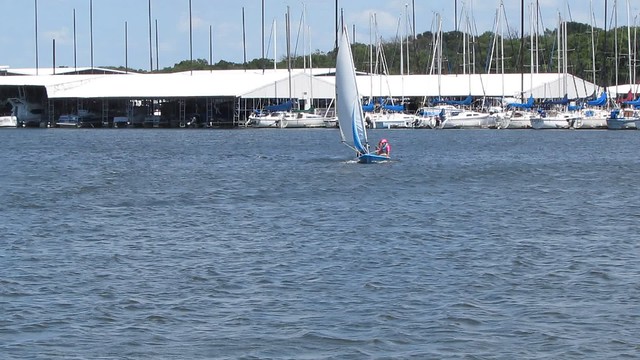
Olivia_Arriving

Thursday, June 9, 2016

The Widened Panama Canal -- June 9, 2016

Bloomberg is reporting:
Panama said it expects 20 million tons of liquefied natural gas to pass through its canal annually once the newly widened waterway is opened this month. That’s almost a tanker of gas a day traveling through, based on Bloomberg calculations.

“The canal opens the possibility for that gas to reach Asian markets in a more competitive way because the Panama Canal route is the shortest,” said Manuel Benitez, deputy administrator of canal authority, in an interview in Panama City on Wednesday. “We’ve already seen that many very large gas carriers have already made reservations.”

The $5.3 billion expansion to the canal is set to be inaugurated June 26, allowing it to handle the kind of massive tankers that transport liquefied natural gas. Its debut is fortuitous for U.S. gas producers as the shale boom has sent domestic supplies surging and drillers are looking to get their fuel to markets abroad.

The expanded canal will help U.S. gas producers by cutting the shipping time to markets in Asia, according to Skip Aylesworth, who manages $1.5 billion in holdings at Hennessy Funds in Boston, and who holds shares in LNG producer Cheniere Energy.
20 million tons of LNG converts to 168 million boe. 

Sunday, June 5, 2016

Light Ends / Light Ends Space-- A New Term (At Least For Me) -- June 5, 2016

Updates

June 12, 2016: this is pretty cool. As noted below, when I googled this term just a few days ago there were five hits. Today, googling "light-ends oil" there were 131,000 hits. Of the 131,000 hits, my post was #14, near the top of the second page. Whoopee. 

 
Original Post
 
There is an incredible amount of information in this paper. I've read the introduction and the conclusion; scanned the information in between. The information "in between" will remain a great reference. 

This link takes you to a "working paper" out of Rice University's Baker Institute for Public Policy, titled "Childhood's End: Developing Asian Giants and the Future of Global Oil Demand." It is dated 2016. A quick look at the paper suggests that Prince Salman is thinking along the same lines.

However, there is a new term -- that's probably been around for decades -- but I just stumbled across it and will come back to it later.

The term is "light ends" or "light ends space." A google search "'light ends space' oil 'natural gas'" led to only five hits, and one of them was a "linked in" hit.

By the way, this subject ("light ends space") and the "working paper" linked above seem, at first glance, to dovetail well with the very astute observation made by Don regarding "gasoline production" numbers, which is noted at length in the "update" at this post. 

Wow, if I miss one day of blogging, I fall behind.

**************************************
A New Term
The link above takes you to a linked "working document" authored by Al Troner. His thesis/article is featured in this month's issue of the Oil & Gas Journal, which requires a subscription. [Update: it looks like one can get to the entire article by googling "'light ends' oil". Here's the link: http://www.ogj.com/articles/print/volume-114/issue-6/general-interest/surge-in-ngl-and-tight-oil-supplies-creates-worldwide-light-ends-space.html.]

Putting "2" and "2" together, it appears that Al Troner, Asia Pacific Energy Consulting, Houston, has not necessarily coined a new term but will do much to put it the term in the everyday lexicon of those of us who follow the oil and gas industry.

I'm pretty jazzed, to say the least, to have come across this. It will be interesting to see where this leads.

The article begins:
While many analysts agree that oversupply, rather than weak demand, led to the current slump in the price of crude oil, few have looked closely at the nature of that supply overhang.
In a new study, Asia Pacific Energy Consulting (APEC) has examined in depth the role of NGLs, in particular condensate, in creating the current surplus, as well as the impact of tight oil and its light derivatives. The condensate, other NGLS (LPG and ethane), light products, and tight oil yeilding much of the new light-product supply all occupy the same light segment of the hydrocarbon spectrum.
The shale revolution has spurred a ballooning of NGL output, paralleled by dizzying growth in tight oil production. Almost all of this incremental liquids production has been light and sweet. The growing volume of this material, with incremental supply in the millions of barrels per day, has begun to shift pricing, trade, marketing, and supply-demand balances for crude -- light-heavy vs sweet-sour --- and in our products, with notable supply gains in LPG, gasoline, and naphtha in contrast to middle-barrel and heavy products.
A "light-ends space" is emerging, not only in the US and the Atlantic Bais but also globally, as markets attempt to adjust to this surge in light, low-sulfur hydrocarbon supply.
**************************************
A New Term: Light-Ends Space
NGLs: Definition

The article focused on the role of condensate as the spearhead creating the light-ends space.

Why? Because condensate is the only NGL that does not need specialized containment and that, when refined, yields a full range of products, from LPG to residual.

Where? Bakken, Eagle Ford, and the Permian.

Facts about condensate:
  • once condensate becomes a liquid, it remains a liquid
  • in a refinery or condensate splitter, it acts much like crude in the slate
  • often confused with light, sweet crude oil but it has distinctive characteristics
  • unlike crude oil, condensate always originates with gas, whether nonassociated or associated
  • whole condensate almost always yields more than 50% naphtha; and is almost always quite clean, low not only in sulfur but also in metals and acid
  • condensates are exceptionally clear, most containing 0.3% sulfur or less
More facts about condensate:
  • most observers try to define condensate by setting an arbitrary API gravity breakpoint
  • in the US commonly 45 degrees API
  • international trade, usually 50 degrees API
But rules are made to be broken
  • there are some crude condensates well above 50 degrees API; e.g., Saudi Arabia's Super Light and Australia's Laminaria
  • there are some crude condensates below 50 degrees API; e.g., Kazakhstan's Karachaganak and Nigerian Oso
  • in definition, what constitutes condensate, API gravity is only a general indicator, not an exact test of what is condensate and what is crude
Bottom line: what makes a condensate a condensate
  • always originates in gas
  • almost always yields 50%+ naphtha
  • is exceptionally sweet
  • contains little if any metals
  • produces little residual oil
  • a crude and condensate can have exactly the same API gravity but the condensate will always yield far more naphtha and far less fuel oil
The US and condensates?
  • the US has emerged as a major NGL power due to the shale revolution
  • despite recent events (2016), overall NGL output will continue to rise despite declining condensate volumes produced with tight oil (EIA)
Why?
  • NGLs are caught in a twilight zone: NGLs come from both the crude and gas sides of total production
  • while condensate has been the most prominent NGL derived from gas produced in association with tight oil, plays such as the Eagle Ford shale; Permian basins also have produced sizable volumes of LPG and even commercial volumes of ethane
  • yet NGLs also come from primarily non-associated gas production as well, such as the Marcellus and Utica shales
*****************************
Notes From a Working Paper

Six chapters:
  • Chapter 1: Introduction
  • Chapter 2: Asia Pacific Demand Growth: Demand Growth by Sector
  • Chapter 3: Recent Developments in Middle-Distillate Retail Price Subsidies
  • Chapter 4: Asia Pacific: Comparing Light-Ends and Middle Distillate Growth
  • Chapter 5: Product Quality Premiums
  • Chapter 6: Conclusion
Chapter 1, Thesis: 
  • Asia Pacific will remain the engine of world oil demand growth
  • but future growth will be at a lower rate of expansion
  • in addition, future demand will shift away from mid-barrel to light-ends products, such as LPG, gasoline, and naphtha
  • bad news: US oil exporters will not get the growth they saw 1990 - 2000, or even 2000 - 2010
  • Asia has begun to exhibit characteristics of more mature economies
  • good news: Asia Pacific will likely continue to lead world oil demand growth for the remainder of this decade and the next (through 2030)
  • the growth will be greatest in the light end of the barrel
  • the working paper focuses on China, India, and Indonesia
Chapter 1.  Introduction

Sections A - H: 
  • historical review
Section I: US exports -- a natural fit. 
  • the growing Asian demand for light ends has coincided with the shale revolution in the UNITED States and a massive influx of sweet, light crude and NGLs onto the US market. With a crude export ban n place, the US had to focus on exporting light refined products and NGLs. 
  • But, since late December 2015, the paradigm has shifted.
  • Asia Pacific wants to end dependence on Mideast; long term trend: North America will compete with Mideast for demand growth in Asia Pacific
  • US West Coast geographically closer to Asia Pacific
  • but US Gulf Coast has a substantial edge in almost every other export factor: 
    • relatively easy permitting process for building infrastructure; 
    • a greater number of sophisticated refineries with more capacity
    • proximity to two of the three largest tight oil basins: Eagle Ford and the Permian
  • the Panama Canal serves as an enabler -- it puts the USGC close enough to compete with Mideast sales on the basis of different price formulae
  • the author talks about the Panama Canal, saying the same thing RBN Energy has already talked about: the revamped canal will allow transit of all LNG tankers, except the two largest, the Q-Max and the Q-Flex; in other words, the Panama Canal can handle 90% of the world's LNG fleet
  • the canal's expansion will be finished in 2017; already talking about further expansion
Section J: Export Opportunities  
  • lower growth
  • light-ends focus
  • Panama Canal changes everything
  • powered by the shale revolution -- and an easing of export regulations -- NGL producers responded quickly to marketing in Asia
Section K: Linked Lines of Query
  • overall demand growth; changes in sector use
  • deregulation and retain subsidies; impact of mid-distillate demand growth
  • for Asia Pacific, it's all about naphtha; Asia is structurally depended on naphtha imports
  • price deregulation has accelerated the use of light product over middle distillates; most fully achieved in Indonesia; to a lesser extent in Thailand, Malaysia, and Vietnam; we will know more about India by the end of the year; Asia Pacific is switching from diesel to gasoline; naphtha will dominate the petrochemical feedstock supply but naphtha is also required as the basestock for gasoline manufacturing
  • future comparative growth rates
  • impact of product quality in maturing Asian economies
Chapter 2. Asia Pacific Demand Gowth: Demand Growth by Sector
A. Asia Pacific
1. Basic Parameters of Demand 
2. Demand Trends by Product & Sector: this is a very, very interesting section; the author talks about a breakout point, "when expanding middle class incomes all for the possibility of acquiring private transport." This has recently been discussed on the blog. A reader personally noted this in India. 
B. Developing Asia
1. China: section on gasoline demand is very, very interesting
2. India: 
3. Indonesia:
C. NIC/Near-NIC Asia
1. Taiwan
2. Singapore
3. Hong Kong -- China, Special Administrative Region (SAR)
D. OECD Asia Pacific
1. Japan
2. South Korea
Chapter 3. Recent Developments in Middle-Distillate Retail Price Subsidies
A. China
1. EIA viewpoint
2. Managed float; indirect subsidies?
3. The 2013 reforms
4. Free market fears
5. Lagging prices; refinery investment
6. Guaranteed margins; pass-on
7. Consumption taxes/value added tax (VAT)
8. Last word
B. India
1. Gas oil / diesel vs gasoline subsidies
2. The burden
3. A look at LPG
4. Kerosene corundum (sic)
5. Taxes
C. Indonesia
1. Subsidy reform
2. The reform program
3. Pending reforms
D. Survey of other major gas oil / diesel market countries
1. Malaysia
2. Thailand
Chapter 4. Asia Pacific: Comparing Light-Ends and Middle Distillate Growth

A. Analysis Drivers -- Light-End Products
1. LPG
2. Gasoline
3. Naphtha
B. Analysis Drivers -- Mid-Barrel Products
1. Kerosene
2. Gas oil / ADO
C. Forecast/Outlook - By sector: Demand Giants vs West
1. Sector focus on transport and petrochemicals
2. Comparison of Growth Rates in OECD vs NIC/Near NIC vs Developing Asia Giants
3. What prospects should US exporters watch for?
Chapter 5. Product Quality Premiums

A. The Nature of tightening product specifications: One-directional, progressively cumulative, and irreversible 
B. Product premiums yet to justify high-cost, high-quality investment -- why?
1. Quality and refining
2. Quality and gas-to-liquids (GTL) plants
C. How long will it take for maturing developing Asia quality standards to catch up with OECD and NIC levels?
D. What marketing parameters should US exporters follow in selling products based on quality?
Chapter 6. Conclusions