Showing posts with label Saudi_US_Imports. Show all posts

Tuesday, June 29, 2021

US Supreme Court Rules In Favor Of PennEast Pipeline -- June 29, 2021

Pipelines: US Supreme Court sides with PennEast regarding eminent domain and pipelines. Link here. 

Ruling leaves in place longstanding pipeline routing practices. Pipelines had feared state veto power on condemnation. Google the blog for occasional notes regarding PennEast. Also, link here. Note how close this vote was: one judge could have overturned this.

The court ruled 5 - 4 that a pipeline company can use federal eminent domain authority to build a line across state-owned land and private lands where easements have been granted by states. This suggests that states can't have it both ways: an easement for a state-approved pipeline but not a permit for a federally permitted pipeline using the same easement.

 ******************************
No Deal
Saudi - Sempra - Port Arthur

See "Saudi Arabia in transition" from yesterday, June 28, 2021.

Today, over at SeekingAlpha, "Sempra, Saudi Aramco unable to seal deal tied to Port Arthur LNG." Also here.

That explains why this:

********************************
The Yolk's On Goober

Link here. 

Wednesday, May 5, 2021

US Crude Oil Imports -- Another Look -- May 5, 2021

Observations:

  • the US now imports more oil from Russia than from Saudi Arabia:
  • Saudi oil goes to west coast; Russia oil goes to east coast
  • of the nine primary sources of US imported oil, all showed a decreased except for three:
  • Ecuador
  • Colombia
  • Russia
  • of the nine primary sources of US imported oil, Saudi Arabia is now in 6th place, behind two small South American countries
  • on a percentage basis, it looks like Iraq took the biggest hit except for Brazil which went to "zero"
  • Mexico took a pretty big hit, also

One could argue:

  • Saudi Arabia is now (and always has been) energy dependent;
  • the US is energy independent -- and the gap is widening (in a good way)

 From social media;


Tuesday, November 3, 2020

OPEC In Deep Doo-Doo -- Aramco's Profit Plunges -- November 3, 2020

I don't know when I first saw it coming. Certainly it was by 2016. But OPEC is in deep doo-doo and the House of Saud is in extremis. 

Data points:

  • 3Q20:
    • Saudi Aramco's net profit slightly less than $12 billion;
    • net profit down almost 45% y/y;
    • free cash flow: $12.4 billion
    • forced to pay a dividend of almost $20 billion for the quarter
  • first nine months of the calendar year:
    • net profit down almost 50%;
    • net profit down to $35 billion;
    • average production: 9.2 million bpd;
  • most interesting:
    • the $75 billion dividend paid by Saudi Aramco will not be able to cover Saudi's budget deficit;
    • the House of Saud won't be able to plug its deficit with the Aramco dividend as it did last year; 
  • tea leaves: 
  • Aramco:
    • its own budget commitments;
    • must meet requirements to buy petrochemicals giant SABIC
  • future? prices are too weak for OPEC to relax production cuts by another two million bopd next January
  • could it get worse? Yup. A Biden presidency.
    • the Biden wing supports Iran
    • sanctions on Iran will be lifted on humanitarian grounds
    • huge hit for Saudi Arabia when Iran gets back into the market

Link to Charles Kennedy.

Aramco reported a net profit of $11.8 billion for the third quarter of 2020, down by 44.6 percent on the year as low oil prices continued to bite into its financial performance.

The company also said it had free cash flow of $12.4 billion at the end of the three-month period and declared a dividend of $18.75 billion for the quarter.

For the first nine months of the year, the hit from low oil prices and depressed demand was stronger. Net profit was down by close to 49 percent to $35.015 billion.

In oil production, the Saudi major reported an average daily of 9.2 million bpd for the first nine months of the year as it continued capping output in compliance with the OPEC+ agreement.

Earlier this year, Aramco declared an annual dividend of $75 billion. That amount, however, will not be sufficient to cover the Saudi budget deficit, Moody’s said in a report last month. Now, with oil prices still low and likely to go lower still if the surge in Covid-19 cases continues in Europe and the United States, Aramco’s earnings will take a bigger hit.

This means that the government in Riyadh will not be able to plug the budget hole with the Aramco dividend as it has done previously.

“The government is unlikely to be able to repeat the maneuver beyond 2021,” Moody’s said in the report. Aramco will have its own capital expenditure needs and its commitment to buy petrochemicals giant SABIC to look after, according to the ratings agency.

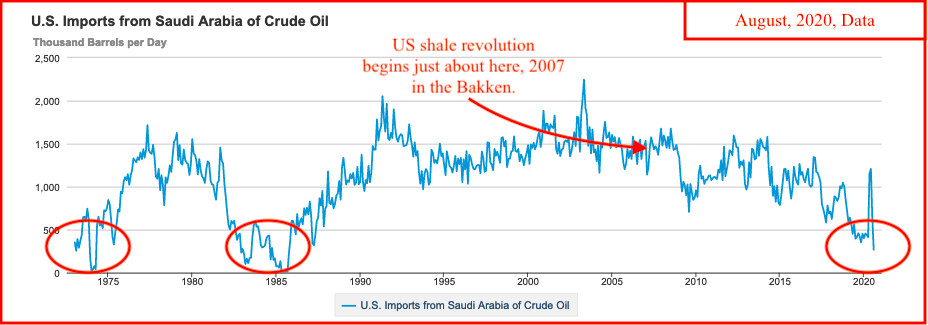
US crude oil imports from Saudi Arabia: huge plunge, not since the 1980s have we seen numbers this low. 
From the "milliondollarway" archives:

This might be good time to re-read this interesting story in Foreign Policy, May 5, 2020; still not behind a paywall; the writer of that article: Jason Bordoff, a former senior director on the staff of the US National Security Council and special assistant to President Barack Obama ... I first linked this article in September, 2020. It will be interesting to see how this plays out.

Saturday, October 31, 2020

Notes From All Over -- The Mideast Edition -- Saturday Morning -- October 31, 2020

Striking graphs this morning. Where do we begin? 

Saudi Arabia's foreign exchange reserves: drop again. I believe this converts to about $453 billion.

From al Khaleej Today:

US crude oil imports from Saudi Arabia: huge plunge, not since the 1980s have we seen numbers this low. 

From the "milliondollarway" archives:

This might be good time to re-read this interesting story in Foreign Policy, May 5, 2020; still not behind a paywall; the writer of that article: Jason Bordoff, a former senior director on the staff of the US National Security Council and special assistant to President Barack Obama ... I first linked this article in September, 2020. It will be interesting to see how this plays out. 

***************************************
Most Under-Reported International Story: Turkey

Turkish lira hits yet another record low, pushing as 8 lira to the dollar -- CNBC;

  • The lira’s value has fallen by nearly 20% year-to-date and halved since the end of 2017. 
  • At the start of 2018, a dollar bought just 3.77 lira; now analysts predict that figure will hit 8.5 or even 9. 
  • Erdogan has previously defended his economic record and in September called interest rates the “tools of his enemies.” 
  • Over the summer he downplayed the lira’s slide, calling it “temporary.” 
  •  Erdogan on Monday urged Turks to boycott French goods after the country projected satirical cartoons of the Prophet Muhammad on government buildings in Paris to protest a recent terrorist attack.

Earlier in October, again CNBC: the Turkish lira is getting smoked; will crash to new lows;

  • Turkey’s embattled currency hit another record low on Thursday, touching 7.95 to the dollar as it barrels toward an unprecedented 8 lira to the greenback.
  • Economic analysts have expressed exasperation for the past several weeks at the policy decisions coming from Ankara, arguing that the currency’s troubles are self-inflicted.   
  • For perspective, a dollar bought just 3.77 lira at the start of 2018. Now analysts predict that figure will hit 8.5. 

As if that weren't bad enough, Saudi is now calling for boycott of "everything Turkish." Not yet official policy but one would think political statements coming out of Saudi Arabia are tightly controlled, sanctioned.  

**********************************
The Only Thing Red, Mr Putin, Is Your Ruble

Earlier this month, Vladimir Putin, when asked about the Bakken, simply stated that the color of water in North Dakota was the color of the red wine in the glass he was holding. I have no idea what he meant by that. Lost in translation. 

On the other hand, not lost in translation: the Russian ruble had a painful week, ended the week in the red. I doubt the ruble felt anything at all. Perhaps Russian investors and bankers felt something, but I doubt the ruble actually felt anything. 

********************************
The US Has Its Mayo Clinic, The Mideast Has Hadassah

Link here. The article is there; it may be a bit hard to find initially with the large ad asking for donations, etc., but if you actually stick it out and get to the article, it's very interesting. My hunch: it's only news to those living outside the Mideast. 

***********************************
Geo-Politics

Let's assume Joe Biden wins the presidency. 

I think I read recently that President Trump is the only American president, or maybe the only American president in modern times, that has not gotten the US into another war. 

It sounds accurate to me. 

If accurate, one has to ask why?

Generally, the US gets into a war in reaction to something else. 

To not get into a new war, one might suggest there has been no conflict overseas that grew big enough for attention by the US. 

But think about it. Not one major military operation by this president. No wonder his "past" generals did not support him. [Yes, I saw the political commercials on television. No matter how hard I try to avoid these things they invariably show up, generally during NFL football games.]

But I digress.

One has to ask why there have been no conflicts that grew big enough for attention by the US. Why didn't China and Taiwan become a bigger story? What happened to North Korea? What happened to Syria and Iran? What happened to Yemen? Israel, Palestine?

One answer: the US president is predictably unpredictable. Similar to Ronald Reagan. 

Now, let's assume Joe Biden wins the presidency.

Unlike President Trump, Joe Biden:

  • has no overarching geo-political compass, unless it's money;
  • will be very, very slow to react to developing situations around the world;
  • will become entirely predictable, at least in the eyes of our adversaries;

After surfing through the international news today and imagining Joe Biden as president, the only question I have: will the first military conflict involving a major US response occur in late 2021, or 2022?

The Mideast is a huge powder keg and I think the regimes are waiting for the outcome of the US presidential election before taking their next step. 

*********************************
Let Me Guess

But we end on this note. Something tells me the world won't miss him.

Prince Azim of Brunei dead at age 38. Cause of death unknown. 

Only details we know:

  • billionaire
  • playboy
  • lived at the family's London mansion in Kensington Palace Gardens

My hunch: Jeffrey Epstein was not directly involved.

Thursday, April 30, 2020

US Crude Oil Imports -- February, 2020, Data

Saudi: data just released / posted today, April 30, 2020 -- link here. In thousands of bbls per day, Saudi Arabian crude oil imports, US.


All: data just released / posted today, April 30, 2020 -- link here. In thousands of bbls per day, all crude oil imports, US.


******************************************
Getting Ready For Summer

How to grill a steak by master chef Robert Del Grande:


Friday, March 8, 2019

US Imports From Saudi Arabia of Crude Oil -- EIA -- December, 2018, Data Released Today

Saudi crude oil exports to US: link here. Monthly data released today:


The average for the previous eleven months this year: 871,000 bopd.

December (most recent month for which data is posted): 842,000 bopd

Previous eleven Decembers: 951,000 bopd.

December, 2018: most recent month for which data is posted: 842,000 bopd.

A lot of talk about how much Saudi Arabian exports to US have declined, but in the big scheme of things, not that remarkable so far. Also, the US needs heavy oil which they used to get from Venezuela; Saudi Arabia is said to be taking advantage of the loss of Venezuela heavy oil, but again, so far, not particularly remarkable.


Friday, August 31, 2018

Not Out Of The Woods Yet -- Saudi Foreign Exchange Reserves Decline -- Saudi-US Oil Imports -- August 31, 2018

Link here. Not out of the woods yet. After turning around in April - June, 2018, Saudi's reserves fell significantly in July despite robust oil prices:

Link here.


Wednesday, August 15, 2018

Crude Oil Imports And Saudi Arabia -- August 15, 2018

Updates

Later, 9:14 p.m. CDT: see this article from oilprice -- a screenshot of that headline is here. Has anyone asked whether Iranian oil is light, heavy, or both? That could make a big difference.
WTI is a light crude oil, with an API gravity of around 39.6 and specific gravity of about 0.827, which is lighter than Brent crude. It contains about 0.24% sulfur thus is rated as a sweet crude oil (having less than 0.5% sulfur), sweeter than Brent which has 0.37% sulfur.
Iranian oil:
  • light: 33.6 (heavier than WTI); with a sulfur content of 1.46%, would be considered sour
  • heavy: 29.6; with a sulfur content of 2.24%, definitely sour
I'm getting way out in front of my headlights, but this may be interesting. The world's largest consumer of oil (by far): the refineries along the Gulf Coast are optimized for heavy oil. As US refiners maintain/increase production, they will have plenty of light oil, but they need heavy oil. If Iran is a major source of global heavy oil, that changes the equation. I have consistently said that Iran's production does not matter (all that much).

But after seeing the weekly petroleum data today, I'm beginning to wonder if I might be missing something. The data points, again that caught my attention:
  • refiners are operating at 98.1% capacity; I don't recall a higher number
  • US crude oil inventories (light oil, I imagine) increased a whopping amount, almost 7 million bbls, a build/an increase rarely seen in the past three years
  • at the same time, the US appears to be importing "near-record" amounts of oil (heavy oil, I imagine)
For a discussion of this data -- US refiners, heavy oil, light oil, imports, etc., see the original post.

Maybe the oilprice article is onto something. Again, like all articles, this article does not differentiate between heavy and light oil.

From the oilprice article, some data points making a case for higher-priced oil:
  • some ultra-bullish hedge funds think that the US sanctions will remove much more than one million bopd
  • some think as much as two million bopd could be taken off the market
  • one ultra-bullish hedge fund suggests that OPEC "has the lowest spare capacity ever right now"
  • that hedge fund suggests $150 in less than two years (18 months to 2 years)
  • Iran's oil exports peaked in April this year at 2.7 million bopd; has been dropping every month since
  • Bank of America Merrill Lynch: total cut-off of Iranian exports would lead to a price spike above $120/bbl
I'm not convinced that taking 1 - 2 million bbls of "oil" off the global market will make any difference. HOWEVER, taking 1 - 2 million bbls of "heavy oil" off the global market -- after what I saw in the weekly petroleum data today -- makes me think the ultra-bullish hedge funds may be correct -- but if they turn out to be right, they were right because they knew the heavy oil/light oil angle and held that close to their chest; or they did not know that and will simply be lucky.

I'm still not convinced, but it is interesting.

On another note: the 2020 rule that sea-going tankers must move to sulfur-free fuel suggests that Iran could be hit hard -- having sour oil -- as far as I can tell. There are several Iranian gradesa nd I only looked at two of them .... 

The biggest problem I have with the article: this statement without providing support for this statement: "... all-time low spare capacity ..." From the article:
According to Pierre Andurand, who manages the US$1.2-billion Andurand Commodities Fund, the world’s spare capacity is at its lowest ever, and this will be a real issue with global oil supply.
What is the basis of that statement? It's been my impression that experts have been arguing "spare capacity" for quite some time.

Original Post 

This is a blurb I posted earlier following the release of the weekly petroleum report today. See this post also.

Imports? up a huge amount -- up by over one million bbls -- total imports right at 9.0 million bbls -- I haven't seen an increase this big in quite some time; what gives?

Quick: how much oil does the US produce? Somewhere between 10 and 11 million bopd.

So, the US is importing almost as much heavy oil as the amount of light oil that we are producing.
  • over the past four weeks, crude oil imports averaged about 8.1 million bopd, almost 1% more than the same four-week period last year; why? 
  • why? of course, the report doesn't say why, but this is what I think is going on -- US refineries are optimized for heavy oil; the US produces almost exclusively light oil (how did this happen? President Obama can tell you, but I digress); 
  • the refineries are operating at 98.1% capacity; that's a lot of oil -- a lot of light oil, but they need heavy oil to balance out the barbell -- the mix of heavy oil / light oil that the refineries-optimized-for-heavy-oil can actually refine
  • there are reports that we are back to exporting "record" amounts of oil from Saudi Arabia; why? we need their heavy oil, now that we can't get enough heavy oil from Canada (Keystone XL killed by President Obama); Venezuela is imploding
  • irony: President Obama's staff favored Iran; hated Saudi Arabia; tried to change the balance of power in the Mideast -- Saudi Arabia vs Iran; not only does Trump put the original sanctions back on Iran, but due to the aborted Keystone XL, Saudi Arabia comes back the winner -- and in an era of "lower prices longer," Saudi Arabia needs all the markets it can get
Anyway, that's my two cents worth. That and fifty cents will get you a senior cup of coffee.

By the way, this might also explain the huge growth in US crude oil inventories. The refineries are operating at 98.1% capacity but they don't need more light oil from the Permian or the Eagle Ford or the Bakken; they need more heavy oil overseas.

**************************************
Foot In Mouth Disease Is Contagious
Governor Cuoma Caught It from President Obama

First, we had President Obama telling successful businesswomen that "they didn't make that.

Now, we have President-wanna-be Cuomo telling us the US was never that great to begin with:

Wednesday, August 1, 2018

Just Released: Saudi Arabie Foreign Exchange Reserves For June, 2018

Link here.


US crude oil imports from Saudi Arabia, 1,000's bbls/day -- so about 875,000 bopd (link here):


Big speakers. Loud.

So Far Away (From Me), Dire Straits

Thursday, July 12, 2018

Wow! A Lot Packed Into This "Oilprice.Com" Screenshot -- July 12, 2018

Updates

Later, 6:39 p. CDT: See first comment:
Gasoline output from our refineries rose by 388,000 barrels per day to a record high of 10,699,000 barrels per day during the week ending July 6th, while
gasoline product supplied fell by 594,000 barrels per day...
AND
our exports of gasoline rose by 699,000 barrels per day to 1,186,000 barrels per day....
Now, I can see us exporting light sweet crude on one hand, and importing sour crude that refineries are optimized for on the other, but gasoline is gasoline, no? so why are we exporting so much overseas that we have to import it from the Saudis?
Original Post


1. Saudi Arabia exporting gasoline to the US. First time ever. Apparently. Remember all those stories that Saudi Arabia was increasing production. This is one reason why: Prince Salman is increasing refining in his own country. Domestically, he needs more production. The other reason for increasing production recently: it's summer in Saudi Arabia and Saudi always increases production in the summer (all things being equal) to produce electricity for air conditioning.

2. WTI has dropped below $70. WTI is priced at Cushing. Must be excess of WTI at Cushing. "Every" oil is down "at the moment," except a slight rise in Brent -- I believe there's a "worker's strike" in the North Sea.

3. But look at that Iranian story: if accurate, Iran's gasoline imports dropped 36% year-over-year. Link here. Apparently this is due to the fact that Iran has brought a huge new refinery on line -- in prepartin for sanctions?
Iran imported 36 percent less gasoline than a year earlier during the first quarter of the Iranian year beginning on March 21 in what may well be a signal the country is shoring up its domestic supply as the start of U.S. sanctions draw near.
Iranian media quoted the managing director of the National Iranian Oil Products Distribution Company as saying that the average daily gasoline imports stood at 5.7 million liters during the first quarter. State news agency IRNA separately reported that the import decline was linked to the start of gasoline production at a new refinery, the Persian Gulf Star Refinery.
A senior executive from NIOPDC’s parent company said Iran imported an average 13 million liters daily of gasoline during the first half of Iranian 2017, but by the last quarter of that year, this had slumped to about 5 million liters daily.
4. The trope continues: "high US gasoline prices and US gasoline prices are increasing."

Friday, March 30, 2018

US Saudi Crude Oil Imports Hit 32-Year Low For Month Of January -- Have To Go All The Way Back To 1986 -- March 30, 2018

Link here. And the difference between January, 2017, and January, 2018, is not subtle. Ouch.


Meanwhile, US crude oil exports hit an all-time high for the month of January, going back to when records were first kept. Link here.


"Drill, baby, drill." Making American great again.

Spot price of WTI (at Cushing), rounded, link here:
  • end of March, 2018: a "solid" $65
  • end of March, 2017 (one year ago): a "less than solid" $50; closer to $47 - $49 
That's really quite remarkable. 15/50 = a 30% jump. And many operators have been able to cut costs over the past year. If oil companies were "evaluated" like analysts "evaluate" Tesla, we would all be gazillionaires.