Showing posts with label NGL_Processing. Show all posts

Thursday, December 3, 2020

ONEOK Seeks To Expand Pipeline Capacity Near Halliday, Dunn County -- December 3, 2020

It's possible this has been posted earlier but do not remember. Regardless, I would rather report a second time than miss something.

From a reader, who alerted me to this story: ONEOK seeks to expand a NGL pipeline that connects to its Bear Creek gas processing plant near Halliday in Dunn County.

Data points:

  • wants to add two pump stations
  • currently carries up to 15, 000 bpd
  • expansion would permit up to 80,000 bpd
  • one pump: on a 5-acre parcel of land eight miles southeast of Watford City
  • second pump: on a 7-acre parcel of land 18 miles northwest of Killdeer
  • pipeline: 38 miles long; built in 2016;
  • no change in maximum operating pressure;
  • NGLs ultimately be shipped via ONEOK's Bakken and Elk Creek pipelines, from eastern MT to Kansas
  • this expansion is separate from a planned expansion of the Bear Creek processing plant

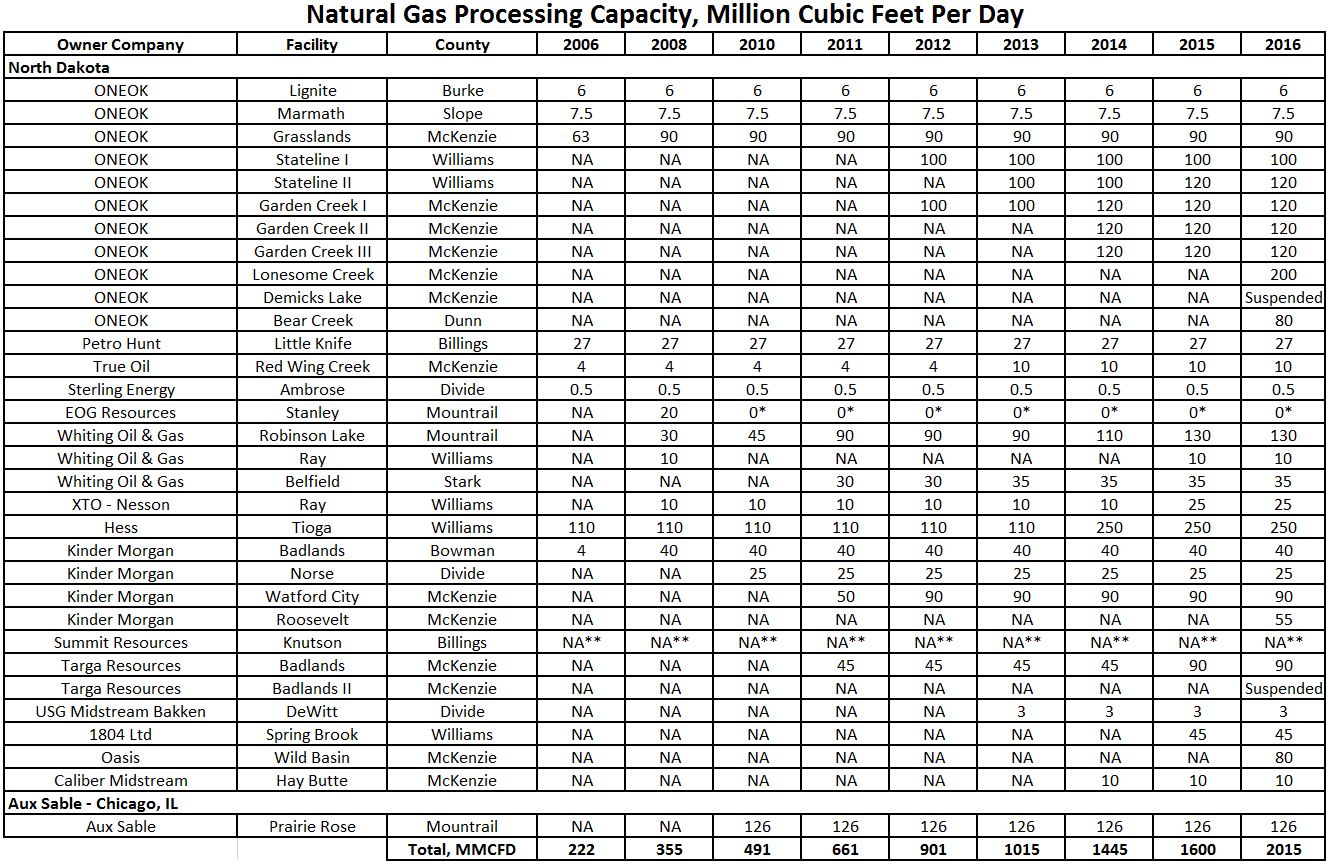
Natural gas processing plants in North Dakota are tracked here.

******************************
Elf On A Shelf

With Sophia's favorite salty snack. 

Saturday, July 4, 2020

Update On The Bill Sanderson Gas Plant West Of Williston -- July 4, 2020

Updates

January 14, 2012: Bill Sanderson completed; ready to go on line.

Original Post 

Link here: plans moving ahead for Bill Sanderson gas plant.

A company that’s building a gas plant to service XTO crude oil production is asking the state for an expedited process for two proposed pipelines that will provide takeaway for the Bill Sanderson Gas Plant in Williams County.
Denver-based OE2 North is proposing to lay two pipelines for the plant that is being built 15 miles west of Williston. One, an 8-inch steel pipeline 1.28 miles in length will carry up to 80,000 barrels per day of NGLs. The other, 4.67-mile, 20-inch steel pipeline will carry up to 250 million cubic feet per day of residue gas. The cost of the two pipelines is an estimated $6 million.
OE2 in its application materials said it will construct both pipelines on privately owned land, for which the company has already acquired rights of way.
The lines will also be co-located for approximately the first mile, at which point the 8-inch NGL line will tie into an existing, third-party pipeline. The second line, a 20-inch residue gas pipeline, will continue another 3.39 miles along existing infrastructure before tying into an existing third-party pipeline.
Above-ground facilities will include a 100- by 100-foot interconnect site at the end of the 8-inch NGL line and a 250- by 250-foot interconnect at the end of the 20-inch residue line, as well as pipeline markers and cathodic test stations along the way.
The lines will not require any compressor stations. Pressure from the associated Bill Sanderson Gas Plant will be adequate for the projected flow rates.
The pipes will be pre-coated with a fusion-bonded epoxy external coating for corrosion protection, and all welds will be nondestructively tested to ensure their structural integrity and compliance with applicable USDOT regulations. Each weld will be externally coated for corrosion resistance.
OE2 hoped to begin construction of the pipelines by July 2020, or after all necessary permits and approvals are in hand. Construction will take about 12 weeks, including backfilling and finish grading.
Much more at the link.

This is a different pipeline discussion than the one at this link.

Back to the Bill Sanderson Gas Processing Plant.
North Dakota natural gas processing plants are tracked here. It appears the Bill Sanderson plant will be the third largest in the Bakken. Hess still has the largest at "425" and Oasis has one at "320."

********************************
Age Range Fact-Checked By The NY Times

 
*********************************
The Virus That Came Out At Night

Among all the other peculiarities of the corona virus, it appears we have discovered another one. The corona virus apparently is most active at night.

Is it possible the virus is carried by mosquitoes?

The following notice was sent out to all residents by our apartment complex manager this past week. Yes, we have "trash valet / front-door pick-up" service. What a great country.


Government-mandated curfews due to Corona virus -- great excuse to shut down protestors. LOL.

Thursday, January 23, 2020

Comparing The New EPD Cryogenic Processing Plant In East Texas With That Proposed For Williams County -- January 23, 2020

We talked about this yesterday: infrastructure build-out starting to show dividends. Now this, from Rigzone: Enterprise starts gas processing at its new Bulldog cryogenic natural gas processing plant in Panola County, Texas. Data points:
  • 200 million cubic feet per day of natural gas
  • can extract up to 12,0000 bbls/day of natural gas liquids
  • combined with its existing Panola cryogenic facility:
    • 320 MMcf/d and 18,000 bpd of NGLs within the region
So, let's compare this with the Outrigger-XOM facility proposed for Williams County:
Outrigger Energy II LLC announced today that it has entered into a long-term definitive gas gathering and processing agreement with XTO Energy, Inc. to service XTO’s production in Williams County, ND.
The gathering system will comprise a 70-mile, 20- and 24-inch diameter, rich gas pipeline originating in eastern Williams County and terminating at a new 250 MMcfd cryogenic gas processing plant located west of Williston, ND. 
Plans are also underway for a plant expansion of up to an additional 200 MMcfd, for total gas processing capacity of 450 MMcfd.

Thursday, July 5, 2018

Brits Like Higher-CO2 Gasoline More Than Diesel, T+35 -- July 5, 2018

From The Financial Times, do as I say, not as I do:
UK sales of new diesel cars fell by 30 per cent in the first six months of this year, as buyers shunned the once-dominant fuel in favour of higher-CO2 petrol. 
Diesel sales fell to 428,612 between January and June, compared to 613,985 in the same period a year earlier. 
Petrol sales climbed 11 per cent to 812,535, taking the fuel’s market share to 61.8 per cent, compared to 52 per cent a year earlier. 
Total UK car sales over the six months fell 6.3 per cent to 1.3m, as the market declined following years of strong growth. Sales in June slipped by 3.5 per cent, despite sales of new cars across Europe rising in the same month.
Chevron-exit?  Chevron getting ready to exit all UK central North Sea assets? Link and data points:
Chevron's presence in the U.K. North Sea spans more than 50 years, according to the company’s website, which highlights that on December 26, 1964, Chevron's joint venture operator Amoseas (American Overseas Petroleum Ltd.) drilled its first North Sea well, 165 miles offshore the United Kingdom.
And now it's leaving. 
Enbridge-exit? Enbridge agrees to sell its Canadian natural gas gathering and processing business
19 natural gas processing plants and liquids handling facilities --
  • total capacity 3.3 billion cf/day
  • 3,550 km of natural gas gathering pipelines
Nineteen gas processing plants. Sounds like a lot. But the state of North Dakota, alone, has about 34 NG processing plants and by 2020 will have a total capacity of almostt 3 billion cf/day
The North Dakota Pipeline Authority tracks the natural gas plants in North Dakota. Link here: https://northdakotapipelines.com/gas-plants/.
California spot prices for electricity will spike today, link here:


NYC: that heat wave?


Saturday, January 6, 2018

Re-Look At "Y Grade" Out Of The Bakken -- January 6, 2018

The other day a reader updated the spot price of "Y grade" products:

 Today's spot pricing at Belvieu, expressed in barrels ...
  • Ethane ~$11/bbl.
  • Propane ~ $40/bbl
  • Butane ~ $42/bbl
  • Pentanes ~ $58/bbl
There have been many, many posts on "Y grade" products. Some of them, based on "relevance":
Also, from the FAQ page:
58. Oil is generally "measured" in barrels (bbls). Is the volume of natural gas liquid (NGL) ("wet" natural gas) also expressed in bbls? No, NGLs are generally expressed in gallons, according to a comment sent in by a chemical engineer.  Incidentally, some think the "additional" "b" comes from "blue barrels." From RBN Energy:
There’s one more aspect of NGL markets that must have been designed to confuse outsiders, because it certainly does.  NGL quantities are quoted in barrels.  NGL prices are quoted in gallons.  Really.  So I’ll sell you 10,000 barrels of non-TET normal butane for $1.36 per gallon.  It never occurs to NGL people to convert either the quantity to gallons or the price to a per barrel number.  They think of everything multiplied by or divided by 42.  Go figure.  And BTW, propane retail people do think in gallons - but that’s another story.

Wednesday, July 26, 2017

Why I Love To Blog -- July 26, 2017

Updates

July 29, 2017: also in Oil & Gas Journal. 

July 28, 2017: see comments. There are three OneOK plants in the same section as the Oasis gas plant. The OneOK plants currently process some over 300 million cubic feet of gas per day.
When the expanded Oasis unit is completed this one square mile area will be  processing 650 MMCF per day.

Later, 9:22 p.m. Central Time: I even had a poll asking where the next natural gas processing plant would be; one of the four answers I suggested include northeast McKenzie County. Wow. The more I blog, the more I forget.

Original Post 

One of the problems with focusing one on subject and blogging so much on that one subject, I start to take things for granted. I often post so fast I really don't think about the implications until later. And sometimes I forget completely about something I posted. That's why I love to blog. Readers have a way of pointing out things I miss, don't see, or forget.

This is a great example. A reader just asked if I had posted anything on the announcement that Oasis planned to expand the natural gas plant near Watford City. As noted, I did link the article and made it very clear that it would be the largest such plant in North Dakota, but then I sort of just let it hang there.

But the note from the reader really brought this announcement home to me. Anyone that knows Tioga, ND, or knows the history of the North Dakota oil industry, knows how big a deal the Hess presence in Tioga is.

For the longest time, the Hess natural gas plant had a capacity of 110 million cubic feet per day. Then in 2014, the Hess plant expanded to 250 million cfpd which made it the largest natural gas plant in North Dakota at that time (and still holds true).

Now imagine that size plant being duplicated near Watford City. This really is a huge deal and I think my first post on the Oasis expansion failed to make that impression. I certainly did not have a mental image of what the expanded natural gas plant would look like.

The expansion will ADD 265 million cfpd to the Wild Basin plant near Watford City. It already has capacity for 80 million cfpd. At 345 million cfpd, this will certainly be a large operation.

So, there you have it. Why I love to blog and how much I learn from my readers.

****************************************
More On The Wild Basin Gas Processing Plant

From North American Shale Magazine, data points:
  • published March 30, 2016
  • pipeline approved
  • 75,000 bbls-per-day pipeline in McKenzie County
  • from: Wild Basin
  • to: Johnsons (sic) Corner
  • the new 10.75 inch oil mainline has one lateral pipeline and is approximately 19 miles long

Google map:

Tuesday, October 11, 2016

Why Canada Needs More Diluent -- And Where They Will Get It -- RBN Energy -- October 11, 2016

In today's RBN Energy post, RBN provides some great information on NGL processing and fractionation by updating Alberta, Canada's activities.

According to RBN Energy, some data points:
  • wet gas contains significant volumes of NGLs
  • wet gas needs to be run through a natural gas processing plant to extract NGLs and remove impurities
  • the resulting mixed NGLs need to be run through a fractionation plant to separate out natural gasoline and other "purity" NGLs
  • natural gasoline (C5) is the in-demand diluent
  • Much of the article focuses on Pembina Pipeline Corp
  • PPC's new fractionator at its Redwater, Alberta, site can separate out ethane
  • this new fractionator is a "twin" of an existing unit at the same location
  • the fractionator can separate out  ethane (C2), propane (C3), normal butane (C4), and natural gasoline (C5) 
  • PPC has also built C3+ fractionators
  • C3+ fractionators can separate out propane (C3) and heavier NGLs (normal butane [C4] and natural gasoline ]C5) but not ethane (C2)
In addition to what PPC has already brought on line and will complete this year (2016), these are PPC's plans for 2017:
  • a 100-MMcf/d Duvernay 1 gas processing plant near the company's Fox Creek Terminal (west-central Alberta); backed by a long-term take-or-pay contract
  • developing plans for a twin plant, Duvernay II
  • will finish and begin commercial operation of RFS III, a C3+ fractionator at Redwater facility
In addition, it should be noted that more crude oil production will come on-line in western Canada:
  • Canadian oil sands will add about 850,000 bopd of production capacity in the 2015 - 2019 period 
  • these were projects started years ago when price of oil was much higher; projects finally being completed
  • these projects are driving the need for more diluent 
  • diluent either in the form of natural gasoline (C5, a natural gas liquid) or field condensate (superlight crude oil (think Bakken oil condensates)
  • Canadian oil sands will also spur development of oil and diluent pipelines, and oil and diluent storage capacity
  • in-province demand fro diluent will increase 200,000 bopd (from the current 550,000 to 750,000 bopd by 2021 as the oil sands expansion projects come on line and ramp up to full production
  • Alberta's current diluent needs are being met to a significant degree by out-of-province sources -- almost all from the US 
Diluent pipelines of note:
  • Enbridge Southern Lights diluent pipeline from Manhattan, IL (near Chicago) to Alberta; 180,000 bopd
  • Kinder Morgan Cochin Pipeline from Kankakee, IL (south of Chicago) to Fort to Alberta; 95,000 bop
  • But now:
  • Alberta focusing on in-province diluent from "wet" gas and field condensate production in Alberta's Montney and Duvernay plays
So much more at the RBN post linked above.

City of New Orleans, Arlo Guthrie

Tuesday, October 4, 2016

Update On Natural Gas Processing Plants In North Dakota; Three Coming On Line By End Of 2016 -- October 4, 2016

Most recent update I could find on North Dakota natural gas processing plants coming on line by the end of the year (2016), from Big Sky Business Journal, data points, August 9, 2016 (note: there may be some errors in volume; the original story may have had some typos and I'm not sure I made the right corrections; if you note errors, send me the right numbers):
  • three natural gas plants in ND are expected to come on line by the end of the year
  • will add 180 MMcfpd to overall processing in ND (180 million cubic feet per day)
  • currently 27 plants in operation; processing 2,015 MMcf a day (2 thousand million cubic feet per day)
The three new plants. The one near Tioga is the latest. I drove by it last week. 
  • Williams County
    • Tioga, five miles northwest of Tioga
    • $3 million
    • Liberty Resources of Denver
    • 20 million cubic feet per day
  • Bear Creek -- completed in August, 2016; see Dickinson Press story dated October 13, 2016
    • Dunn County
    • ONEOK Partners
    • 80 million cubic feet
    • $265 million to $375 million
  • Oasis Petroleum: Wild Basin, McKenzie County 
    • $160 million
    • 80 million cubic feet
  • Currently, the state captures 89% of natural gas; the goal was 85%
  • ONEOK Partners posted a $253 million profit in natural gas in May, 2016 -- a 74% increase over the previous year
A North Dakota database of natural gas processing plants is at this link but I'm not sure it is up to date. I did not see the Liberty Resources plant, unless I missed it.

Tuesday, July 19, 2016

Three New Natural Gas Plants Should Be Coming On-Line "Shortly" -- Lynn Helms, July 19, 2016

Lynn Helms recently noted that three new natural gas plants should be coming on-line shortly. At the article, also note his comments about the Hess facility in Tioga.

According to the table at this site, four new plants were scheduled for completion in 2016:
  • Lonesome Creek, McKenzie County, ONEOK, 200 million cfpd
  • Bear Creek, Dunn County, ONEOK, 80 million cfpd
  • Roosevelt, McKenzie, KMI, 80 million cfpd  
  • Wild Basin, McKenzie, Oasis, 80 million cfpd

Wednesday, March 23, 2016

Bear Creek Natural Gas Processing Plant Should Be On-Line By Third Quarter 2016 -- March 23, 2016

From an earlier post, two natural gas processing plants were to be completed this year. At the time of the original post, I did not know the status of these processing plants. A reader provided the update -- ONEOK suspended plans for the Demicks Lake plant:
  • Demicks Lake, McKenzie, 200 MMcf/d -- announced July 30, 2014; to be completed in 2016; in this press release Oneok said more projects might be announced before the end of 2014; appears to have been revised upward to 400 MMcf/d in an article dated December 18, 2014. Update: see comments below -- this project was suspended; press release February 24, 2015.
  • Bear Creek, northwest Dunn County, 80 MMcf/d -- announced Sept 22, 2014; $300 million; to be completed 2Q16; 
Bear Creek will be the first natural gas processing plant in Dunn County.

Based on an article published in late 2015, the Bear Creek NG processing plant is now scheduled to be completed in the 3Q16.

I believe a ONEOK pipeline that would originate at the Bear Creek processing plant has just been approved. See this link. 

From The Bakken Magazine:


Based on reader's description, see first comment, the star in the graphic is about where the Bear Creek natural gas processing plant should be located:


Note CLR's Oakdale field is just to the northwest, as is Rattlesnake Point. Burlington Resources "controls" Corral Creek, also to the north, one of the best spots in the Bakken. I mention these fields because the wells in this area appear to be producing a fair amount of natural gas. There are a number of great fields in this area.

Tuesday, December 8, 2015

Phishing For Phools -- December 8, 2015

Updates

December 20, 2016: the Freeport terminal is on-line; first shipment sailed December 16, 2016.

Later, 12:21 p.m. CT: see first comment. Just after receiving that comment, I saw this story. Phillips 66 commissions a 100,000 b/d NGL factionator in Texas -- 
Phillips 66 Co. has commissioned a 100,000-b/d NGL fractionator near its 247,000-b/d Sweeny refinery in Old Ocean, TX.
Supported by 250 miles of pipelines and a multimillion-barrel storage cavern complex, Sweeny Fractionator One is now producing purity ethane and LPGs that deliver via pipeline to local petrochemical customers as well as to the market hub at Mont Belvieu, TX.
The company said it expects to begin LPG deliveries to international markets once it completes the 150,000-b/d LPG export terminal at Phillips 66’s existing marine terminal in Freeport, TX.
The Freeport LPG export terminal, which will have an initial export capacity of 4.4 million bbl/month, remains on schedule for startup during second-half 2016.
At a combined capital investment of more than $3 billion, Sweeny Fractionator One and the Freeport LPG export terminal will connect to a 100,000-b/d de-ethanizer unit to be installed at the Old Ocean site that will upgrade US propane for export  
December 8, 2015: here's another example of the cost of new natural gas projects. Seeking Alpha is reporting on the Caithness Moxie Freedom power plant in Luzerne County, PA, the first plant using GEs high efficiency 7HA.02 gas turbines to be project financed.
The 1,029 megawatt (MW) plant will be able to generate the equivalent power needed to supply approximately one million US homes.  
GE Energy Financial Services and its co-leads arranged $592 million senior secured credit facilities to support the Caithness Moxie Freedom Projects construction and operation, with eight other banks in the syndicate. 
I don't know if this is the total cost of the project, but if so, $592 million / 1,029 MW = $575,315 / MW.

Compare that with $6 million / MW that the Minneapolis folks paid for a few MW of solar energy at their airport.

Also note the efficiency of these turbines:
GEs HA gas turbines are the worlds largest and most efficient at more than 61% combined cycle efficiency, and lead the industry in total life-cycle value. HA technology provides cleaner, reliable and cost-effective conversion of fuel to electricity.
Compare that to the load factor of solar energy: 9%.

Original Post
 
Finally some good news coming out of Minnesota. This is a nice story coming out of Minnesota because it gives us current cost estimates for a new natural gas plant vs solar/wind.

PrairieBizMagazine is reporting:
Minnesota Power is moving forward with plans to build a major natural gas-fired power plant, accepting bids through January from multiple companies in an ongoing push to move away from coal.
The utility is expected to negotiate with multiple bidders in 2016 for the plant which could be built anywhere in the Upper Midwest -- not necessarily in northern Minnesota, but within the Midwest electric grid system, company officials said.
Specifications require the proposals to be between 200 and 400 megawatts, and the facility -- essentially a large gas turbine that would fire to create electricity when demand requires -- will cost from $300 million to $400 million to build, said Al Rudeck, Minnesota Power's vice president of strategy and planning.
$400 million / 400 WM = $1 million / MW. At $300 million / 400 MW = $750,000 / MW.

Compare that to the $7 million / MW that airports in Minnesota and Wisconsin are spending for solar and then then this:

From an August 25, 2014, post, this is 30-second sound bite for "cost of renewable megawatt":
  • Solar: $3 million / MW
  • Wind: $2.5 million / MW
  • Natural gas: $865,000 / MW
It looks like the numbers haven't changed much, except for the hobby projects at Minnesota and Wisconsin airports. Note the data about solar load factor at this post. 

Phishing for Phools.
*******************************
Phishing For Ohio Phools

When I read this article sent to me by Don, I had to laugh.

My comments back to Don:

I had to laugh -- as soon as I saw the size of the project: 20 MW.
  • 20 MW with local utility committed to buy 5 MW
  • $120 million
  • $6 million / MW
  • Phishing for Phools
The good news: the fish will have no shortage of dead-bird parts to feast upon.

Friday, November 21, 2014

Zavanna To Build 45-Million CFD Natural Gas Processing Plant Seven (7) Miles Northeast Of Williston; To Be On-Line Before End Of Year (2014) -- November 21, 2014

 Updates

January 10, 2015: The Bismarck Tribune is reporting:
A temporary exemption from state natural gas flaring rules was granted Friday by the North Dakota Industrial Commission to an operator completing work on a natural gas processing plant and gas-gathering system.
Commissioners unanimously voted in favor of the exemption for Denver, CO-based Zavanna LLC. The company is the majority partner in a joint venture with Westminster, CO-based Flatirons Field Services, called 1804 Ltd. 
Helms said 1804 Ltd. has nearly completed a natural gas processing plant about 7 miles northeast of Williston. The plant has a 64-mile underground natural gas gathering system in place.
The reason for the exemption, Helms said, is to allow the company to purge its gas-gathering system prior to starting the $90 million gas plant.
Helms said the exemption would allow the company to flare until March 31 or until the plant starts up, whichever comes first.
The plant was originally scheduled to come online by the end of September but delays in the delivery of some parts for the plant pushed back the gathering system purge, according to Helms, who said, once the plant goes online, wells flaring in a six township area around the plant would all be able to connect to the gathering system. The amount of gas being flared in the area is approximately 33 million cubic feet per day.
 Original Post

Somehow I missed this, reported back in October, 2014. Petroleum News is reporting:
Meeting gas capture targets is taking center stage for many oil and gas operators in North Dakota, and one small operator in the Williston Basin chose to tap into a venture to tackle the flaring challenge.
As part of its strategy, Denver-based Bakken operator Zavanna LLC has developed a joint venture with Flatirons Field Services to build a 45 million cubic feet per day gas processing plant seven miles northeast of Williston.
Flatirons Field Services, a midstream company also based in Denver, was formed in 2012 by founders of the former Western Gas Resources which serviced North Dakota when vertical wells were being drilled in the state.
This is Flatiron’s first project in the Bakken and the company expects the plant to be operational by December. Capacity could expand beyond 45 million cubic feet per day based on Zavanna’s processing needs.
As Petroleum News Bakken reported in the Oct. 19 edition, Zavanna is an anchor customer for ARM Midstream’s planned Williston Basin crude oil gathering system.
In August, Zavanna ranked 24th among the top 50 Bakken oil producers in North Dakota for operated, non-confidential wells with an average output of 6,410 barrels per day according to the latest data available from the North Dakota Department of Mineral Resources. 
It's hard to believe that Google has a satellite view of something so recent, so I have my doubts this is it but it is about seven (7) miles northeast of Williston. Based on satellite views  of 100-million cfd NG plants, this seems about the size one would expect for a 45-million cfd facility:


This is on 131st Avenue Northwest, just south of the intersection of 131st Avenue NW and 57th Street Northwest (County Road 6). If you want to explore the map on your own, plug in coordinates: 48.229952, -103.519264.

A big "thank you" to a reader for sending me the link.

*************************************
For Investors Only

Trading at new highs today: AAPL, BRK.A, BRK.B, EEP, EEQ, UNP.

*************************************
Watch That First Step (Their Headline, Not Mine) -- Deductibles Will Getcha

The often-steep Obamacare deductibles, which are on top of monthly premiums that customers have to pay to have insurance, can come as a surprise to enrollees. [Especially since many folks a) don't understand insurance [any kind of insurance]; and, b) don't know how to spell or pronounce "deductible."
"You're paying a lot of money for health insurance and then you go to use it, and then you say, 'OK, until this deductible is satisfied, I might be paying completely for doctor and specialist visits?'" he said.
The average deductible for an individual enrolled in a bronze plan in 2015 will be $5,181, or $100 more than 2014 limits. For families in bronze plans, the deductible next year will be $10,545, or $159 more than this year.  
Yes, you read that correctly. A family paying monthly premiums for health care with the "most affordable ObamaCare plan" will have to pay more than $10,000 before their health care kicks in. I haven't read the small print, so there may be different interpretations, but that's how I define a "deductible" and that's what the author of the article suggests.

The good news: it's easy to sign up for ObamaCare. 

ObamaCare's official name, I am often reminded by readers, is the Affordable Care Act.

As noted earlier, investors in health insurance companies are going to do very, very well. This is another article, by the way, that was not published before the election. But mainstream media is now setting the stage to move POTUS off-stage (he's already STAGE LEFT) to make room for the newly annointed.

Remember: This is not an investment site. Do not make any investment, financial, or relationship decisions based on what you read here or what you think you may have read here. Make no travel plans based on what you read here. I post quickly and frequently; typographical and factual errors are likely. If this information is important to you, go to the source.

It would be interesting know what the deductibles are in the National Health System (British).

***********************************
Switching Gears

Now that the unnamed autumn 2014 polar vortex is winding down, time to move to the next subject that will last about as long, and generate as many headlines: the Ferguson Fiasco.

And so we begin:
  • FBI sends 100 agents to Ferguson ahead of grand jury decision
  • Prosecutor preparing news conference to announce
  • Safeguards in place to protect identity of jururs
  • School district cancels classes
  • US Attorney General Eric Holder tells "law enforcement to behave"
  • Ferguson protestors erupt, want officer Wilson dead
  • Police families go into hiding
  • Michael Brown's father asks for calm
How long will Ferguson/St Louis burn? Human behavior is fairly predictable. I doubt we've changed much in the past 2,000 years. The Great Fire of Rome was an urban fire that started in the morning of 16th July in the year 64 AD. It caused widespread devastation before being brought under control after six days. Differing accounts either blame Emperor Nero for initiating the fire or credit him with organizing measures to contain it and provide relief for refugees (Wiki).

In the Ferguson case, we already know who will get credit for containing it. 

Monday, September 29, 2014

Update On EPD's Fractionating Facilities Around Houston, TX -- September 29, 2014; NGL Fundamentals

Updates

October 1, 2014: this is the best description yet, from the comments below:
Y-grade pipelines have in-line analyzers and flow meters that continuously measure both and density. A quality assurance (QA) system is in place so that accuracy is ensured.

The Vantage pipeline to Alberta from the Hess plant is probably the longest ethane pipeline in North America. OneOK y-grade pipe line takes Bakken NGLs to Conway, Kansas, where the propane is fractionated and sent to north to Iowa and points north. The rest of the NGLs are sent to Mt Belvieu, TX, where the rest of the fractionations occur.
Some shippers have started to use tankers to take ethane to Asia and Europe. Bakken ethane is left with the methane, as OneOK doesn't find it profitable to transport it to Conway and then to Texas. Bakken ethane may have billions of dollars in economic potential for ND if a cracker is ever built.
Later, 4:00 p.m. CDT: a reader is wondering how y-grade is transported to the fractionator since different components have different monetary value. Hopefully a reader will provide more insight. My hunch is that there is a "black box" at the pad that measures the percentage makeup of the NGL. But I really don't know. Way beyond my expertise. But it's a great question. Wiki comes close to answering the question, but not quite (unless I missed it, which is possible). It's very possible, the value of the y-grade (and its components) is determined "after the fact," after it has been processed at the natural gas processing plant.
 
Original Post
Houston Business Journal is reporting: 
Houston-based Enterprise Products Partners LP will build its ninth natural gas liquid fractionator at its complex in Mont Belvieu that is just east of Houston.
The massive pipeline company is increasingly busy in the Houston region, already building the world's largest ethane export facility at the Houston Ship Channel, and also just completing this week the the first segment of the Aegis ethane pipeline between Mont Belvieu and Beaumont.
Enterprise's fractionators are used to separate ethane and NGLs like butane and propane from the natural gas, or methane. This ninth fractionator will have a capacity of 85,000 barrels a day and is expected to begin operations as early as January 2016, according to Enterprise.
Enterprise also said it has secured the required permits and emission credits for a similarly sized 10th NGL fractionator at the same complex. Upon completion of the ninth fractionator, Enterprise will have gross NGL fractionation capacity of 755,000 barrels a day at Mont Belvieu and total gross NGL fractionation capacity of approximately 1.2 million barrels daily. Enterprise will have 265,000 barrels a day of propane production capability at Mont Belvieu upon the completion of the ninth fractionator.
I would assume RBN Energy has discussed these developments; I can't recall everything RBN Energy has touched on but they have discussed the activity in the Houston and the Houston Ship Channel on many occasions and in great detail. A search of "Houston Ship Channel will bring you to several posts of all the activity going on there.

RBN Energy provides a great introduction to the NGLs:
Let’s start at the beginning – before the NGL products become NGL products. 
The majority of US natural gas liquids (NGLs) reach fractionation centers such as Mont Belvieu in the form of semi-processed y-grade. Traders do not trade y-grade and there is no posted price for it.  All you can do with y-grade is fractionate it into purity products. 
The value of y-grade is all in the purity products. So when you talk NGL trading, you are talking trading of the individual NGL products.
Recall that once fractionated, y-grade becomes five unique purity products; ethane, propane, normal butane, isobutane and natural gasoline. Unlike y-grade, each of these products has a specific market value and they are traded each day.  A lot.  The majority of those trades occur at market hubs where there is a critical mass of infrastructure – with the two biggest being Mont Belvieu, TX and Conway, KS.
Purity products are traded both physically (transfer from seller to buyer at a point within the physical trade location) and financially (via derivative transactions where the parties settle up against an index price, usually OPIS). 
NGL fundamentals can also be found here. 

Monday, September 22, 2014

ONEOK Announces Another Natural Gas Processing Plant -- Dunn County -- September 22, 2014

Press release here.
Oneok Partners announced today plans to invest approximately $480 million to $680 million between now and the end of the third quarter 2016 to:
  • Build a new 80-million cubic feet per day (MMcf/d) natural gas processing facility – the Bear Creek plant – and related infrastructure in northwest Dunn County, North Dakota, which will process natural gas produced from the Bakken Shale in the Williston Basin; and
  • Construct a new 100-MMcf/d natural gas processing facility – the Bronco plant – and related infrastructure in southern Campbell County, Wyoming, which will process natural gas produced from the NGL-rich Turner, Frontier, Sussex and Niobrara Shale formations in the Powder River Basin.
"In 2014, the partnership has announced $1.5 billion to $1.9 billion in capital-growth projects – a continuation of our $7.5 billion to $8.2 billion capital-growth program planned through 2016," said Terry K. Spencer, president and chief executive officer of ONEOK Partners.  
"The Bear Creek and Bronco plants will increase our natural gas processing capacity across our operating footprint by 180 MMcf/d and add additional natural gas and natural gas liquids volumes on our systems. These projects further demonstrate the value of the partnership's integrated operations that allows us to better serve area producers."
I track the ONEOK NG plants here.

Saturday, August 2, 2014

The Next North Dakota Boom -- Capitalism -- The Bakken And NGLs -- August 2, 2014

Background:
The Bismarck Tribune is reporting:
Currently [the price of US natural gas] is hovering at about $4.50. Extracting the layers, or molecules, can become complex and specific quite quickly, but the overall concept is something the average person can grasp.
"You don't need to review your chemistry to understand it, but, the way to think about it is in a cubic-foot of natural gas produced in the Williston Basin you will find somewhere around 8-12 gallons of raw natural gas liquids," John Gibson, former CEO, ONEOK and non-executive chairman of the Board, ONEOK Partners said. "That's ethane, propane, butanes all mixed up. If you go down into Oklahoma or the Texas in the pan handle, that same cubic foot will have say, three gallons per MCF. As you can tell by the numbers there is a whole lot of natural gas liquids in the Williston Basin."
Reports from the Energy Information Agency reinforce Gibson's testimony that Bakken offers some of the richest NGLs in the country. Breaking down the NGL market even further, each well drilled contains a great deal of ethane, propane, butane and natural gasoline, which can be stripped out, fractionated and put into the gas pipeline network. This process is not necessarily new in oil and gas, but is relatively new to North Dakota.
 "With respects to the Marcellus and other shale plays that are offshore, the NGL technologies are proven but the locations are new," Don Bari, Vice President, Technology and Analytics Groups, IHS Chemical, said. "All the infrastructure is already set up in the Gulf so that has had an early influence."

Tuesday, November 19, 2013

Twelve (12) New Permits -- The Williston Basin, North Dakota, USA; The New NG Processing Plant Will Almost Exceed Total NG Processing Capacity In All Of North Dakota in 2006 (One Year Before The North Dakota Bakken Boom Began)

The big news today: ONEOK announces a huge new natural gas processing to be built west of Watford City, southeast of Williston, North Dakota, again, in the heart of the Bakken. 
This will be a 200-million cubic feet per day (MMcf/d) natural gas processing facility – which almost exceeds the total natural gas processing capacity in North Dakota in 2006. In 2006, the total natural gas processing capacity in North Dakota was 227 million cubic feet per day. 

Active rigs: 184

Twelve (12) new permits --
  • Operators: CLR (6) EOG (3), Statoil (2), Whiting
  • Fields: Northwest McGregor (Williams), Parshall (Mountrail), Ragged Butte (McKenzie), Sanish (Mountrail)
  • Comments:
The wells coming off the confidential list were posted earlier; see sidebar at the right.

Wells coming off the confidential list Wednesday:
  • 25224, 110, Whiting, BSMU 3007, Big Stick, a Madison well, t8/13; cum 6K 9/13;
  • 25441, drl, QEP, Kummer 1-6-7BH, Grail,
  • 25519, drl, SM Energy, Walla 13-19H, Poe,

Why I Love To Blog -- Incredible Timing, November 19, 2013 -- A Must Read: ONEOK Announces 7th NGL Processing Plant In The Bakken; Another ~ $Billion Investment In The Bakken

For quite some time I have mentioned that we won't see a decrease in flaring until we see an increase in natural gas processing capacity.

In fact, yesterday, I wrote a very, very long post on exactly that subject: suggesting it was not a shortage of pipeline to wells, but a shortage of natural gas processing plants and capacity. 

I suggested that the operators had done their part, putting their wells on natural gas pipelines, but the "system" had let them down by not providing adequate natural gas processing coverage.

When I wrote that post, I also did not know (and could not find) the status of the ONEOK Bakken NGL pipeline.

A reader just sent me the following story. One word: I.N.C.R.E.D.I.B.L.E.

From an ONEOK press release:
ONEOK today announced plans to invest approximately $650 million to $780 million between now and the second quarter 2016 to:  
  • Build a new 200-million cubic feet per day (MMcf/d) natural gas processing facility – the Lonesome Creek plant – and related infrastructure in McKenzie County, N.D., in the Bakken Shale in the Williston Basin; the Lonesome Creek plant is the partnership's sixth new natural gas processing plant built in the region since 2010 and seventh plant overall; and
  • Complete a second expansion of the Bakken NGL Pipeline, which will increase the pipeline's capacity to 160,000 barrels per day (bpd) from 135,000 bpd.
Flashback. Back on April 26, 2013, the question was asked where the next natural gas processing plant would be built. The opinions then:
  • northeast McKenzie County, in Watford City area: 36%
  • on the Fort Berthold Indian Reservation: 12%
  • just off the reservation, to the west: 10%
  • western Mountrail County, in the Stanley area: 24% (MDW voted this choice)
  • in Whiting's Pronghorn Prospect, Stark County: 17%
I don't know where "Lonesome Creek" is but KXNET is reporting that the plant will be twelve (12) miles west of Watford City. That is in McKenzie County, right on the highway, and in an very active area:


See first comment; I brought that comment up here because comments are not "searchable." That comment:
Not sure if this matters at all but approximately 12 miles west of Watford City would be just 4 miles west of Arnegard and this is where the Northern Border NG Pipeline crosses US Highway 85 running from northwest to southeast. May be just a coincidence. 
According to wiki: 
Northern Border Pipeline is a natural gas pipeline which brings gas from Canada through Montana, North Dakota, South Dakota, Minnesota, and Iowa into the Chicago area. It is owned by TC PipeLines, LP and ONEOK Partners and is operated by TC PipeLines, LP .
I will correct the location if given better data.

So, to update, the ONEOK natural gas processing plants:
  • Grasslands Facility (McKenzie County, built prior to 2006; expanded in 2008)
  • Garden Creek I
  • Garden Creek II
  • Garden Creek III
  • Stateline I
  • Stateline II
  • Lonesome Creek (the sixth one since 2010)
The Garden Creek plants are co-located northeast of Watford City.

The Stateline plants are west of Williston.

Operators In The Area

Triangle USA Petroleum
XTO Energy, Inc
KOG Oil & Gas
Slawson Exploration
Zenergy, Inc

More On This Announcement

From the press release (linked above):
The new Lonesome Creek plant is expected to cost approximately $320 million to $390 million.  When complete, the new plant will be the partnership's largest natural gas processing plant in North Dakota and will increase the partnership's total natural gas processing capacity in the state to approximately 800 MMcf/d. 
In addition to the Lonesome Creek plant, ONEOK Partners also expects to invest approximately $230 million to $290 million for related expansions and upgrades to its existing natural gas gathering and compression infrastructure.  The Lonesome Creek plant and related infrastructure are expected to be completed by the end of 2015 and will be supported by acreage dedications from producers.
To accommodate NGL volumes produced from the new Lonesome Creek plant, ONEOK Partners expects to invest an additional $100 million to increase capacity on its Bakken NGL Pipeline, an approximately 600-mile pipeline completed in April 2013 that transports unfractionated NGLs produced in the Williston Basin to the partnership's 50 percent-owned Overland Pass Pipeline.
From the KXNET link above:
ONEOK currently processes 50 percent of the natural gas in the Bakken, 30 percent of that is being flared right now, but once this new plant is up and running the company plans to reduce that number to 10 percent.
They're also investing in an expansion to their Bakken NGL Pipeline.
"Spending about 100 million dollars just on that pipeline expansion itself where we'll be looping the pipeline to increases it's capacity from an expected 135,000 barrels per day to 160,000 barrels per day," Spencer said.
The plant will be located 12 miles west of Watford City and is expected to be complete by the end of 2015.
North Dakota's Natural Gas Infrastructure

A PDF.

There are in fact three Bear Paw/ONEOK plants in this document (p. 9): one at Lignite, Burke County, and one at Marmarth, Slope County, plus one more, the Grasslands facility in McKenzie County. The Grasslands (McKenzie) facility appears to be in the same area as the newly announced facility.

A map in this document shows nicely the Northern Border Pipeline mentioned by a reader above.

Sunday, March 24, 2013

Best Analysis Of The Week? At SeekingAlpha: Everything You Need To Know About Natural Gas and The Bakken

Richard Zeits is writing: Bakken: The Bounty Of Super-Rich Gas - Everything Investors Need To Know.

I know there is some remuneration for contributing to SeekingAlpha, but it seems in this case, whatever it is, it is not enough. This is an incredible article.

It is so full of data and information, it makes no sense for me to do my usual highlighting. Just go to the linked article and spend some time there. [I did add some comments below.]

For newbies: remember, the Bakken is not considered a "gassy field." The Bakken is an "oily" field. In fact, when I first started blogging about the Bakken I had no plans to talk about natural gas, partly because I did not understand natural gas, but more importantly, because economic value of natural gas in the Bakken was felt to be about 3% of total oil & gas economic value. Incredible, huh? Natural gas in the Bakken with three percent of total oil & gas economic value and natural gas in the Bakken has become a huge story.

From the beginning I gave a lot of credit to ONEOK for pioneering natural gas industry in the Bakken. My interest in natural gas in the Bakken all started when I accidentally drove by a ONEOK natural gas gathering and process plant under construction northwest of Williston and not knowing what it was. Whiting has also become a big name in natural gas in the Bakken. And then this week, it was announced that Crescent Point Energy was going to align all its wells with ONEOK natural gas pipelines in Divide County, north of Williston.  Same with Whiting in its Red River wells in the southwest part of the Bakken, putting in natural gas lines before completing those wells.

Great article. A huge "thank you" to Don for sending me this article. I'm not sure how I missed it earlier this week.

Some Takeaways From the Article

Three things that are important to note about Bakken gas:
  • It is super-rich in NGLs and is characterized by perhaps the highest heat content among North American unconventional plays;
  • It is growing fast; and,
  • As a by-product of drilling for oil, it is essentially "costless."
There is an interesting "convergence" of numbers: the Bakken is forecast to produce 1.5 million bopd by 2015 - 2016 (I think in an earlier post, I mistakenly said "they" projected reaching 1.5 million bopd in the Bakken by the end of this year; at best, I think it's a million); the Bakken could produce 1.5 billion cubic feet/day of  gas within the next three years.

From the article:
With crude production from the Bakken expected to grow for over a decade, associated gas output should also rise to much higher levels, possibly as high as 2.5 Bcfe/d of raw gas at the wellhead. This would position the Bakken as a very significant source of NGL supply in North America and will create a continued growth opportunity for Midstream infrastructure providers focused on the Bakken.
This, perhaps, is the most important part of the linked article:
Not all E&P operators will benefit equally from the processing infrastructure build-out. Given that the Williston Basin remains gas infrastructure short, some operators may find themselves without processing agreements and will have to wait until sufficient capacity is finally available. Production volume and acreage/well concentration are particularly important to an operator's ability to secure gathering & processing agreements on reasonable terms.
The distribution of economic benefit is another important issue. Operators who control processing and gathering infrastructure will obviously be in a better position to receive the highest value for their product. Hess Corp. and Whiting Petroleum are two examples of large operators taking significant control of infrastructure development in their operating areas. Hess' midstream solution is the most comprehensive and integrated: it includes a large-scale processing and fractionation facility, a dedicated ethane pipeline (Vantage pipeline), and an anchor shipper position on a new lateral interconnection to an interstate gas pipeline.
But, good news, short term:
In summary, gas takeaway capacity from the Williston Basin does not appear to have structural constraints, at least in the near term, and all the volumes produced by processing plants should find transportation solutions, regional or interstate. While Bakken gas may trade at a Canadian-type differential to Nymex, the basis should stay reasonably narrow (by the historical standards for AECO basis).
But there is much more to the pipeline story, longer term. Go to the link for more. Be sure to read "Oil Finder"'s comment near the bottom of the comments. He highlights one of the problems publicly traded companies have with quarterly need to please investors.

Tuesday, September 4, 2012

Monday Morning Energy Links; Development of the Bakken Is Seen As Accidental By Some

The IPs for wells coming off the confidential list over the weekend have been posted here.

With all the news of new ONEOK natural gas processing plants in the Bakken, one might be interested in learning about "frack spreads" as they apply to processing natural gas. In this discussion, this has nothing to do with hydraulic tracking to complete a Bakken well. RBN Energy explains.

*****************************

Chrysler says its US sales rose 14 percent last month as the Ram pickup truck had its best August in five years. 
Meanwhile, Volt production will be halted sometime later this year so that production can catch up with demand. To the best of my knowledge, the federal government is not offering any incentives for folks to purchase Chrysler products.

*****************************
Some irony in this story. Ohio may just be the most important swing state this election. And it is the "tracking boom" in Ohio that is giving a boost to Obama.
"We're moving to energy independence by accident," said Philip Verleger, who directed the US Treasury office of energy policy under President Jimmy Carter and is now an industry consultant.  
"Energy policy had nothing to do with it." 
The boom in oil and natural gas is setting up an election-year irony: a green-energy president who is getting a boost form fossil fuels. [Never mind his EPA will regulate tracking in his second term.] 
Oil and natural gas is on the rise largely because of hydraulic factoring, which has given drillers access to reserves in shale rock formations once too costly to produce. The so-called tracking injects millions of gallons of water, sand and chemicals thousands of feet below the surface to free fossil fuels trapped there, a process that Obama's environmentalist allies say increases air and water pollution.
Hmmm. "We're moving to energy independence not by accident" is right up there with "you didn't build it."

I wouldn't call what is happening in the Bakken an "accident."

If "we" get to energy independence it will be in spite of efforts by the current administration.

*******************************

When you read this article, an article about a huge oil spill that may contaminate Albuquerque's drinking water, see if you can see what federal agency is not even mentioned:
As environmental disaster sites go, it doesn't look like much. A scattering of rushing wellhead covers and a machine noisily sucking hydrocarbon vapors from the earth scarcely hint at what has grown into a $50 million headache. 
But nearly 500 feet beneath this spot, a plume of aviation gas and jet propellant that leaked undetected for decades from an Air Force fuel depot has sunk into the aquifer, drifting toward wells that help supply Albuquerque's drinking water.
A "word search" of the article does not return "EPA."

Having said that, I assume the EPA is all over this one. Let's hope so for Albuquerque's sake.

*******************************

The president grades himself on the economy: incomplete. Very, very scary considering where he wants to take the country. An entire term to turn things around: a trillion-dollar stimulus and we still have 12% unemployment in some states; 8% overall; gasoline nearing $5.00/gallon on East and West Coasts; and, those are just the headlines.