Locator: 51116RENEWABLES.
The cost of renewables:

Locator: 49944GREENAGENDA.
First of all, whatever Denmark does, no matter how successful it will make no difference whatsoever.


Talk about spin! Wow!
A failure by any other name is still a failure.
********************************
Just Ride!

Locator: 49967COAL.
US military coal: President Trump orders US military to buy power from coal plants, for security. Link here.
We're the ideologues! LOL.
The Sierra Club headline:

The correct headline:


Locator: 49817ISONE.
Locator: 49817INSANE.
Winter Storm Fern, 2026.
Updates
Later, 6:47 p.m. ET: what a mess -- when it comes to "resource mix" -- how in the world do "they" manage this? This is what "all of the above" looks like:

Later, 4:00 p.m. ET: more of the same -- link here --


Later, 12:00 a.m. ET: I think I saw this years ago; then lost interest. But curious how Vermont's tree huggers would handle the cold: yup! Oil! LOL.


Earlier Post
ISO-NE: link here.
$300 in the middle of the night. 10x what it would cost if they would have stuck with natural gas from Pennsylvania.

All that natural gas in Pennsylvania and tree huggers in Vermont are using oil? Exactly what were they thinking?

No way to run a railroad, as they say.

Locator: 49922OIL.
Two of the biggest scams perpetuated on the American people -- and they're obviously related:
Looking back on this -- global warming and peak oil -- China was behind this story.
By the way, "Peak Oil" is tagged. Peak Oil.


Locator: 49828NDENERGY.
The Bismarck Tribune has this story behind a paywall: North Dakota regulators on Wednesday approved the state's first energy storage facility. where will that storage facility be?

Google Gemini, no paywall:
How much energy could be stored, link here:
It would store up to 140 megawatts of power from a nearby wind farm in times of increased demand. As an example, that much power could keep the Bis-Man area and the Mandan refinery running up to four hours, according to the Public Service Commission.
How much would the Linton project cost: $180 million.
Locator: 48678ELECTRICITY.
Note: in a blog like this with a lot of numbers / data points, there will be typographical and content errors.
This blog is being re-posted as originally posted back on June 4, 2025 (March, 2025, data) but the numbers are updated to reflect the most recent data, the May, 2025, data.
Link here to The New York Times.
Of course, Trump is being blamed.
Let's not mention New Yorkers refusing that natural gas pipeline.
From The New York Times:
The cost of electricity is rising across the country, forcing Americans to pay more on their monthly bills and squeezing manufacturers and small businesses that rely on cheap power.
And some of President Trump’s policies risk making things worse, despite his promises to slash energy prices, companies and researchers say.
This week, the Senate is taking up Mr. Trump’s sweeping domestic policy bill, which has already passed the House. In its current form, that bill would abruptly end most of the Biden-era federal tax credits for low-carbon sources of electricity like wind, solar, batteries and geothermal power.
Repealing those credits could increase the average family’s energy bill by as much as $400 per year within a decade, according to several studies published this year.
$400 / year at worst within a decade. Oh give me a break. Surging? As The New York Times says. At most, an increase of $400 / year within a decade.
So, on average, $40 / year increase.
Why didn't The New York Times say $4,000 over the next 100 years. Four-thousand dollars certainly sounds a lot worse than $400.
Average electricity bill in the US:
Texas, 2025: $170.63, higher than the national average due to increased consumption during extreme weather conditions.
Bottom line:
Whatever.
Probably consistent with inflation.
Americans have it so great. The rest of the world would like to have our energy costs.
What's killing Americans when it comes to inflation:
Residential electricity is not on that list.
Now, the most recent rates by state.
North Dakota, once again, the lowest among all 57 states, last column, all sectors.
North Dakota: 8.34 cents.
Iowa, poster child for wind: 8.99 cents.
Texas: 10.22 cents.
California: holy mackerel -- 26.03 cents! Is anyone paying attention?
Those numbers are in the final column, "all sectors."
For commercial which is much, much more expensive:
California, commercial:
North Dakota, commercial:
Residential costs: North Dakota is among the lowest, but not the lowest. For May, 2025:
Commercial costs: North Dakota is the lowest. For May, 2025:
Industrial costs: North Dakota is among the lowest but not the lowest, mostly because North Dakota does not have a large industrial base.
Locator: 48728SOLAR.
From Charles Kennedy over at oilprice. Mosaic, home page. Wiki. A "national" company but headquartered in Oakland, California.

Look at this:
US residential solar financing has taken a sharp dive, with Mosaic, a top lender underwriting over $15?billion in home energy loans, filing for Chapter 11 bankruptcy on Monday.
Founded in 2010, Mosaic enabled rooftop solar, battery storage, and efficiency upgrades for over 500,000 homeowners, but was struck hard by rising interest rates, uncertainties around federal Sections 25D and 48E tax credits, and tighter capital conditions.
The company secured $45?million in debtor-in-possession financing, including $15?million in fresh capital, enabling Mosaic to continue operations and fulfill ongoing loan and construction commitments. Court filings also show motions to maintain payroll, vendor contracts, and complete installations caught mid-project, according to PV magazine.
Mosaic’s filing extends a troubling trend in solar finance. This week Sunnova, another major rooftop provider, also filed for Chapter 11, listing assets and liabilities between $10?billion and $50?billion, and laying off 55% of its workforce (~718 employees).
Both firms cited weakened demand, rising rates, rollback of subsidies in key markets like California, and policy uncertainty—including threats to solar tax credits.
Industry analysts warn that Mosaic’s collapse may slow new rooftop solar installations in 2025, undermining the 1.1?GWdc of residential PV added in Q1, already down 13% year-on-year.
Projects funded through other third-party models, like power-purchase agreements, may outlast bank-loan structures, but the disruption jeopardizes momentum for residential solar growth.
The Big Beautiful Bill:
For energy markets, the broader takeaway is not optimistic because it is impossible to decouple solar demand from financing and regulation. As Washington debates tax-credit extensions, installers and financiers are vulnerable. The coming weeks are pivotal, with Congress potentially taking a firm stance on whether the residential solar boom remains intact or buckles under financial strain.
From earlier today:
Sunnova files for bankruptcy: link here. Add it to the list. Wiki.
Locator: 48701RENEWABLEENERGY.
In response to the original post: link to this story.
A Japanese company has halted construction on a $1.6 billion factory in South Carolina to help make batteries for electric BMWs, citing “policy and market uncertainty.”
While Automotive Energy Supply Corp. didn't specify what those problems are, South Carolina's Republican governor said the company is dealing with the potential loss of federal tax breaks for electric vehicle buyers and incentives for EV businesses as well as tariff uncertainties from President Donald Trump's administration.
The South Carolina plant is supposed to sell battery cells to BMW, which is building its own battery assembly site near its giant auto plant in Greer. BMW said the construction pause by AESC doesn’t change its plans to open its plant in 2026.
AESC has already rolled back its South Carolina plans. They announced a second factory on the Florence site, but then said earlier this year that their first plant should be able to handle BMW's demand. That prompted South Carolina officials to withdraw $111 million in help they planned to provide.
I think there's more to the story. None of which has to do with Trump but Trump will get all the blame.
For more on the BMW story, see this link.


************************************
A Musical Interlude
So, two energy truisms:
China took advantage of #2 and played America for thirty years.

From Barron's today: link here.
The “Big, Beautiful” Republican tax and spending bill is giving clean-energy companies fits. It ends tax credits early for things such as solar panels and battery factories, takes away support for electric vehicles, and will make wind turbines even harder to install.
But one section of the bill appears to be causing the most headaches of all—a new set of provisions that takes away tax credits if a project relies on China for any part of its clean-energy-supply chain. That could include components as small as wires or specialized screws, according to people in the industry and tax lawyers. The anti-China rules are “unworkable,” said Jim Murphy, CEO of leading renewable developer Invenergy, at a conference held by the American Council on Renewable Energy in New York this week. “They really close the door on any ability to do any broad deployment.” Invenergy is privately held, but other major renewable developers like NextEra Energy and AES are publicly traded.
China dominates the supply chain for almost all clean-energy products, from base molecules, such as rare earth minerals and polysilicon, to the finished products. That’s been a concern for lawmakers of both parties, with Republicans raising particularly loud alarms. Just this week, Republican Senators Rick Scott and Marsha Blackburn demanded an investigation into an anonymously sourced report that some Chinese solar components had been found to contain communications devices.
Those kinds of worries are why Republicans in the House of Representatives included language in the tax bill to deny credits for any equipment with connections to a “Foreign Entity of Concern,” which includes China. Those rules are now being debated in the Senate, and could change in the weeks ahead. Sen. Thom Tillis, a Republican from North Carolina, said that the provisions on China are “void of any understanding of just how these supply chains work,” though it’s not clear if he’ll force any changes.
On its face, the ban on Chinese material would seem to help U.S. clean-energy deployers and manufacturers. The U.S. has been trying to catch up to China in clean energy. The Inflation Reduction Act set aside $370 billion to support that effort. Renewable projects like solar farms can qualify for credits worth 30% or more of the value of the installation, and there are valuable subsidies for products made in domestic factories.
It’s starting to work. Today, U.S. factories make enough solar panels to fulfill much of the country’s demand for them. But there’s a very big hitch. The subcomponents of those panels are still made almost exclusively in China, which has spent more than a decade building up its supply chain. The same thing goes for the cells in batteries that go into electric vehicles and power-storage devices. On its latest earnings call, Tesla said it still relies on Chinese battery cells, though it’s trying to shift some manufacturing to the U.S. “We are in the process of commissioning equipment for the local manufacturing of LFP [lithium iron phosphate] battery cells in the U.S.,” Chief Financial Officer Vaibhav Taneja said.
****************************************
Amphibious Landings
Today: there were very few stories in mainstream media today regarding D-Day, June 6, 1944.
When I was looking something up regarding D-Day, AI replied that the landings on the beaches of Normandy, France, was one of the largest amphibious assaults in history.
I was surprised ot see "one of the biggest." So I asked AI what was the largest amphibious assault in history. This time, AI, the same "source of AI," got it right, saying that the invasion of Normandy on June 6, 1944, was the largest amphibious assault in history.
Quick! What was the second largest amphibious assault in history? The Battle of Okinawa.
What was the third? The Gallipoli Campaign.
Number four? The Invasion of the Philippines.
What was Operation Chromite? Number 5. The Inchon Landing, Korea.
Locator: 48678ELECTRICITY.
Link here to The New York Times.
Of course, Trump is being blamed.
Let's not mention New Yorkers refusing that natural gas pipeline.
From The New York Times:
The cost of electricity is rising across the country, forcing Americans to pay more on their monthly bills and squeezing manufacturers and small businesses that rely on cheap power.
And some of President Trump’s policies risk making things worse, despite his promises to slash energy prices, companies and researchers say.
This week, the Senate is taking up Mr. Trump’s sweeping domestic policy bill, which has already passed the House. In its current form, that bill would abruptly end most of the Biden-era federal tax credits for low-carbon sources of electricity like wind, solar, batteries and geothermal power.
Repealing those credits could increase the average family’s energy bill by as much as $400 per year within a decade, according to several studies published this year.
$400 / year at worst within a decade. Oh give me a break. Surging? As The New York Times says. At most, an increase of $400 / year within a decade.
So, on average, $40 / year increase.
Why didn't The New York Times say $4,000 over the next 100 years. Four-thousand dollars certainly sounds a lot worse than $400.
Average electricity bill in the US:
Texas, 2025: $170.63, higher than the national average due to increased consumption during extreme weather conditions.
Bottom line:
Whatever.
Probably consistent with inflation.
Americans have it so great. The rest of the world would like to have our energy costs.
What's killing Americans when it comes to inflation:
Residential electricity is not on that list.
Now, the most recent rates by state.
North Dakota, once again, the lowest among all 57 states.
North Dakota: 11.08 cents.
Iowa, poster child for wind: 12.55 cents.
Texas: 15.30 cents.
California: holy mackerel -- 32.41 cents! Is anyone paying attention?
That's residential. For commercial which is much, much more expensive:
California, commercial:
North Dakota, commercial:
Locator: 48599B.
Real ID: kicks in today. Law passed in 2005. Every president kicked the can down the road. President Trump? First 100 days.
UK wind: top story of the day. Orsted cancels major UK offshore wind farm. Link here.
Rivian: unlike Lucid, having a few problems. Link here. Cuts EV delivery outlook; cites tariff impact.
AMD: huge jump in revenue, q/q. Link here. $3.7 billion vs $610 million one year ago.
Vistra: swings to 1Q25 loss. Link here.
*****************************
Back to the Bakken
WTI: $59.64.
New wells:
Thursday, May 8, 2025: 23 for the month, 123 for the quarter, 315 for the year,
41141, conf, CLR, Stangeland 11-7HSL,
RBN Energy: Whitewater and Company-led JV expand role in moving Permian gas to coast. Archived.
Several large, publicly held midstream companies play critical roles in transporting crude oil, natural gas and NGLs from the Permian Basin to markets along the Gulf Coast, and all of them are investing hundreds of millions or even billions of dollars to expand their Permian-to-Gulf infrastructure. But there’s a privately held outlier among them — WhiteWater Midstream, which has developed key gas pipelines in Texas and has been partnering with MPLX, Enbridge and others to own and develop a few more. In today’s RBN blog, we look at the growing portfolio of WhiteWater and the WPC joint venture (JV) and discuss highlights from our new Drill Down Report on Permian-to-Gulf infrastructure projects.Even amid the economic uncertainty triggered by the ongoing trade war, a long list of publicly held midstreamers — Enterprise Products Partners, Energy Transfer, Targa Resources, Phillips 66 (P66) and ONEOK among them — are developing an even longer list of crude-, gas- and NGL-related projects in the Permian and from West Texas to the Gulf Coast. Gathering systems. Gas processing plants. Pipelines. Fractionators. Export terminals.
WhiteWater Midstream, whose name is familiar to everyone interested in the Permian, is a different animal — a giraffe among zebras, you might say. Austin-based and with financial backing from I Squared Capital and other private-equity sources, WhiteWater was formed in 2016 and has been involved in developing several key gas pipelines and other gas-related assets between the Permian and the Gulf Coast.
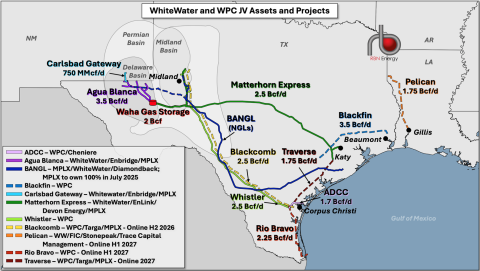
Figure 1. WhiteWater and WPC JV Assets and Projects. Source: RBN
First came Agua Blanca (dark-purple line in Figure 1). This pipeline system delivers natural gas from a number of processing plants in the Permian’s Delaware Basin to the Waha Hub. Agua Blanca started in 2018 as a 72-mile system with a capacity of 1.4 Bcf/d; it has been expanded several times since then and now has more than 200 miles of pipe and a capacity of more than 3 Bcf/d. The pipeline is currently owned by WhiteWater (75%), Enbridge (15%), and MPLX (10%). The three companies also share ownership of the 400-MMcf/d Carlsbad Gateway gas pipeline system (light-blue line) in the Delaware, which feeds residue gas into Agua Blanca.
This was reported back on February 5, 2025, but for some reason was in the news again this past week. Perhaps it was the Andy Hall article published in AS two days ago. Ivanpah really was an environmental disaster. Remember when CLR was fined for one dead migratory bird found in a waste oil pit? And I think they could have made it a criminal offense, but I've long since forgotten. Don't even get me started.
Beyond technical hurdles, Ivanpah also faced significant environmental concerns. While solar energy is generally considered clean, the plant’s intense light reflection created an unexpected hazard for wildlife. The glare from the mirrors attracted insects, which in turn drew birds into the concentrated solar beams, leading to thousands of avian fatalities annually.
Conservationists labeled Ivanpah a death trap for birds, with reports estimating that up to 6,000 birds per year were fatally scorched by the facility’s powerful solar flux.
However, the final blow to Ivanpah wasn’t its engineering or environmental impact—it was the rapid evolution of the solar market.
The rise of photovoltaic solar panels, which are cheaper to install and maintain, made Ivanpah’s solar thermal technology economically uncompetitive. Additionally, advancements in energy storage allowed photovoltaic systems to generate power even at night, eliminating one of Ivanpah’s key advantages.
As a result, Ivanpah is scheduled to shut down in 2026, marking the end of an ambitious but ultimately unsustainable project. Plans are already underway to develop new solar initiatives in the area, including the construction of a solar park to replace the facility.
Ivanpah to close two of three units well ahead of schedule.

For more on Ivanpah, search for "Ivanpah" on the blog. IYKYK.
This was from February 5, 2025:
*****************************
Solar
Ivanpah: not on my bingo card today. Scheduled to close in 2039 -- about fifteen years from now-- two of three solar farms are to be closed immediately and the operator is looking to close the third of three units.
And this has nothing to do with any executive order by Trump.
Even the Sierra Club didn't like this project.
Abject failure. Solar farms are expected to last forever -- after all,
they're cheap and the fuel source is free. Oil wells last longer than
this. My hunch: the depreciation / tax credits expired. Time to initiate
a new farm with new depreciation, tax credits, tax incentives, subsidies from US taxpayers. .

Locator: 48555SOLAR.
By the way, before we get started, the elite universities are putting up a good front confronting Trump on the anti-semitism issue, but two things:
It's been one hundred days.
And we move on.
Later
April 30, 2025: Equior, link at Reuters. Should have stayed in its lane, stayed with its core competency (oil).

Original Post

First Solar, the country’s largest solar manufacturer, said that tariffs will significantly reduce revenue and earnings this year, sending the stock down 10% in after-hours trading.
First Solar missed Wall Street’s consensus expectation for the first quarter, reporting earnings of $1.95 a share versus the projection of $2.49 a share.
The company also revised guidance sharply lower. It said that tariffs could reduce its 2025 revenue from a range of $5.3 billion to $5.8 billion to a range of $4.5 billion to $5.5 billion. It reduced its earnings per share expectations from a range of $17 to $20 to a range of $12.50 to $17.50.
First Solar has several factories in the U.S., but also produces some of its solar film in India, Malaysia, and Vietnam, all of which are subject to new tariffs.
It plans to redirect its Indian supply to the domestic market in India, said CEO Mark Widmar. It may have to idle the factories in Malaysia and Vietnam.
Locator: 48531B.
WTI: $63.07.
New wells:
RBN Energy: counting on a boom in natural gas demand for power?
Rising demand for electricity to serve data centers, manufacturing and other power-consuming sectors of the economy is spurring the development of scores of gas-fired plants — up to 100 gigawatts (GW) of new capacity by 2040. How much power those new plants will actually generate — and, with that, how much natural gas they will require — remain open questions, however. A recent study indicates that the vast majority of incremental power demand over the next 15 years could be supplied by solar and wind and that gas demand for power may remain pretty much flat. But the Trump administration’s dim view of most renewables — and clear preference for fossil fuels — suggest otherwise. In today’s RBN blog, we discuss gas demand for power in the late 2020s and 2030s.
Trump: first 100 days as of April 30, 2025. His term has just begun. He's farther along on his second term path than he was at similar point in his first term
RWE: for the US -- wind is dead.
Solar: plan B. Needs natural gas back up.
Someone has the wrong data, and I certainly can't sort it out. Link here. I'm particularly concerned about the "USA" projection.

Locator: 48520WIND.
This is for the archives. Everyone of my readers has seen this story. If not, they're not paying attention. LOL.

Lede:
Germany's RWE just pulled the plug on its U.S. offshore wind business.
Quietly. No fireworks, no headlines about thousands of turbines scrapped—just a dry admission that it's "halting activities" in American waters.
For one of Europe’s biggest green energy giants to walk away from a market as large as the U.S., in the middle of an energy transition no less, is not just a business decision.
It’s a red flag.
The exit—confirmed by a speech manuscript published ahead of a yet-to-be-delivered speech by the company’s CEO—comes as RWE rethinks where and how it deploys capital. In March, the company slashed $11 billion off its low-carbon investment plan, citing rising costs, hostile regulatory environments, and a spike in its required return on investment from 8% to 8.5%. In other words: too risky, too expensive, too slow. [Sounds like the US oil sector, under Biden, Kerry, Pocahontas, and many others.]
RWE's CEO, Markus Krebber, had already warned last fall that Trump’s return to power could delay or derail projects on the U.S. East Coast. Now, the company is making that pivot official. All U.S. offshore wind operations are paused—indefinitely—and RWE will instead chase safer, more lucrative projects in places like Germany, where it just broke ground on a new 22.8-MW onshore wind farm.
Blaming the failure of an inefficient business plan on Trump. So, what else is new?
*************************
Meanwhile
Again, for the archives, my readers have already seen this story.

Locator: 48580ISONE.
Energy:

Despite wind providing as much energy as ever for New England, ISO-NE is still relying on oil at highest levels I've seen in some time. An astounding 6% of the resource mix is attributable to oil. Assuming "hydro" is not a limiting factor, my hunch is oil is very, very cheap compared to what Canada is charging New England for their "clean" energy. Oil, at 6%, represents twice the resource mix compared to clean energy, "hydro" at 3%. Wow. They can't complete that Constitution pipeline fast enough!

Locator: 48538RENEWABLES.
BP: may be the poster child for this turn of events. Most recently, link here.
BP: back to petroleum.
In the big scheme of things, the Venn diagram(s):

I'm not sure which is a better representation, A or B.
DEI and Renewable Energy were both "political solutions" to problems that may or may not have existed.
From the linked article at oilprice:

*********************
Cost Of Renewables
Exhibit A.

Locator: 48514GREEN.
Global climate change economy teeters: Bloomberg link here.
**********************
For The Archives

Locator: 48443GREEN.
Global climate change economy teeters: Bloomberg link here.
**********************
For The Archives
**************************
For The Archives
I flew with the 525 TFS, Bitburg Air Base, Germany, from 1984 - 1986, and again, from 1989 - 1993, also Bitburg AB, Germany. My primary a/c was the F-15.
In the photo below, the F-15 is the second a/c from the POV of the aircrew member pictured.