Showing posts with label Hydrogen. Show all posts

Tuesday, June 10, 2025

Why Does This Have The Feel Of A Rube Goldberg Cartoon? Jue 10, 2025

Locator: 48734HYDROGEN.

For the archives. I have absolutely zero interest in this story but it may be important for the archives someday.

MIT: finding a solution to a problem that doesn't exist; and producing a product "no one" wants. Producing hydrogen from aluminum cans and seawater. 

Link here.

“No sane project developer is going to start producing hydrogen without having a buyer for it, and no sane banker is going to lend money to a project developer without reasonable confidence that someone’s going to buy the hydrogen,” BNEF analyst Martin Tengler notes.

“It’s no different than any other energy development at scale. Natural gas pipelines didn’t get built without customers,” says Laura Luce, chief executive officer of Hy Stor Energy.

Meanwhile, Trump’s “Big, Beautiful Bill” could have dire consequences for the hydrogen sector if it becomes law. The sweeping policy bill will do away with billions in tax credits provided by Biden’s Inflation Reduction Act (IRA), with Section 45V tax credit considered a major boon for low-carbon hydrogen and ammonia projects across the country. Losing 45V tax credits may seriously erode the economic viability of dozens of companies including Plug Power (NASDAQ:PLUG), Air Products & Chemicals (NYSE:APD), CF Industries (NYSE:CF), Bia Energy, Clean Hydrogen Works and Monarch Energy.

Saturday, December 21, 2024

2024: The Day The Music Died -- December 21, 2024

Locator: 44498HYDROGEN.

Link here.


From Motley Fool, the same folks who are telling us that Buffett is likely to sell the rest of his AAPL in 2025.

Power Plug: I remember when Motley Fool recommend this company back in January, 2000, and many times since. It's one of their favorites, it seems:

**********************************
Disclaimer
Brief Reminder 

  • I am inappropriately exuberant about the US economy and the US market.
  • I am also inappropriately exuberant about all things Apple. 
  • See disclaimer. This is not an investment site. 
  • Disclaimer: this is not an investment site. Do not make any investment, financial, job, career, travel, or relationship decisions based on what you read here or think you may have read here. All my posts are done quickly: there will be content and typographical errors. If something appears wrong, it probably is. Feel free to fact check everything.
  • If anything on any of my posts is important to you, go to the source. If/when I find typographical / content errors, I will correct them. 
  • Reminder: I am inappropriately exuberant about the US economy and the US market.
  • I am also inappropriately exuberant about all things Apple. 
  • And now, Nvidia, also. I am also inappropriately exuberant about all things Nvidia. Nvidia is a metonym for AI and/or the sixth industrial revolution.
  • Longer version here. 

Friday, November 29, 2024

Another Green Energy Business Will Be Phased Out -- November 29, 2024

Locator: 44455HYDROGEN.

Tag: hydrogen batteries green energy EVs cost renewables

Link here.

Monday, October 28, 2024

Five New Permits; Three Permits Canceled; Three DUCs Reported As Completed -- October 28, 2024

Locator: 48672B.

Hydrogen: from RBN Energy, September 10, 2024: 

RBN Energy: how existing US hydrogen infrastructure forms a base for future expansion. Archived.

The hype around low-carbon-intensity (LCI) hydrogen that captivated many energy transition fans over the past four years has lost some momentum of late as industry players recalibrate their investment plans in the face of spiraling costs. Still, the U.S. government is moving full speed ahead — the Bipartisan Infrastructure Law (2021) and Inflation Reduction Act (2022) promise to flow billions of dollars into LCI hydrogen infrastructure via tax credits and other incentives.
Which raises this question: Will LCI hydrogen make economic sense or not? In November 2021, the Department of Energy (DOE) asked the National Petroleum Council (NPC) to take a deep dive into the topic. In today’s RBN blog, we begin a review of the issues at hand.

Reality sucks, link here.

Remember Plug Power? I was suckered into investing, but got out quickly.

The "hydrogen" headlines this past year

Updates

October 28, 2024: hydrogen stocks crash as hype faces reality check.

September 10, 2024: hydrogen infrastructure update, RBN Energy.

August 19, 2024: hydrogen collapsing.

April 24, 2024: what's holding back hydrogen vehicles.

March 11, 2024: natural gas pipelines and hydrogen hubs.

December 28, 2023: Biden hits the brakes on hydrogen. A flurry of year-end stories.

************************************
Back to the Bakken

WTI: $67.69.

Active rigs: 41.

Five new permits, #41283 - #41287, inclusive:

  • Operators: CLR (3); Koda Resources (2)
  • Fields: East Fork (Williams); Deaneville (Divide County)
  • Comments;
    • Koda Resouces has permits for two Bock wells, NWNw 24-161-102, 
      • both to be sited 483 FNL with one at 654 FWL and the other 689 FWL;
    • CLR has permits for two Peterson wells and one Chloe well, SWSE 20-156-99; 
      • all three to be sited to be sited 300 FSL and at 1753 FEL; 1817 FEL: and, 1785 FEL

Three permits canceled:

  • MRO: Quincy, Ebeltoft, and Beverly Dunn County; NWNE 18-145-93;

Three producing wells (DUCs) reported as completed:

  • 37578, 0, BR, Mathistad 2B MTFH, McKenzie County;
  • 37581, 867, BR, Cross 2A MBH, McKenzie County;
  • 40601, 526, True Oil; Slash Federal 11-4 4-9 TF1H; McKenzie County;

Monday, August 19, 2024

Another Passing Fad? Hydrogen -- August 19, 2024

Locator: 48464H2.

Hydrogen is tracked here. What a debacle.

Link here to The WSJ.  

Is this foreshadowing "big truck hydrogen"? Daimler is heavily invested in hydrogen.

From the linked article:

Startups promising to power planes, ships and trucks with clean fuel are sputtering before they get off the ground, showing how hard it will be to wean many industries off oil and gas.
A company backed by United Airlines that raised hundreds of millions of dollars to turn trash into jet fuel appears to have shut down. Another, backed by Airbus, JetBlue and GE Aerospace, that was working on using hydrogen to power planes went bust.
Chevron, BP and Shell, meanwhile, are scaling back projects to make biofuels from cooking fats, oils, greases and plant material.

 “The excitement of the early days has not lived up to the hype,” said Andy Marsh, chief executive of Plug Power, a startup that recently opened one of the country’s first plants making green hydrogen, a potential replacement for fossil fuels in industries such as steel making and chemical production.

The poster child for hydrogen energy:


Monday, December 25, 2023

EOY -- EVs -- December 25, 2023

Locator: 46387EVS. 

California ports and EV trucks, link here.

I don't even care -- just the fact a Chevy Blazer is more expensive than a Cadillac is all I need to know --

The Chevy Bolt: on again, off again.

  • a salute to the Bolt, InsideEVs. But again, look how "challenging" it is for buyers. My hunch: the average car salesman has no idea what EVs are all about, how to explain the charging, the tire size, etc.
  • GM to extend Chevy Bolt EV production through the end of December, 2023; link here.

********************************
Losing Interest

Brian Gitt: link here.

WSJ: US consumers losing interest in EVs. Link here. 

Charging companies:  Link here. Charging companies no longer seen favorable by investors. Schadenfreude.

NIO: introduces the ET9. Much of the new technology is in-house design. Starts at $112,000. NIO describes it as its “Smart Electric Executive Flagship.” Link here.

*************************

Link here. Car And Driver.

Link here. Autonomous vehicles have found a niche.

Link here. Honda Prologue: and Japanese answer to the Chevy Blazer EV (sales now suspended).


Link here
. Chevy Blazer EV -- The Ultium platform is a mess.


Link here
. From 2022 -- EV EPA efficiency comparison.


Link here
. Range loss over time.


Link here
. Usable battery. Looks like data is from 2024.

Link here.  Chevy Blazer EV price range and range, 2024. Sales suspended December 23, 2023.

Link here. CCS vs NACS, US News.

Link here. With minimal EV penetration, Netherlands grid is not up to the task.

********************************
Hydrogen

Link here. Hydrogen tracked here. The blog. Locator: 10001H2. 

Link here. Leaked White House proposal undermines hydrogen start-ups, initiative. Financial Times.

Link here. Bad news for blue hydrogen.

Friday, October 13, 2023

Wow, Wow, Wow! The Seven Sisters — Heartland Hydrogen Hub — October 13, 2023

Locator: 45761H2HUBS.

Link here. Charles Kennedy.

  • Mid-Atlantic H2: blue
  • Appalachian H2: deep blue
  • California H2: deep blue
  • Gulf Coast (Houston) H2: blue
  • Heartland H2: blue
  • Midwest H2: blue
  • Pacific Northwest H2: deep blue

Link here.

Link here.

Link here.

Link here.

Why North Dakota “won”: for its good writing. LOL.

The “meat” of the application, penned by Miss North Dakota:

The Hub plans to offer unique opportunities of equity ownership with the Mandan, Hidatsa and Arikara Nation and to local farmers and farmer co-ops through a private sector partnership that will allow local farmers to receive more competitive pricing for clean fertilizer. These initiatives can help reduce roughly 1 million metric tons per year of carbon emissions—roughly equivalent to the annual emissions of 220,000 gasoline-powered cars—while extending profit-sharing and benefits from the expanding hydrogen economy to wider communities, a model with the potential for replication across the Midwest. 
The Heartland Hydrogen Hub’s use of open access storage and pipeline infrastructure will create a hydrogen network accessible to both current and new hydrogen users. The Heartland Hydrogen Hub has committed tens of millions of dollars to create an education consortium to oversee career development, workforce training, apprenticeship programs, and K-12 STEM education, which includes several tribal colleges and universities. A goal of the Heartland Hydrogen Hub is to contract hundreds of millions of dollars for businesses owned by women, minorities, disabled veterans, disadvantaged communities, or LGBTQ persons.

Monday, January 30, 2023

Bakken Energy's Beulah Hydrogen Plan -- Into Thin Air -- January 30, 2023

Behind a paywall; will watch for story elsewhere, but this pretty much says it, from The Bismarck Tribune:

To the reader who sent me the link:

" ...Bakken Energy has already spent $4.76 million of that money and is unlikely to return it."

I assume most of that money went to pay officers, directors, CPAs, and lawyers.

I never had much hope for this -- in the big scheme of things, it certainly appears some snake oil salesmen outsmarted the state.

********************************
A Note To The Granddaughters

I can't remember if I have previously posted this, but it's too precious to lose.

Yesterday at Jason's Deli after the soccer game, I was talking with my son-in-law about secondary containment on well pads in the Bakken.

He is consulting with an oil company on this very issue: pad design. The younger granddaughter, age 7, who had just scored 7 of the 11 points in the 11-0 trouncing of their adversary, was bored with my monologue on secondary containment.

After we got up to go -- they were driving, I was biking -- our older granddaughter, the 10-year-old, came up to me and said she was not bored with the discussion. She had been very quiet, but it turns out she was listening and understanding. She told me that landfills are required to use liners to prevent waste from getting into ground water. She also knew about various layers of clay and gravel to protect landfill waste from getting into the ground water.

I asked her how she knew this: she said she read a book on the environment in her school library.

Tuesday, October 18, 2022

Hydrogen

Locator: 10001H2. This is where hydrogen will now be tracked.

Previously, archived: link here.

HYDROGEN 

January 3, 2025: Hydrogen? Dead. Link here.

December 3, 2024: the day the music died.

November 23, 2023: still a long way to go. 

July 3, 2023: hydrogen energy requires a lot of .... water. And the sites around the world being proposed for hydrogen generation don't have a lot of ... water. Link here.

May 4, 2023: Motiva joins Shell — shuts down its hydrogen-fueling stations.

November 30, 2022: Pacific Northwest update.

October 19, 2022: reality sucks.

October 18, 2022: Shell shuts its hydrogen stations in the UK.

************************
Background

Beulah, ND: the nation's Great Plains Hydrogen Hub.

RBN Energy: clean hydrogen hub plans taking shape in the Midwest and Great Plains.

PADD 2 — the 15-state region that includes both the Midwest and the Great Plains — is a major player in U.S. hydrocarbon production and refining, not to mention energy consumption, with its rich mix of industry and farming. It’s also bound to be a hot spot in the energy transition, given its vast wind resources, scores of ethanol plants, and extensive plans for carbon capture and sequestration (CCS). Not surprisingly, there also may be a clean hydrogen hub or two in PADD 2’s future — after all, it’s got natural gas in spades, plus lots of zero-carbon nuclear plants, countless wind farms, and more existing and potential hydrogen end-users than you can shake a stick at. In today’s RBN blog, we discuss the PADD 2 proposals now under development and why they may have a good shot at winning Department of Energy (DOE) support.

A provision in last year’s $1-trillion-plus Infrastructure Investment & Jobs Act provides a total of up to $8 billion in federal funding over five years to support the development of several clean hydrogen hubs around the U.S. Last month, the DOE announced that concept papers from hub proponents are due November 7; full applications are due April 7, 2023; winners will be notified in the fall of 2023; and award negotiations with the winners will be completed in the winter of 2023-24. DOE also said that most of the six to 10 selected proposals will each receive between $500 million and $1 billion in federal support, though it’s possible that a proposal could receive a little less or a little more, depending on its size and need.

Hydrogen, the "North Dakota story," link here. 

Now, this update. From Rigzone, "Biden hydrogen hub plan sparks $8 billion race."

Many of the states in the race have decided to join efforts in regional partnerships rather than go it alone. Their approaches tend to be based on available resources.

New York, for example, formed an alliance with Massachusetts, New Jersey and Connecticut last month.

Another partnership that includes Arkansas, Louisiana and Oklahoma would use existing infrastructure to form the basis of its hub. Hydrogen is already produced in the region using natural gas. The hydrogen output is used there in some manufacturing processes, such as lowering sulfur content of fuels from refineries.

A third alliance involving Colorado, New Mexico, Utah and Wyoming also seems to be taking an “all-of-the-above” approach.

In February, a coalition of businesses that includes Equinor ASA, Mitsubishi Power, Marathon Petroleum Corp. and United States Steel Corp. said they would help work on a hub that would knit together Ohio, Pennsylvania and West Virginia.

North Dakota hydrogen is tracked here.  

******************
North Dakota Hydrogen

Link here.

North Dakota's hydrogen hub is among entities with its name in an $8 billion hat, seeking federal grant funds for regional hydrogen hubs. You may recall that hydrogen hubs were on the Department of Energy's list of "moonshot" ideas in the early days of the Biden Administration. Now the department has money to put toward that goal, and it has blown the starting whistle for those grants.

Over at National Law Review, March 17, 2022 -- like only two weeks ago -- this is how you apply for free money -- or "almost" free money -- from the US DOE. 

If folks recall, North Dakota has one of the leading reputations for getting free money from the US government. Among everything else, I do believe North Dakota is #1 -- based on per capita spending -- for federal money for drone R&D. Now, it's time to be #1 -- again, based on per capita spending -- on hydrogen hubs. 

The deadlines have already passed; hopefully "we" were ahead of the game. Here's how it worked:

The Department of Energy (DOE) has begun the process of establishing “Hydrogen Hubs” that are funded in the Infrastructure Investment and Jobs Act, aka the “infrastructure package.” 
The infrastructure package provides $8 billion for hydrogen hubs, plus an additional $1 billion for hydrogen electrolysis research, development, deployment and commercial applications. Another $500 million was appropriated in the infrastructure package for a Clean Hydrogen Manufacturing, Recycling, Research, Development and Demonstration Program. 
All of this funding is to be distributed over the next five years. 
The Hydrogen Hub Program. Through the Regional Hydrogen Hub Program DOE will choose a minimum of four locations in the U.S. to locate hydrogen hubs — networks of clean hydrogen producers, potential clean hydrogen consumers, and connective infrastructure located in close proximity. 
The law calls for diverse energy sources for hydrogen production at the hubs, requiring, to the maximum extent practicable, that one hub produce hydrogen from fossil fuels; one from renewables; and one from nuclear energy. 
H2 Matchmaker. To help hydrogen players connect with others and create “hubs”, DOE has stood up the “H2 Matchmaker” tool, an interactive map which includes various hydrogen producers, infrastructure companies, consumers, and other stakeholders, along with their contact information. 
You can find the H2 Matchmaker map here, where you will also find the H2 Matchmaker Self-Identification Form. You can use the H2 Matchmaker Self-Identification form to submit your own information for the H2 Matchmaker Map.

 ********************
RBN Energy

RBN Energy: making sense of the hydrogen buzz, production edition, part 2. Archived.

Based on the response we received to our first-ever hydrogen blog last fall, it’s fair to say we didn’t waste this space on a fringe subject. To be honest, the level of interest in hydrogen far exceeded our expectations, and suggested that we might have even been a little bit late to the party — but fashionably so, if you ask us. In the weeks since then, we’ve spent a fair amount of time distilling the tremendous amount of news flow and reading material that was either sent our way or popped up in the daily news feeds. 
You could go a lot of different directions with hydrogen and it’s still very easy, in our view, to get lost in the forest of green energy technology. So, as we are wont to do, we have stuck to our simple approach of tackling this fuel just like we do with hydrocarbons, and we are first turning our attention upstream. Today, we continue our series on hydrogen with a look at the top production methods for the fuel.

So, what is "blue hydrogen" about which The Williston Herald is talking? 

From the RBN Energy blog regarding blue hydrogen, the stuff Mitsubishi was talking about in Bismarck this past week:  

The existing hydrogen market is huge. It also emits significant amounts of carbon. That’s because, according to the International Energy Agency (IEA), around 75% of the hydrogen produced in the world is synthesized using natural gas, mostly through a process called steam methane reforming (SMR).

Note that another 20+% of global hydrogen is produced using coal, thanks mostly to China. In the U.S., about 95% of the hydrogen produced comes from natural gas, according to the Department of Energy (DOE).

Similar to the rest of the world, most of the natural gas is turned into hydrogen via SMR, although there are a few partial oxidation (POX) plants that make up a small sliver of the supply side of the market.

We won’t cover POX today, or another technology for producing hydrogen from natural gas called autothermal reforming (ATR), but the processes are not very different than SMR.

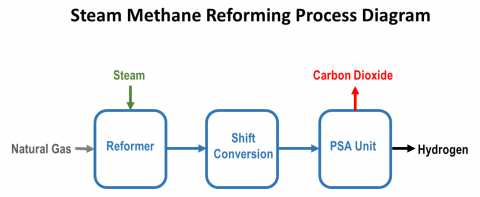
To that end, Figure 1 below shows a simplified process flow diagram for a typical SMR unit.
Simplified SMR Flow Diagram

Figure 1. Simplified SMR Flow Diagram. Source: RBN

To create hydrogen via SMR, natural gas is first fed into a processing unit called a reformer. There it reacts with high-temperature steam and a catalyst, usually one that is nickel-based, to form hydrogen and carbon monoxide. The resulting gas mix is then fed to the shift conversion unit, where the carbon monoxide reacts with the steam to produce even more hydrogen, plus carbon dioxide (CO2). The hydrogen and carbon dioxide are then sent to a pressure swing adsorption (PSA) unit, where the CO2 is removed from the hydrogen.

Naturally, our Figure 1 is simplified, and there are a bunch of other pieces of equipment such as heat exchangers and dryers that we left off, but you get the general idea.

According to data published by the Argonne National Laboratory, the SMR process is about 70%-80% efficient. Using the low end of that range and an assumed $3 per million British thermal units (MMBtu) natural gas price, we estimate the natural gas costs of SMR equate to about $0.50 per kilogram (kg), a number supported by a recent IEA study.

The IEA also assumes another $0.17/kg in other variable costs for SMR, along with $0.34/kg to cover capital costs. That math brings SMR hydrogen production costs to just about $1/kg, assuming you do nothing to contain the produced carbon dioxide.

The IEA estimates that installing a carbon capture, utilization, and storage (CCUS) technology brings total costs up to $1.50/kg of hydrogen.

Even with the added cost of containing the CO2, SMR is cheap when compared to just about any other method of production. Also, while some SMR units feature CCUS, most do not. Remember from Part 1 of this series that hydrogen produced from natural gas via SMR is called “gray” hydrogen. If you combine CCUS with the SMR, your turn the hydrogen from gray to “blue”.

It's okay to ignore this next paragraph:

How much do SMR units produce each year? That’s a good question, and answering it isn’t as easy as you might like. To our knowledge, there is no requirement to report hydrogen production in the U.S., so there’s nothing in the way of historical data from the Energy Information Administration (EIA) like there is for most of the hydrocarbon world. The most recent information we could find from the DOE estimated U.S. hydrogen production at about 10 million metric tons per year (Mtpa). On a daily basis, that’s roughly 11 billion cubic feet per day (Bcf/d) of hydrogen containing approximately 3 million MMBtu. That translates to about 3 Bcf/d of natural gas equivalent energy. Further, if we assume almost all of that produced hydrogen was generated with natural gas-based SMR — the DOE estimates appear to exclude by-product hydrogen relinquished by refinery and chemical plant processing units — the amount of natural gas used to produce it would come out to roughly 4.3 Bcf/d. Note that math (4.3 Bcf/d of natural gas used to make the hydrogen energy equivalent of 3 Bcf/d) uses the low-end of our previously stated 70%-80% efficiency range.

But don't ignore this paragraph:

All of which is to say that gas demand from the hydrogen industry is already a huge component of the existing energy balance within the U.S., a fact not lost on most natural gas analysts. Note also that the DOE estimates about 25% of that hydrogen is consumed in the ammonia industry, with most of the rest in the refining and petrochemical sector.

For what it’s worth, we could find no production data for the “green” methods of producing hydrogen, which we discuss next.

So, blue hydrogen: Remember from Part 1 of this series that hydrogen produced from natural gas via SMR is called “gray” hydrogen. If you combine CCUS with the SMR, your turn the hydrogen from gray to “blue”.

Quick! Who combines CCUS with CO2 EOR? Full circle. We're back to Denbury.   

Some folks suggest Denbury is about the only operator of note involved with CO2 EOR and CCUS.

I think I've said enough.

Disclaimer: this is not an investment site.  Do not make any investment, financial, job, career, travel, or relationship decisions based on what you read here or think you may have read here. 

Finally, There Are A Few Wells Coming Off The Confidential List -- October 18, 2022

SPR (strategic political release): Biden set to release another ten million bbls?

  • he must really be worried about $7-gasoline in California
    • SPR release won't help; California's marginal oil comes from Saudi Arabia
  • the real problem is $5-diesel across the rest of the nation
    • SPR release won't change that
  • to work, the SPR release also needs to include ban on exports
    • Brent will spike, and
    • WTI will follow

Beulah, ND: the nation's Great Plains Hydrogen Hub. 

Hydrogen:

***************************
Back to the Bakken

The Far Side: link here.

Active rigs: 43.

WTI: $85.27.

Natural gas: $6.045

Wednesday, October 19, 2022: 25 for the month, 25 for the quarter, 470 for the year.
38365, conf, CLR, Fuller 5-2H,

Tuesday, October 18, 2022: 24 for the month, 24 for the quarter, 469 for the year.
38849, conf, Ovintiv, Kramer 150-97-18-19-5HR,
38366, conf, CLR, Fuller 4-2H1,

RBN Energy: clean hydrogen hub plans taking shape in the Midwest and Great Plains. Archived.

PADD 2 — the 15-state region that includes both the Midwest and the Great Plains — is a major player in U.S. hydrocarbon production and refining, not to mention energy consumption, with its rich mix of industry and farming. It’s also bound to be a hot spot in the energy transition, given its vast wind resources, scores of ethanol plants, and extensive plans for carbon capture and sequestration (CCS). Not surprisingly, there also may be a clean hydrogen hub or two in PADD 2’s future — after all, it’s got natural gas in spades, plus lots of zero-carbon nuclear plants, countless wind farms, and more existing and potential hydrogen end-users than you can shake a stick at. In today’s RBN blog, we discuss the PADD 2 proposals now under development and why they may have a good shot at winning Department of Energy (DOE) support.

A provision in last year’s $1-trillion-plus Infrastructure Investment & Jobs Act provides a total of up to $8 billion in federal funding over five years to support the development of several clean hydrogen hubs around the U.S. Last month, the DOE announced that concept papers from hub proponents are due November 7; full applications are due April 7, 2023; winners will be notified in the fall of 2023; and award negotiations with the winners will be completed in the winter of 2023-24. DOE also said that most of the six to 10 selected proposals will each receive between $500 million and $1 billion in federal support, though it’s possible that a proposal could receive a little less or a little more, depending on its size and need.

Monday, April 11, 2022

Hydrogen -- April 11, 2022

Hydrogen, the "North Dakota story," link here. 

Now, this update. From Rigzone, "Biden hydrogen hub plan sparks $8 billion race."

Many of the states in the race have decided to join efforts in regional partnerships rather than go it alone. Their approaches tend to be based on available resources.

New York, for example, formed an alliance with Massachusetts, New Jersey and Connecticut last month.

Another partnership that includes Arkansas, Louisiana and Oklahoma would use existing infrastructure to form the basis of its hub. Hydrogen is already produced in the region using natural gas. The hydrogen output is used there in some manufacturing processes, such as lowering sulfur content of fuels from refineries.

A third alliance involving Colorado, New Mexico, Utah and Wyoming also seems to be taking an “all-of-the-above” approach.

In February, a coalition of businesses that includes Equinor ASA, Mitsubishi Power, Marathon Petroleum Corp. and United States Steel Corp. said they would help work on a hub that would knit together Ohio, Pennsylvania and West Virginia.

North Dakota hydrogen is tracked here. 

Wednesday, April 6, 2022

One Well Coming Off Confidential List; WTI Melting Up -- April 6, 2022

Russia:

  • Russia will find it needs the West a lot more than the West needs Russia;
  • once the oil income starts to fall, it's all over
  • every week this war drags on, sets Russian economy back another year;
  • the Vietnam War was a huge drag on the US economy; Putin's War will be exponentially worse for Russia
  • now Charles Kennedy suggests that Russian oil production dipped for the first time since August, 2021; link here.
    • marker: 11.01 million bopd (oil + condensate)
    • 0.6% lower than production in February
    • under OPEC+ agreement, Russia allowed to increase production by 100,000 bopd; did not "take advantage of that"
  • Russia needs western technology to keeps it oil industry operating at peak capacity;
  • at least they have pipelines, something the US would like more of. LOL.

Oil:

  • OPEC basket: continues to move up
  • Brent: up 1%; up $1.18; trading at $107.80
  • WTI: up 1.4%; up $1.43; trading at $103.40

New Mexico rig count: 96 (link here)

  • North Dakota: 36

Average automobile fuel cost by state: updated as of early March, 2022. 

  • most expensive: three guesses and the first two don't count
  • least expensive: Arkansas - Oklahoma - Texas in that order
  • most expensive: $4.94 (at least it's not over $5)
  • least expensive: $3.34

Immigration: wow, wow, wow! I hinted at this data point some years ago, but I'm not going to expand. I don't need the pushback. LOL.

  • from The WSJ: add declining immigration to problems weighing on the labor market
  • industries that depend on foreign-born employees face high job vacancy rates and wage pressures;

*******************************
Back to the Bakken

Active rigs:

$103.40
4/6/202204/06/202104/06/202004/06/201904/06/2018
Active Rigs3613406257

Wednesday, April 6, 2022: 11 for the month, 11 for the quarter, 170 for the year

  • 37601, conf-->loc/A, Whiting, Littlefield 41-2H, Sanish, first production, 11/21; t--; cum 107K 2/22;

RBN Energy: can green methanol help clean up global shipping? 

When the world’s second-largest container-ship company makes a massive, long-term commitment to a carbon-neutral shipping fuel, you can’t help but take notice. Over the past few months, A.P. Moller-Maersk has placed orders for a dozen large, ocean-going container vessels that will be fueled by “green” methanol, which can be produced by “breaking up” water to produce hydrogen, then combining the H2 with captured CO2 to “make up” enviro-friendly bunkers. And, to ensure an ample supply of the climate-friendly fuels for its first 12 “boxships,” the shipping giant also has entered into strategic partnerships with six alternative fuel companies that by 2025 will be producing a total of at least 730,000 metric tons (MT) a year of either bio-ethanol or e-methanol — two chemically identical forms of green methanol. In today’s RBN blog, we discuss why Maersk thinks bio-methanol and e-methanol may be the carbon-neutral shipping fuels everyone’s been searching for.

The global shipping industry spent the 2010s ratcheting down emissions of old-school pollutants — mostly sulfur dioxide (SO2) — from the 50,000-plus tankers, dry bulkers, container ships, tankers, cruise ships, and other commercial vessels plying international waters. As we said in a number of blogs on the International Maritime Organization’s (IMO) ever-tightening environmental rules, the maximum allowable sulfur content in marine fuel (or bunkers) used around most of the world plummeted from 4.5% in January 2010 to only 0.5% in January 2020, when IMO 2020 was implemented. As of January 1, 2015, the allowable sulfur content in bunkers used in the IMO’s Emission Control Areas (ECAs) — which include Europe’s Baltic and North seas and areas within 200 nautical miles of the U.S. and Canadian coasts — was slashed from 1% to 0.1%.

Saturday, April 2, 2022

If You're Not Following The "Energy Chaser," You're Not A Bakkeneer -- April 2, 2022

Link here.

North Dakota's hydrogen hub is among entities with its name in an $8 billion hat, seeking federal grant funds for regional hydrogen hubs. You may recall that hydrogen hubs were on the Department of Energy's list of "moonshot" ideas in the early days of the Biden Administration. Now the department has money to put toward that goal, and it has blown the starting whistle for those grants.

Over at National Law Review, March 17, 2022 -- like only two weeks ago -- this is how you apply for free money -- or "almost" free money -- from the US DOE. 

If folks recall, North Dakota has one of the leading reputations for getting free money from the US government. Among everything else, I do believe North Dakota is #1 -- based on per capita spending -- for federal money for drone R&D. Now, it's time to be #1 -- again, based on per capita spending -- on hydrogen hubs. 

The deadlines have already passed; hopefully "we" were ahead of the game. Here's how it worked:

The Department of Energy (DOE) has begun the process of establishing “Hydrogen Hubs” that are funded in the Infrastructure Investment and Jobs Act, aka the “infrastructure package.” 
The infrastructure package provides $8 billion for hydrogen hubs, plus an additional $1 billion for hydrogen electrolysis research, development, deployment and commercial applications. Another $500 million was appropriated in the infrastructure package for a Clean Hydrogen Manufacturing, Recycling, Research, Development and Demonstration Program. 
All of this funding is to be distributed over the next five years. 
The Hydrogen Hub Program. Through the Regional Hydrogen Hub Program DOE will choose a minimum of four locations in the U.S. to locate hydrogen hubs — networks of clean hydrogen producers, potential clean hydrogen consumers, and connective infrastructure located in close proximity. 
The law calls for diverse energy sources for hydrogen production at the hubs, requiring, to the maximum extent practicable, that one hub produce hydrogen from fossil fuels; one from renewables; and one from nuclear energy. 
H2 Matchmaker. To help hydrogen players connect with others and create “hubs”, DOE has stood up the “H2 Matchmaker” tool, an interactive map which includes various hydrogen producers, infrastructure companies, consumers, and other stakeholders, along with their contact information. 
You can find the H2 Matchmaker map here, where you will also find the H2 Matchmaker Self-Identification Form. You can use the H2 Matchmaker Self-Identification form to submit your own information for the H2 Matchmaker Map.

Friday, January 28, 2022

Bureau Of Ocean Energy Management -- Thank You -- January 28, 2022


Old news by now; US federal judge annulled the government's massive GoM lease sale last November, 2021, on ground that the BOEM "broke environmental law." The was the biggest oil and gas lease ever in the Gulf of Mexico. 

Companies will be reimbursed. 

Analysis:

  • analysts talk about need for oil companies to show restraint; not drill so much; focus on free cash flow and return cash to investors;
  • nothing like vacating the biggest oil and gas lease ever to force these Big Oil companies to show restraint and quit drilling;
  • they will have to increase activity in onshore shale to make up shortfall. Whoo-hoo.

Today: 

  • WTI: surges 2.30% at already high prices
    • up $2.00
    • now trading solidly above $88.
  • at this rate, up $2.00 / day, WTI will over $100 in six days (tongue in cheek; don't take seriously) 

**********************************
Hydrogen As A Transportation Fuel

Cliff's notes:

  • hydrogen comes from electrolysis of water
  • apply electricity to H2O to get hydrogen and oxygen
  • that really, really, really takes a lot of electricity and is really, really, really expensive
  • to make electrolysis even remotely competitive with conventional fuel sources, need inexpensive power source
  • the most inexpensive power source, the dirtiest of the dirty: lignite
  • [imagine the loss of energy going from lignite to electrolysis]
  • definitions:
    • brown hydrogen: "made" from coal, currently, generally lignite;
    • blue hydrogen: "made" from natural gas
    • green hydrogen: "made" from high-cost, high-energy wind towers and solar panels, energy

niche:

  • hydrogen will have huge niche, particularly in forklifts in warehouses; clean; minimal maintenance;
  • but almost all that hydrogen will come from fossil fuel for the next twenty years

Link here to Australian story about using lignite to make hydrogen.

Sunday, January 2, 2022

Themes -- 2023

Locator: 442023C.

Revolutions

AI: a new decade begins.

The Over-Riding Themes

Global energy: the 21st century is America's century.

Medicine: it's all about CRISPR, mRNA.

Information: it's all about semi-conductors, automation, robotics.

De-globalization: not all will agree. Many will fight it. Too much invested. 

China's downfall (added November 1, 2023)

Themes Posted in 2022 for 2023.
With Updates

Economy 

US banking crisis: will follow here.

Ukraine:

  • Putin's War: shifting the burden to the population. The Russia File -- from the Wilson Center. Link here. April 17, 2023

Tectonic shifts: link here.

For investors:

Unemployment:

ESG is dead:

US: the three-day workweek. 

Coal: the transitional fuel. 

  • Germany using more coal than ever, April 17, 2023.

Oil:  

De-globalization:

European de-industrialization:

  • October 9, 2022 -- where this theme will be followed.
  • April 17, 2023: Germany shuts down last nuclear reactor. 

Renewable energy:

  • will continue to send bad vibes.

AAPL: 

  • re-shoring
  • opens first retail store in India, April 17, 2023.
  • expands operations in India, moving out of China.

Semi-conductors:

  • the Biden administration policies will cripple China;
  • Peter Zeihan

"Flu":

  • 2022 - 2023 season will be worse than most Americans expect.
  • one word: complacency

Hydrogen:

Politics

The downfall of Donald Trump: added May 4, 2023. To be tracked here.  

Monday, August 16, 2021

Blue Hydrogen -- It's Happening -- North Dakota -- August 16, 2021

Updates

January 17, 2023: the update from RBN Energy did not include the Bakken.

August 17, 2021: link here. Blue hydrogen in the UK. Graphic pending, the dual-track blue hydrogen / green hydrogen program in the UK. Blue hydrogen in the UK will exceed CO2-emissions target, link here.

Original Post

A huge "thank you" to a reader for alerting me to The Williston Herald story. 

For background, see this June 2, 2021, post: blue hydrogen, Mitsubishi, Denbury, RBN Energy, and all that jazz. 

For more background, gray hydrogen, blue hydrogen, and green hydrogen, at Forbes, February 22, 2021.

“Green hydrogen is what Europe absolutely wants. But blue hydrogen is what a lot of the world thinks we can afford sooner and it’s probably going to be good enough,” he said. “It’s really more of a market-driven thing than a technology thing.”

From The Williston Herald (by the way, has anyone noticed that the Herald is getting better and better or is that just me?), link here. Data points:

  • blue hydrogen hub in the Bakken
    • to be built in about half the time "it usually takes" 
      • a greenfield plant normally take ten years to build / become operational
      • operator says a brownfield plant might take just five years
  • operator / source of data: Bakken Energy
  • announced August 16, 2021 (today)
  • the deal:
    • official name: the North Dakota Hydrogen Hub
    • partners: Basin Energy and Mitsubishi Power
    • Basin Electric Coop will purchase the assets of the Dakota Gasification Company
    • Dakota Gasification Company owns the Great Plains Synfuels Plant
    • expected to close April 1, 2023
  • Synfuels to continue existing operations through 2025
  • the plant, when complete:
    • 310,000 metric tons of hydrogen per year
    • primarily sourced through locally natural gas (CH4 --> CO2 and hydrogen)
  • Mitsubishi Powers Americas
    • the centrally-located North Dakota Hydrogen systems will connect Mitsubishi's planned wester and eastern US hubs to establish a national hydrogen network
    • Mitsubishi: will create: a Change in Power division
  • the CO2 will end up in CCS projects

From the blog, June 2, 2021, linked above:

To that end, Figure 1 below shows a simplified process flow diagram for a typical SMR unit.

Simplified SMR Flow Diagram

Figure 1. Simplified SMR Flow Diagram. Source: RBN

To create hydrogen via SMR, natural gas is first fed into a processing unit called a reformer. There it reacts with high-temperature steam and a catalyst, usually one that is nickel-based, to form hydrogen and carbon monoxide. The resulting gas mix is then fed to the shift conversion unit, where the carbon monoxide reacts with the steam to produce even more hydrogen, plus carbon dioxide (CO2). The hydrogen and carbon dioxide are then sent to a pressure swing adsorption (PSA) unit, where the CO2 is removed from the hydrogen.

Monday, May 10, 2021

Well, This Can't Be Good -- Hydrogen -- May 10, 2021

A thousand-mile journey begins with one step. --- ancient Chinese proverb. 

From social media and google:


Monday, March 22, 2021

Plug Power, FuelCell -- Warning Signs -- Bloomberg -- March 22, 2021

Link here. 

Banks don't like losing money.

Once shale operators started showing severe debt issues, lending became an issue. That is an oft-repeated story. 

That was also true of the battery industry a decade ago. 

Now, hydrogen and the clean energy industry could be facing the same problem. 

Good, bad, or indifferent, we all have our own worldviews. 

But it's hard to to ignore this:

Valuations are extended, with FuelCell’s enterprise value-to-sales ratio sitting at 58 for the current fiscal year. That compares with 5.9 for Apple Inc. and 13 for Tesla Inc., according to data compiled by Bloomberg. They are fairly subdued however, when compared with the 113 EV-to-sales ratio FuelCell hit in 2000 or the 187 Ballard Power Systems Inc. reached the same year, amid an early version of today’s fuel-cell exuberance.

Disclaimer: this is not an investment site.  Do not make any investment, financial, job, career, travel, or relationship decisions based on what you read here or think you may have read here. 

Thursday, March 18, 2021

Why Explorers Are Not Targeting More Natural Gas On The Way To Hydrogen -- Westwood -- March 18, 2021

For newbies: scope 1, 2, and 3 emissions. 

From Westwood: why explorers are not targeting more gas in response to the "Energy Transition."

There has been much talk about natural gas as a transition fuel, primarily in helping to lower emissions and pollution by displacing coal in power generation, but also in complementing intermittent renewables, and targeting the (blue) hydrogen economy in the longer term. Forecasters of energy demand, such as the IEA, tend to project gas demand holding up for longer than oil, and a number of E&P companies include natural gas as a core part of their energy transition and net-zero emissions strategies. Is there any evidence that explorers are now targeting more gas in exploration?

Not yet.  In fact, 2021 is expected to see the lowest proportion of high impact exploration wells targeting gas in more than a decade.

Overall, 32% of high-impact wells targeted gas prospects in 2011-2019. The highest proportion was  in 2019 when ~45% of high impact wells targetted gas. This was due to  drilling campaigns by BHP in deepwater Trinidad, BP in MSGBC and Exxon/Eni in the Eastern Mediterranean. There were also slight increases in 2014 and 2015 as East Africa was drilled out, however, oil has remained the primary target throughout the period accounting for two thirds of high impact exploration wells.


Reasons provided by Westwood:

So why is gas exploration not proving more popular during the energy transition?

Firstly, most of the world’s E&P companies have not yet committed to reducing their scope 3 emissions, and are therefore not specifically targeting natural gas exploration as part of an energy transition strategy. The focus is still on near term targets of reducing Scope 1 and 2 (operational) emissions to maintain a licence to operate.

Secondly, more than 60% of the discovered resource in 2012-2020 was gas, even though ~70% of high-impact wells were targeting oil. 
This was due to a number of giant gas discoveries, as well as the industry discovering gas in plays where oil was the primary target.
In fact, the industry has already found more natural gas than it needs or can commercialise in current market conditions. 
~36bnboe of gas discovered 2008-2016 remains in the ground with no current plans for development (see Westwood’s ‘Stalled Resources’ insight in October 2020). The exploration for gas that is happening now is focused on plays where the route to market is clearer, but big gas prospects with access to an attractive gas market that can be commercialized quickly are hard to find.

Until this equation changes explorers will still tend to favour oil.

Thursday, March 11, 2021

No Wells Coming Off Confidential List Today; We're Goin' To The Moon; Why US Shale Production Keeps Exceeding Expectations -- March 11, 2021


Most interesting bit of trivia posted this week: BNSF accounts for twenty-five percent of Berkshire Hathaway's EBITDA. Previously posted. I don't know about you but I find that absolutely incredible. BNSF only accounts for 9% of BRK's holdings, but accounts for 25% of its income EBITDA or something like that. I might have that wrong, but if you want to check, it was posted yesterday with a link.

We're goin' to the moon.

Firster things firster: this is so cool. Yesterday I posted a note about John Fogerty and CCR. Today, RBN Energy's choice of songs: Centerfield by John Fogerty. Whoo-hoo. Link here. I was going to post this song last night but I felt I had posted it so many times, I thought, "not again." But here we go:

By the way: from a reader, a comment from yesterday --

Regarding John Fogerty. Saw an interview with him by Dan Rather in which he was asked “how many times have you played Proud Mary?” After thinking about, Fogerty responded “not enough”.

First things first:

I've been watching sports talk television in the morning (0700 - 1200) almost exclusively for the past six months. 
It's been mostly about Dak Prescott and the Cowboys. It's amazing how "they've" missed the big story. How Jerry Jones played the media was priceless. He took lessons from Elon Musk. It's interesting that someone like me who understands the business of sports finally figured it out. For now, all I will say: Jerry Jones was brilliant. One wonders if Dak was playing along.

Don't fight the ECB. So, why are Dow futures surging after a record-setting day yesterday? Here and here.

Jobless numbers: if anyone cared, there would be more of an uproar of the loss of jobs connected with killing the Keystone XL. That's why the jobless report no longer matters. In fact, did it ever matter? Even the unions no longer care.

This seems like a problem. Link here. But then, it's been a problem for many years. 

LA ports. The Port of Long Beach posts busiest February on record amid ongoing import rush. Link here.

  • TEUs: increased over 43%, year/year -- repeat, a 43% increase year-over-year
  • loaded inbound containers grew by over 50% year over year
  • did anyone say we're going to come out of the pandemic faster than anyone expected?
  • note: although activity typically slows in February as East Asian factories close for up to two weeks to celebrate the Lunar New Year, China largely worked through the holiday to fill back orders and meet the increasing demands of consumers ordering items online;

Sad. Not sad. Every hotel was sold out in Midland last night. Link here.

Someone finally gets it. Rig counts don't matter. How long have I been saying this? Finally, someone gets it. This will be re-posted as a stand-alone post. Perhaps the only thing that needs to be read this week. Maybe this month. Stay tuned. I will post the link later. Don't worry I won't forget. It's a great article. The writer made only one mistake of any real substance. Archived.

And finally: Sonic allows customers to tip carhops with updated app at 1,000 locations. One of those locations is located across the street from our apartment complex. I go to Sonic once every five years. From a reader:

I can take or leave the rest of their menu.  They feature "Tot-chos", which are nachos made with tater tots instead of corn chips.  I know people who are absolutely addicted to them.  Tater tots have never been my thing, but they have a very loyal following.

The fresh limeade, however, calls my name every couple weeks during the summer and occasionally the rest of the year.  I order a very large drink and am always surprised that I finish the entire thing.  They're running a special now,and drinks are half price if you order them online.  They also do cherry limeade if someone likes a sweeter beverage, but I like mine tart enough to rattle my teeth just a little.

So, I don't order the largest size, I order the penultimate. LOL.
Rigs: in the Bakken -- at 12 - 15 for the past year or so. Prediction: by the end of CY21, there is a 90% chance there will be 21 active rigs in the Bakken, and a 50% chance that there will be 30 or more. I generally don't make predictions but when I do, they are usually wrong. 

Seeing the cup as half empty: me, I see the cup as half full, but Noah obviously doesn't. From Reuters, this opening from Noah:
Crude oil in storage at major land and sea hubs rose last week as a build-up in China and the US Gulf Coast reflected oil markets' bumpy road to recovery. This has nothing to do with a "bumpy road" to recovery. 
This is just how things are. Not only is the recovery not "bumpy," it's moving along a lot faster than anyone predicted six months ago. Previously posted.

***************************************
Back to the Bakken

Active rigs:

$65.40
3/11/202103/11/202003/11/201903/11/201803/11/2017
Active Rigs1556655945

No wells coming off confidential list today.

RBN Energy: hydrogen slides "on deck" and ready to play. Archived.

In the world of public equities, nothing speaks relevance like a PowerPoint slide in the earnings call and conference decks that companies put together for analysts and investors. If a topic’s not important, then it probably didn’t “make the deck” — or even the appendix, for that matter. As consultants, we at RBN are familiar with this concept and we’ve been watching for some time to see just how long it would take hydrogen, one of our favorite recent subjects, to make its way into the slide-deck line-ups at some of the largest energy companies. Well, that time has arrived, with two energy stalwarts prominently featuring 2021’s darling subject over the last few days. However, with a new topic comes a need to put things in context. No problem, we are here to help on that. Today, we continue our series on H2 with a look at some recent hydrogen-focused slides from ExxonMobil and Enterprise Products Partners.

Two of my favorite companies: XOM and EPD -- both mentioned above. How good can it get!

Disclaimer: this is not an investment site.  Do not make any investment, financial, job, career, travel, or relationship decisions based on what you read here or think you may have read here.