Showing posts with label CarbonCapture. Show all posts

Wednesday, October 25, 2023

Deep Pockets -- If OXY Can't Do It, Who Can? October 25, 2023

Locator: 45821CO2. 

Link here.


Link here.


It took a little sleuthing, but I believe this is "plant" we're talking about: Stratos, Ector County, Texas. From Energy Intelligence, May 3, 2023:

On a tract of wind-whipped scrubland in remote Ector County, Texas last week, Occidental Petroleum formally unveiled the project it now calls “Stratos,” a direct air capture (DAC) facility foundational to the company’s future ambitions. With numerous executives, partners, local officials and other interested parties in attendance, the formal groundbreaking didn’t offer much to look at beyond an early-stage construction site and some ceremonial shovels. But the event was imbued with a sense that something big was under way — the first glimpse of a plant that is one day expected to pull up to 1 million tons of CO2 from the air. Stratos, using technology from Canada-based Carbon Engineering, will be the first and largest project of its kind and a milestone in the battle to reduce CO2 emissions. Oxy CEO Vicki Hollub said the plant’s new name is meant “to convey a real sense of scale and possibility,” both in terms of the technology and the climate challenge itself. “It’s an ambitious challenge,” she told the crowd.

Stratos is the first of potentially dozens of DAC plants Oxy intends to build over the next decade-plus. It is initially designed to capture 500,000 tons/year of CO2, with start-up due in late 2024 and commercial operations set to commence in 2025. A second, identical plant would double the capture capacity of the site in the Permian Basin. Oxy has wagered a good part of its future on DAC; Hollub believes that within about 10 years the company’s low-carbon business will be about equal to the revenue, earnings and cash flow of its chemicals business, which is expected to generate income of $1.3 billion-$1.6 billion in 2023. Oxy is already the world’s largest handler of CO2, permanently storing up to 20 million tons per year, almost exclusively for enhanced oil recovery (EOR). The DAC business will support EOR as well, initially, but will also open up new revenue streams through the sale of carbon offsets, a business line that is already gaining momentum.

The strategy will not come cheap. Stratos is expected to cost at least $1 billion. Oxy’s hope is that each future plant will get successively less expensive as it incorporates best practices and moves more into “mass production.” Michael Avery, president of 1PointFive, the Oxy subsidiary leading the Stratos project, said “this first facility will not just be a milestone in size, but a cornerstone of learning, informing how we optimize direct air capture plants going forward.”

Thursday, February 23, 2023

Okay -- Who's Responsible For Writing This Guy's Speech? -- February 23, 2023

Well, if you are a farmer and “they” want to put a CO2 pipeline through your property this should give you a warm fuzzy:

I wonder if he had a slide of the explosion in East Palestine, OH, as part of his presentation? LOL.

Thursday, December 9, 2021

Would-Be World's Largest Carbon Capture Pipeline -- Update -- December 9, 2021

I have to find a post where this story is and will be followed. Let's follow this story here. Now, how to tag it? NDXL-Pipeline? Or Pipeline-NDXL? Oh, there it is, it already has a name: Midwest Carbon Express.

Link here

There is no such thing as a "CO2 spill" -- well, at least not yet -- they're running out of excuses to ban pipelines .


Wednesday, November 24, 2021

What's Going On In Mercer County -- November 24, 2021

Note: This post is in progress but there's enough here for most readers to put the story together.

Disclaimer: in a long note like this coming from multiple sources, there will be content and typographical errors. Facts and hunches will be interspersed and it will be difficult to separate the two.


Updates

December 6, 2021: update; Midwest Carbon Express.

November 26, 2021, daily activity report -- a geophysical permit approved --

  • Echo Seismic USA, Inc, Coteau 2-3, 145N-87W, 145-88W, 146-87, and 146-88; Mercer County;

November 25, 2021: see comments. Link here, dated November 15, 2021. Data points:

  • Midwest Carbon Express pipeline
  • from Iown and vicinity; to carry CO2 generated by CO2 plants to injection sites in Oliver and Mercer counties, North Dakota
  • would cross the Missouri River north of Bismarck
  • as much as 12 million metric tons of CO2 annually; equates to annual carbon emissions of 2.6 million cars;
  • pipeline developer: Summit Carbon Solutions; "subsidiary" of the Iowa-based Summit Agricultural Group
  • Wade Boeshans: executive VP of the pipeline developer
    • previously worked as president of BNI Energy
    • BNI Energy operates BNI Coal's Center Mine next to the Milton R Young Station
    • MRY Station: a coal-fired power plant where another large CCS is under development
  • pipeline terminates west of Center, ND, and south of Beulah
  • proposed: 10 to 15 injection wells

November 25, 2021: see first comment below. That comment has link to Bismarck Tribune article. Archived here. If behind paywall, headline will provide enough background. Data points:

  • Great Plains Synfuels Plant, Beulah, ND
  • operated by Basin Electric Power Coop subsidiary: Dakota Gasification Co
  • currently captures 2 million metric tons of CO2 annually from the facilty
  • facility produces synthetic natural gas from coal
    • gas compressed to liquid (GTL)
    • piped north to Canada; injected to boost oil production
  • current project:
    • short pipeline from facility to an injection site north to Coteau Properties CO
    • Coteau operates the mine that feed coal to the synfuels plant

November 24, 2021: Summit Carbon Solutions has moved T&S Drilling 1 from Milton Flemmer 1 (#38594) to Archie Erickson 2 (#38622); see this post;

Where We Stand In Mercer County

There are three "operators" of interest:

Summit Carbon Solutions

Rampart Energy

  • Coteau 1
  • a wildcat, SWSW 1-145-88

UND EERC

  • Flemmer 1

Background

For background, see this post from June 28, 2021 -- just a few months ago.

Rampart Energy Company:

  • has been operating in North Dakota since 1959
  • Rampart Energy has about 50 records on file
  • Coteau 1: wildcat, SWSW 1-145-88; a "long way" from the Bakken;
  • south of the lake; well east of the Bakken; southeast (outside) the Ft Berthold Reservation;
  • if this is a crude oil well (not a natural gas well), this will be interesting to follow
  • from "Bakken operators:

Rampart Energy Company 

  • June 16, 2021
    • Rampart's wildcat, Coteau 1, will be sited in SWSW 1-145-99, Mercer County, 555 FSL and 460 FWL; the oil field is also a wildcat; 
    • Rampart has about 50 permits in North Dakota; it has been active in North Dakota since 1959; 
    • Rampart's previous well in North Dakota, #27081, Craig Allen 10-3H, Stanley oil field; SESW 11-155-91; a Bakken well that was drilled in 2015 and has reported a respectable 228K bbls crude oil cumulative;

Now today: I believe these are carbon capture exploratory wells. To the best of my knowledge, NDIC is not updating the map or the scout tickets, so it's difficult to figure out what's going on. 

A reader writes:

I see they have a rig drilling the Coteau #1. I'm assuming it's for carbon capture? 

But a buddy of mine said there's what looks like 2 more drilling locations ready to MIRU between I-94 and Beulah on highway 49. Any insight on this?

If any reader has any update on the Rampert Energy rigs drilling these wells, readers would appreciate an update.

Later

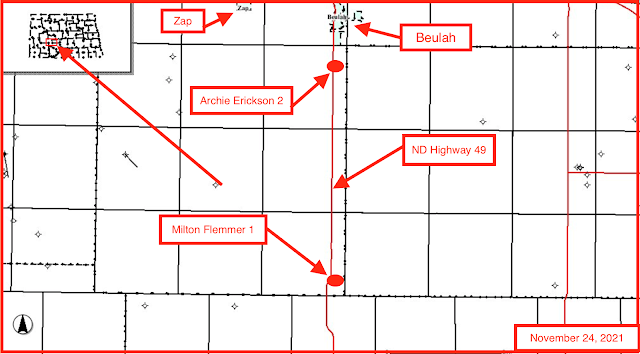
This must the location the reader's buddy was reporting when he/she said there appeared to be two more drilling locations ready to MIRU between I-94 and Beulah on Highway 49. So far my sleuthing only comes up with Milton Flemmer 1. If the buddy is correct, we may also be looking at Milton Flemmer 2 but that's a bridge too far right now. 

See this post from October 20, 2021:

  • Summit Carbon Solutions has a permit, #38622, for an Archie Erickson 2 well, to be sited in SWSW 12-142-88, a wildcat, to be sited 902 FSL and 794 FWL

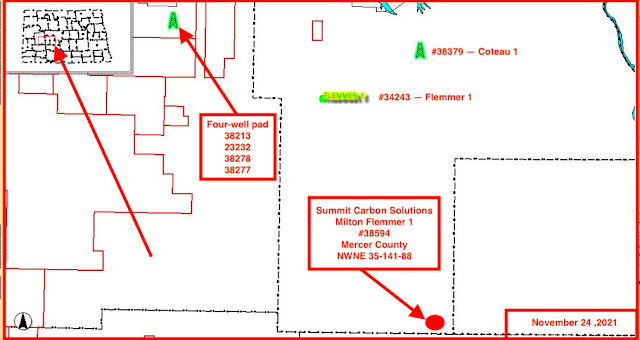
So, the first map, November 24, 2021:

Map updated November 24, 2021, following NDIC's end-of-day daily activity report: 

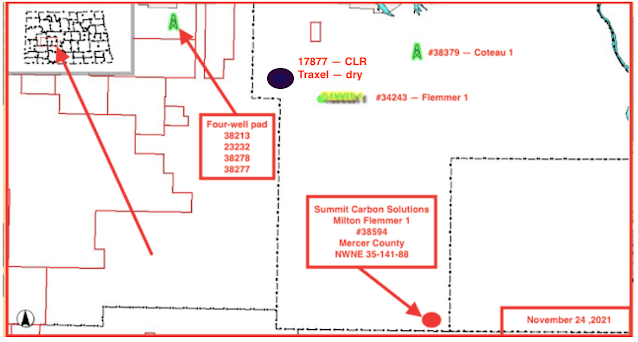
Wow, it never quits. Seeing these maps, this post, a reader was reminded of a wildcat that Harold Hamm drilled back in 2009 looking for the eastern fringe of the Bakken. In the map below, the black circle is the general location of that well:

  • 17877, PA/84, CLR, Traxel 1-31H, Beaver Creek Bay, t12/09; cum 12K 12/13;

The map:

Giant Pipeline In US Midwest Tests Future Of Carbon Capture -- Reuters -- November 23, 2021

Synopsis:

  • ethanol plants in Iowa produce a lot of CO2
  • opportunity for these plants to pipe CO2 to North Dakota where it can be stored
  • Summit Carbon Solutions: pipeline across midwest and injection sites in North Dakota
  • farmers in Iowa not happy with idea of pipelines across their land: NIMBY
  • see this post for more.

Original Post

Feature story of the day. You may have to "register" to get to article over at Reuters but it's free. I've archived the article. Regular readers know what this is all about. I'll come back to it later when I get caught up.

Link here

Nov 23 (Reuters) - Dan Tronchetti received a letter in August that alarmed him: Summit Carbon Solutions, a company he'd never heard of, wanted his permission to conduct survey work for a 2,000-mile pipeline it planned to route through his Iowa corn and soybean fields.

The project, dubbed the Midwest Carbon Express, had ambitions to become the world's largest carbon dioxide pipeline, moving climate-warming greenhouse gases from Midwest biofuels plants to North Dakota for permanent storage underground.

But Tronchetti's first concern was for his livelihood. "It would go more than half a mile through prime farmland," he said.

The 65-year-old is among dozens of landowners along the route who are refusing to cede their property to the project, according to Reuters interviews with five landowners, four community groups organizing opposition, several academics and industry sources plus a review of filings with state regulators.

The impasse could escalate into potential court battles if Summit tries to seize the land by claiming eminent domain. Such legal fights contributed to the cancellation of the Keystone XL oil pipeline this year.

The outcome of the dispute poses huge stakes for Summit's $4.5 billion project, and for the Midwest ethanol producers it would serve who are hoping to wipe away their carbon footprints and burnish their green credentials.

It also represents what could be the biggest test yet for the carbon capture and storage (CCS) industry, which has struggled for years but which advocates say could become a powerful tool in the global fight against climate change.

Underground geological formations in the United States have the potential to store 2.6 trillion tons of planet-warming CO2, enough to cover all of America's historical emissions and those to come for centuries, according to the Department of Energy.

But there are open questions about whether CCS can ever fill them. Despite billions of dollars of public investment over the past decade, the technology remains relatively untested.

The United States boasts just 12 operational commercial CCS facilities that together have an annual capacity to store away 19.64 million tons of carbon, about 0.4% of national emissions.

Much, much more at the link; this is simply the beginning of a long, long article. 

Thursday, October 21, 2021

Notes From All Over -- The Kyndryl Edition -- October 21, 2021

UNP, 3Q21 earnings:

  • profit topped analysts' expectations
  • cost cuts and price increases bolstered the bottom line even as cargo growth lagged
  • UNP cut its 2021 volume target
  • volume growth, 5%, down from a target of 7%;
  • EPS: $2.57 vs $2.51, and higher than than the $2.01 a year earlier;
  • revenue rose 13% to $5.6 billion vs $5.4 billion forecast

Economic indicators released today: wow, wow, wow -- the housing sales numbers were absolutely incredible. I was impressed. 

A reminder, IBM to split into two companies:

  • Kyndryl ("can drill") would have been a better name for an oil company
  • link here; and, here.

Wework: set to go public via a SPAC two years after failed IPO. Link to WSJ

Supply chain shortages:

  • US: just-in-time delivery
  • China: just-in-case delivery

********************************
CCS

Updates

October 21, 2021: HartEnergy has the story, finally. And also at KFYR

North Dakota’s regulatory framework for geologic sequestration of carbon dioxide (CO2) is leading the nation again as the North Dakota Industrial Commission approved the first Class VI well in North Dakota on Oct. 19.

 North Dakota was the first state to receive primacy of Class VI wells from the US EPA in 2018, followed only by Wyoming in 2020.

Original Post

North Dakota carbon storage: ethanol plant seeks to capture emissions. Amy R. Sisk.

Tuesday, October 19, 2021

Carbon Cycle Modeling -- Tom V. Segalstad -- University of Oslo -- October 19, 2021

Published in 2009, I believe.

At this site, click on the "down arrow" to the right of "download full-text PDF" and then click on "read full-text."

From the reader who sent me this link and the paper:

I have attached a paper on the carbon cycle---how long CO2 stays in our atmosphere and where it goes. 

It is great information on the dogma of climate change. If electric propulsion is to replace internal combustion propulsion, the cost of “clean” energy must be competitive with “dirty” energy. We both know it is not even close including heavy subsidies. That is why the cost of carbon based energy will be manipulated upward. Europe is starting to figure out the real costs in alternatives and is rapidly changing their direction.

 The loss of ethane et al when slowing down the use of hydrocarbon fuels has yet to be felt financially and actually in shortages of everything we use. 

Most of our “stuff” comes from the well. I hope more people realize the whole thing is a bunch of crap. The political motivation is varied between power and money, who cares, it’s still all crap. They think stopping pipelines will somehow limit the use of oil. Let’s see how that works. 

Ironically CNBC is now reporting on the "return" to coal due to the global energy crisis.

Thursday, October 14, 2021

North Dakota: A Gift To The Planet -- U.S. Secretary of Energy Jennifer Granholm -- But We Already Knew That -- October 14, 2021

Over at Yahoo!News

U.S. Secretary of Energy Jennifer Granholm, during a visit to the Energy & Environment Research Center at UND, said she believes North Dakota is poised to play a key role in addressing climate change.

Granholm visited Grand Forks on Thursday, Oct. 14, to tour the EERC with Sen. John Hoeven, R-N.D., and Gov. Doug Burgum. Following that tour, they held a discussion with energy company executives from across the state.

That discussion focused on the generation of clean power, but also on advancing to commercialization carbon capture utilization and storage technology (CCUS) — essentially stripping carbon from coal or other energy sources, and burying it underground. Energy executives said doing so will require expanded federal financial assistance.

Granholm said she doesn't view combating climate change with a silver bullet, but rather "silver buckshot." In North Dakota, that buckshot pattern hits several targets, including further rolling out wind and solar power, but also working to decarbonize fossil fuels.

And, then look at this:

Burgum said North Dakota "hit the jackpot of geology" because the state can store 252 billion tons of carbon underground in a carbon "sink." That amount, he said, equates to 50 years of national carbon production from energy generation, or 4,400 years in what North Dakota generates on its own.

Granholm agreed, saying: "You've got a comparative advantage, clearly in carbon capture and storage because of your geography," and called the storage capacity a "gift to the planet."

In May, Burgum announced an ambitious plan to make North Dakota carbon neutral by 2030. Burgum said since that announcement, investment from outside the state has poured in, to the tune of $25 billion for projects like carbon capture programs.

Monday, October 4, 2021

November, 2021, Hearing Dockets -- CO2 Storage Cases

Link here.

All cases from the Milton R. Young Station, Minnkota Power Cooperative.

These are cases, not permits:

  • 29029: 41 sections for storage in Oliver County. Storage in Broom Creek formation.
  • 29030: 41 sections for storage in Oliver County. Storage in Broom Creek formation.
  • 29031: 41 sections for storage in Oliver County. Storage in Broom Creek formation.
  • 29032: 41 sections for storage in Oliver County. Storage in Broom Creek formation.
  • 29033: 41 sections for storage in Oliver County. Storage in Deadwood formation.
  • 29034: 41 sections for storage in Oliver County. Storage in Deadwood formation.

Friday, August 13, 2021

North Dakota Carbon Capture And Storage -- August 13, 2021

Updates

October 21, 2021: HartEnergy has the story, finally. And also at KFYR

North Dakota’s regulatory framework for geologic sequestration of carbon dioxide (CO2) is leading the nation again as the North Dakota Industrial Commission approved the first Class VI well in North Dakota on Oct. 19.

 North Dakota was the first state to receive primacy of Class VI wells from the US EPA in 2018, followed only by Wyoming in 2020.

Original Post

Re-posting:

North Dakota carbon storage: ethanol plant seeks to capture emissions. Amy R. Sisk. Key words:

  • Richardton ethanol plant
  • Red Trail Energy
  • could be the first project in North Dakota that both captures and injects carbon emissions underground
  • North Dakota and Wyoming are the only states that have assumed full permitting authority fro the EPA for carbon injection projects
  • first  location: a well east of the Stark County plant targeting the Broom Creek rock formation more than 6,300 feet deep
  • CO2 would form a plume in the pore space
  • "supercritical" under high pressure and temperature
  • CO2 to be trapped there forever; the nearest drinking water source lies 4,000 feet above the injection layer, but if it escapes, hey, we have carbonated water
  • 90% of landowners with pore space in the project area have signed leases, meeting the state's 65% threshold for a project to move forward
  • one carbon capture project has already operated for years within North Dakota at Basin Electric Power Cooperative’s Great Plains Synfuels Plant near Beulah. Carbon dioxide from the facility is piped to Canada where it’s injected into old oil fields to boost oil production

Sunday, September 13, 2020

Project Tundra Sets Up Second Test Well -- Source -- September 13, 2020

The story:

  • test well rig just south of the main plant at the Milton R. Young Station
  • plant's owner: Minnkota Power Cooperative
  • first-of-its-kind CO2 capture and storage initiative
  • legislative leaders shown a table of boxes filled with rock core samples from well drilled this summer four miles to the northwest

No doubt it was the table of boxes filled with rocks that swayed them.

Monday, December 2, 2019

New Operator In North Dakota: An Ethanol Producer, Red Trail Energy, LLC, Has An Oil And Gas Permit -- December 2, 2019

Updates

December 11, 2019: what is Red Trail up to? From April 20, 2019, US News, a carbon capture project. Data points:
  • this is being done to meet West Coast fuel standards
  • the company recently completed a geophysical survey of eight square miles around the plant
  • company's goal is to produce ethanol that will meet the low carbon fuel standards of California and/or the Pacific Northwest
  • the company and the EERC are targeting the Broom Creek formation, about 6,400 feet below ground that area
  • proposal: to inject about 160,000 metric tons of CO2 per year into the well
  • leaks? can anyone say Aliso Canyon gas leak?
December 7, 2019: from a reader, regarding the Red Trail Energy permit, see first comment:
The permit Red Trail is requesting for drilling could likely be related to research for a carbon sequestration project. Ive heard they have interest in a potential CO2 capture project. There will likely be permits requested for a well or wells in Oliver County in the near future as well which are related to Project Tundra, another potential CO2 capture project.
Original Post

Active rigs:

455.9812/2/201912/02/201812/02/201712/02/201612/02/2015
Active Rigs5666533964

One permit renewed:
  • Bruin: an FB Leviathan permit in McKenzie County
Four new permits, #37229 - #37232, inclusive
  • Operator: WPX (3); Red Trail Energy, LLC
  • Fields: Spotted Horn (McKenzie County); Wildcat (RTE 10, Stark County)
    • WPX has permits for a 3-well Patricia Kelly pad in section 3-150-94, Spotted Horn oil field;
    • Red Trail Energy, LLC, has a permit for a wildcat in SENE 10-139-92;
Over at the NDIC well search site, this is the first and only permit (so far) for Red Trail Energy, LLC.  The website for Red Trail Energy greets visitors with huge "Ethanol" banner.
From the website:
Red Trail Energy, LLC (RTE) is a North Dakota-based investor group formed to finance, construct and operate a corn-based ethanol production facility located near Richardton, North Dakota. This vision became a reality when the $99 million, state-of-the-art plant began producing ethanol, in January of 2007. RTE now employs 47 personnel with an annual payroll of $2.9 million.
As one of the first coal-fired ethanol plants in the nation, RTE produces 50 million gallons of ethanol, using 18-20 million bushels of corn and ~100,000 tons of coal, annually. The plant will generate 2.8 gallons of ethanol from every bushel of corn. Coproducts produced by RTE include 125,000 tons of dried distillers grain and 80,000 tons of modified-wetcake annually.
The Richardton plant’s physical layout is composed of eleven structures, totaling 100,000 square feet of buildings, including administration, maintenance, processing, grain receiving, dried distillers grains storage, coal island, dryers and a pump house. The second-generation plant incorporates all the latest advances in ethanol processing, including equipment and technologies proven to boost efficiency and return on investment.
No mention of oil and gas operations.  The wildcat will be drilled on/near RTE property north of Richardton, ND. Richardton is east of Dickinson and about 100 miles west of Sterling, ND, where one turns south to Linton, ND. Linton is the county seat for Emmons County. Folks may remember Linton, ND: that's where the recent NDIC hearing on the DAPL expansion was held. Emmons County is the location of the fabled "Sleeping Giant" natural gas field.

From a reader, alerting me to RTE, which could end up being quite a story:


****************************************
Hope Springs Eternal

Area under discussion:


Thursday, April 19, 2018

Making America Great Again! The Federal Government Cedes Control On CCS To North Dakota -- April 19, 2018

Don sent me this story some weeks ago. I did not post it at the time, I don't think. Can't remember. If I did not post it, I don't remember why. Maybe I was very busy. Whatever.

Here it is now, sent to me by another reader: the EPA -- the federal government, wow -- approves North Dakota's request to manage its CSS program! Data points:
  • the State of North Dakota felt that it (the state) could "implement and enforce" its own Class VI Underground Injection Control (UIC) program; and, requested permission to do so
  • oh, yes, now I remember, I did do a google search to learn about the UIC program and then moved on
  • Class VI UIC: long-term storage of CO2 captured from industrial and energy-related sources
  • generally referred to as CCS: carbon capture and storage
  • 2016: the state awarded almost one-half million dollars to Red Tail Energy and the EERC (UND) to study CCS at Red Tail Energy's ethanol manufacturing facility near Richardton, ND, to reduce the carbon footprint associated with ethanol production
Now, I remember why I did not post it (if, in fact, I did not post it): the press release exceeded the acronym/sentence ratio allowed by the blog's editor.

In short hand, this is how the above data points would have looked:
  • EPA grants ND I&E of Class VI Underground Injection Control (UIC)  
  • Class VI UIC: LTS of CO2 from I&ER sources
  • Class VI UIC: CCS
  • 2016: ND awarded $490K to Red Tail Energy & EERC (UND) to study CCS at RTE's EMF near 58652 to reduce the CF associated with EP
Comment: I am amazed that the federal government would trust the state of North Dakota to "implement and enforce" CCS. Making America great again!

By the way, it is my understanding that President Trump is in favor of carbon capture and storage; but he is adamantly against carbon capture and release.

Later: my bad. A reader informed me that President Trump has not tweeted on carbon capture and release. Trump's concern with "capture and release" has to do with illegal immigrants along the southern border.

Tuesday, January 10, 2017

Hey, This Is Texas! Of Course This Facility Is The Largest Of Its Kind In The Universe -- January 10, 2017

This could be the biggest non-Bakken story of the year to date.

Updates

October 31, 2017: EIA update on Petra Nova
The Petra Nova facility, a coal-fired power plant located near Houston, Texas, is one of only two operating power plants with carbon capture and storage (CCS) in the world, and it is the only such facility in the United States.
The 110 megawatt (MW) Boundary Dam plant in Saskatchewan, Canada, near the border with North Dakota, is the other electric utility facility using a CCS system.
Petra Nova’s carbon-capture system is designed to capture about 90% of the carbon dioxide (CO2) emitted from the flue gas slipstream, or about 33% of the total emissions from Unit 8. The post-combustion process is energy intensive and requires a dedicated natural gas unit to accommodate the energy requirements of the carbon-capture process.
 The carbon dioxide captured by Petra Nova’s system is then used in enhanced oil recovery at nearby oil fields. Enhanced oil recovery involves injecting water, chemicals, or gases (such as carbon dioxide) into oil reservoirs to increase the ability of oil to flow to a well.
By comparison, Kemper had been designed to capture about 65% of the plant’s CO2 using a pre-combustion system. The capital costs associated with the Kemper project were initially estimated at $2.4 billion, or about $4,100 per kilowatt (kW), but cost overruns led to construction costs in excess of $7.5 billion (nearly $13,000/kW). Petra Nova CCS retrofit costs were reported to be $1 billion, or $4,200/kW, and the project was completed on budget and on time.
April 13, 2017: press release, no link -- "Secretary Perry celebrates successful completion of Petra Nova carbon capture project." Data points, same as those previously posted, but these new ones or important enough to be reposted:
  • joint venture: NRG Energy (US) and Nippon Oil (Japan)
  • funded in part by US DOE; originally conceived as a 60-MW electric capture project
  • expanded to a 240 MWe Houston-area power plant; quadrupling the size of the capture project without additional federal investment 
  • 5,000 tons of CO2 captured daily; EOR at the West Ranch Oil Field
  • to boost production from 500 bopd to 15,000 bopd
  • estimate: 60 million bbls of recoverable oil from EOR operations
January 10, 2017: also in Financial Times.  Additional data points:
  • the project is called Petra Nova
  • $1 billion project
  • capturing CO2 from the equivalent of 240 megawatts of power generation
  • covering costs by using gas for oil production
Original Post

At Reuters via Rigzone:
  • operations have begun
  • NRG Energy and JX Nippon Oil & Gas Exploration
  • $10.4 billion carbon capture facilty
  • Texas coal-fired power plant
  • emissions are being used to extract crude from nearby oilfield
    • 80-mile pipeline (yes, at least one state can still build pipelines) to the West Ranch Oil Field
    • West Ranch Oil Field opened in 1930; produces 300 bopd
    • with EOR, production should jump to 15,000 bopd within three years
  • unlike wind and solar projects, this project will NOT result in higher utility costs for consumers
  • CO2 extraction = EOR (enhanced oil recovery) -- several readers have spent several years waiting for this news -- time to break out the champagne
  • largest of its kind in the world
    • US DOE funded $190 million for the project's construction
    • Japan: $250 million in loans
    • NRG / JX Nippon: split the remaining $600 million
    • Mitsubishi: engineered the plant
    • at its peak: 1.6 million tons of CO2/year (4,000 tons/day) -- 90% of NRG's nearby power plant, the largest in Texas
  • since opening December 29, 2016: 111,000 tons of CO2 (111,000 / 12 days = 9, 250 tons/day (I may have done the math wrong, but the first ten days, the average collected more than doubled expectations
  • the other science project, the incredibly expensive Kemper, MS, plant is yet to come on-line
    • cost $7 billion (so far) 
  • the Texas plant: $1.04 billion
  • uses a different process to capture CO2

Saturday, July 19, 2014

Personnel Costs, Railroads; Texas To Get Bragging Rights To Having First Existing Coal-Fired Power Plant Retrofitted To Capture Carbon (CO2)-- July, 2014

On July 17, 2014, I mentioned in passing the personnel costs associated with engineers/railroads. Today The Dickinson Press is reporting:
BNSF Railway has struck a tentative agreement with a union that would allow one-person train crews on certain routes if a monitoring system is in use.
The proposed agreement, which is at odds with the national union’s staunch support of two-person crews, also conflicts with a possible federal rule that would require two crew members aboard trains.
According to BNSF, the tentative agreement allowing a one-person crew would not apply to large trains carrying hazardous cargo, including crude oil and ethanol.
“BNSF has special handling procedures and operating rules for hazardous materials including loaded crude unit trains, which, among other things, require two people in the locomotive,” BNSF spokeswoman Amy McBeth said Friday. “That would not change under the agreement.”
The railroad’s agreement with the Transportation Division of the Sheet Metal, Air, Rail, and Transportation Union, SMART, would apply to about 60 percent of BNSF’s system.
Anyone wanna bet this will happen? For the record, I'm not taking bets.


*******************************
Texas: First Existing Coal-Fired Power Plant To Be Retrofitted 
With Coal Gas Capture Technology

Data points:
Where to get the CO2?
  • coal-powered W. A. Parish power plant eighty (80) miles away generates C02
  • retrofit the power plant to capture the CO2 and move it to West Ranch oil field by pipeline
  • joint venture: NRG Energy (Texas utility) and JX Nippon Oil and Gas (Japanese)
  • to be completed in 2016
Why is this news?  The project marks the first time an existing coal-fired power plant is being refitted with coal gas capture technology.


*******************************
Velocity of Money 
and
Government's Obfuscation With Gasoline Consumption Data

Some months ago I posted a number of observations while reading Sylvia Nasar's book on economics: Grand Pursuit. All things being equal, it is not the amount of money the government prints, but it is the velocity of money moving through the economy that correlates best to inflation. I was reminded of that again by the excellent "guest post" over at ZeroHedge: US gasoline consumption plummets nearly 75%. It's an article worth bookmarking and reading when one has time.

*******************************
No New "Red Lines"After Malaysian Airlines "Tragedy"
When "last chance" means "extend the deadline"

It was noted on Los Angeles radio yesterday that the president did not set any new "red lines" following the shoot-down of the Malaysian airliner. However, earlier in the week, this Reuters headline: Iran warned of "last chance" in talks after deadline missed.

So, what does "last chance" mean?  Extend the deadline:
The countries agreed to extend the high-stakes negotiations by four months.
I can't make this stuff up. No longer any more "red lines"; rather, "one last chance."

Monday, December 23, 2013

Maybe The Dots Are Connecting On CO2

For background read:
Now this story, sent in by a reader, AP vis Yahoo!Finance:
America's newest, most expensive coal-fired power plant is hailed as one of the cleanest on the planet, thanks to government-backed technology that removes carbon dioxide and keeps it out of the atmosphere.
But once the carbon is stripped away, it will be used to do something that is not so green at all.
It will extract oil.
When President Barack Obama first endorsed this "carbon-capture" technology, the idea was that it would fight global warming by sparing the atmosphere from more greenhouse gases. It makes coal plants cleaner by burying deep underground the carbon dioxide that typically is pumped out of smokestacks.
But that green vision proved too expensive and complicated. So the administration accepted a trade-off.
To help the environment, the government allows power companies to sell the carbon dioxide to oil companies, which pump it into old oil fields to force more crude to the surface. A side benefit is that the carbon gets permanently stuck underground.
The program shows the ingenuity of the oil industry, which is using government green-energy money to subsidize oil production. But it also showcases the environmental trade-offs Obama is willing to make, but rarely talks about, in his fight against global warming.

Friday, December 20, 2013

CO2 Is Not A Hazardous Waste -- Obama Administration

I don't know how big a deal this is for the Bakken -- yet -- but something tells me this is very, very good news for some folks. 

From Argus Media:
The Environmental Protection Agency (EPA) yesterday issued a final rule that exempts CO2 injected underground from hazardous waste regulations, a step the agency said would help ensure “safe and effective deployment” of carbon capture and sequestration (CCS) technologies.
The rule, issued under the Resources Conservation and Recovery Act, is intended to fill gaps in policy on CCS and help spur its use at stationary sources such as power plants. The resources conservation act governs the handling of municipal and industrial waste.
CCS is not yet used at a commercial-scale operation, but a few projects are under construction and EPA has proposed requiring new coal-fired power plants to capture at 30-50pc of CO2 emissions. CCS project developers have noted that regulatory gaps make planning difficult in spite of government initiatives to promote the technologies.
The new rule follows EPA's creation in 2010 of a new class of underground storage wells specifically for CO2sequestration under the Safe Water Drinking Act — Class IV wells. That ruling also established how wells used for CCS should be sited, constructed, tested and monitored.

Sunday, January 6, 2013

Another Carbon Capture Process -- New Technology -- Absolutely Nothing To Do With The Bakken -- At Least Not Yet

Updates

January 6, 2013: Pilot plant to capture atmospheric CO2 going up in Calgary, Alberta.
A Canadian company has developed a cleansing technology that may one day capture and remove some of this heat-trapping gas directly from the sky. And it is even possible that the gas could then be sold for industrial use.
Carbon Engineering, formed in 2009 with $3.5 million from Bill Gates and others, created prototypes for parts of its cleanup system in 2011 and 2012 at its plant in Calgary, Alberta. The company, which recently closed a $3 million second round of financing, plans to build a complete pilot plant by the end of 2014 for capturing carbon dioxide from the atmosphere, said David Keith, its president and a Harvard professor who has long been interested in climate issues. 
This will drive faux environmentalists mad: using CO2 to extract even more oil from the earth:
Should the cost of capturing carbon dioxide fall low enough, the gas would have many customers, he predicted. Chief among them, he said, would be the oil industry, which buys the gas to inject into oil fields to force out extra oil. The injection has minimal risk, said Howard J. Herzog, a senior research engineer at the Massachusetts Institute of Technology. “The enhanced oil recovery industry has put tens of millions of tons of carbon dioxide into the ground every year for decades with no problems,” he said.
Much of the carbon dioxide for enhanced oil recovery comes from naturally occurring underground reserves that are piped to oil fields, said Sasha Mackler, vice president of Summit Carbon Capture, a unit of Summit Power Group in Seattle. Summit Carbon Capture harvests carbon dioxide gas from coal and natural gas-burning plants before it can be spewed into the air.
Original Post 

This is a new technology that I have not seen before; lots of moving parts to the story, new names, new companies. It's best you to the linked story to sort it out yourself but I will put down some data points that caught my eye. (Some numbers rounded.) Again, a big "thank you" to Don for sending it my way.

This is a new company built around a new technology that captures CO2 to
a) convert it to acid and baking soda that can be sold; and/or,
b) converted to a solid that can safely be stored in landfills
The new technology was developed partly with the aid of a Department of Energy grant. 

Capitol Aggregates, a cement company, in San Antonio, TX, where I now call home, will build a plant with a new patented process that will "offset" 225,000 tons of CO2/year. Cement production is a significant source of CO2. If I read the article correctly, that plant will cost about $125 million.

I have no idea if 225,000 tons is huge amount of CO2 or not. What does one compare it to?

It turns out that Air Products & Chemicals Inc is building a $430 million project at a Valero refinry in Texas where it will capture 1 million tons of CO2 and pipe it to Denbury Resources for enhanced oil recovery (EOR) -- CO2 flooding of old oil fields.

Anyway, a lot of data points, new technology, San Antonio, all very interesting. See the story at the link.

Friday, October 19, 2012

Minor Bakken Note: Geologic Storage of Carbon Dioxide in the Williston Basin

The commission has added a new case to the agenda in October:
17431, on a motion of the Commission to consider adopting new rules and amendments to the "Geologic Storage of Carbon Dioxide."

The case number is lower than oil-and-gas related cases, so not sure if this is new, or carried over, or something else. Regardless, the case number is unimportant; the subject is interesting.