Showing posts with label MusingsWinter. Show all posts

Saturday, October 30, 2021

Anticipation -- October 30, 2021

Here we go: Dallas Cowboys vs Minnesota Vikings -- tomorrow night, Sunday night football.

Sports tonight;

  • 5:00 p.m.: NASCAR junior varsity.
  • 7:00 p.m. World Series, MLB, game 4.
  • 7:00 p.m. college hockey, at Nashville, Hall of Fame, North Dakota (UND) vs Penn State;

Dear John: apparently union reaches deal with John Deere. Needs to be fact-checked.

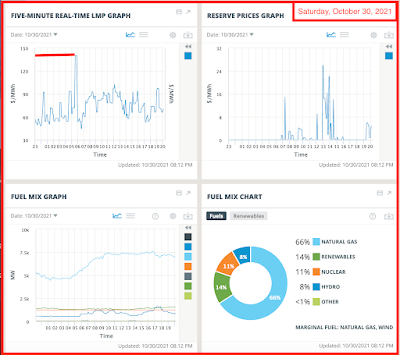
ISO NE: link here -- a spike to $135 / MWh early this morning.

Weather:

Covid vaccine rollout:

  • prior to "the Biden mandate," vaccinations were running about 750,000 / day;
  • now, after "the Biden mandate," vaccinations are trending toward 1.6 million / day.
  • administration is delivering significantly more doses to those administering the vaccine. 

Influenza surveillance, US: negligible

Tuesday, March 11, 2014

US Energy Coal Policy Running Amok

I don't even know where to begin; I don't have a dog in this fight. I am simply a spectator. A spectator who is watching US policy run amok.

Read this article a couple of times. See how many story lines you can find. I find this paragraph particularly interesting:
In Pennsylvania, Attorney General Kathleen G. Kane said her office had been flooded with complaints from consumers whose utility bills had soared, in some cases tripling.
In Rhode Island, the utility National Grid received permission for a 12.1 percent electricity rate increase in January, nearly all of it because of higher prices for the gas used to make electricity.
This article is not in a "coal" journal. It's not from Rigzone. It's not from the Oil & Gas Journal. The article is from The New York Times. The editors won't admit it but they are finally starting to get it.

Going forward the incumbents have three problems:
  • ObamaCare
  • high utility costs
  • unemployment/underemployment and 99+ week-benefits not renewed
The article tries to extend this energy problem to the entire United States; to some extent it is true. But right now it's hitting the northeast hard.
In New York, Con Edison increased the price of each kilowatt-hour about 16 percent this month compared to last year. And in Ohio, energy retailers will demand higher prices from customers like Ms. Cundiff when annual contracts are renewed.
No war on coal? LOL.
Underlying the growing concern among consumers and regulators is a second phenomenon that could lead to even bigger price increases: Scores of old coal-fired power plants in the Midwest will close in the next year or so because of federal pollution rules intended to cut emissions of mercury, chlorine and other toxic pollutants. Still others could close because of a separate rule to prevent the damage that cooling water systems inflict on marine life.
So, we will see what next winter brings. Let's keep our fingers crossed it's not frigid weather caused by global warming.
For utilities, another frigid winter like this one could lead to a squeeze in supply, making it harder — and much more expensive — to supply power to consumers during periods of peak demand.
By the way, I don't know what the writers mean by "for utilities." The utilities will do just fine. The consumers won't. 

By the way, if folks think utility costs are high in Rhode Island right now, wait until the incumbents vote to increase renewable energy requirements:
Wind costs significantly more than either coal or natural gas.
Friday, March 7, 2014

Musings On The Bakken: Cold Winters

I just got back from the Bakken.

I drove cross-country from Los Angeles to Williston, a few days in the Bakken, and then Williston, back to Dallas-Ft Worth area.

The story linked below discusses the challenges the Bakken operators face during the harsh winters. It will be interesting to see how this plays out over the next few years. During my week in the Bakken, I noted that during some of the harshest weather, the operators continued to build pads, drill, and frack.

One thing the article did not mention (unless I missed it), the impact cold weather has on the rails. Anyone who has Amtrak'd knows how winter weather impacts the train. Everything slows down. Folks forget that 71% of Bakken oil is moved by rail.

Personally, I think the spring thaw and (occasional) flooding presents a bigger challenge to everyone operating and working in the Bakken.

Now the story over at Rigzone:
Data published by the North Dakota Industrial Commission’s Department of Mineral Resources showed a 48,305 barrel-a-day decline in the state’s production for the month of December.
The report attributed the production decline primarily to the severe winter weather that hit the state at the end of last year.
According to the DMR, the state experienced low temperatures of 21 to 31 degrees below zero, four major snow storms and five major wind storms in December. Oil production for November had climbed by 31,278 barrels a day to 911,292 barrels a day, for a 3.6% increase over October’s level. The production drop in December was 5.3%.
The production decline, which was clearly impacted by weather, may also be demonstrating that there is a fundamental slowing in output and activity underway, which is not a good omen for the future for America’s oil output. During December, the drilling industry, according to the DMR, operated 190 rigs, up from 184 in November. The January rig count was 188. There were 119 wells completed during December, down from the 138 wells reportedly completed in November.
The monthly report stated that the days from spud to completion for wells drilled during December increased to 132 days, for an increase of 18 days from the length of time it took to drill wells in November. Another very interesting observation from the DMR report was that there were a total of 635 wells that had been drilled and were awaiting completion at the end of December, an increase of 125 wells during the month.
What the report doesn’t show, however, is how many of the wells being drilled were Bakken horizontal wells versus vertical wells in other producing formations. If we assume that 100% of the current drilling activity is for Bakken oil, which is not an unreasonable assumption given how hot the play is, then we can look at the change in the number of producing Bakken wells to see what is actually happening to activity in North Dakota. The December Bakken producing well count showed a 40-well increase from November, which if we compare against the 119 wells reportedly completed during the month of December leaves us with 79 wells that would have been added to the drilled-but-uncompleted total. That leaves us with 46 unaccounted wells from the figures for wells drilled, in production and added to the drilled-but-uncompleted pool. We are not sure whether we should be worried about this number of unaccounted for wells, or attribute them to weather-related counting issues.