Showing posts with label SaudiAramcoIPO. Show all posts

Tuesday, March 18, 2025

Taco Tuesday -- March 18, 2025

Locator: 48523B. 

Stranded astronauts: splashdown scheduled for just before 6:00 p.m. EDT this evening, Tuesday, March 18, 2025. Should splash down off the coast of Florida at 4:57 p.m. CDT.

JFK: files to be released today? 

March Madness: begins tonight, with the "first four" play in. 

  • this evening: two separate games, UNC/San Diego and Alabama/St Francis
  • tomorrow evening: two separate games: Texas/Xavier and American/Mt St Mary's
  • Thursday day/afternoon/evening/night: first round, sixteen games
  • schedule here.

Google: acquires Wiz for $32 billion; links everywhere. Cybersecurity play. Incredibly bullish for sixth industrial revolution.

  • deal was not completed under Biden administration due to anti-trust concerns ($30 billion at the time)
  • completed under Trump administration within first 100 days
  • this one acquisition exceeds entire dollar-amount of all previous Google acquisitions

Saudi Aramco: link here.

Chevron: Hess acquisition still moving forward, Chevron announces purchase of a bit of Hess (5% since start of year).

  • Chevron putting on its game face;
  • not all are getting a warm fuzzy on this deal.
  • link here.

Globalstar: Apple, link here.

Dallas NASDAQ:

Inflation watch, Texas beer: $5.99.

************************************
Back to the Bakken

WTI;

New wells:

  • Wednesday, March 19, 2025: 50 for the month, 165 for the quarter, 165 for the year,
    • 40032, conf, Hunt Oil, Oakland 154-89-31-29H 1,
    • 39890, conf, Hunt Oil, Halliday 146-93-11-1H-1,
    • 39889, conf, Hunt Oil, Halliday 146-93-12-36H 1,
  • Tuesday, March 18, 2025: 47 for the month, 162 for the quarter, 162 for the year,
    • 40482, conf, Silver Hill Energy Operating, Tucson W 158-94-26-35-1MBH,
    • 40473, conf, Hess, GO-John-156-98-0508H-4,
    • 40157, conf, Hess, EN-Schroeder-157-94-1102H-4,
    • 40031, conf, Hunt Oil, Shell 153-89-6-8H 1,

RBN Energy: Gulf coast refiners to be tested by loss of Venezuelan crude oil. Archived.

The Trump administration announced on February 26 that it is ending Chevron’s permit to operate in oil-rich Venezuela, which will halt U.S. imports of Venezuelan crude by early April. These changes, combined with other recent developments, are likely to significantly impact complex U.S. Gulf Coast refiners relying on heavy crude. In today’s RBN blog, we’ll discuss these impacts — an issue our Refined Fuels Analytics (RFA) practice examined in its recently updated Future of Fuels report. 

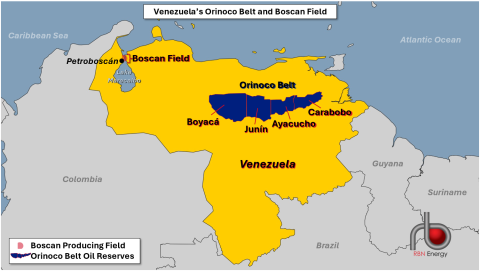
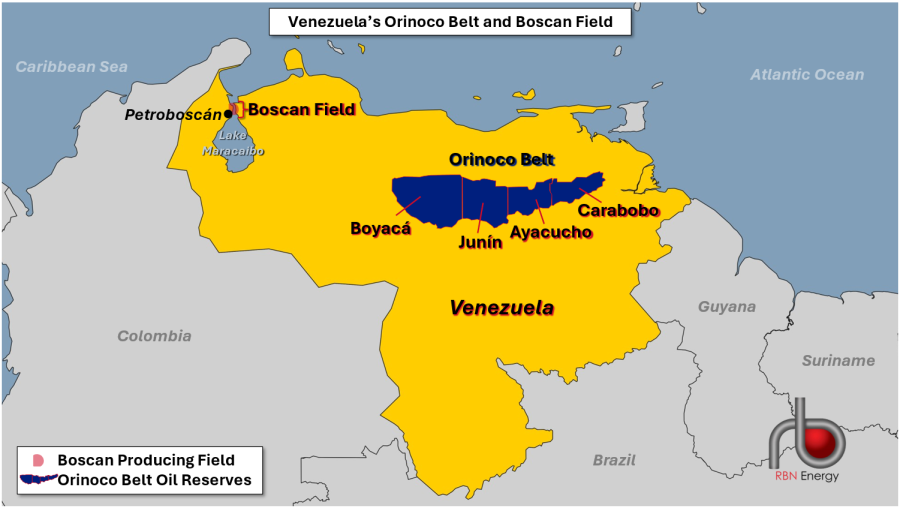
First, some background. Chevron and its corporate predecessors have more than a 100-year history of operations in Venezuela. Chevron’s legacy company, Venezuelan Gulf Oil, began drilling in 1924, spurring commercial oil production there, and followed that up with operations at Lake Maracaibo and the Boscan Field (tiny, pink-shaded area in Figure 1 below) in northwestern Venezuela. Then-President Carlos Andrés Pérez nationalized Venezuela’s oil industry in 1976 and established Petróleos de Venezuela S.A. (PDVSA) as the state-owned oil company, but despite the nationalization, Chevron remained, and it was asked to form joint ventures (JVs) with PDVSA. In 2006-07, then-President Hugo Chávez’s regime increased royalties and taxes on foreign oil companies and made other changes that prompted some companies — including ExxonMobil and ConocoPhillips — to leave Venezuela.
Venezuela’s Orinoco Belt and Boscan Field

Figure 1. Venezuela’s Orinoco Belt and Boscan Field. Source: RBN
Tuesday, August 11, 2020

Notes From All Over -- Saudi Aramco Update -- August 11, 2020

Before we get started. The price of gasoline in north Texas is about $1.85 / gallon, unleaded, least expensive. At our neighborhood service station, $1.64/gallon. 
 
Now back to the Saudi Aramco story.
 
I linked this article last week but it was behind a paywall, though, for some reason, it showed up on my iPad. Whatever. I tried to get to it this evening, but was stopped by the paywall. Then I googled the headline ("Saudi Aramco sticks to dividend pledge despite plunge in earnings") and it popped up on both the laptop and the iPad.

I find Saudi Arabia and the Saudi Aramco story fascinating. 

Saudi Aramco will pay $75 billion in demands this year despite the fact that their earnings probably don't cover the payout. But, to get the IPO approved by the king, the prince had to promise that the $75 billion dividend would be paid regardless of how well the oil company did. 

Look at this: in the most recent quarter, Saudi Aramco reported a net income of $6.6 billion, a 73% fall from the same period a year ago. So, three data points:
  • $6.6 billion net income in 2Q20;
  • a 73% fall in net income compared to a year earlier;
  • dividend payout: $75/4 = almost $20 billion -- well beyond the $7 billion in net income
And there's nothing to suggest the oil company will do any better in the next four quarters. Everyone says it is so incredibly cheap to drill for oil in Saudi Arabia as it is, which suggests to me that the company can't cut much more in expenses to improve their bottom line. 

It is true that the price of Brent has increased from $20 earlier this year to $40 and China is importing a lot more oil. But again: $7 billion in income in 2Q20, and the company needs almost $20 million to simply cover the dividend. From the article: 
Despite the uncertainty surrounding the global economy, Saudi Aramco said it would maintain the world's biggest quarterly dividend at $18.75 billion, most of it intended for the government in Riyadh, in line with its pledge for an annual $75 billion payout. 
The shareholder handout is far bigger than free cash flow for the period of $6.1 billion, which is down from $20.6 billion a year ago. 
But then this strange statement:
Mr Nasser told reporters that "our intention is to pay $75 billion, subject to board approval and depending on market conditions." Minority (i.e., non-government stockholders) shareholders, who own 1.5 percent of the company, will be "protected" for the next five years and given priority payments.
A new term for me: gearing ratio:
The company's gearing ratio -- a measure of financial leverage -- has already jumped to 20.1 percent, from minus 4.9 percent in the previous quarter. Saudi Aramco said this was related to the June acquisition of a majority stake in chemicals company Sabic from the Public Investment Fund, Saudi Arabia's sovereign wealth fund, for $69 billion. 
Saudi Aramco had expected the gearing to go up because of the deal, but the level far exceeded the company's longer-term target of 5 percent to 15 percent. 
Further, the government has already been forced to raise the kingdom's debt ceiling from 30 per cent of gross domestic product to 50 per cent, and Riyadh has borrowed more than $20 billlion on local and international markets this year.
I will quit there.

The article is worth a read. 

It's very possible that within my lifetime I will see the end of the House of Saud.
 
That's the number one reason I remain bullish on oil; the House of Saud will do what it takes to survive. 

And if you don't understand "gearing ratio," this is a great time to learn. Start here: Investopedia.
A higher gearing ratio indicate that a company has a higher degree of financial leverage and is more susceptible to downturns in the economy and the business cycle. This is because companies that have higher leverage have higher amounts of debt compared to shareholders' equity. Entities with a high gearing ratio have higher amounts of debt to service, while companies with lower gearing ratio calculations have more equity to rely on for financing.
The Recipe Page

I'm not sure if this beats salmon grilled on the Weber, but since I did not have a Weber but wanted salmon for dinner, I decided to give it a try. My notes to my wife in Portland, OR, who loves salmon:
On the drive home from Montana/Portland, I happened to catch a very, very interesting program on talk radio about bees and honey.

As part of the program, they talked about baking/grilling salmon with honey.

I tried this recipe.


I don't know if I would recommend it or not, but I found the crispiness very delicious and will do it again.

But warning: be sure not to over cook the salmon.

It does not say how long to cook on stove top. I was watching it very, very closely and made sure I kept spooning the butter/honey on the salmon and limited stove top to about five minutes.

Then the directions said 5 - 6 minutes in oven/broiler. I probably had it in the broiler/oven for four minutes and that was almost too long.

Anyway, I loved it and will do it again. Incredibly simple. It seems like it was done before I even started.
And, of course, you have to have a skillet that can go directly from stove top to oven.

Clean-up was very, very easy. I used a non-stick oven-ready skillet. By the time I got back to the skillet, the honey/butter residue was almost impossible to remove from the skillet. I put it back on the oven top, heated it up very carefully, and then, with a wooden spatula, the honey/butter residue was removed without any trouble.

Saturday, November 9, 2019

Wow! Are You Kidding! Will The Prince Get Away With Murder Again! Talk About Your Classic Bait And Switch; Hold On To Your Keffiyeh -- November 9, 2019

Updates

November 10, 2019: across the board, the Saudi Aramco IPO is being panned --
Saudi in deep trouble and no credibility, a laughingstock IPO, emperor with no clothes:


Original Post 

How many years did we hear about a Saudi Aramco IPO? Five years? Six years? I honestly don't recall but it has been many years.

And "how much" of Saudi Aramco was going to be made available to the public? 2%. Two percent.

Last week the Saudi Aramco IPO was finally launched. It was noted that the prospectus was coming out AFTER the IPO launched. Folks were buying into a "publicly traded company" without knowing what was being sold. A page from the Obamacare page book. "We need to pass the bill to find out what's in it"-- Nancy Pelosi.

The prospectus is yet to be released but the most important "data point" has been leaked.

"How much" of the company is being offered to investors?

Hold on to your keffiyeh.

Reuters is reporting that  Saudi Aramco is looking to sell up to 0.5% of the state oil giant to retail investors in its planned initial public offering (IPO).

"Up to." Which means it may not even be 0.5%.

The news was released on Saturday morning, 8:48 a.m. (EST, I assume).

So, at the end of the week, investors assumed they were investing in as much as 2% of Saudi Aramco. Today we learn that they were investing in no more than 0.5% of the company.

Let's see. 0.5 is what percent of 2.0? Twenty-five percent?

Tuesday, October 22, 2019

Six New Permits -- October 22, 2019

IPO: ever since it was announced I was highly skeptical the IPO would ever see the light of day (one post here, back on February 19, 2018). The IPO was delayed at the last minute earlier this week and now news is trickling out why that occurred (hint: not enough interest). Today there is a story that Saudi Arabia is issuing $250 billion in bonds to shore up its foreign reserves assets. I was going to post a "tea leaves suggest" that the IPO is not going to happen, or if it does, it's going to be watered down to something very, very small and listed only on some obscure Mideast bourse. But zerohedge beat me to it and probably did a better job than I would have:
Saudi Aramco’s IPO looks doomed to failure as it targets a $2 trillion flotation.
Tepid oil prices, the fraught politics of the Middle East and the demonization of fossil fuel producers in response to climate change fears have all made the initial public offering (IPO) a mission impossible.
The kingdom had looked poised to list up to 2 percent of its shares on its domestic market within weeks. But the long-delayed partial privatization of the world’s largest state-owned oil company now faces another indefinite postponement after the devastating attacks last month on some of its most important facilities at Abqaiq and Khurais in the Eastern Province of Saudi Arabia.  

API weekly inventory data:  
  • forecast: 2.232 million bbls
  • actual: 4.45 million bbls
**********************************************
Back to the Bakken

Active rigs:

$54.2210/22/201910/22/201810/22/201710/22/201610/22/2015
Active Rigs6171543469

Six new permits, #37106 - #37111, inclusive:
  • Operators: BR; Crescent Point Energy
  • Fields: Twin Valley (McKenzie); Marmon (Williams)
  • Comments:
    • BR has permits for a 5-well Carlsbad pad in section 17-152-97, Twin Valley oil field
    • Crescent Point Energy has a permit for a CPEUSC Njos well in section 26-157-100, Marmon oil field;
Thirteen permits renewed:
  • EOG (7): seven Burke permits in Mountrail County
  • QEP (2): two MHA permits, one in Mountrail County; one in Dunn County
  • Whiting: a Cvancara permit in Mountrail County
  • CLR: one Elveida permit in Divide County
  • NP Resources: one Trotter Federal permit in McKenzie County 
  • Petro-Hunt: a Mongoose permit in McKenzie County

Friday, August 30, 2019

I May Take The Day Off -- Good Luck To All -- August 30, 2019

This has to reassure investors.


Apparently, the IPO will list only on the Saudi exchange initially; Japan, possibly the second exchange. Will "shun" New York, Hong Kong markets.

Saturday, August 10, 2019

And I Thought It Was Going To Be A Quiet Saturday Morning -- August 10, 2019

Epstein dead. No link. Story everywhere. "Was no longer on suicide watch." Obviously some big rollers were involved. This pretty much ends the investigation. A collective sigh of relief was heard across the US, from Maine to New Mexico.


Uber: latest firm to flounder post-IPO.

Solar: SoftBank's bid to build a solar-power empire founders.

IPO: Saudi plans for biggest-ever IPO are back on. Later: largest company in the world by revenues; first conference earnings call; last 30 minutes; no one learns anything new. Alfalfa breathes a sigh of relief. Link here.

**************************
Solar

From the linked story:
For years, SoftBank Group Corp. Chief Executive Masayoshi Son has talked about building a global renewable-energy empire capable of carrying solar power across continents.
The Japanese investor sought deals of immense scale in Saudi Arabia, India and beyond. He promised to spend hundreds of billions of dollars tackling one of the world’s toughest challenges—meeting its growing energy demand with less carbon-intensive sources.
Today, his boldest proposals are foundering. Mr. Son has announced plans to build as much as 220 gigawatts of solar capacity in Saudi Arabia and India by 2030—equivalent to half of what exists today around the world. Yet SoftBank has managed to contract for around 3 gigawatts in India and has about 700 megawatts in Japan. The company hasn’t completed a project in Saudi Arabia and doesn’t appear close to winning a major contract there soon.
In India, developers including SoftBank were hit last year by unexpected increases in taxes and tariffs, cancellations of auctions and land disputes. One solar park in the country where SoftBank is building a plant has been hit by delays stemming from squatters refusing to move off the land allocated to the project.
Japan: note that is "megawatts," not "gigawatts."

1,000 megawatts = 1 gigawatt. 

******************************
IPO

From the linked article:
Saudi Arabia’s oil company is reviving plans for an initial public offering with the aim of accomplishing what would be the world’s biggest listing as soon as early next year.
The IPO process for Saudi Arabian Oil Co., known as Saudi Aramco, is being accelerated as government officials hope to capitalize on the positive market reaction to the state-owned company’s debut bond sale in April, which raised $12 billion.
Saudi officials also believe international outrage over the murder of dissident journalist Jamal Khashoggi in the kingdom’s consulate in Istanbul is easing.

Lipstick On Your Collar, The 50s and 60s Show

Thursday, August 8, 2019

Energy Notes From All Over, Part 1 -- August 8, 2019

Re-look? Saudi's bookkeeping is a lot like their annual estimate of their reserves. No matter how much changes, they never change. At $80-oil, the Prince Salman-Saudi-Aramco-5% IPO valued the world's largest oil company at $2 trillion. At $60-oil, the world's largest oil company is still valued at $2 trillion. Reuters.  But you know, Prince Salman may be right this time. What was the price of oil in "early 2016"? Depending on the definition of "early 2016," oil was selling for less than $40 at that time. Link here, click on 5-year chart.

Ethanol margins at multiyear lows: rising corn prices and oversupply of ethanol. Link at EIA.

Disclaimer: this is not an investment site. Do not make any investment, financial, job, travel, career or relationship decisions based on what you read here or think you may have read here.

China: crude oil imports jump 14% in July. Headline. 

Chevron: warns that earnings could be hurt due to "developments" in Venezuela. Too many eggs in one basket? Venezuela likely (?) to nationalize the company's assets. No link. Story everywhere.

China: could start slowing imports of crude oil from USA. No link. Story everywhere.

Cheenazuela: and then look at this -- where would China get that oil if it doesn't come from US? From Venezuela. It doesn't take a rocket scientist to connect the Chevron-Maduro-China dots.

***************************
Oasis

Oasis earnings, 2Q19: I missed this -- reported earlier this week -- a reader reminded me -- press release (some numbers rounded):
  • net cash: $214 million
  • adjusted EBITDA: $250 million 
  • production: 85,000 boepd, an increase of 6.3% from 2Q18
  • July, 2019, production averaged: almost 90,000 boepd
  • Permian (Delaware) well costs targeted at almost $10 million -- 10,000-foot laterals
  • LOE: $7.32/boe
Oasis earning, 2Q19, other sources:
  • Zacks:
    • EPS: 3 cents/share beating consensus of 2 cents/share; compares to 10 cents / share a year ago
  • shares drop 29% on updated guidance, Motley Fool
  • transcript at SeekingAlpha -- items specificd to the Bakken -- 
    • Bakken well costs average just less than $8 million; a path toward $7 million by end of 2019
    • the Wild Basin (in the Bakken) will become less strategic to Oasis going forward
At least it was not a "Whiting loss." 

And that was it.

Oasis shares trading under $3.00.

That which does not kill us makes us stronger. 

Tuesday, April 9, 2019

"Down Day" For Almost Everything; WTI Held Above $64

API weekly crude oil inventory data -- a big build -- a build of 4.1 million bbls. Forecast: a build of 2.294 million bbls (again, false precision). Including this week’s data, the net build is now 7.53 million barrels for the 13-week reporting period so far this year, using API data. But look at the gasoline inventory data: The API this week reported a draw in gasoline inventories for week ending April 5 in the amount of 7.1 million barrels. Analysts estimated a much smaller draw in gasoline inventories of 2.009 million barrels for the week. All background noise. Traders will do what they want regardless of the data. WTI trended down today, closing just below $64.

Aramco IPO: it's always been my contention we would never see an Aramco IPO. More evidence to support that contention: the "run on Aramco bonds was so huge, there is no need for an IPO." 

Active rigs:

$64.064/9/201904/09/201804/09/201704/09/201604/09/2015
Active Rigs6358493193

Three new permits:
  • Operator: Petroshale
  • Field: Croff (McKenzie County)
  • Comments:
    • Petroshale has permits for a 3-well Anderson North pad in section 14-149-96 in Croff oil field
Five permits canceled:
  • EOG (3): three Riverview permits in McKenzie County
  • Newfield (2): two Bernice permits, both in McKenzie County
Two permits renewed:
  • Whiting: a Westin TTT permit and a Kaden TTT permit, both in Mountrail County
Five producing wells (DUCs) reported as completed:in progress
  • 35312, A, CLR, Putnam 8-25H1, East Fork, t--; cum --;
  • 35311, A, CLR, Putnam 7-25H, East Fork, t--; cum --;
  • 35310, A, CLR, Putnam 6-25H1, East Fork, t--; cum --;
  • 34458, 1,931, Hess, CA-E Burdick-155-95-2017H-6, Capa, t3/19; cum --;
  • 32164, 1,812, Hess, CA-Anderson Smith-155-2635H-4, Capa, t3/19; cum --; 
    • 16083; off-line; t2/07; cum 253K 10/18;

Thursday, July 5, 2018

Saudi Foreign Reserves Fall Again -- July 5, 2018

Jobs: ADP -- private sector added 177,000 jobs in June. May numbers revised up to 189,000 from 178,000. The June number was close to the forecast who had expected an average of 190,000.
The government's monthly data will be released Friday. The unemployment rat is expected to hold steady at 3.8%, an 18-year low. Heaven forbid for the Trump team if unemployment ticks up to 4%. The mainstream media will have a field day, as they say.

I no longer pay much attention to "jobs" data any more. I've long forgotten the "thresholds." From the blog:
Economists estimate the labor market needs to create about 125,000 jobs a month to keep the unemployment rate steady, though estimates vary -- Reuters.
*************************** 
Doubts Grow

I said from the very beginning and have brought it up many times since: strong doubts that we will ever see the Aramco IPO. My reasons for doubting the IPO were probably wrong (maybe not) but regardless, "doubts grow," according to The WSJ

I track the Saudi Aramco IPO here.

****************************
Saudi Foreign Exchange Reserves

A reminder: prices have been inching up in May. Foreign exchange reserves, I assume, = income - expenses. And Saudi has a lot of expenses.

Just posted today at this link:


Thursday, June 21, 2018

Saudi Aramco IPO May Slip Beyond 2019 -- June 21, 2018

I wonder if readers remember this post: Saudi Aramco IPO delayed until 2019. That was posted a little over a year ago, back in March, 2018. Now, not to anyone's surprise, it is being reported that the IPO "may slip beyond 2019." All I know is that the kingdom "needs" $100-oil to make the IPO work. At least that was said some time ago. OPEC "basket" is now trading under $73.

I track the IPO milestones here

****************************
Nothing To Do With The Bakken
For The Archives
Posted For A Number Of Reasons
Link here for the complete article and I think it's a free link. 

From the current edition of The London Review of Books.

On the morning of February 18, 2011, Jack Adcock, a six-year-old boy, was brought into Leicester Royal Infirmary with diarrhea and vomiting.

He died eleven hours later.

The pediatric physician looking after him was convicted in November, 2015, of manslaughter by gross negligence, and in January, 2018, she was struck off the medical register (disbarred, as it were from ever practicing medicine again, in England).

Jack Adcock, the six-year-old, had Down’s syndrome and had previously undergone surger to repair a congenital heart condition.

When he arrived at the infirmary, after twelve hours of diarrhea and vomiting, he was described as being unresponsive. Initial blood test showed high levels of lactate and acid in his blood, which can be the result of shock, a secondary condition in cases of sepsis or dehydration.

The pediatrician (in training, by the way) attributed [the abnormal blood results] to dehydration caused by gastroenteritis and treated Jack with IV fluids. His bloods (sic) improved (although not back to normal values), he woke up, and he was observed drinking and playing.

While waiting for the results of further blood tests and a chest x-ray, the pediatrician (in training, by the way) went to see the many other patients she was responsible for that day, including a baby who needed a lumbar puncture for possible meningitis.

The pediatrician, who was in her sixth year of specialist training, was doing the work of two doctors, covering the children’s assessment unit (CAU) and referrals from [the emergency room] and [and other outside physicians] while the other pediatrician (also in training) was away on a training day (no cover had been provided).

The on-call consultant for the CAU was not in the hospital until the afternoon. The rest of the team consisted of two far more junior physicians who were beginning their pediatric rotations — one of them spent the whole afternoon on the phone to the laboratory getting blood results because the IT system was down.

The results of the blood tests that the pediatrician requested when Jack first arrived did not come back for six hours because of the IT issues. The pediatrician did not see the chest x-ray until three hours after it had been done. It showed pneumonia and she prescribed antibiotics.

It was a further hour before the antibiotics were administered by the agency nurse who wasn’t trained in pediatrics.

She, too, has been convicted of manslaughter for not adequately monitoring Jack or alerting the pediatrician to his deterioration [in fact, he had improved; he was seen drinking and playing].

The prosecution argues that the pediatrician had not reviewed the chest x-ray and blood results quickly enough, and that she should have started the antibiotics earlier and should have “escalated” her concerns to the on-call consultant, Dr Stephen O’Riordan, who was informed of Jack’s case and results at the usual 4:30 p.m. handover but didn’t review him (he has suffered no repercussions). O’Riordan has stated that he wasn’t asked to review Jack, but it would be reasonable to assume that a doctor of his seniority and experience would have made his own assessment of the seriousness of Jack’s condition (a child who had apparently recovered nicely with IV fluids, and was now drinking and playing; I doubt any senior consultant would have been “interested” in reviewing the case or the patient at that point): a consultant will often review a worrying case without being expressly asked to do so, and the Royal College of Paediatrics and Child Health recommends a consultant review of every patient within twelve hours of admission.

On the day of Jack’s death, the CAU was so busy that the pediatrician worked her 13-hour shift without a break.

It is worth nothing that she had only just come back after maternity leave, she was working in a hospital that was new to her, and she had received no induction from the [National Health Service].

At 7:45 p.m. Jack’s heart stopped and a crash call was put out alerting the medical team, including the pediatrician (who must have been in her 12th hour of work without a break).

Forty-five minutes earlier Jack had been given his regular medication, enalapril, a drug used to treat high blood pressure by his month.

The pediatrician had specifically not prescribed the enalapril as it can precipitate cardiac arrest in a patient who already has low blood pressure due to shock (at her trail she was criticized for not making it clear to the mother not to administer it).

Resuscitation was started, but briefly stooped because the physician in charge (the pediatrician who was in her 12th hour of a 13-hour shift; just off maternity leave; in a new hospital) thought a “do not resuscitate” order was in place. The inquest (surprisingly) ruled that this interruption did not contribute to Jack’s death as his condition was by then too far advanced. (Surprising, not because the inquest was correct in this matter, but the prosecutor could have easily gotten a bigger damage award had he pressed this issue; I guess the prosecutor felt that destroying the pediatrician’s livelihood and career was enough).

Jack was declared dead at 9:20 p.m.

Then, much more soul-searching continues.

At the end of the day, the pediatrician was found guilty of gross negligence manslaughter. She received a suspended sentence of two years’ imprisonment and was order to pay 25,000 English pounds to the prosecution. In 2017, the Medical Practitioners Tribunal Service imposed a 12-month suspension from the medical registrar (effectively disbarring her from practicing medicine in the UK, concluding that the pediatrician did not pose a continued risk to patients. This was challenged by the General Medical Council in the High Court — an unprecedented move —  and the judge agreed to her permanent erasure from the medical register [from the National Health Service].

Monday, March 19, 2018

The Political Page, The Market And Energy Page -- Yeah, Sometimes They Overlap -- March 19, 2018 -- Groningen To Be Cut -- Huge News For US LNG Exports

Wow, I'm off the net for one hour while biking back from the library and so much news pops up in that one hour.

First, most important: TSLA shares plunge. Hard to say why. The market in general has plunged, but there have been a lot of red flags around Tesla the past two weeks. But then this, just being reported today, at WSJ: Uber suspends driverless-car program after pedestrian killed. The Arizona test program was a big, big deal for all involved. My hunch: the shutdown will be temporary. The implications will last a lot longer. Phantom Touch, Vampire Drain, and now Pedestrian Pain.

Second, and more interesting, at least for me: Groningen natural gas field production cut decision by Mar 31: minister. Reported over at Platts.
Dutch economy minister Eric Wiebes will send a letter to the country's Cabinet containing details of a major cut to extraction levels at the Groningen gas field by March 31 at the latest.
Last Thursday, when Wiebes visited the damage claims desk in Groningen, he told local media he would send a letter about the future of gas extraction at Groningen by the end of March.

The current production quota for the 2017-18 Gas Year ending September 30 is 21.6 Bcm.

Following a 3.4-magnitude earthquake in the northern Dutch province of Groningen on January 8, with reports saying the quake was related to gas extraction, Wiebes said Groningen gas production could be cut by up to 2 Bcm in the current gas year, depending on temperatures.

Dutch gas regulator SodM also recommended a 12 Bcm/year cap on gas output from Groningen be introduced.

However, the final decision is up to Wiebes and he was expected to announce a production cut for the current gas year by March.
Groningen is not linked at the sidebar at the right; maybe it should be. LOL. It's easy to find -- just "google/search" Groningen on the blog.

Third: international Saudi Aramco IPO shelved. Will list IPO on Saudi exchange only, for time being.
  • Saudi Arabia is walking back plans for a massive public share offering for state oil giant Aramco, the world's biggest oil company, on a big international stock exchange.
  • Aramco is now expected to move forward with a listing on the Saudi stock exchange, with plans for an international listing at least temporarily shelved.
  • Aramco said a range of international listing options were still under consideration.

Thursday, March 15, 2018

The Market And Energy Page, T+15 --- March 15, 2018; How Did Bloomberg's Gadfly Miss This One?

Disclaimer: this is not an investment site. Do not make any investment, financial, job, travel, or relationship decisions based on what you read here or what you think you may have read here.

Wow. EOG has 40% upside -- Fitzsimmons over at SeekingAlpha.
  • like many Canadian energy stocks these days - Enbridge has suffered a massive sell-off: down 14% YTD and down 20% since the merger with Spectra was completed
  • but ENB's liquids pipelines in Canada are running at full capacity. And its storage assets benefit from the back-up in Canadian supply
  • dividend growth prospects are excellent and management has committed to growing the dividend at a 10% CAGR through 2020
  • an analysis of EV/EBITDA at a 14x midstream multiple (using 2018 estimated EBITDA) indicate shares are deeply discounted
  • the shares could easily trade up 40%, or to $46, from the current $33. Add in the current 6.3% dividend and the total return would be 45%+ 
  • the dividend story is incredible
  • mentions Line-3 in passing; a big concern 
Texas holdem: cold snap could trigger gas supply emergency in UK if Putin orders Russian gas giants turn off taps due to spy scandal (won't happen; ships already in port, or very close)
  • the cards:
    • Putin's hole cards: two aces
    • Theresa May's hole cards: an ace and an 8
    • the flop: an ace, another 8
    • the turn: yet to come
    • the river: yet to come
  • we've been talking about this since the winter of 2013-2014, maybe 2011-2012
  • now we have the winter of 2017-2018
  • Putin's in control, but a full house beats three of a kind
Beating a dead horse named Ipo. Now Bloomberg --
A couple of years on, the IPO hasn't yet happened, and there are now signs it could be pushed into 2019. The figure looks like it resulted from a highly scientific process of multiplying Saudi Arabia's roughly quarter-trillion barrels of proved oil reserves by a multiple of $8. But the fact that Aramco is being privatized in the first place undercuts such simple valuation by reserves, because the IPO acts as a hedge against weaker long-term oil demand. It makes little sense to apply such blanket valuations against 60 years' worth of production (companies usually carry about 10 - 15 years of proved reserves on the books).
Rule number one with an IPO: Don't announce a target value years ahead of the actual sale -- especially if one is tempted to use the word "trillion."
That rule was broken way back with Saudi Arabian Oil Co., or Saudi Aramco. In early 2016, when Prince Mohammed bin Salman first unveiled plans to list shares in the oil behemoth, he boasted about a price tag of $2 trillion. A couple of years on, the IPO hasn't yet happened, and there are now signs it could be pushed into 2019.
The problem: cash flow. Saudi Arabia can't get there from here.

Cash flow:
How Saudi gets there (hint: it won't, unless there's a huge geopolitical event):


One big problem: when it comes to some offerings, cash flow does not matter at all. It's all about the mojo. If cash flow mattered, Tesla would have gone away a long, long time ago.

How could Bloomberg's gadfly miss that?

"Everyone" will want a piece of the Saudi Aramco pie. Or not. But cash flow is not the driver.

Other comments:
  • look at that: to get to Shell's 7% cash flow at $65, the Saudi Arabia IPO is worth about half ($1.1 trillion) vs what Prince Salman wants ($2 trillion)
  • another trope dashed: Saudi's net profit per bbl on $65 oil is ... drum roll ... $18/bbl
******************************* 
If I Had My Druthers ...

... I wouldn't post links to oilprice.com, but sometimes it's almost impossible not to link some articles. We've talked about this for quite some time. This is why I suggested the other day that the biggest oil story of the year might be ExxonMobil's decision to move to light oil at its Gulf Coast refineries. RBN Energy has talked about this more than once. From oilprice.com:
"2020 is going to usher in a mammoth sea change for the global petroleum market. On January 1, 2020, the International Maritime Organization - the agency that regulates the global shipping market - will enforce a global sulfur cap of 0.5 percent on marine fuels.
While this is this going to have the biggest impact on fuel oil and middle distillates, it is also going to influence the crude flows of heavy sweet barrels. In fact, it already is.
Heavy sweet crude is going to be increasingly in demand in 2020, as refiners look to pivot towards producing low sulfur fuel oil.
Lest we forget, lighter crude yields less fuel oil, while sour crude raises the sulfur content.
The challenge for the global market is going to be getting its hands on heavy sweet crude. According to our ClipperData, heavy sweet crude exports make up just over 1 percent (!) of total waterborne exports, and have been on the wane in recent years. Of these exports, nearly two-thirds come from West Africa.
Paragraph 6: Angolan Dalia is the leading grade, but there are also exports of Lokele from Cameroon, Baobab from the Ivory Coast, Yombo from Congo and Ebok from Nigeria. Doba, which is produced in landlocked Chad, is the second-largest export, and hits the global market via loadings from Cameroon.
In terms of the destination of these grades, three countries account for a half of all barrels: the U.S., India and China. An interesting trend is emerging, as illustrated in the chart below. China has surpassed the U.S. in just the last year to become the largest recipient.
For newbies: there are two huge things I've learned from the blog over the years regarding heavy oil vs light oil
  • US refiners along the Gulf Coast optimized their operations for heavy oil at great cost about ten years ago; killing the Keystone XL changed everything
  • heavy oil: distillates, like fuel oil; light oil: gasoline (see graphic)
The coolest thing about the story above: while reading paragraph six (6) above, a 2 x 4 hit me on the head, and a light bulb went off: quick -- name the one country in the world that is investing heavily in African heavy oil.

Yup: China.

As I said to my son-in-law last night, things are moving very, very fast. My only regret: I won't live long enough to see many of these "sea-changes" -- pun intended.

Sunday, March 11, 2018

Here It Is -- It's Official (?) -- SaudiAramco IPO Delayed Until 2019 -- March 11, 2018

Financial Times reporting: SaudiAramco IPO delayed until 2019.
The kingdom had targeted a late 2018 listing, with shares to be sold on Saudi Arabia’s Tadawul exchange. But preparedness for the offering and willingness for a simultaneous or sequential flotation on a foreign exchange has been questioned
Delays on IPO decision-making come as advisers have struggled to achieve the $2tn valuation that Prince Mohammed wants. 
Saudi Aramco’s finances and internal operations have been shrouded in secrecy for decades and its close relationship with the state has raised financial, legal and regulatory challenges. 
Not in the headline but in the story:
... any foreign flotation was likely to happen in 2019 at the earliest.
Or ever.
***************************
Bjorn Lomborg Now Linked In

Bjorn Lomborg is now linked at the sidebar at the right. I considered removing Mark Perry and replacing Mark Perry with Bjorn Lomborg, but elected to keep them both for now. 

Shell Changes Mind On Convent Refinery -- Louisiana -- Part To The Motiva - Saudi Aramco Story -- March 11, 2018

You may remember this story, reported some time ago:
Shell became the sole owner of the Convent refinery in May 2017 after it completed the transaction for the separation of assets, liabilities, and businesses of Motiva Enterprises LLC with Saudi Aramco. Under that deal, Aramco got the biggest refinery in the U.S., Port Arthur in Texas, while Shell received the Norco and Convent refineries in Louisiana.
Shell had planned to permanently decommission the Convent refinery:
Initial plans were to permanently decommission the gasoline unit as part of a project to integrate the Convent plant with the 225,800-bpd refinery in Norco, Louisiana, through a network of pipelines.
Shell has now changed its mind. The refinery will undergo a major overhaul this summer; gasoline production will halt for an unspecified period of time.
Shell decided not to permanently close the gasoline unit in early 2018, opting instead to overhaul it to extend its production life for at least another four to five years, Shell spokesman Ray Fisher told Reuters at that time.
Oil major Royal Dutch Shell halted gasoline production at its Convent, Louisiana, refinery between Thursday and Friday.
As of Friday morning, it was not immediately clear how long the gasoline producing unit with processing capacity of 92,000 bpd would remain offline.
The gasoline-producing unit of the 227,586-bpd Convent refinery was scheduled to undergo a major overhaul this summer, after Shell dropped its plans to decommission it.
Shell plans to shut for a planned overhaul the gasoline producing unit at Convent for some six weeks starting in June.
I don't see a cost figure but a major overhaul for extending a refinery only four to five years suggest that Shell sees quite an opportunity for selling gasoline overseas.

Monday, February 19, 2018

Update On Another "Never-Ending" Story -- The Saudi Aramco IPO -- February 19, 2018

I don't track the IPO in any particular place yet, but there is a tag, SaudiAramcoIPO.

I've stated many times, there is a continuum with regard to the IPO, from the far left (it won't happen at all) to the far right (it will be an incredible success, listing on the NYSE, and over-subscribed, with Warren Buffett buying as much as he is allowed).

I tend to rest along the continuum near the left, that the IPO won't happen at all. The tea leaves suggest that, at best, the IPO might be listed only on the Riyadh bourse, as they say, watered-down and with very strict investing rules. In fact, googling Riyadh bourse today brings up this as the first hit:
Then, the second one:
And then the third hit:
And when do analyst think the listing could occur? It could be years from now, in today's news. For it to be listed on the NYSE, the Kingdom is going to have to be a lot more transparent about its holdings and its operations. There is one particularly questionable data point: year after year after year -- perhaps decades -- the Saudis have never officially changed their recoverable reserves estimates. At least I read that once upon a time.

**********************************
A Fixer-Upper At The North End Of Main Street
Grapevine, Texas

Monday, January 29, 2018

Either I'm Misreading The Article, Or The Headline Has Nothing To Do With The Story -- January 29, 2018

Updates

January 30, 2018: burr under my saddle. This headline-article has really bothered me. It's not like Platt's to post a "misleading" headline. I finally figured it out. Platt's was suggesting this: Saudi Arabia needs a higher price for crude oil if its Aramco IPO is going to succeed, and the IPO/oil industry is an existential issue for Saudi Arabia.

This is the nightmare: if the price of crude oil continues to rise, it benefits US shale and puts Saudi Arabia's crude oil share of the market at risk. That was the "nightmare" that Platt's was referencing. The headline confused me but it now makes sense: rising crude oil prices will create another shale oil nightmare for Saudi Arabia.

Original Post
 
This is Platt's headline: Saudi’s Aramco IPO dream could create shale oil nightmare.

Nowhere in the story is the word "nightmare" used.

The story begins:
Saudi Arabia’s dream of securing a $100bn windfall from the IPO of Aramco may be clouding its judgement.
The kingdom needs higher oil prices to entice international investors to buy a stake in the state-owned company, which supplies almost all its crude.
Using its OPEC clout to restrict global supplies and pump up the cost of its barrels makes the mega offering look more appealing but the move has also revived the kingdom’s biggest enemy in the form of US shale oil.
Oil prices have climbed 33pc to trade around $70 per barrel since the Organisation of the Petroleum Exporting Countries (OPEC), with the help of Russia, agreed in late 2016 to shave 1.8m barrels per day (bpd) of crude from world supplies.
That deal — brokered primarily by Riyadh — has now been extended for another year. 
Why is that a nightmare for shale oil? The article continues:
Of course, there is more at play than just Aramco. The International Monetary Fund argues that Saudi Arabia needs oil prices at their current levels to function efficiently without having to burn any more of its foreign reserves, which have dropped by about a third from their peak in August 2014 at $737 bn to compensate for the loss of revenues.
The slump also forced Riyadh to slash state benefits and subsidies, many of which have been reinstalled since oil prices recovered.
Selling a stake in Aramco is the centrepiece of his grand vision to modernise the oil-rich kingdom. Politically, its success depends on achieving the prince’s own valuation of around $2 trillion.
However, few bankers or industry experts believe such a lofty figure is attainable, even in the current buoyant environment. 
Again, I still don't see the nightmare.

I am obviously missing something.

Most interesting line in that article: However, few bankers or industry experts believe such a lofty figure ($2 trillion) is attainable, even in the current buoyant environment.

That supports my view that I have huge doubts the IPO will even be launched outside the mideast.

Monday, January 29, 2018 -- Peak Oil? What Peak Oil? Canadian Shale Oil On The Front Burner

The Geography Page

Updates

February 19, 2018: it's being reported that the US, Japan, India, and Australia are teaming up to "take on" China's "belt and road" initiative.
The plan was on the agenda of Australian Prime Minister Malcolm Turnbull's meeting with President Donald Trump later this week.
 
China's multibillion-dollar Belt and Road Initiative aims to connect Asia, Europe, the Middle East and Africa with a vast logistics and transport network, using roads, ports, railway tracks, pipelines, airports, transnational electric grids and even fiber optic lines.
Maybe no one would agree with me but I see this as (positive) fallout from Trump's decision to ditch the TPP -- pitting the entire Asia-Pacific against the US. Trump wants bilateral deals, not deals with EU-like entities where things get tied up for decades. Trump also likes competition. And here it looks like China will get some competition from an unlikely group of four: India, Australia, Japan, and the US.

Original Post

Expansion: From Twitter this is a map of China's new "belt and road initiative" investment strategy.


Item: China has announced it is a "near-Arctic" country and will compete with the US, Canada, Russia, Iceland, Denmark, et al for a piece of the Arctic.

China's "belt and road initiative," from The Economist:
Launched in 2013 as “one belt, one road”, it involves China underwriting billions of dollars of infrastructure investment in countries along the old Silk Road linking it with Europe.
The ambition is immense. China is spending roughly $150bn a year in the 68 countries that have signed up to the scheme. The summit meeting (called a forum) has attracted the largest number of foreign dignitaries to Beijing since the Olympic Games in 2008. Yet few European leaders are showing up. For the most part they have ignored the implications of China’s initiative.
Wiki: this is such a big deal, "one belt, one road" has its own wiki page.

*****************************
Investors Spooked

Purge winds down. Saudi corruption purge winds down but scars will liner -- Reuters.
Saudi Arabia’s stock market celebrated the release of some of the kingdom’s top businessmen from detention on Sunday but the after-effects of a purge of the business elite may last for years, deterring private investment.
Billionaire Prince Alwaleed bin Talal, head of global investment firm Kingdom Holding 4280.SE, was among at least half a dozen tycoons freed at the weekend after over two months of confinement in Riyadh’s Ritz-Carlton Hotel.
Their release signaled a massive anti-corruption drive, in which authorities detained over 200 people and said they aimed to seize $100 billion of illicit assets, was drawing to a close. The Ritz-Carlton is to reopen to the public in mid-February.
Fallout: the purge is one more reason supporting my view (previously posted), the SaudiAramco IPO won't happen; if it does, it will be listed only on the Saudi exchange. From twitter:


************************************
Market And Energy Page

Savings are in: ten-year bonds now yielding over 2.7%.

DPS: Dr Pepper Snapple spikes almost 40% this morning. Keurig buys Dr Pepper Snapple -- largest soft-drink deal ever. Personal note: we were given a Keurig for Christmas. I was not a fan of Keurig until our trip out to Lakeside, MT: now I'm a "believer" in Keurig. Love it.

Filloon: over at SeekingAlpha, Hess' well designs in the Bakken.
Hess oil production over the first 16 months of well life has improved by 38 MBO and natural gas has almost doubled.
McKenzie County: the average location after January of 2016 produces 140 MBO and 276 MMcf over the first 16 months of well life.
Disclaimer: this is not an investment site. Do not make any investment, financial, job, relationship, or travel-related decisions based on anything you read here or think you may have read here.

Shale is in: from Reuters -- why Canada is the next frontier for shale oil. An update of the Duvernay and Montney.
Canadian producers and global oil majors are increasingly exploring the Duvernay and Montney formations, which they say could rival the most prolific U.S. shale fields.
Canada is the first country outside the United States to see large-scale development of shale resources, which already account for 8 percent of total Canadian oil output. China, Russia and Argentina also have ample shale reserves but have yet to overcome the obstacles to full commercial development.
Together, the Duvernay and Montney formations in Canada hold marketable resources estimated at 500 trillion cubic feet of natural gas, 20 billion barrels of natural gas liquids and 4.5 billion barrels of oil, according to the National Energy Board, a Canadian regulator.  
[For perspective: the Bakken is estimated to have 50 billion bbls of recoverable oil, more than 10x the estimate for the Duvernay/Montney given above. Both the Duvernay and the Montney are linked at the sidebar at the right.]
************************************* 
Back to the Bakken 

Active rigs:

$65.711/29/201801/29/201701/29/201601/29/201501/29/2014
Active Rigs573845146190

RBN Energy: refined-product delivery and storage infrastructure in Mexico, part 3.

*****************************
Flashback: The Bakken Is Dead -- Platts -- 2016

Even Platts joined the chorus back in 2016. Platts didn't say it specifically, that the Bakken was dead, but certainly that was how their story on February 19, 2016, could have been interpreted.
For months, analysts have said that reports of the death of the Bakken oil boom have been greatly exaggerated.
Despite the historic collapse in oil prices and North Dakota’s rig count falling to levels not seen since 2009, producers have largely maintained steady supply levels as they employed better technology in the most promising geology.
While production wasn’t nearing 2 million b/d as some statewide officials had dreamed of a year earlier, it was holding stable in a range of about 1.16 million b/d to 1.21 million b/d throughout much of last year and even increased from one month to the next five times throughout the year.
When monthly production did fall off, it was incremental and often blamed on secondary factors, like flaring reduction targets or oil conditioning rules.
But the long-awaited drop in Bakken production may have officially begun, as data released by North Dakota’s Department of Mineral Resources this week shows.
It continues:
Daily oil production averaged just over 1.15 million b/d in December, down 29,506 b/d, or 2.5%, from the previous month. It marks the lowest daily production level in the state since August 2014 and the first real downturn in statewide oil supply caused by the persistent dip in prices.
Fast forward to a month or so ago. North Dakota crude oil production is back in the "1.16 milliion b/d to 1.21 million b/d" range. Crude oil production surged 7.1% month-over-month in October, 2017.
Oil production
  • October, 2017: 1,185,499 bopd
  • September, 2017: 1,107,345 bopd
  • Delta: +78,154 bopd, +7.1%
  • huge jump in production
Unfettered, North Dakota will produce 2.2 million bopd (previously posted).

Many North Dakota mineral owners are reporting record royalty payments. 

The Hess-Targa deal, recently announced/previously posted is a big, big deal. The Bakken is back.

***************************
Where's The Action?

From The Emergent Group:
  • Permian Basin +4.4% to 427 rigs compared to last week's 409 rigs
  • Cana Woodford -4.2% to 68 rigs compared to last week's 71 rigs
  • Eagle Ford -1.5% to 66 rigs compared to last week's 67 rigs
  • Marcellus +7.8% to 55 rigs compared to last week's 51 rigs
  • Haynesville -2.2% to 45 rigs compared to last week's 46 rigs
  • Williston stayed flat at 45 rigs this week
  • DJ-Niobrara stayed flat at 25 rigs this week
  • Utica stayed -4.2% to 23 rigs compared to last week's 24 rigs
  • Granite Wash +9.1% to 12 rigs compared to last week's 11 rigs

Sunday, January 28, 2018

Indecision Delays IPO Launch -- January 28, 2018

From The Wall Street Journal: the Aramco IPO s stalled by indecision over where to list. Saudi Arabia’s state-owned oil producer continues to weigh risks of listing in New York, London, Hong Kong or locally.

Most likely it's due to all those "transparency" rules over at the NYSE.

******************************
The Road To New England

Updates

February 2, 2018: New Hampshire site evaluation committee votes unanimously to deny the "right-of-way."


Original Note
 
A reader sent me this note:
  • executive summary, in a couple of weeks, a crucial decision will be made by small, New Hampshire board (Site Election Committee)  on whether or not to allow Northern Pass transmission line to be built through state
  • the 1,000 Mw - to be sourced by Quebec Hydro - was chosen days ago by Massachusetts to be supplier to fulfill "renewable' mandates
  • problem? not yet built nor even approved. And the approval is far from certain as ALL the juice will be sent on power lines despoiling NH mountainsides for Mass' consumption
  • if the line is approved, court fights will immediately ensue
  • if the line is approved, it will be a near miracle to be in service late 2020, a full year AFTER Pilgrim nuke is retired
  • Bottom line is NE is entering 'interesting' times.
So, there are two problems here:
  • decision yet to be made; tea leaves not particularly helpful; in New England many decisions on energy seem capricious
  • at least a year, maybe more, for a huge energy gap
Map and story here, final vote delayed until March 30, 2018, so we'll see in a couple of months. 

Background, from UtilityDive:
  • Massachusetts chose the Northern Pass transmission project to supply 9,450,000 MWh of renewable energy annually to the state's utilities to meet goals established in the Global Warming Solutions Act passed two years ago.
  • Northern Pass, owned by Eversource Energy, is developing a 192-mile transmission line that would move power from Hydro-Quebec dams in Canada to a substation in Deerfield, N.H. Northern Pass will provide up to 9.4 TWh of hydropower annually, while also reducing  wholesale energy costs, project backers say.
  • The transmission line will begin at the Canadian border in Pittsburg, N.H., and will extend 192 miles to the point where it connects to the New England electric grid. Sections of the line will also be buried along roadways to reduce the impact of views around the White Mountain National Forest. Contract negotiations are expected to be completed by March 27 and sent to regulators by April 25 for review, according to the state's timeline.
********************************
The Road To California

The California PUC suggests the natural gas crisis is so acute that utilities should place a moratorium on new natural gas hook-ups for commercial and industrial customers. Wow, this will encourage new commercial and industrial customers to relocate and/or expand in California. By the way, look at the trend in the cost of energy in southern California.

Sunday, January 14, 2018

Saudi Arabia's Sovereign Weath Fund May Be Considering Borrowing $5 Billion This Year; Meanwhile, Those Crazy Norwegians -- January 14, 2018

From multiple sources, being reprinted everywhere, this link from the Daily Star:
Saudi Arabia’s sovereign wealth fund, which aims to become a $2 trillion investment giant, is considering borrowing from banks for the first time as it seeks investments in the kingdom and abroad, according to people familiar with the matter. The Public Investment Fund, or PIF, has held talks with local and international banks and could raise about $5 billion this year, some of the people said, asking not to be identified because the information is private.
No final decisions on timing or size have been made and the PIF may instead turn to government financing. A spokesman for the PIF declined to comment.
The fund is willing to borrow as it seeks to diversify the kingdom’s oil-dependent economy and boost returns from investments, Managing Director Yasir al-Rumayyan said in a Bloomberg Television interview in October. Saudi Arabia is stepping up efforts to turn the PIF into a global giant by giving it ownership of state-owned oil company Saudi Aramco, which is preparing for what could be the world’s biggest initial public offering.
This may be the first time the PIF has talked about borrowing money, but I do believe that Saudi has done some borrowing in the past year or so.

Regardless, borrowing $5 billion over the course of a full year seems fairly trivial when talking about becoming a "$2 trillion investment giant." 

*****************************
For The Archives: Those Crazy Norwegians

Ten industry world records. Link here.

The #1 record, "the concert under the sea" is on YouTube:


If you are bored by the beginning (which seems to be in German) skip ahead to 8:25.

This was sent to me by a reader and it's quite incredible if you haven't seen this before.

The underwater evacuation sequence is amazing: remember, these are professional singers, not professional scuba divers.

The concert begins at 29:29.

There's something to be said for bringing a Yamaha (baby) grand piano down a deep-sea drilling rig.

Those crazy Norwegians.

Wednesday, December 20, 2017

"If You Can't Beat 'Em, Join 'Em" -- December 20, 2017; ATT To Pay "Every" Employee A $1,000 Special Bonus Because The Tax Bill Passed

Saudi Arabia reportedly looking at US shale assets to diversity Aramco. Link here. And, here, at The Wall Street Journal.
Saudi Arabia is reportedly looking at natural-gas assets in Texas shale basins and is in talks with a U.S. liquefied natgas producer as it looks to break into U.S. shale.

State-run oil giant Saudi Aramco is in early negotiations with Tellurian to buy a stake or some of its natural gas. The report also said Armaco has asked about assets in the Permian and Eagle Ford shale formations.

If the company starts production in the U.S., it would be the first time it had any output from outside the kingdom. It also would come after three years of struggles to cool shale's growth, which has upended markets that Saudi Arabia once swayed as the swing producer.

But the kingdom's domestic energy needs may be prompting an embrace of its U.S. rivals. Investing in shale would give Saudi Arabia access to the U.S. industry's ability to quickly start and stop production projects and use that knowledge back at home.

"Saudi Arabia has a lot of shale, a lot of tight gas," said Jim Krane, an energy analyst at Rice University's Baker Institute for Public Policy. "Aramco needs to get to the gas because Saudi Arabia is very short on natural gas. The only way to get to it without imports is to tap into shale."

Saudi Aramco won't be the first Middle Eastern country to invest in U.S. shale; the UAE's Mubadala sovereign fund has invested in a private equity firm in U.S. shale, the report said.
Much, much more at the linked article.

The linked WSJ article is the better of the two articles:
Using hydraulic fracturing techniques to unlock oil and gas from shale formations, the U.S. has become the world’s largest producer of oil and gas combined and is starting to export its energy abundance. Saudi oil shipments—once the dominant source of crude for America—in September hit their lowest levels to the U.S. in 30 years.
“From a historical standpoint, it’s striking,” said Jason Bordoff, director of Columbia University’s Center on Global Energy Policy. It is “a reminder of how dramatic the impact of the shale revolution has been,” he said.
The changes have helped accelerate a transformation in Saudi society orchestrated by 32-year-old Crown Prince Mohammed bin Salman.
I think residents of New York state need to be asking their governor why US shale looks so good to Saudi Arabia and their state government bans fracking. I think the adage, "cut off your nose to spite your face" fits in this particularly circumstance.

By the way: I wonder if Jane Nielson is still following the Bakken?

***************************************
The Road To Germany 
(Re-Posting From October 26, 2017)

One could devote a whole blog to Germany's energy problems. A reader has sent me a number of links to various articles showing how bad things really are (and getting worse) in Germany. I read a fair amount of material on Germany's energy challenges late last night. But this data point jumped out at me, buried in a very technical journal touting the success Germany is having with its renewable energy program (wink, wink):

About 90% of hard coal was imported, in comparison with 98% import dependence for oil and 90% for natural gas.
Imagine if Hillary had been elected, and then served two full terms, and banned fracking as she promised during her campaign, and put a lot of miners out of work, as she also promised -- what would the US look like if US energy needs were those of Germany? What would the US look like if the US imported 98% of its oil, 90% of its natural gas, 90% of its hard coal?

*************************************
The Magnitude of the GOP Tax Bill

A "never Trumper" sent me an e-mail:
Still hard for me to wrap my head around the fact that either party can write major legislation in secret with no input from the other party. Yes, I know the democrats do this, too, but it just doesn’t seem right.
My "not-ready-for-prime-time" reply:
You have no idea how many times the GOP asked the Democrats to come on board, in general.
Specifically, they targeted six Democratic senators up for re-election but those Democratic senators refused to come to the meetings. Afraid of Schumer.
One of the targeted individuals was Heidi Heitkamp of ND -- this was a huge bill for all those North Dakota millionaires due to oil and she refused to get involved. I talked about that in my blog. She had an opportunity to get her own chapter in "Profiles in Courage" to do what was good for North Dakota, but she was afraid of Schumer.
Just after that exchange, I happened to hear a five-minute interview with Paul Ryan on the Rush Limbaugh radio show. This is what stood out:
  • "never-Trumpers" will listen to Rachel Maddow's "take" on the tax bill but these same "never-Trumpers" won't listen to the originators of the bill (e.g., Paul Ryan) who know it best or read the tax bill for themselves;
  • this is a huge bill, much bigger than anyone can imagine -- can you imagine if your tax bill went from 35% to 21% overnight? think about that;
  • the average corporate tax rate in the industrialized world is 21.5% which means that some countries have rates lower than 21% -- but the US is now at the average corporate tax rate in the industrialized world; companies will no longer re-locate overseas simply to take advantage of lower tax rates
  • the tax cut bill is very much unlike ObamaCare which was a) a huge drag on the economy; b) seen as a "train wreck" by Dems who actually voted for it; c) a huge tax on every American; d) a huge disruptor of the American health sector; and,which was e) taking America down the road to socialism (vis-a-vis Canada, the EU, Russia)
  • the tax cut bill is completely different: as far as I can tell, no one will be sending more money to Washington, DC; it opens up ANWR (Alaska) for drilling; it pretty much ends ObamaCare as we know it
  • I have no idea why anyone is upset about the corporate tax rate cut; DC has a spending problem, not a revenue problem 
  • Congress and senators listened to the public; they got rid of that crazy, crazy FIFO idea
  • Paul Ryan has been working on this bill for decades; folks who suggest this was rushed are the same folks who would suggest the Beatles were an overnight sensation; the Beatles worked their asses off from 1957 to 1962 in clubs in Germany and England; their first album was not recorded until 1963
  • a bill that has been worked on for decades and is several hundred pages long is going to have a lot in it of which none of us are even aware (by the way, look up the history of the IRA)
  • much of it is too technical for any of us to understand but "bean-counters in green visors in the back offices" will spend the next several months figuring it out; 
  • the Affordable Care Act quickly became known as ObamaCare; even its #1 apologist knew that it was not affordable; over time ObamaCare was seen as a disparaging term for the healthcare program; so far, the alt-left and "never-Trumpers" have not been able to come up with a disparaging name for this bill (though, over time, they may succeed); "Tax Cut Bill For Millionaires" does not have the snappy soundbite that ObamaCare has; "Trumponomics" -- currently favored by CNBC won't last; Reaganomics  worked; "Trumponomics" won't
  • as I noted above, Heidi Heitkamp did North Dakota no favors by not trying to get something in this bill that would have helped her state; anyone can offer amendments; if she thought this bill was going to pass, she should have gotten something for her state (having said that, North Dakota did have a strong US senator and he certainly watched out for our interests); by stepping out from under the Schumer shadow she could have had her own chapter in Profiles in Courage
*********************************
One-Two Punch

The first punch: see the short note on Germany's energy needs above.

The second punch: America's 21% corporate tax rate.

**************************************
ATT Will Pay "Every" Employee A $1,000 Special Bonus
 -- Simply Because The Tax Bill Passed

Link here:
Today, Congress approved legislation representing the first comprehensive tax reform in a generation. The President is expected to sign the bill in the coming days.
Once tax reform is signed into law, AT&T* plans to invest an additional $1 billion in the United States in 2018 and pay a special $1,000 bonus to more than 200,000 AT&T U.S. employees — all union-represented, non-management and front-line managers. If the President signs the bill before Christmas, employees will receive the bonus over the holidays.
“Congress, working closely with the President, took a monumental step to bring taxes paid by U.S. businesses in line with the rest of the industrialized world,” said Randall Stephenson, AT&T chairman and CEO. “This tax reform will drive economic growth and create good-paying jobs. In fact, we will increase our U.S. investment and pay a special bonus to our U.S. employees.”
You can bet they are going to earn a lot more just from all the overtime pay that comes with $1 billion in CAPEX -- and the bonus, if paid in 2018, will be at a lower tax rate than if it is paid this year.

*****************************
Others

Fifth Third Bank: will raise minimum hourly wage to $15; will distribute a $1,000 special bonus to employees.

Wells Fargo: will raise minimum hourly wage to $1/hour. No mention of any bonus. Says hourly rate will increase once the tax bill is signed.

Comcast: fourth company to announce. Will give employees a $1,000 bonus.

Oksol: announces that in addition to the three trips to Flathead Lake every year, he will now take four cross-country trips each year because the GOP tax bill passed. My first trip will be to Albuquerque, NM. Details pending.

Others overnight: Boeing, but less specific.