Locator: 48337TEXAS.
Showing posts with label Video. Show all posts
Showing posts with label Video. Show all posts
Monday, August 5, 2024
Thursday, October 15, 2020
Reader Had A Question About A Well In The Bakken -- October 15, 2020
A reader did not understand why she was receiving royalties from a well that was located nowhere near the minerals she owned.
We've gone through this a gazillion times, so I am surprised that folks still have questions. But if this person has questions, I am sure others have questions.
As my dad would say, "do I have to draw you a picture?"

Tuesday, February 25, 2020
EIA Dashboards Have Been Posted -- Bakken Surges -- February 25, 2020
The February, 2020 "dashboards" have been posted.
EIA dashboards, March, 2020, vs February, 2020:
Look at the crude oil production/well in the various fields?


The right kind of oil: link here.

Lost in translation:
EIA dashboards, March, 2020, vs February, 2020:
- natural gas storage
- EIA pdf, Bakken: https://www.eia.gov/petroleum/drilling/pdf/bakken.pdf
- EIA, pdf, Permian: https://www.eia.gov/petroleum/drilling/pdf/permian.pdf
- EIA, pdf, Eagle Ford: https://www.eia.gov/petroleum/drilling/pdf/eagleford.pdf
Look at the crude oil production/well in the various fields?
- Change in production, month-over-month, from one average rig:
- Bakken: an incredible jump of 31 bbls/day/rig; month-over-month; and that was top of an already-high monthly production --perhaps this is why CLR is "damn the torpedoes, full speed ahead"
- Permian: in comparison, despite low figures to begin with, the Permian saw a change of only two (2) bbls/day/rig, month-over-month;
- Eagle Ford: similar profile to the Bakken, but lagging slightly


The right kind of oil: link here.

********************************
For The Granddaughters
Lost in translation:
Wednesday, February 12, 2020
All Politics -- Nothing About The Bakken -- February 12, 2020
New Hampshire: I watched the reporting of the New Hampshire, 2020, primary on MSNBC, CNN, Fox News. Most of the time I spent on MSNBC: it's so much fun watching their reactions and how they spin (or try to spin) the news. Observations:
- all night, on MSNBC, Brian Williams kept trying to bring the story back to the DOJ prosecutors that resigned over the "Stone" case; he was never able to get that narrative going; both my wife and I follow the news very, very closely (my wife more than I, in fact) and neither of us could remember exactly what "Stone" had done; most Americans won't even know who "Stone" was;
- if I had watched MSNBC only, I would have thought that turnout was poor for the GOP; in fact, I would not even have been aware anyone voted in the GOP primary but we will get to those numbers later
- Trump doubled Obama's 2012 vote total in New Hampshire;
- with 87% of precincts reporting:
Trump: 120,000 votes - Obama, with 100% of precincts reporting: 49,080 votes
- the gap will increase once all 2020 votes are in
- incumbent President George W. Bush: 53,962 votes (2004)
- incumbent President Bill Clinton: 76,797 votes (1996)
- there was a coordinated effort by RNC and Trump to drive up turnout for Trump in NH
- Trump had huge rally in Manchester, NH, on the eve of the state's primary
- Trump's rally: more than all other rallies in NH that same night (my hunch: more were turned away from Trump's rally due to lack of room) than actually went to Dem rallies)
- voters "seemed to have a zeal uncommon for supporters of an incumbent president"
- Sanders/Buttigieg, combined: 140,000 votes with 87% precincts voting
- there are still more open jobs than there are unemployed people, an unusual situation that has persisted for nearly two years:
- before that, the ranks of those out of work exceeded the number of open jobs (and Obama famously said those jobs were never coming back; he was "writing" off the unemployed as a hopeless situation)
- job openings have fallen; now at their lowest level in two years
- the decline comes after job openings hit highest level on records dating back to December 2002
- nearly all other measures of labor market remain healthy
- so the AP headline writer chose one data point of many to use as the headline; one data point that could be spun as negative; all others very, very positive and signally a strong jobs market
- as bad as the spin was at the Minot Daily News, it would have been worse at The Bismarck Tribune;
***********************************
The Lego Page
Wednesday, July 3, 2019
XTO To Build Gas Plant In Williams County -- July 3, 2019
Link here. Data points:
From moneyrates, a PDF will load on your desktop.

Most of you may just want to skip ahead to 5:58:
I Can't Help Falling In Love With You, Arlo Guthrie
- Williams County: approves permit, 4 - 1
- XTO
- "gas plant": 150 million cubic feet per day
- neighbors had objected
- Planning and Zoning Commission: a tie vote (generally means a "No" for the county)
- 76 acres in Judson Township
- permit includes an outline for an adjacent future plant if the company plans to expand
Natural gas processing plants in North Dakota are tracked here.
It appears this would be XTO's second gas plant in North Dakota. The XTO plant in Ray, ND, has a nameplate capacity of 25 million cubic feet per day.
It appears this would be XTO's second gas plant in North Dakota. The XTO plant in Ray, ND, has a nameplate capacity of 25 million cubic feet per day.
*****************************************
Fantasy Land
From moneyrates, a PDF will load on your desktop.

***********************************
More Fun On The Water
************************************
A Musical Interlude
Most of you may just want to skip ahead to 5:58:
Making America Great -- A Hat Trick, Today? -- July 3, 2019
Updates
July 4, 2019: S&P 500 hits all-time record high. Third consecutive day of record highs.
- Dow 30: 26,966, +170 (a 52-week high; possibly an all-time high?)
- S&P 500: 2,995.82, +22.81 (record high)
- Nasdaq: 8,170, +61.14 (52-week high: 8,176)
Disclaimer: this is not an investment site. Do not make any investment, financial, job, travel, or relationship decisions based on what you read here or what you think you may have read here.
Hey, are we having fun or what! That's what Sophia said to me the other day -- on the lake ... but look at this -- the S&P 500 hit all-time records on two consecutive days -- could traders make it a hat trick? A third consecutive day? The S&P is up 9 points right now, or about 0.3% on a short trading day. It's 10:19 a.m. ET, and the markets will close at 1:30 p.m. ET today. So, we'll see, as the president would say.
Weekly EIA US Crude Oil Data -- July 3, 2019
US weekly crude oil inventory data, EIA: link here.
- weekly change: decreased by 1.1 million bbls (WTI unchanged at $56.88)
- US inventories: 468.5 million bbls; 5% above five-year average
- refiners operating capacity: 94.2% -- about "right"
Week 0
|
November 21, 2018
|
4.9
|
446.9
|
Week 1
|
November 28, 2018
|
3.6
|
450.5
|
Week 2
|
December 6, 2018
|
-7.3
|
443.2
|
Week 3
|
December 12, 2018
|
-1.2
|
442.0
|
Week 4
|
December 19, 2018
|
-0.5
|
441.5
|
Week 5
|
December 28, 2018
|
0.0
|
441.4
|
Week 6
|
January 4, 2019
|
0.0
|
441.4
|
Week 7
|
January 9, 2019
|
-1.7
|
439.7
|
Week 8
|
January 16, 2019
|
-2.7
|
437.1
|
Week 9
|
January 24, 2019
|
8.0
|
445.0
|
Week 10
|
January 31, 2019
|
0.9
|
445.9
|
Week 11
|
February 6, 2019
|
1.3
|
447.2
|
Week 12
|
February 13, 2019
|
3.6
|
450.8
|
Week 13
|
February 21, 2019
|
3.7
|
454.5
|
Week 14
|
February 27, 2019
|
-8.6
|
445.9
|
Week 15
|
March 6, 2019
|
7.1
|
452.9
|
Week 16
|
March 13, 2019
|
-3.9
|
449.1
|
Week 17
|
March 20, 2019
|
-9.6
|
439.5
|
Week 18
|
March 27, 2019
|
2.8
|
442.3
|
Week 19
|
April 3, 2019
|
7.2
|
449.5
|
Week 20
|
April 10, 2019
|
7.0
|
456.5
|
Week 21
|
April 17, 2019
|
-1.4
|
455.2
|
Week 22
|
April 24, 2019
|
5.5
|
460.1
|
Week 23
|
May 1, 2019
|
9.9
|
470.6
|
Week 24
|
May 8, 2019
|
-4.0
|
466.6
|
Week 25
|
May 15, 2019
|
5.4
|
472.0
|
Week 26
|
May 22, 2019
|
4.7
|
476.8
|
Week 27
|
May 30, 2019
|
-0.3
|
476.5
|
Week 28
|
June 5, 2019
|
6.8
|
483.3
|
Week 29
|
June 12, 2019
|
2.2
|
485.5
|
Week 30
|
June 19, 2019
|
-3.1
|
482.4
|
Week 31
|
June 26, 2019
|
-12.8
|
469.6
|
Week 32
|
July 3, 2019
|
-1.1
|
468.5
|
***************************************
In Trail
Rigs Matter -- For the Oil Service Companies -- July 3, 2019
Link here to Bloomberg.
From twitter, later today:

Six-year-old in front. Five-year-old (birthday earlier this week) in back. Flathead Lake, Montana.
For the oilfield services industry, it’s no longer about merely navigating a downturn. It’s now about survival.
Five years after crude began its plunge to less than $30 a barrel from more than $100, the companies that drill and frack wells are living in a new world. The producers they work for have become increasingly efficient and cost-conscious, reacting to shareholder demands for payback and a crude market that’s recovered only part of that brutal decline.
Meanwhile, the service companies that handed out discounts in the downturn are barely holding on. Schlumberger Ltd. and Halliburton Co., the two biggest, have each fallen by more than 65% since crude started tumbling, and Weatherford International Plc on Monday filed for bankruptcy. Contrast that with the oil producers, collectively down less than 50%.
When crude began recovering in March 2016, the servicers started refortifying. But with their customers keeping a lid on spending, the gear began to pile up. In February, Rystad Energy, an industry consultant, estimated that supplies of U.S. fracking gear -- the pumps that blast water, sand and chemicals underground to release crude in what has become the most expensive part of drilling -- will exceed demand by about 68% by year’s end.
At the same time, producers have enjoyed an output boom in recent years, doing more with less by using new methods and technology. Shortened horizontal drilling times and longer laterals that require fewer wells to be drilled are taking a toll on servicers.
In June 2014, the U.S. pumped 8.4 million barrels of crude using 1,545 drilling rigs. Last month, it produced about 12.2 million barrels, 45% more, with just 788 rigs.Pretty much says it all.
From twitter, later today:

***********************************
Cruising
Six-year-old in front. Five-year-old (birthday earlier this week) in back. Flathead Lake, Montana.
Monday, October 22, 2018


Thursday, February 1, 2018
Early Video Of The Bakken -- From 2016
I've never seen this video before even though it was posted back in 2016.
See if you note something that no one has ever mentioned before regarding what you see in this video.
[See comments: no need to "guess" any more. A reader burst my bubble. I thought the big pads suggested the operators knew from the beginning that there would be multiple wells on each pad. A reader reminded me that the big pads were needed for the frack spreads, and he was absolutely correct. Again, I saw something that wasn't there; readers were smarter than I. LOL. But it did generate a few thoughts. Thank you.]
[However, having said that, the big pads do mean that there is plenty of room for additional wells. Should make mineral owners excited.]
See if you note something that no one has ever mentioned before regarding what you see in this video.
[See comments: no need to "guess" any more. A reader burst my bubble. I thought the big pads suggested the operators knew from the beginning that there would be multiple wells on each pad. A reader reminded me that the big pads were needed for the frack spreads, and he was absolutely correct. Again, I saw something that wasn't there; readers were smarter than I. LOL. But it did generate a few thoughts. Thank you.]
[However, having said that, the big pads do mean that there is plenty of room for additional wells. Should make mineral owners excited.]
Wednesday, November 30, 2016
Bakken 2.0: Dunn County's Breakeven Costs About The Same As Iran's; A Little Higher Than Iraq's -- Reuters -- November 30, 2016
So much for the trope that it's so much cheaper to drill in the Mideast. It may cost Saudi Arabia $12.50 / bbl to produce but its national budget is based on $92 oil.
From Reuters: leaner and meaner -- US shale greater threat to OPEC after oil price war.
This is a must-read article for Bakken fans. It is quite amazing. Note:

Amazing, huh?
The trillion-dollar mistake:
 And more:
I can't wait for Donald Trump to visit the Bakken.
Energy Drilling Rig No. 7 in Casper, Wyoming, from 2014:
From Reuters: leaner and meaner -- US shale greater threat to OPEC after oil price war.
This is a must-read article for Bakken fans. It is quite amazing. Note:
- this article is a Reuters article; and,
- of all the shale plays in the US, it is the Bakken that is singled out.
In a corner of the prolific Bakken shale play in North Dakota, oil companies can now pump crude at a price almost as low as that enjoyed by OPEC giants Iran and Iraq.In an earlier post it was noted that break-even costs in some areas of the Bakken are now below $20/bbl. Compare that with the break-even costs for middle eastern oil field breakeven costs at the linked article:
Amazing, huh?
The trillion-dollar mistake:
Rather than killing the U.S. shale industry, the ensuing two-year price war made shale a stronger rival, even in the current low-price environment.
In Dunn County, North Dakota, there are around 2,000 square miles where the cost to produce Bakken shale is $15 a barrel and falling, according to Lynn Helms, head of the state's Department of Mineral Resources.Again, this is a Reuters article:
Dunn County's cost is about the same as Iran's, and a little higher than Iraq's. Dunn County produces about 200,000 barrels of oil a day, about a fifth of daily production in the state.
It is North Dakota's sweet spot because it boasts the lowest costs in the state, yet improved technology and drilling techniques have boosted efficiency for the whole state and the entire U.S. oil industry.
The breakeven cost per barrel, on average, to produce Bakken shale at the wellhead has fallen to $29.44 in 2016 from $59.03 in 2014, according to consultancy Rystad Energy. It added that in terms of wellhead prices, Bakken is the most competitive of major U.S. shale plays.
Wood Mackenzie said technology advances should further reduce breakeven points.More at the link.
I can't wait for Donald Trump to visit the Bakken.
Energy Drilling Rig No. 7 in Casper, Wyoming, from 2014:
Tuesday, October 11, 2016
One New Permit; Six Permits Canceled; Four DUCs Reported As Completed -- October 11, 2016
Active rigs:
Wells coming off confidential list Wednesday:

| 10/11/2016 | 10/11/2015 | 10/11/2014 | 10/11/2013 | 10/11/2012 | |
|---|---|---|---|---|---|
| Active Rigs | 33 | 68 | 190 | 185 | 190 |
Wells coming off confidential list Wednesday:
- 31312, SI/NC, Hess, AN-Brenna, no production data,
- Operator: BR
- Field: Little Knife (Dunn)
- Comments:
- Hess (6): six CA-Anderson Smith permits in Williams County
- 30282, 2,806, BR, Jerome 21-15MBH, North Fork, t9/16; cum --
- 30943, 2,517, Statoil, Richard 8-5 6TFH, Banks, , t9/16; cum --
- 31390, 896, XTO, Sara 41X013DXA, Grinnell, t8/16; cum 1K after 1 day;
- 32323, 938, Hess, EN-Freda-154-94-2635H-11, Alkali Creek, t916; cum --
***********************
Sophia Painting
First Time She Ever Held a Paint Brush in Her Hand
Look at that smile, that technique.
First Time She Ever Held a Paint Brush in Her Hand
Look at that smile, that technique.
Tuesday, October 4, 2016
North Dakota's Autumn Colors -- October 4, 2016
The video may not do justice to the incredible autumn colors of North Dakota, but it will have to do. The video was take about two weeks ago when I was driving north to the Bakken, I was almost "blown away" by the bright yellow as I drew closer to the north unit of the Teddy Roosevelt National Park just south of Watford City. It was incredible. I never understood artists talking about "fire" leaping out at them when painting some landscapes, but now I understood. This was truly incredible.
I don't think I am exaggerating when I say this is even better than what I remember seeing in New England.
In New England, at least for me, all the foliage and all the forests, is claustrophobic. And, too much. It's almost as if the painter should have quite earlier, but for some reason kept painting more trees, and more red, and more yellow, so it became kitschy and overwhelming.
But not in North Dakota. Not overdone at all. The painter knew exactly when to quit. And to make those bright yellows leap out at you and surprise you, he/she surrounded the yellow blaze with drab (in a positive way) brown geologic formations offset with evergreens.
The video cannot possibly show you how incredible the scenery was, but it will give you an idea. This is on US Highway 85, going north, just south of the Long X bridge, just before one enters the long descent into the valley carved out by the Little Missouri River.
Interestingly enough, the formations and the scenery outside the park to the south and to the west seem even better than what one sees inside the park, and my hunch is the ranchers will keep it that way.
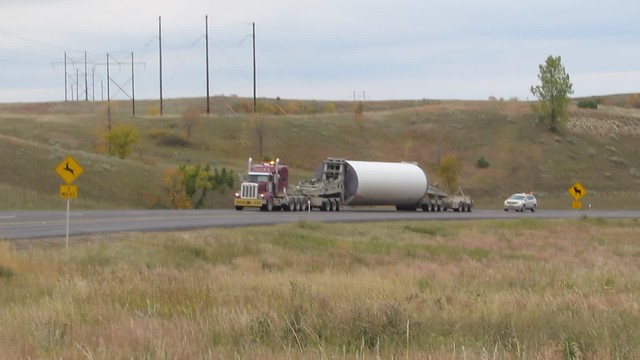
Going south, I happened to catch a semi carrying part of a wind tower to be raised at the wind farm near Hebron, North Dakota. The components for that wind farm, and I hazard to bet, the components for all wind farms in western North Dakota, including the one four miles north of Tioga, are staged and will be staged out of Red River Oilfield Services east of Williston.
I don't think I am exaggerating when I say this is even better than what I remember seeing in New England.
In New England, at least for me, all the foliage and all the forests, is claustrophobic. And, too much. It's almost as if the painter should have quite earlier, but for some reason kept painting more trees, and more red, and more yellow, so it became kitschy and overwhelming.
But not in North Dakota. Not overdone at all. The painter knew exactly when to quit. And to make those bright yellows leap out at you and surprise you, he/she surrounded the yellow blaze with drab (in a positive way) brown geologic formations offset with evergreens.
The video cannot possibly show you how incredible the scenery was, but it will give you an idea. This is on US Highway 85, going north, just south of the Long X bridge, just before one enters the long descent into the valley carved out by the Little Missouri River.
Interestingly enough, the formations and the scenery outside the park to the south and to the west seem even better than what one sees inside the park, and my hunch is the ranchers will keep it that way.
Going south, I happened to catch a semi carrying part of a wind tower to be raised at the wind farm near Hebron, North Dakota. The components for that wind farm, and I hazard to bet, the components for all wind farms in western North Dakota, including the one four miles north of Tioga, are staged and will be staged out of Red River Oilfield Services east of Williston.
Construction In Watford City -- October 4, 2016
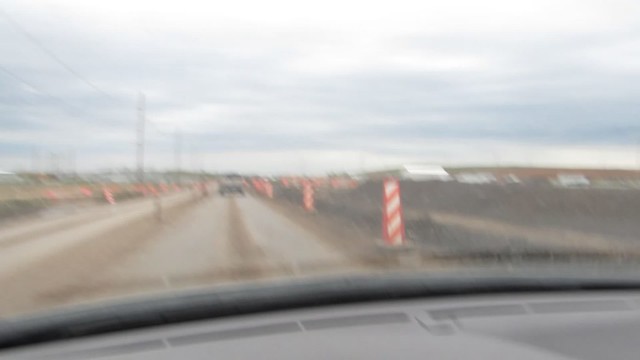
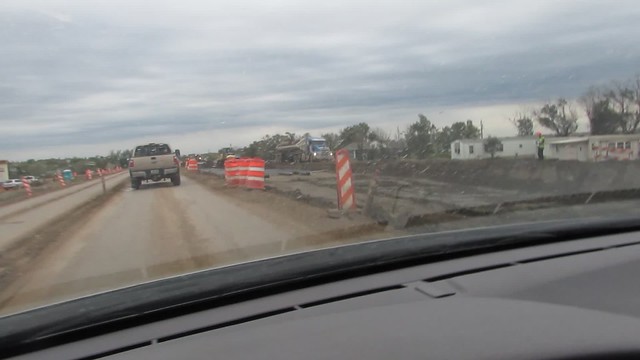
Last week when I visited the Bakken, instead of taking the bypass around Watford City, I took the "main road" through the city. This was what I saw, all the way from the south end of the city to the main intersection in the "center" of town.
By the length of each video, you can get an idea of just how big a project this is. There is about four minutes of video and I stopped filming well short of getting to the "center" of Watford. I think I stopped filming just before I got to the traffic signal at the "old" ND State Highway 22 turnoff but I could be wrong; things have changed so much with the bypass, I did not recognize old landmarks.
Something else: throughout the boom, DOT and commercial operators did absolutely everything to keep traffic moving. Note: there are no flagmen on this entire stretch; there are no detours; there are no temporary traffic lights; there is nothing to slow traffic down. This is inside city limits and vehicular traffic was traveling at almost the posted speed limit despite construction, heavy equipment, and heavy traffic. When we lived in Boston, there were no less than three uniformed policemen and two cruisers for any road project, no matter how minor, including painting a crosswalk.
This is heading north:

Because of download constraints, my videos have to be short, otherwise I would have tried to do this in one continuous shot.
One of the things that struck me while in Williston was the number of folks still coming from out-of-state. One of the first men I talked to was working on a city construction project. He was from Florida and had never seen snow. He hoped the project he was working on would be complete before winter so he could return home before it began snowing.
The vast majority, it seems, of the "contract" workers at Bethel Home where my 95-year-old dad lives were out-of-staters. A lot came from foreign countries, particularly South Africa.
If folks were still coming to North Dakota to find work, it made me wonder just how bad the economy was in other parts of the US. Don wondered the same question when he sent me the link to this Dickinson Press article about workers still coming to Williston and Watford City to find work.
Don noted this in the article:
The story does not mention the price of new homes or rental costs. They have come way, way down. Man-camps used to run upwards of $200 a night are now advertised as $24.99/night, but I think those were "old" signs -- it appears most man-camps in Williams County have closed. I don't know for sure, but there was no sign of life at any of the ones I drove by, including the big one west of Tioga.
I would be surprised if one couldn't find incredibly inexpensive lodging, and although it wasn't particularly noticeable, there were a fair number of houses on the east side (the "old" Williston) up for sale.
By the length of each video, you can get an idea of just how big a project this is. There is about four minutes of video and I stopped filming well short of getting to the "center" of Watford. I think I stopped filming just before I got to the traffic signal at the "old" ND State Highway 22 turnoff but I could be wrong; things have changed so much with the bypass, I did not recognize old landmarks.
Something else: throughout the boom, DOT and commercial operators did absolutely everything to keep traffic moving. Note: there are no flagmen on this entire stretch; there are no detours; there are no temporary traffic lights; there is nothing to slow traffic down. This is inside city limits and vehicular traffic was traveling at almost the posted speed limit despite construction, heavy equipment, and heavy traffic. When we lived in Boston, there were no less than three uniformed policemen and two cruisers for any road project, no matter how minor, including painting a crosswalk.
This is heading north:
Because of download constraints, my videos have to be short, otherwise I would have tried to do this in one continuous shot.
*******************************
Some Say Watford City's Population Could Surpass Williston's
One of the things that struck me while in Williston was the number of folks still coming from out-of-state. One of the first men I talked to was working on a city construction project. He was from Florida and had never seen snow. He hoped the project he was working on would be complete before winter so he could return home before it began snowing.
The vast majority, it seems, of the "contract" workers at Bethel Home where my 95-year-old dad lives were out-of-staters. A lot came from foreign countries, particularly South Africa.
If folks were still coming to North Dakota to find work, it made me wonder just how bad the economy was in other parts of the US. Don wondered the same question when he sent me the link to this Dickinson Press article about workers still coming to Williston and Watford City to find work.
Don noted this in the article:
In Watford City, which some real estate experts say is on pace to surpass Williston's population in coming years, the story is much the same.I think that's a bunch of "real estate hype." I can't imagine Watford City's population surpassing Williston's population, ever. But it does emphasize how fast things continue to develop in Williston and Watford City.
The story does not mention the price of new homes or rental costs. They have come way, way down. Man-camps used to run upwards of $200 a night are now advertised as $24.99/night, but I think those were "old" signs -- it appears most man-camps in Williams County have closed. I don't know for sure, but there was no sign of life at any of the ones I drove by, including the big one west of Tioga.
I would be surprised if one couldn't find incredibly inexpensive lodging, and although it wasn't particularly noticeable, there were a fair number of houses on the east side (the "old" Williston) up for sale.
Friday, June 24, 2016
What If The Panama Canal Expansion Does Not Work As Advertised? -- June 24, 2016
Updates
December 3, 2020: traffic jams at the canal.
April 20, 2018: a first for the newly expanded Panama Canal -- three LNG tankers cross in one day.
October 8, 2017: Panama Canal is a huge success -- The Wall Street Journal. Taking business away from the Suez Canal.
February 4, 2017: milestone -- first LNG tanker arrives at Japan from lower 48; from US shale; previously, all US LNG to Japan came from Alaska;
August 25, 2016: first US LNG tanker arrives in China via Panama Canal.
July 30, 2016: apparently there have been some fender benders in the Panama Canal. It appears The New York Times has assigned several folks a single assignment: report on fender benders in the newly expanded Panama Canal. Currently the team is made up of Walt Bogdanich, Jacqueline Williams, and Graciela Mendez, all of whom wrote both articles, and were listed in the exact same order. This issue will soon become a meme.
July 5, 2016: this is kind of cool, sort of a "human interest" story on the "historical passage of Cosco Shipping Panama" -- the first Neopanamax container ship through the expanded Panama Canal.
The Chinese giant Cosco Shipping has made the inaugural transit on Sunday June 26, 2016, through the expanded Panama Canal expansion project, an event appreciated by thousands of people in Agua Clara lock province of Colon.
Spectators watched as the Neopanamax cargo ship, Cosco Shipping Panama, made its way through the new Agua Clara locks, part of the Panama Canal expansion project, near the port city of Colon, Panama.
The container vessel had set sail from the Greek Port of Piraeus today on its way to Panama to make history.
The inaugural ship, Cosco Shipping Panama is a 158-foot-wide, 984-foot-long (slightly longer than three football fields) behemoth that is one of the modern New Panamax class of mega-vessels that are seen as the future of global shipping and will now be able to use the canal.
It carried some 9,000 cargo containers during the inaugural voyage and now heads to South Korea. Originally named Andronikos, the vessel was renamed by China COSCO Shipping to pay respect to the people of Panama and for the honor of the inaugural transit.
This ship was selected during a draw for the inaugural transit through the expanded waterway.June 27, 2016: I don't think there's much new in this article for regular readers, but it's a nice analysis from The Oil & Gas Journal:
The opening of a new, third set of locks on the Panama Canal will cut the distance between the US and Far East by more than one-third for vessels that can now transit the waterway but hadn’t been able to before. A voyage from the US Gulf Coast to the Far East around the Cape of Good Hope typically takes 45 days vs. the 25-30 taken by passage through the canal.
Old Panamax vessels could measure up to 965 ft long, with a 106-ft beam and 39.5 ft draft. Neopanamax ships can measure 1,200 ft by 160 ft by 50 ft, boosting capacity to 400,000-600,000 bbl from 300,000-500,000 bbl.
This increase will allow passage of the very large gas carriers typically used to carry propane and other LPG and products tankers but falls short of the scale needed to accommodate fully loaded very large and ultra-large crude carriers, the vessels that haul the majority of crude shipments. VLGC passage will be far more efficient than the ship-to-ship transfers required until now to move LPG across the isthmus.
Distillate and gasoline led Atlantic-to-Pacific petroleum traffic through the canal last year, with a respective 9.5 million and 9.1 million long tons, according to the US Energy Information Administration. But net US length in these markets doesn’t compare to that in ethane and propane, for which the ability to move more volume more quickly will be a welcome relief. The continued strength of demand for refined products in western South America also is questionable.
China is already the biggest single customer for US propane and second-biggest for LPG and the ability to move these volumes more efficiently will likely only increase that flow.
EIA data show trade to both China and Japan having already accelerated before the canal expansion’s opening. LPG shipments to Japan more than tripled to 166,000 b/d in the first 3 months of 2016 from 49,000 b/d for the same period last year. Shipments to China jumped to 161,000 b/d from 66,000 b/d in the same window.June 26, 2016: if you can get pass the paywall (good luck), The Los Angeles Times had a great article on the highly successful inaugural "crossing."
The first VLGC to pass through the new locks will be the Lycaste Peace, carrying propane from Enterprise Products Partners for discharge in Tokyo Bay in Japan. By 2018 US exports of LPG will likely equal those of Qatar and the United Arab Emirates combined.
Chinese freighter laden with nearly 9,500 metal cargo containers transited the expanded Panama Canal on Sunday, inaugurating the interoceanic waterway and opening a new era in global trade.
As midmorning clouds dissipated over the 50-mile-long canal, the vessel Cosco Shipping Panama began moving through the new Caribbean-facing Agua Clara locks, part of a $5.4-billion expansion to allow for the passage of bigger ships through the historic waterway. The expansion has been nearly a decade in the making.
Whereas the original canal opened in 1914 to accommodate ships carrying as many as 5,500 cargo containers, the new locks can handle ships ferrying 13,000 such containers. Operators say the expansion was necessary to keep the historic canal competitive in a global freight market.
The expansion ostensibly makes the canal a more efficient option for freight companies shipping goods from China to the Eastern Seaboard, which is the canal’s most important and lucrative commercial route.June 26, 2016: so, how did the inaugural "crossing" go? Savannah Now is reporting:
Fireworks exploded as a huge container ship made an inaugural passage through the newly expanded Panama Canal on Sunday, formally launching the Central American nation’s multibillion-dollar bet on a bright economic future despite tough times for global shipping.
After crossing the Atlantic locks at Agual Clara under a cloudy sky in the early morning in the northern province of Colon, the Chinese-owned Cosco Shipping Panama, carrying some 9,000 cargo containers, approached the Cocoli locks near the capital in the afternoon under the guidance of several tugboats.
The Cosco Shipping Panama is a 158-foot-wide, 984-foot-long behemoth that is one of the modern New Panamax class of mega-vessels that are seen as the future of global shipping and will now be able to use the canal.
The waterway’s capacity doubles with the new locks, and canal authorities are hoping to better compete with the Suez Canal in Egypt and tap new markets such as natural gas shipments between the United States and Asia.
From the linked New York Times article below:
Okay, so now you can do the math.But the locks’ size is the captains’ biggest concern — and they illustrate it on napkins, sheets of paper and blackboards. The new locks are 1,400 feet long and 180 feet wide. Big container ships are 1,200 feet long and 160 feet wide. Tugboats fore and aft measure nearly 100 feet each. Do the math, they say.
Original Post
The NY Times article suggests that things are not as rosy as one might think with regard to the newly expanded canal. The writers suggest that things are (very) likely to go wrong, and if they go wrong, the reader wonders if this will affect the American LNG export industry.
By the way, the article is truly a great example of print media (the NY Times) using the internet to best effect to tell a story. It's a must read; the graphics and videos are awesome.
But back to the question. I am the last person to ask. I am an eternal optimist. I am inappropriately exuberant when it comes to energy. I am always looking through oily-stained glasses.
Having said that, I think this is how an optimist would answer the question.
The neo-Panamax vessels are here to stay. Even if the Panama Canal goes away, folks are going to be using these vessels to move LNG to Asia and to Europe.
Even if the widened Panama Canal is not big enough for the new ships PLUS the towboats, they will increase capacity of the overall canal, I assume.
The US LNG export industry is barely getting started; the Panamanians will have plenty of time to work some of the issues that can be worked. (Of course, widening/lengthening the locks are no longer an option; that's been done, for now.)
If the new canal does not work out, it does not affect US LNG going to Europe.
If the new canal does not work out as planned, one wonders immediately if TransCanada, Sempra, KinderMorgan and others might not be huge beneficiaries. There are already natural gas pipelines from Texas to the west coast. They would have to increase the capacity of these pipelines (which seems to go more easily than putting in completely new lines). The biggest problem would probably be adequate "space" for new storage and export facilities along the west coast.
By the way, the best part of the NY Times article had to do with the cost of the expansion. When I saw the figure some months ago, I thought the cost was incredibly low. It turns out that was accurate: the writers suggest it was a "rock-bottom budget."
My hunch is that the canal will have some huge growing pains, and there will likely be some headline stories of incredibly bad mishaps, but in the long run, the engineers will get it sorted out. But, again, I am an eternal optimist.
***********************
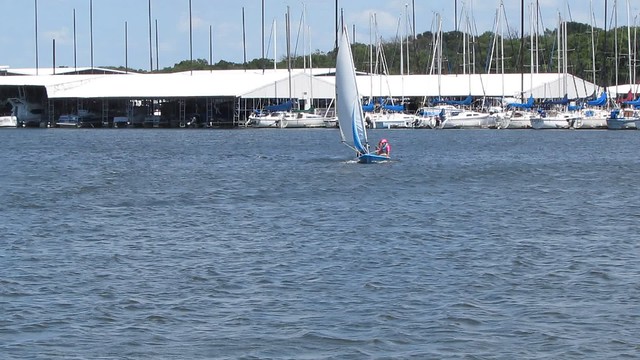
Day 5 Of Sailing Camp
Olivia's Crew Coming Into Port
Subscribe to:
Posts (Atom)