Showing posts with label Wind_UK. Show all posts

Wednesday, May 7, 2025

Wednesday -- May 7, 2025

Locator: 48599B.

Real ID: kicks in today. Law passed in 2005. Every president kicked the can down the road. President Trump? First 100 days.

UK wind: top story of the day. Orsted cancels major UK offshore wind farm. Link here.

Rivian: unlike Lucid, having a few problems. Link here. Cuts EV delivery outlook; cites tariff impact.

AMD: huge jump in revenue, q/q. Link here. $3.7 billion vs $610 million one year ago.

Vistra: swings to 1Q25 loss. Link here.

*****************************
Back to the Bakken

WTI: $59.64.

New wells:

Thursday, May 8, 2025: 23 for the month, 123 for the quarter, 315 for the year,
41141, conf, CLR, Stangeland 11-7HSL,

Wednesday, May 7, 2025: 22 for the month, 122 for the quarter, 314 for the year,
41261, conf, BR, Tilton Diamond Forest 2A-ULW-R,
40714, conf, Silver Hill Energy, Tank E 156-98-1-12-5MBH,

RBN Energy: Whitewater and Company-led JV expand role in moving Permian gas to coast. Archived.

Several large, publicly held midstream companies play critical roles in transporting crude oil, natural gas and NGLs from the Permian Basin to markets along the Gulf Coast, and all of them are investing hundreds of millions or even billions of dollars to expand their Permian-to-Gulf infrastructure. But there’s a privately held outlier among them — WhiteWater Midstream, which has developed key gas pipelines in Texas and has been partnering with MPLX, Enbridge and others to own and develop a few more. In today’s RBN blog, we look at the growing portfolio of WhiteWater and the WPC joint venture (JV) and discuss highlights from our new Drill Down Report on Permian-to-Gulf infrastructure projects.

Even amid the economic uncertainty triggered by the ongoing trade war, a long list of publicly held midstreamers — Enterprise Products Partners, Energy Transfer, Targa Resources, Phillips 66 (P66) and ONEOK among them — are developing an even longer list of crude-, gas- and NGL-related projects in the Permian and from West Texas to the Gulf Coast. Gathering systems. Gas processing plants. Pipelines. Fractionators. Export terminals.

WhiteWater Midstream, whose name is familiar to everyone interested in the Permian, is a different animal — a giraffe among zebras, you might say. Austin-based and with financial backing from I Squared Capital and other private-equity sources, WhiteWater was formed in 2016 and has been involved in developing several key gas pipelines and other gas-related assets between the Permian and the Gulf Coast.
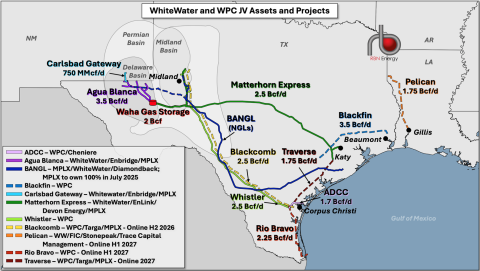
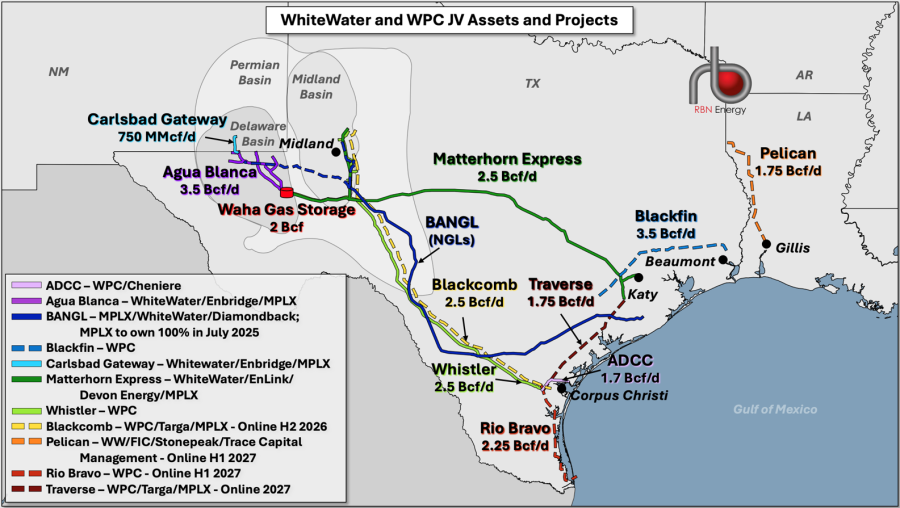
WhiteWater and WPC JV Assets and Projects

Figure 1. WhiteWater and WPC JV Assets and Projects. Source: RBN

First came Agua Blanca (dark-purple line in Figure 1). This pipeline system delivers natural gas from a number of processing plants in the Permian’s Delaware Basin to the Waha Hub. Agua Blanca started in 2018 as a 72-mile system with a capacity of 1.4 Bcf/d; it has been expanded several times since then and now has more than 200 miles of pipe and a capacity of more than 3 Bcf/d. The pipeline is currently owned by WhiteWater (75%), Enbridge (15%), and MPLX (10%). The three companies also share ownership of the 400-MMcf/d Carlsbad Gateway gas pipeline system (light-blue line) in the Delaware, which feeds residue gas into Agua Blanca. 
Sunday, November 29, 2020

Sunday, November 29, 2020 -- Part 3

Sports: wow, NFL today looks bleak until maybe the Sunday night football game. Breaking: NFL says Broncos' quarterback can't play today .... because ... he broke protocol. LOL. Shooting self in foot. Oh, I misread that. Not the Broncos' quarterback but all of the Broncos' quarterbacks. Somehow there must be more to the story. I must be missing something. If accurate, it should be a fun game to watch. LOL. NFL today. Broncos were to play the Saints later this afternoon. And apparently this game will be on Fox. My hunch? This will be the most-watched NFL game this year. LOL.

From Yahoo!Sports:
On Sunday afternoon, in Week 12 of the weirdest NFL season ever, the Denver Broncos will take to their home field without a quarterback. 
So they’ll reportedly turn to a practice squad wide receiver who has never played an NFL snap
And who, one month ago, was working a normal-person job. And who, when he last did anything resembling quarterbacking in 2018, completed two of eight passes for 2 yards – and one interception. 
With Denver’s entire QBs room ineligible due to COVID-19 contact tracing, the team will likely use Kendall Hinton, a former quarterback at Wake Forest and Southern Durham (N.C.) High School whom the Broncos signed to their practice squad earlier this month.

Egg on face: ESPN's Steven A. Smith said he was genuinely afraid for Roy Jones, Jr's life. Steven A. Smith was genuinely afraid Roy Jones would be severely injured if not killed by Mike Tyson.That was Friday, November 27, 2020. In fact: a draw.

Dividends: from Investopedia: Garmin (really?), Starbucks (okay, possibly), Target (okay, but share appreciation seems to be the bigger opportunity for Target), AbbVie (this one pops up often on many lists), and, BlackRock (I seldom see this on dividend lists). 

Perhaps for dividend growth but none of these returns impress me -- it must have been a slow day for Investopedia or someone was talking their book, as they say. Why start with a company with low dividend and wait for growth? Start with a great company with potential for growth that is already paying a nice dividend. Of the five mentioned above, none have a remarkable dividend except for AbbVie.

Disclaimer: this is not an investment site.  Do not make any investment, financial, job, career, travel, or relationship decisions based on what you read here or think you may have read here.

Global warming, reality sucks: British coal plants are being fired up to meet "temporary" electricity shortfall. Remaining UK coal plants supply only 6% of the grid's electricity to cover power supply drop and cold weather. Link here. Sent by a reader; huge thanks.

Britain has fired up some of its last remaining coal power plants to help keep the lights on as the country’s wind turbines slow over a few days and the demand for electricity rises.

Three of the UK’s last coal power plants, operating at Drax, West Burton, and Ratcliffe, were called on to supply 6% of electricity on Thursday morning.

Coal’s share of the electricity mix was roughly double the share of wind and solar power in the electricity mix, and six times the average contribution made by coal plants in the final months of last year.

The coal plants are likely to keep running over the next few days, alongside a fleet of gas-fired power plants, before breezy weather returns to help meet the rising demand for electricity from renewable energy sources.

Saturday, June 13, 2020

Hornsea: Lies, Lies, And More Lies -- Continued -- June 13, 2020

Have I ever blogged about Hornsea? Yup. From August 16, 2019: lies, lies, and more lies. LOL. So, now an update, from Not A Lot Of People Know That: BBC brags about Hornsea Wind Farm -- but forgets to mention the cost. Lies, lies, and more lies. From the BBC.
In his puff piece for renewable energy today, the BBC’s Justin Rowlatt noted that:

Now the UK has the biggest offshore wind industry in the world, as well as the largest single wind farm, completed off the coast of Yorkshire last year.

Nothing could sum up the moronic obsession with renewable energy better than this statement. There is in fact a good reason why we have the biggest offshore wind industry – we are the only country daft enough to pay the exorbitant bill for it.

The largest wind farm, of course, is Hornsea, a 1200MW project. It may be the biggest, but it also happens to be one of the most expensive sources of electricity in the world.

The contract price for Hornsea is £162.47/MWh, which under CfD is a guaranteed price, which will be index linked for 15 years. In short, a licence to print money.

The current market price for electricity is below £20/MWh, so Hornsea is getting eight times what it would get if it had to trade in the market.
And then this:
Hornsea, by the way, is joint owned by Oersted (formerly DONG) and Global Infrastructure Partners LLP, a global wealth fund. I find it hard to understand how sending hundreds of millions of pounds every year to either of those companies can possibly benefit the UK economy.
Wiki entry here.

*****************************
Whatever Happened to Fukushima?
Published 16 Hours Ago By The Economist

From The Economist: blocked by a paywall, but you can see the entire article here. Archived here.
The hoped-for transformation [to renewable energy], however, has been “slow and almost invisible”, Mr Yamada laments.
Renewable generation has grown from 10% of the power supply in 2010 to 17% in 2018, almost half of which comes from old hydropower schemes.
Most nuclear plants, which provided more than a quarter of the country’s power before the disaster, have been shut down, at least for the time being.
But for the most part they have been replaced not by wind turbines and solar panels but by power stations that burn coal and natural gas. The current government wants nuclear plants to provide at least 20% of electricity by 2030. It also wants coal’s share of generation to grow, and has approved plans to build 22 new coal-fired plants over the next five years. The target for renewables, by contrast, is 22-24%, below the current global average, and far lower than in many European countries.

Monday, July 15, 2019

Stop These Things -- UK -- July 15, 2019

From "Stop These Things":
The cost of Britain’s ‘green’ energy policies is staggering: power prices have surged and the worst is yet to come.
Notwithstanding efforts from those in on the greatest scam of all time, the facts can’t be concealed: Britain’s heavily subsidised and chaotically intermittent wind power fleet is responsible for power prices increasing at double-digit rates, as John Constable notes at the link above.
Old story? Hardly. Dated January 16, 2019 -- earlier this year.

Scotland hits wind record.

Monday, June 11, 2018

Wind Energy And The Road To Great Britain -- July 11, 2018

Updates

July 20, 2018: update here, the wind drought in the UK continues.  

Original Post 

Wow, talk about perfect timing.

I just posted an entry in which all agree: renewable energy is one of the least efficient ways to go about replacing coal consumption in a short period of time.

The article did not say what the least efficient way to go. Most likely that's nuclear power. It takes ten years to get the permits, and then another ten years to build the damn thing. Assuming all goes well.

So, here we have a most interesting story.

Apparently, those living in the United Kingdom are learning that:
a) the wind doesn't blow all the time (except over Menwith Hill);
b) wind power is not dispatchable; and,
c) their Kingdom does not have a good answer for energy when the wind quits blowing
Here's the story. Huge thanks to Don; I would have missed it.
  • Britain has gone nine days with no wind generation
  • forecasts show the doldrums to persist for another two weeks
  • day-ahead power prices are the highest level for this time of year for at least a decade
  • except for a surge forecast for June 14th, the forecast is for the wind to stay low for at least the next two weeks
  • UK turbines can produce about as much power as 12 nuclear reactors when conditions are right
  • recently, wind generated about 4.3% of the Kingdom's electricity
  • coal output has dropper near zero
  • gas and nuclear power have picked up the slack, 54% and 25% respectively
  • repeat: natural gas is now supplying more than half of the Kingdom's electricity requirements, and that's without all those Teslas which Musk promises us we will see next year
So, the Kingdom's answer? I can't make this up:
  • A new nuclear reactor. The financing push begins soon. Whenever that might be.
Great graphics, by the way, as usual, at the linked Bloomberg article. 

By the way, one more thing: this wind-thing won't happen during the winter. Had it happened during the winter it would be a catastrophe for England. In the summer, not so bad. Just higher prices.

************************************
Kim-Xi Moon Pies

I see the marketing in Singapore for summit-related kitsch has begun. There's still time for someone who wants to fight the trademark fights to start working on Kim-Xi Moon pies for next year.

Wednesday, February 3, 2016

Wednesday, February 3, 2016

Updates

February 5, 2016: more on that Amazon story from WSJ
The revelation this week that Amazon.com Inc. may open bookstores across the U.S. would seem to defy a 20-year-old online blueprint to pummel brick-and-mortar retailers with cutthroat prices and a seemingly limitless product selection.
But Amazon’s apparent plan to build a physical presence in shopping malls and urban centers is following the playbook of smaller Internet retailers that are finding early success reaching shoppers via storefronts and kiosks.
Web retailers including eyeglasses seller Warby Parker, jewelry outlet Blue Nile Inc. and clothing boutique Bonobos Inc. are addressing one of the biggest disadvantages of online shopping with showroom stores that enable customers to touch, feel and try on goods before they buy them online. Their small outlets also act as brand boosters, helping offset the prohibitively expensive costs of acquiring customers online.
Original Post
 
From The Wall Street Journal today.

Wow, ChemChina will buy Swiss seeds and pesticides for $43 billion. This is absolutely huge.

Chinese companies shopping abroad at record pace.

GM’s fourth-quarter profit surged amid growth in China and booming sales of pickup trucks and sport-utility vehicles in the U.S.

But the biggest news of the day: Amazon considers opening up to 400 bookstores, expanding Seattle experiment. Online retail giant Amazon considers large expansion of Seattle prototype book store, joining online retailers that already have opened physical stores and posing a potential threat to Barnes & Noble. Sure, why not? Open the warehouses to the general public. Barnes and Noble took years to build to 640 stores; and, the 255 Books-A-Million stores which I avoid at all costs. If one has a choice, Half-Price Books is so much better than Books-A-Million. [Did someone let the "cat out of the bag?"]

Isn't this interesting. Toyota ending the Scion brand. Toyota Motor Corp. is killing its Scion brand, folding the vehicles back into the Toyota brand portfolio, 13 years after the brand debuted and helped the company capture young buyers. I always wanted a Scion, but I wanted a Tesla or a Volt first. 

Comcast profit buoyed by growth in video and broadband subscribers. Comcast increased video customers in the fourth quarter, adding to a surprising comeback for the cable industry in a weak overall pay-TV market. 

************************** 
Wind: This Might Make Sense For England -- Might Is The Operative Word

World's largest wind farm announced: Denmark’s Dong Energy, part-owned by Goldman Sachs, is going ahead with the world’s largest offshore wind farm, the Hornsea project off the coast of northeast England, making it the first of its kind to have the capacity to produce more than one gigawatt of electricity.
The 1,200-megawatt project, located 120 kilometers off the coast of the county of Yorkshire, will be the first offshore wind project is set to power more than a million British homes, the company said. The project will receive U.K. government support in the form of a fixed tariff for the first 15 years of production.
**************************
Bots: Increase Warehouse Productivity By 800%

Techinsider is reporting:  
The bots work alongside humans and do all the normal grunt work. Warehouse workers usually walk 12 to 16 miles each day. With the robots, they don't have to.
The robots now meet the human workers in the middle of the warehouse. As soon as someone completes an order online, the bot's system knows exactly where to go in the 275,000-square-foot warehouse.
Each bot (which doesn't look anything like a human) has a platform for arms and a two-foot-diameter base with wheels for feet. It zips around at about 4.5 mph, or the equivalent of a fast walk. If stray boxes or wires stand in its path, its vision technology can "see" in real-time to avoid them.
Since the robots are able to move faster than humans without tiring, Welty says the system will boost warehouse productivity by up to 800%. The bots will also not be subject to human error, which means that they can get the order right nearly every time.
As a way to increase productivity and speed, many online retailers have been using robots, conveyor belts, and cranes to fulfill orders for the past decade. Amazon has exclusive rights to Kiva Systems' robots, but Welty says Locus' robots are smaller, and more lightweight and versatile.
Unlike Kiva's bots, the Locus robots can be incorporated into the warehouses' existing infrastructure. The warehouse doesn't need to move any shelves or aisles. Locus can program the robot to navigate the warehouse exactly how it is. 
Sort of like Roomba.