Wednesday, October 26, 2016

Chicago Hammering Cleveland Tonight; Tesla Beats Expectations; Shares Surge -- October 26, 2016

The Russian a/c carrier / Northern Fleet has sailed through the Strait of Gibralter; is in the Mediterranean Sea, more than three hours ago. Don't laugh at Putin's rusty navy -- he, at least, has an a/c carrier. 
Moscow’s illegal annexation of territory in Georgia and Ukraine, as well as its brutal assault on rebel forces in Syria, are all part of Mr Putin’s plan to re-establish Russia as a major player on the world stage. And, with America transfixed by the horror show that the current presidential election contest has become, who is to say the opportunistic Mr Putin might not be tempted to embark on yet another military adventure, perhaps this time focusing his attention on the vulnerable Baltic states?
Watch the price of gasoline in November: indications suggest the price of gasoline could spike in Europe in November, 2016.

TSLA: beat expectations; shares surge; this is a surprise profit of $22 million, buoyed by record sales of its pricey EVs; its first profit after 12 quarterly losses amid a push to generate cash for building its $35,000 Model 3. Good for them. This really puts the kibosh on those shorting the stock. This will be fun to watch.

World Series: Meanwhile, Chicago -- the favored team -- must have had it with Cleveland last night -- now leading 4 - 0 at the top of the 5th evening. They need to wrap up this win before it begins raining. Now, 5 - 0 -- walks a batter, bringing in an unearned run. Wow. Normally, games would be considered completed after five innings, but some years ago the baseball commissioner said games would be completed ... regardless. Rain starting to fall at the bottom of the ninth. If they don't finish tonight, the weather looks bad tomorrow. [Chicago wins: 5 -1. The series is tied 1 - 1. Now, on to Chicago. Day off tomorrow, then three days in Wrigley Field.]

Reading. If you have nothing better to do tonight -- other than watching the World Series -- I highly recommend the book review / essay in The Wall Street Journal this past weekend: "The Truth About Egypt's Revolution."
And yet the day before Mr. Mubarak’s resignation, Director of National Intelligence James Clapper assured a House committee that “the term Muslim Brotherhood is an umbrella term for a variety of movements.
In the case of Egypt, a very heterogeneous group, largely secular.” The White House too seemed unaware of the kind of movement that might replace Mr. Mubarak.
On Feb. 1, 2011, just a week after the protests began, President Obama declared that a change of government in Cairo “must begin now.” (By comparison, it was five months before he said the same about Syria’s Bashar al-Assad.) When Mr. Mubarak stepped aside 10 days later, a U.S. diplomat later recalled that Mr. Obama’s advisers toasted with vodka and beer.
Meanwhile, the US cedes the Atlantic Ocean to the Russians and the Chinese as Obama's Pentagon withdraws from another key strategic position. Another ally thrown under the bus. Truly amazing. Just one more Obama legacy. Less than 86 days. If historians are honest ten years from now, President Obama will go down as the most inept president in modern US history.

America's Energy Policy: White Paper from Horizons: Journal of International Relations and Sustainable Development. Of course, this paper will be outdated as soon as Hillary or Trump takes the oath of office, next January 20, 2017.

Global Warming: I don't know if this is early or not, but it's not even November yet. The National Weather Service predicts snow in the northeast: snow showers with accumulations of 3 to 7 inches possible over the Catskills and Adirondacks in New York.

Dumbing-down American education. Oil, gas automation sector suffering from skills shortage -- Rigzone -- I don't think the article said anything we didn't already know; I wouldn't bother clicking on the link.

The Accountant. I think most folks would enjoy this Ben Affleck movie. 

A Most Interesting Graph -- October 26, 2016

From John Kemp:


If I read the graphic and the legend correctly, this is the change in crude oil stockpile shown above:
  • red line: inventories, 2016 - 10 yr median
  • yellow line: 2016 - 2015

Energy Source Mix -- USA -- West, East, And Texas -- October 26, 2016

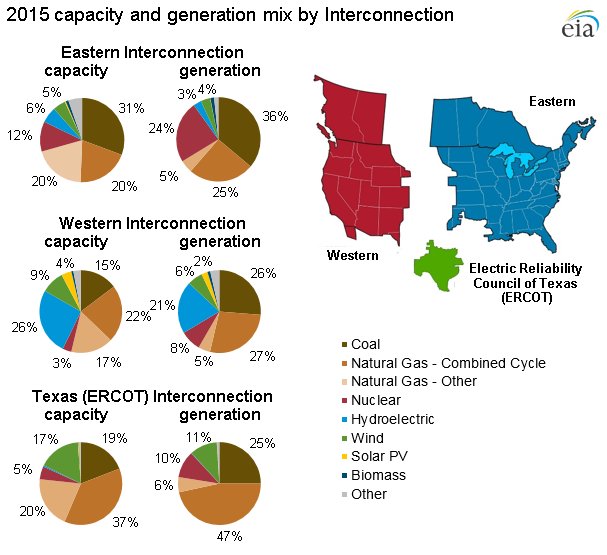
Energy source mix varies among the three U.S. #electricity grids http://go.usa.gov/xkAax:


The big takeaway: for those states in the east that mandate renewable energy, they have quite a ways to go, and it's going to be very, very expensive. Right now, in the East, only 4% of total energy is generated by wind (5% capacity), and there is no solar. As nuclear energy declines, currently 24% of total generation, something is going to have to replace it. Coal is dead, so that pretty much leaves natural gas.

The second big takeaway: the EIA in this metric, places the entire North Dakota/Minnesota to Oklahoma/Louisiana corridor in the East which tends to skew the energy breakdown a bit. If the Dakotas, Minnesota, and Iowa were put into the West, where at least the Dakotas belong, the wind situation for the East would be catastrophic.

For me this is how it breaks out;
  • East: coal and natural gas (Marcellus, Utica), and when nuclear goes away, natural gas will approach 75%, maybe more, of source for generated electricity
  • West: coal, natural gas, and a bit of wind, not much solar except as a niche player
  • Texas: natural gas (huge; almost 50% generation), coal, and wind; solar, still inconsequential
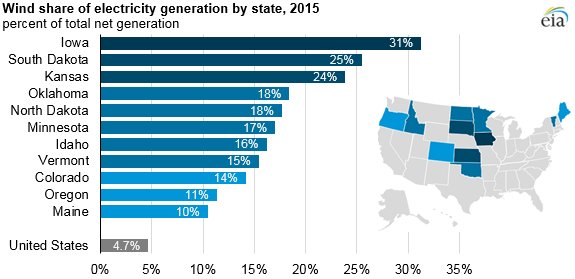
By state:


Note: the big takeaway from the graphic above: California wind -- nada, zilch, nil. Even Texas, with all it's wind, is too low to round up over 0%. At least that's what the graphic is telling me.

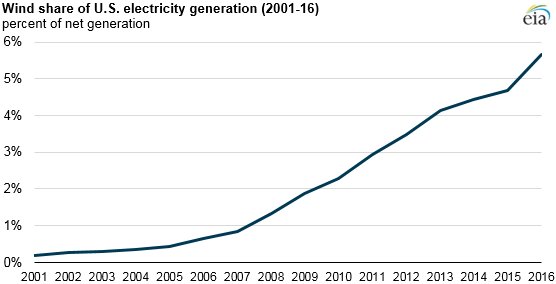
The graphic below is pretty "spectacular" until you realize:
  • that we are still talking only 6%; as natural gas increases, the "wind percentage" could actually drop
  • most of that wind generation is in the West and Texas; almost none in the East; and,
  • the US is slowly running out of "locations" for wind energy (for a number of reasons).
************************************
Tiresome

The misinformation provided by warmists has become incredibly tiresome. From Breitbart:
CNBC viewers are being snookered.

The business news network featured an article in the “Sustainable Energy” section of its Website that proclaimed: “Renewables surged past coal in 2015 to become world’s biggest source of electricity: IEA.”

In reading that headline, one might get the impression that wind turbines and solar panels produced more electricity last year than coal. But the fine print actually reveals a very different picture.

The opening paragraph of the article by “Freelance digital reporter” Anmar Frangoul gives a clue as to the sleight of hand being used. Frangoul cites the International Energy Agency (IEA) as reporting that “Renewable energy moved past coal in 2015 to become the biggest source of global electricity capacity.” The key word there is “capacity.”

What’s noteworthy is that capacity is far different from actual production. The average wind turbine has a maximum rated capacity of roughly 2 megawatts. That means, if the wind is blowing between 26-56 mph, the turbine can spin up to its peak generating capacity. In such moments, the wind turbine can produce its full 2 megawatts.

However, wind turbines, like solar panels, offer only intermittent power generation. Wind turbines can only produce power when there is sufficient wind—and when they are not shut down due to cold weather, repairs, or high winds. And solar panels only produce electricity during periods of direct sunlight. Thus, while a wind turbine can have a maximum capacity of 2 megawatts, its typical output may often be far less, or even 0 megawatts (on a windless day).

In contrast, and as the IEA itself notes, coal provided 40.8 percent of worldwide power generation in 2014. The renewables that Frangoul crows about—defined by the IEA as “geothermal, solar, wind, heat, etc.”—produced only 6.3 percent of all power.

Thus we see some of the misleading language in the CNBC article.

Frangoul talks about renewables producing 23 percent of world power generation in 2015—which is only possible when hydropower’s robust 16.4 percent is added to renewables’ paltry 6.3 percent share.
And while the IEA says that “renewables represented more than half the new power capacity around the world” in 2015, one has to remember their frustrating intermittency.
Wind turbines only generate roughly 20 percent of their installed capacity, and solar panels yield an even more meager 10 percent. 
Much more at the link. Wow, it gets tiresome. 

CLR To Report A Nice Bakken Well Thursday -- October 26, 2016

OPEC: Organization of Producers Exempt from Cuts/Caps. 

Active rigs:


10/26/201610/26/201510/26/201410/26/201310/26/2012
Active Rigs3668194182186

Wells coming off confidential list Thursday:
  • 31753, 950, CLR, Maryland 2-16H,  Catwalk, 38 stages, 8.2 million lbs, t5/16 cum 84K 8/16;
  • 32558, SI/NC, SM Energy, Martin 2-4HN, Burg, no production data,
Two new permits:
  • Operator: Petro-Hunt
  • Field: Little Knife (Dunn)
  • Comments:
Three permits renewed:
  • CLR (3): one Chicago permit and two Charlotte permits, all in McKenzie County.
One DUC reported as completed:
  • 28015, 816, Petro-Hunt, USA 153-95-23C_14-2HS, Charlson, t10/16; completed, apparently, but absolutely no production; 
*****************************************
31753, see above, CLR, Maryland 2-16H,  Catwalk:

DateOil RunsMCF Sold
8-20161872319943
7-20162324520716
6-20162366821934
5-20161670716663
4-201611560

 *****************************************
Memo to self: come back to this later. And the national debt. And this.

Nothing About The Bakken -- Monet's Bathers -- October 26, 2016

Wow, this makes my day.

A few weeks ago, a spectacular, special exhibit of Monet's early years opened at the Kimbell Museum in Ft Worth, TX. We visited the exhibit the first Tuesday, the second day the exhibit was opened to the public. I was overwhelmed. I was in awe. At that visit last week I mostly just took in the paintings but did not read much about them. I was not interested in the descriptions, or the history, or the critiques. I just wanted to see the paintings, some of which I had seen in Europe, and had not seen for years, and will likely never see most of them again.

Yesterday we visited the exhibit again (it's half-price for seniors on Tuesdays) -- and we will visit at least twice more, once with the granddaughters and once more just before the exhibit moves to San Francisco, its only other venue.

But yesterday, I  went to learn. We were the first ones in the gallery; it would fill up within 45 minutes, so like an impressionist painting, I had to be fast.

I learned a lot.

One vignette: in his early years Monet and his wife had been disowned by his family; he was dirt-poor; and they could go a week without bread, heat, or light. Without Renoir's generosity, Monet may have literally starved to death. His stimulant was oil painting.

Be that as it may, Renoir and Monet, side-by-side, painted swimmers at a swimming hole on the Seine River, in English, "Swimmers at La Grenouillère." From wiki:
La Grenouillère was a popular middle-class resort consisting of a spa, a boating establishment and a floating café. Optimistically promoted as "Trouville-sur-Seine", it was located on the Seine near Bougival, easily accessible by train from Paris and had just been favoured with a visit by Emperor Napoleon III with his wife and son. Monet and Renoir both recognized in La Grenouillère an ideal subject for the images of leisure they hoped to sell.
Monet and his family were living in Bougival at the time.

I write all that to write this. Today, while reading Edmund de Waal's The Hare With Amber Eyes, on page 78:
He (Charles Ephrussi), living in Paris at the time (back in the 1870s) bought a spectacular painting by Monet of bathers, Les bains de la Grenouillère.
Wow! Completely unexpected!

As noted above, Renoir and Monet painted La Grenouillère side-by-side. Renoir painted three paintings (sketches, of course), and Monet, two. Monet's two paintings were "sketches" -- very accomplished sketches, of course -- which he would use to paint a larger, finished canvas.

Monet's larger, finished canvas of the bathers has never been found; it is presumed destroyed. From wiki:
A bigger size painting, now lost but formerly in the Arnhold collection in Berlin, may well have been the "tableau" that he dreamed of.
De Waal's The Hare With Amber Eyes is the story of his family's wealth in art, particularly Japanese ceramics, the netsuke, and how objets d'art are moved along through history.

Everything his family owned was stolen or destroyed by the Nazis in the 1940s -- except for the 264 netsuke.

Renoir's and Monet's paintings of the bathers are important in the art world for this reason: this appears to be the turning point in Monet's career as well as a turning point in the history of art.

I wondered where Monet's finished painting of La Grenouillère is; now I know.

Note: with regard to The Hare With Amber Eyes. The author is Edmund de Waal, the #1 ceramicist in England at the time the book was written. It's hard to tell from the family tree, but if I have it right, Edmund is the grandson of Hendrik de Waal, who married into the Ephrussi family when he married Elisabeth, the daughter of Victor [which would be the author's great-grandfather], who in turn was the son of Ignace von Ephrussi [the author's great-great-grandfather), the second-born son to the patriarch, Charles Joachim Ephrussi, b.1793 - 1864. Charles, who figures prominently as the collector of the 264 netsuke in the book was born 1849 (Odessa) and died 1905 (Vienna). Charles was the son of the first-born son of the patriarch Charles, thus making the author a distant nephew of Charles.

*************************
A Note For The Granddaughters

For Monet, he used two words for sketches: pochade and esquisses.

These are not sketches in "my" sense of the word. These are often the 2' by 3' paintings by famous painters seen in the best museums of fine art. The pochade "comes first" and then later, the artist paints the esquisse, sort of like the final dress rehearsal before the opening of a London stage play, for which folks pay to see.

These "sketches" (paintings by another name) are then the "models" for the final large, often wall-sized painting that may or may never be seen except by a very fortunate few. When these paintings get that large, it is hard for the artist (or any owner) to hide them or protect them from being stolen.

Next time you visit a fine arts museum, watch the small print: if the curator is very precise, you may see the word "sketch" more often than "painting."