Manic Monday -- The Blockade Edition -- Monday, April 13, 2026
Locator: 50515B.
WTI: what does it mean if the price of WTI is lower at the end of the day than at the opening? Asking for a friend. Later: at mid-morning, WTI is $2 lower than it was at the opening. Overnight, WTI briefly hit $105; at the opening, WTI was $104; now, mid-morning, WTI is $102. Later: after lunch, WTI is down slightly from last reading, at $101.70.
Investing: for the extended family members, not general readership -- the big investing story today, Micron; link here.
CVX: surges on announcement of large discovery in the Gulf of America. Link here. Pre-market: CVX is in line with the rest of the oil & gas sector. I don't see any surge based on this announcement. New target: $255 vs the previous $217. Currently in the $185 - $190 range.
TTE: getting a bit more press than usual today.
Blockade: rules have changed immensely overnight; as usual, after initial announcement, President Trump clarifies; even those countries against the war now support Trump on this update -- source.
*************************** Back to the Bakken
WTI: $104. With announcement of blockade of the Strait of Hormuz, later modified, WTI surged 8%; added $8.
New wells reporting:
Tuesday, April 14, 2026: 41 for the month, 41 for the quarter, 198 for the year,
Saturday, April 11, 2026: 27 for the month, 27 for the quarter, 184 for the year,
41504, conf, Hess, RS-Piepkorn-155-92-1208H-1,
RBN Energy: US refiners using Persian gulf crude seek alternatives. Link here. Archived.
U.S.
refineries are, of course, far less dependent on crude oil from the
Middle East than they were before the Shale Revolution and the ramp-up
in Western Canadian production. But the ongoing war on Iran and the
cutoff in oil supplies from the Persian Gulf is forcing several East
Coast, Gulf Coast and West Coast refiners to look elsewhere for the
mostly medium-sour crude they had been sourcing from Saudi Arabia, Iraq,
the United Arab Emirates (UAE) and Kuwait before recent hostilities
started and the Strait of Hormuz was shut down to most shipping. In
today’s RBN blog, we look at which U.S. refineries had been receiving
Persian Gulf oil, the qualities of that crude, and the alternative
sources of replacement oil — at least until the Middle East returns to
normal.
U.S. imports of crude oil from the Persian
Gulf have experienced many ups and downs over the past 60-plus years,
rising from about 500 Mb/d in the early 1960s to a then-record 2.4 MMb/d
in 1977, then falling to less than 250 Mb/d in the mid-1980s — mostly
due to new Alaska North Slope production and a post-embargoes shift to
non-OPEC alternatives. Another round of rising imports from the Persian
Gulf followed, however, and by 2001 a new record (more than 2.6 MMb/d)
had been set, followed by a gradual and then accelerating decline as the
Shale Era took hold. By 2025, the U.S. was receiving just under 500
Mb/d, about as much as it did when JFK was taking office and The Beatles
were playing their first gigs.
To put that in
perspective, U.S. crude oil imports from the Persian Gulf accounted for
only 8% of the 6.2 MMb/d of total imports in 2025 and only 3% of the
16.1 MMb/d of U.S. refinery input last year, compared to 17% of the 15.1
MMb/d of refinery input in 2001, when imports from Saudi Arabia and its
Gulf neighbors peaked.
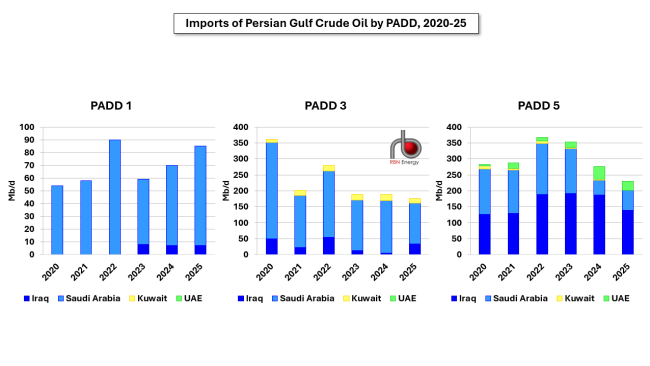
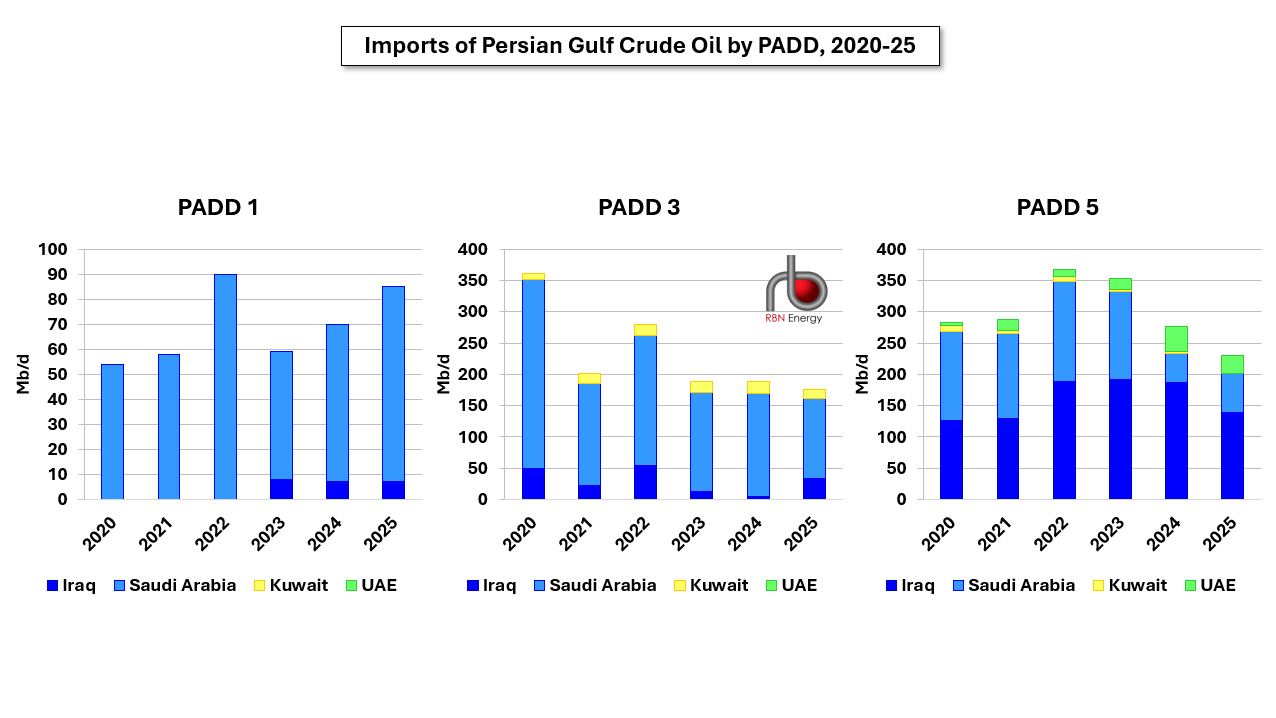
As shown in the three charts
in Figure 1 below, U.S. imports of crude oil from the four Persian Gulf
producers (not including Iran, which last sent small volumes of crude
to the U.S. in 2023) declined through most of the early 2020s (stacked
layers), from 699 Mb/d in 2020 to 491 Mb/d in 2025. But imports to PADD 5
(West Coast; right chart) have remained steady and last year the region
was the #1 importer from the Persian Gulf for the third year in a row,
receiving an average of 230 Mb/d. PADD 3 (Gulf Coast; middle chart)
started out this decade as the top importer, taking 362 Mb/d in 2020 —
and topping PADD 5’s 283 Mb/d that year— but by 2025 the volumes sent to
the Gulf Coast had fallen to only 176 Mb/d. Persian Gulf deliveries to
refineries in PADD 1 (East Coast; left chart) averaged 85 Mb/d last
year, the second-highest level in the 2020s.
Figure 1. Imports of Persian Gulf Crude Oil by PADD, 2020-25. Source: EIA