Pipeline: Texas --> California. PSX and KMI. Link here.
Coal: IEA continues to spin the story. Nothing to see here. Coal usage continues to increase and will do so for years to come. Track today's IEA story on coal on x. Link here. Link here.
Weather: incredibly warm across the nation for this time of year. North Texas will soon get to near 80°F.
************************************ Back to the Bakken
WTI: $56.52. WTI jumps $1.50 on Trump's blockade (or as CNBC has it, "blockade") of Venezuela. By the way, that blockade of Venezuela? A two-for-one for the State Department -- Cuba is collateral damage.
New wells reporting:
Thursday, December 18, 2025: 43 for the month, 166 for the quarter, 750 for the year,
Costanza wells, Devon Energy: amazing wells. Link here.
RBN Energy: Vermont -- one state's drive to slash GHGs slams into reality, and send a warning to others. Link here. Archived.
Five years ago, Vermont enacted a law requiring steep reductions
in its greenhouse gas (GHG) emissions. To help achieve that legally
binding mandate, the state in 2023 approved a statute directing
regulators to develop an incentives-based program under which heating
oil and propane suppliers would drive households and businesses toward
electric heat pumps, biodiesel and other lower-carbon space-heating
alternatives. But regulators determined this year that the plan would be
too costly and would hit Vermont’s many low-income residents the
hardest. Now everything’s in limbo. In today’s RBN blog, we’ll discuss
what happened when the Green Mountain State’s good intentions
encountered the realities of a major fuel initiative, and what Vermont’s
experience implies for ambitious programs in other states.
Many
would argue that Vermont is the quirkiest of the 50 states, with an
independent streak a mile wide and — dear to our hearts here at RBN — a
homegrown ice cream company with a penchant for naming many of its
flavors after music and musicians (Cherry Garcia, Bohemian Raspberry and
Goodbye Yellow Brickle Road, to name just a few). It’s certainly the
snowiest state, with average annual snowfall of 90 inches (!), and one
of the coldest (seventh overall, with an average winter temperature of
22°F). As locals put it in their own inimitable way, Vermont has four
seasons: almost winter, winter, still winter, and road construction — the last of these tied to the wear-and-tear from seemingly endless snowplowing and road-salting.
With
all that cold weather and snow, it should come as no surprise that home
heating is a major topic of conversation. Vermont is different here,
too: Only 17% of the state’s homes (all of them in northwestern Vermont)
have natural gas heat, compared to 46% of the U.S. as a whole, and a
miniscule 10% of Vermont homes rely on electric heat (mostly heat pumps
or electric baseboard), way below the 42% U.S. average. Instead, most
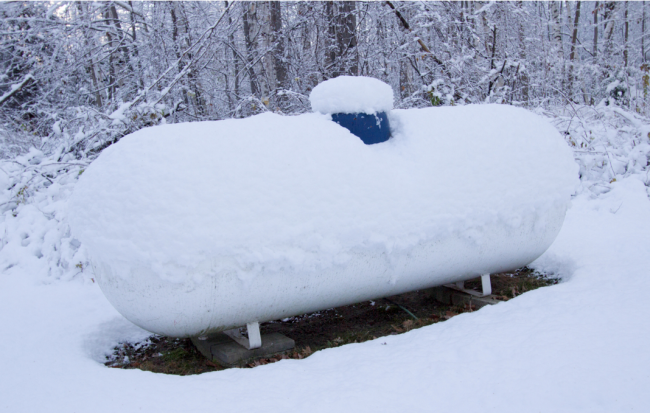
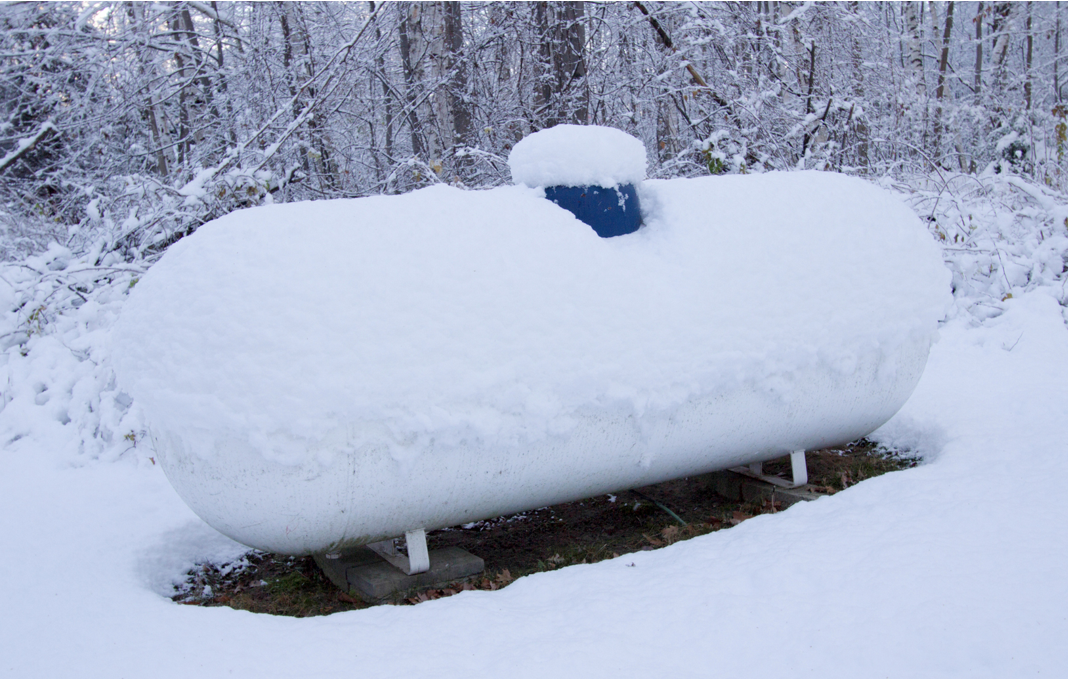
Vermonters turn to either heating oil (36%), propane (20%; see photo
below), or — far more than any other state — wood (14%). About 3% comes
from other sources, including biodiesel derived from used cooking oil.
(All stats are the latest available from the EIA.
A snow-covered propane tank used for home heating. Source: National Propane Gas Association
Space
heating for Vermont’s commercial and industrial sectors also leans
heavily toward heating oil and propane (with an assist from natural gas,
again in the northwest), though it must be said that renewables are on
the rise. For example, Ben & Jerry’s main plant in St. Albans, VT,
gets most of its heat from biogas produced by anaerobic digesters that
break down out-of-spec ice cream and other organic waste.
According
to Vermont’s latest Greenhouse Gas Emissions Inventory (see Figure 1
below), residential/commercial/industrial heating (aka “RCI fuel use”)
accounted for a hefty 33% of the state’s GHG emissions in 2022
(right-most blue bar segment), the most recent year with complete data.
Only the transportation sector, with 39% (right-most light-purple bar
segment), contributed more — mostly from salt-encrusted Subaru Outbacks,
we’d guess. The state’s electric industry, which secures virtually all
its power from renewable sources (primarily hydroelectric, but also
solar and wind), accounted for only 3% (right-most aqua bar segment).